



Necrostatin-7

Based on 1 Customer Validation
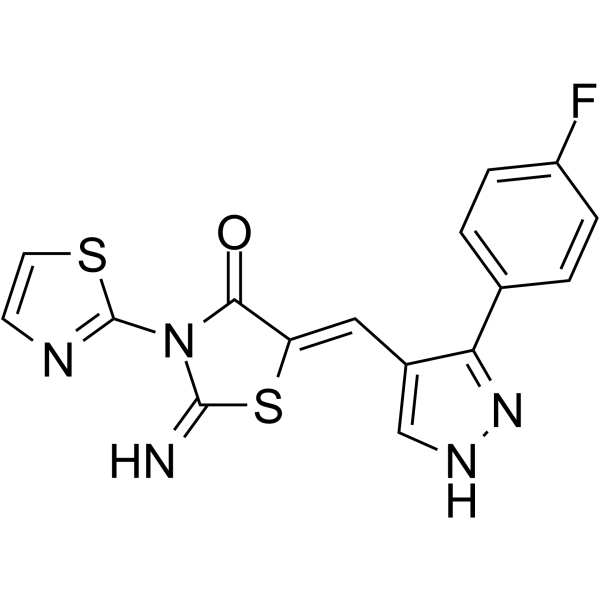
Necrostatin-7 (Nec-7) is a Necroptosis inhibitor with an EC50 of 10.6 μM. Necrostatin-7 inhibits signal transduction from RANK to NFATc1 without affecting the activation of MAPK or NF-κB. Necrostatin-7 suppresses the expression levels of Acp5, Atp6v0d2, Ctsk and Dcstamp. Necrostatin-7 reduces myocardial infarction size, ameliorates adverse left ventricular remodeling, decreases myocardial wall stress, reduces the amount and length of scar tissue, and improves left ventricular function. Necrostatin-7 exerts cardioprotective effects in a rat model of permanent coronary artery occlusion. Necrostatin-7 can be used in research related to osteolytic bone diseases and myocardial infarction.
For research use only. We do not sell to patients.
- Purity : 99.64%
- CAS No.: 351062-08-3
- Formula: C16H10FN5OS2
- Molecular Weight:371.41
-
Storage:Powder -20°C, 3 years ; In solvent -80°C, 6 months , -20°C, 1 month

To place orders, for customer services and technical support, please contact: MedChemExpress USA
Tel: 609-228-6898 E-mail: [email protected] [email protected]


-
 Biological Activity
-
Chemical Information
-
Solvent & Solubility
- Protocols
- Purity & Documentation
- References
-
 Help & FAQs





Biological Activity
Description
Cellular Effect
|
Cell Line

|
Type | Value | Description | References |
|---|---|---|---|---|
| Jurkat | EC50 |
10.6 μM
Compound: nec-7
|
Inhibition of TNF-alpha-induced necroptosis in FADD-deficient human Jurkat cells
Inhibition of TNF-alpha-induced necroptosis in FADD-deficient human Jurkat cells
|
[PMID: 18768316] |
In Vitro
Necrostatin-7 (0.1-3 μM; 3 days) dose-dependently inhibits M-CSF- and RANKL-induced osteoclast differentiation in primary bone marrow-derived macrophages at concentrations from 0.1 to 3 μM, with near-complete inhibition at 2 μM and 3 μM, without reducing BMM viability[1].
Necrostatin-7 (1-3 μM; 5 days) dose-dependently inhibits osteoclastic bone resorption by primary bone marrow-derived macrophages at concentrations from 1 to 3 μM, with near-complete inhibition at 2 μM and 3 μM after 5 days of treatment[1].
Necrostatin-7 (1-3 μM; 1-3 days) dose-dependently suppresses RANKL-induced expression of osteoclastogenic marker genes (Acp5, Atp6v0d2, Ctsk, Dcstamp) in primary bone marrow-derived macrophages at 1 μM and 3 μM over 1 to 3 days of differentiation[1].
Necrostatin-7 (1-3 μM; 1-3 days) dose-dependently inhibits RANKL-induced NFATc1 autoamplification in primary bone marrow-derived macrophages at 1 μM and 3 μM over 1 to 3 days of differentiation, with near-complete suppression at 3 μM[1].
Necrostatin-7 inhibits TNF-α-induced necroptosis in FADD-deficient human Jurkat T cells with an EC50 of 10.6 μM[2].
MedChemExpress (MCE) has not independently confirmed the accuracy of these methods. They are for reference only.
In Vivo
Pretreatment with necrostatin-7 (14.5 mg/kg; i.p.) reduces left ventricular scar tissue and scar length, and lowers plasma N-terminal pro-brain natriuretic peptide levels, indicating improved left ventricular function in rats with permanent coronary occlusion-induced myocardial infarction[4].
MedChemExpress (MCE) has not independently confirmed the accuracy of these methods. They are for reference only.
-
Animal Model:Wistar rats (male)[3]
-
Dosage:14.5 mg/kg
-
Administration:i.p.; single dose 1 hour prior to permanent coronary occlusion
-
Result:Reduced serum NT-proBNP level to 0.2 ng/mL.
Reduced myocardial infarct size to 9.0%.
Reduced infarct length to 2.9 mm.
-
Animal Model:strain not specified[4]
-
Dosage:14.5 mg/kg
-
Administration:i.p.; single dose 60 minutes before coronary occlusion
-
Result:Reduced the amount of scar tissue and scar length in the left ventricle.
Decreased plasma levels of N-terminal pro-brain natriuretic peptide.


Chemical Information
-
CAS No. 351062-08-3
-
Appearance Solid
-
Molecular Weight 371.41
-
Formula C16H10FN5OS2
-
Color Light yellow to brown
-
SMILES
O=C1N(C2=NC=CS2)C(S/C1=C\C3=CNN=C3C4=CC=C(F)C=C4)=N
-
Synonyms
Nec-7
-
Shipping
Room temperature in continental US; may vary elsewhere.
-
Storage
Powder -20°C 3 years In solvent -80°C 6 months -20°C 1 month


Solvent & Solubility
In Vitro:
DMSO : 10 mg/mL (26.92 mM; Need ultrasonic; Hygroscopic DMSO has a significant impact on the solubility of product, please use newly opened DMSO)
Please refer to the solubility information to select the appropriate solvent. Once prepared, please aliquot and store the solution to prevent product inactivation from repeated freeze-thaw cycles.
Storage method and period of stock solution: -80°C, 6 months; -20°C, 1 month. When stored at -80°C, please use it within 6 months. When stored at -20°C, please use it within 1 month.
Please refer to the solubility information to select the appropriate solvent. Once prepared, please aliquot and store the solution to prevent product inactivation from repeated freeze-thaw cycles.
Storage method and period of stock solution: -80°C, 6 months; -20°C, 1 month. When stored at -80°C, please use it within 6 months. When stored at -20°C, please use it within 1 month.
Concentration (start) × Volume (start) = Concentration (final) × Volume (final)


Purity & Documentation
-
Data Sheet (280 KB)
-
SDS (392 KB)
- English - EN (392 KB)
- Français - FR (392 KB)
- Deutsch - DE (392 KB)
- Norwegian - NO (392 KB)
- Español - ES (392 KB)
- Swedish - SV (392 KB)
- Italian - IT (392 KB)
- Korean - KR (392 KB)
- Portuguese - PT (392 KB)
-
Handling Instructions (2659 KB)
References
[1]. Fuji H, et al. Necrostatin-7 suppresses RANK-NFATc1 signaling and attenuates macrophage to osteoclast differentiation. Biochemical and biophysical research communications. 2018 Sep 05;503(2):544-549. [Content Brief]
[2]. Zheng W, et al. Structure-activity relationship study of a novel necroptosis inhibitor, necrostatin-7. Bioorganic & medicinal chemistry letters. 2008 Sep 15;18(18):4932-5. [Content Brief]


Complete Stock Solution Preparation Table
Please refer to the solubility information to select the appropriate solvent. Once prepared, please aliquot and store the solution to prevent product inactivation from repeated freeze-thaw cycles.
Storage method and period of stock solution: -80°C, 6 months; -20°C, 1 month. When stored at -80°C, please use it within 6 months. When stored at -20°C, please use it within 1 month.
| Optional Solvent | Concentration Solvent Mass | 1 mg | 5 mg | 10 mg | 25 mg |
|---|---|---|---|---|---|
| DMSO | 1 mM | 2.6924 mL | 13.4622 mL | 26.9244 mL | 67.3111 mL |
| 5 mM | 0.5385 mL | 2.6924 mL | 5.3849 mL | 13.4622 mL | |
| 10 mM | 0.2692 mL | 1.3462 mL | 2.6924 mL | 6.7311 mL | |
| 15 mM | 0.1795 mL | 0.8975 mL | 1.7950 mL | 4.4874 mL | |
| 20 mM | 0.1346 mL | 0.6731 mL | 1.3462 mL | 3.3656 mL | |
| 25 mM | 0.1077 mL | 0.5385 mL | 1.0770 mL | 2.6924 mL |


Necrostatin-7 Related Classifications
HY-117200 Related Classifications
 Powered by Bioz
Keywords
- Necrostatin-7
- 351062-08-3
- Nec-7
- Necrostatin7
- Necrostatin 7
- Nec7
- Nec 7
- Necroptosis
- RANKL/RANK
- myocardial infarction
- primary bone marrow-derived macrophages
- bone resorption
- RANK
- necroptosis
- rat models of permanent coronary occlusion
- NFATc1
- FADD-deficient human Jurkat T cells
- osteoclastogenesis
- RANK-NFATc1 signaling axis
- Inhibitor
- inhibitor
- inhibit