



Retrorsine
Based on 2 publication(s) in Google Scholar
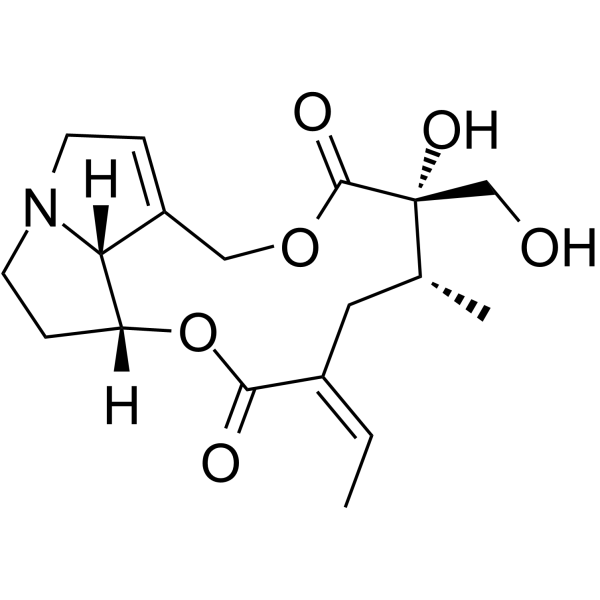
Retrorsine is a naturally occurring toxic pyrrolizidine alkaloid. Retrorsine can bind with DNA and inhibits the proliferative capacity of hepatocytes. Retrorsine can be used for the research of hepatocellular injury.
For research use only. We do not sell to patients.
- Purity: 99.91%
- CAS No.: 480-54-6
- Formula: C18H25NO6
- Molecular Weight:351.39
-
Storage:
-20°C, protect from light
* In solvent : -80°C, 6 months; -20°C, 1 month (protect from light)

To place orders, for customer services and technical support, please contact: MedChemExpress USA
Tel: 609-228-6898 E-mail: [email protected] [email protected]


-
 Biological Activity
-
Chemical Information
-
Solvent & Solubility
- Purity & Documentation
- References
-
 Help & FAQs
-

Natural Product Library
HY-L021
-
Macrocyclic Compound Library
HY-L041
-
Traditional Chinese Medicine Active Compound Library
HY-L065
-
Alkaloids Library
HY-L071
-
Plant-Sourced Natural Product Library
HY-L115
-
Heterocyclic Compound Library
HY-L138
-
Bioactive Compound Library Max
HY-L181
-
MCE Bioactive Compound Library
HY-L001V
-
Natural Product Library Plus
HY-L021P
-
Natural Product and Natural Product-Like Compound Library
HY-L021M
-
Bioactive Compound Library
HY-L001
-
Miao Ethnicity Medicine Compound Library
HY-L190
-
Heat-Clearing and Detoxification Traditional Chinese Medicine Compound Library
HY-L194
-
RO5 Drug-like Natural Product Library
HY-L200
-
High-Throughput Bioactive Compound Library
HY-L205
-
High-Throughput Natural Product Library
HY-L206
-
Ancient Chinese Classical Formulas Traditional Chinese Medicine Active Compound Library
HY-L209
-
Diarrhea-Related Traditional Chinese Medicine Active Compound Library
HY-L224
-
Mongolian Medicine Compound Library
HY-L238
-
Tonifying Traditional Chinese Medicine Monomer Compound Library
HY-L246
-
Mass Spectrometry Natural Product Library
HY-L262


Publications Citing Use of MedChemExpress (MCE) Retrorsine
More

Biological Activity
Retrorsine (60-240 μM; 24 hours) significantly reduces HSEC-CYP3A4 cells viability and GSH levels, and increases formation of pyrrole-protein adducts[3].
MedChemExpress (MCE) has not independently confirmed the accuracy of these methods. They are for reference only.
-
Cell Line:HSEC-CYP3A4 cells
-
Concentration:60 μM, 120 μM , 240 μM
-
Incubation Time:24 hours
-
Result:Significantly decreased cell viability.
MedChemExpress (MCE) has not independently confirmed the accuracy of these methods. They are for reference only.
-
Animal Model:Male Wistar rats (180±20 g), portal branch ligation (PBL) model[4]
-
Dosage:30 mg/kg
-
Administration:Intraperitoneal injection, twice, separated by 2-week interval
-
Result:Strongly impaired the liver weight gain, protein and DNA synthesis as well as induction of cell cycle related proteins in the regenerating lobes after PBL.


Chemical Information
-
CAS No. 480-54-6
-
Appearance Solid
-
Molecular Weight 351.39
-
Formula C18H25NO6
-
Color White to off-white
-
SMILES
O=C(O[C@]1([H])CCN2[C@]1([H])C(COC([C@](CO)(O)[C@H](C)C/3)=O)=CC2)C3=C/C
-
Structure Classification
-
Initial Source
-
Shipping
Room temperature in continental US; may vary elsewhere.
-
Storage
-20°C, protect from light
* In solvent : -80°C, 6 months; -20°C, 1 month (protect from light)


Publications (2)
-
Journal Impact Factor
-
Most Recent
-
Ecotoxicol Environ Saf
Regulatory role of oxidative stress in retrorsine - Induced apoptosis and autophagy in primary rat hepatocytes. [Abstract]2024 May 27:279:116515. PMID: 38810283 -
Toxicon
Retrorsine-induced hepatotoxicity is mediated by inhibition of the EGFR/AKT/c-Jun axis and disruption of calcium homeostasis in primary hepatocytes. [Abstract]2026 Mar 15:272:108998. PMID: 41539484


Solvent & Solubility
DMSO : 100 mg/mL (284.58 mM; Need ultrasonic; Hygroscopic DMSO has a significant impact on the solubility of product, please use newly opened DMSO)
Please refer to the solubility information to select the appropriate solvent. Once prepared, please aliquot and store the solution to prevent product inactivation from repeated freeze-thaw cycles.
Storage method and period of stock solution: -80°C, 6 months; -20°C, 1 month (protect from light). When stored at -80°C, please use it within 6 months. When stored at -20°C, please use it within 1 month.
Please refer to the solubility information to select the appropriate solvent. Once prepared, please aliquot and store the solution to prevent product inactivation from repeated freeze-thaw cycles.
Storage method and period of stock solution: -80°C, 6 months; -20°C, 1 month (protect from light). When stored at -80°C, please use it within 6 months. When stored at -20°C, please use it within 1 month.
Concentration (start) × Volume (start) = Concentration (final) × Volume (final)
Select the appropriate dissolution method based on your experimental animal and administration route.
- For the following dissolution methods, please ensure to first prepare a clear stock solution using an In Vitro approach and then sequentially add co-solvents:
- To ensure reliable experimental results, the clarified stock solution can be appropriately stored based on storage conditions. As for the working solution for In Vivo experiments, it is recommended to prepare freshly and use it on the same day.
- The percentages shown for the solvents indicate their volumetric ratio in the final prepared solution. If precipitation or phase separation occurs during preparation, heat and/or sonication can be used to aid dissolution.
Add each solvent one by one: 10% DMSO 40% PEG300 5% Tween-80 45% Saline
Solubility: ≥ 2.5 mg/mL (7.11 mM); Clear solution
This protocol yields a clear solution of ≥ 2.5 mg/mL (saturation unknown).
Taking 1 mL working solution as an example, add 100 μL DMSO stock solution (25.0 mg/mL) to 400 μL PEG300, and mix evenly; then add 50 μL Tween-80 and mix evenly; then add 450 μL Saline to adjust the volume to 1 mL.
Preparation of Saline: Dissolve 0.9 g sodium chloride in ddH₂O and dilute to 100 mL to obtain a clear Saline solution.
Add each solvent one by one: 10% DMSO 90% (20% SBE-β-CD in Saline)
Solubility: ≥ 2.5 mg/mL (7.11 mM); Clear solution
This protocol yields a clear solution of ≥ 2.5 mg/mL (saturation unknown).
Taking 1 mL working solution as an example, add 100 μL DMSO stock solution (25.0 mg/mL) to 900 μL 20% SBE-β-CD in Saline, and mix evenly.
Preparation of 20% SBE-β-CD in Saline (4°C, storage for one week): 2 g SBE-β-CD powder is dissolved in 10 mL Saline, completely dissolve until clear.
Please enter the basic information of animal experiments:
-
-
-
-
Recommended: Prepare an additional quantity of animals to account for potential losses during experiments.
Please enter your animal formula composition:
-
%DMSO +
Recommended: Keep the proportion of DMSO in working solution below 2% if your animal is weak.
-
%+
-
+%Tween-80 + +
-
%Saline +
The co-solvents required include: DMSO, . All of co-solvents are available by MedChemExpress (MCE). , Tween 80. All of co-solvents are available by MedChemExpress (MCE).
Working solution concentration: 0.22 mg/mL
Method for preparing stock solution: mg drug dissolved in μL DMSO. Stock solution concentration: mg/mL. * In solvent : -80°C, 6 months; -20°C, 1 month (protect from light)
1. Take μL DMSO stock solution;
2. Add μL .
μL , mix evenly;
3. Then add μL Tween 80, mix evenly;
4. Then add μL
Please ensure that the stock solution in the first step is dissolved to a clear state, and add co-solvents in sequence. You can use ultrasonic heating (ultrasonic cleaner, recommended frequency 20-40 kHz), vortexing, etc. to assist dissolution.


Purity & Documentation
-
Data Sheet (282 KB)
-
SDS (480 KB)
- English - EN (480 KB)
- Français - FR (480 KB)
- Deutsch - DE (480 KB)
- Norwegian - NO (480 KB)
- Español - ES (480 KB)
- Swedish - SV (480 KB)
- Italian - IT (480 KB)
- Korean - KR (480 KB)
- Portuguese - PT (480 KB)
-
Handling Instructions (2659 KB)
References
[1]. F J Cubero, et al. Hepatic proliferation in Gunn rats transplanted with hepatocytes: effect of retrorsine and tri-iodothyronine. Cell Prolif. 2005 Jun;38(3):137-46. [Content Brief]
[2]. S Laconi, et al. Liver regeneration in response to partial hepatectomy in rats treated with retrorsine: a kinetic study. J Hepatol. 1999 Dec;31(6):1069-74. [Content Brief]
[3]. Yao Lu, et al. Establishment of a novel CYP3A4-transduced human hepatic sinusoidal endothelial cell model and its application in screening hepatotoxicity of pyrrolizidine alkaloids. J Environ Sci Health C Toxicol Carcinog. 2020;38(2):169-185. [Content Brief]
[4]. Christian Picard, et al. Retrorsine: a kinetic study of its influence on rat liver regeneration in the portal branch ligation model. J Hepatol. 2003 Jul;39(1):99-105. [Content Brief]


Complete Stock Solution Preparation Table
Please refer to the solubility information to select the appropriate solvent. Once prepared, please aliquot and store the solution to prevent product inactivation from repeated freeze-thaw cycles.
Storage method and period of stock solution: -80°C, 6 months; -20°C, 1 month (protect from light). When stored at -80°C, please use it within 6 months. When stored at -20°C, please use it within 1 month.
| Optional Solvent | Concentration Solvent Mass | 1 mg | 5 mg | 10 mg | 25 mg |
|---|---|---|---|---|---|
| DMSO | 1 mM | 2.8458 mL | 14.2292 mL | 28.4584 mL | 71.1460 mL |
| 5 mM | 0.5692 mL | 2.8458 mL | 5.6917 mL | 14.2292 mL | |
| 10 mM | 0.2846 mL | 1.4229 mL | 2.8458 mL | 7.1146 mL | |
| 15 mM | 0.1897 mL | 0.9486 mL | 1.8972 mL | 4.7431 mL | |
| 20 mM | 0.1423 mL | 0.7115 mL | 1.4229 mL | 3.5573 mL | |
| 25 mM | 0.1138 mL | 0.5692 mL | 1.1383 mL | 2.8458 mL | |
| 30 mM | 0.0949 mL | 0.4743 mL | 0.9486 mL | 2.3715 mL | |
| 40 mM | 0.0711 mL | 0.3557 mL | 0.7115 mL | 1.7787 mL | |
| 50 mM | 0.0569 mL | 0.2846 mL | 0.5692 mL | 1.4229 mL | |
| 60 mM | 0.0474 mL | 0.2372 mL | 0.4743 mL | 1.1858 mL | |
| 80 mM | 0.0356 mL | 0.1779 mL | 0.3557 mL | 0.8893 mL | |
| 100 mM | 0.0285 mL | 0.1423 mL | 0.2846 mL | 0.7115 mL |


Retrorsine Related Classifications
HY-N6638 Related Classifications
 Powered by Bioz