



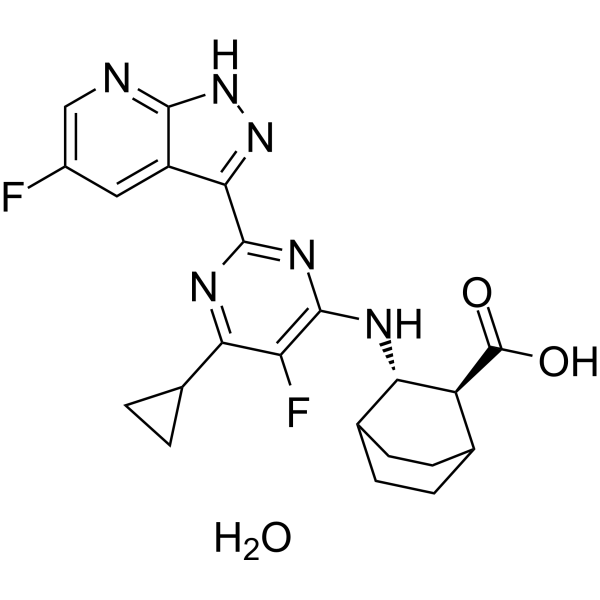
Onradivir monohydrate
Onradivir (ZSP1273) monohydrate is an orally active antiviral agent targeting influenza A virus RNA polymerase PB2 subunit with an IC50 of 0.562 nM. Onradivir monohydrate inhibits cap binding to influenza A virus RNA polymerase PB2 subunit, suppresses viral replication, reduces viral titres and RNA loads, and inhibits influenza A virus infection. Onradivir monohydrate maintains high survival rates in influenza A virus-infected mice, and reduces influenza A virus titers in a murine model. Onradivir monohydrate can be used for the research of influenza A virus infection.
Nur für Forschungszwecke. Wir verkaufen nicht an Patienten.
- CAS. Nr.: 2375241-19-1
- Formel: C22H24F2N6O3
- Molecular Weight:458.46
-
Speicherung:
Please store the product under the recommended conditions in the Certificate of Analysis.

To place orders, for customer services and technical support, please contact: MedChemExpress USA
Tel: 609-228-6898 E-mail: [email protected] [email protected]


-
 Biologische Aktivität
-
Chemical Information
- Protokoll
- Reinheit & Dokumentation
- Verweise
-
 Help & FAQs


Alle DNA/RNA Synthesis Isoform-spezifische Produkte anzeigen
More

Biologische Aktivität
Beschreibung
IC50 & Target
|
RNA Polymerase |
In Vitro
Onradivir (0.457-1000 nM; 24 h post-6-hour transfection) monohydrate potently inhibits influenza A virus polymerase activity in HEK293T cells, with a mean IC50 of 0.562 nM[2].
Onradivir (0.17-10,000 nM) monohydrate does not inhibit most tested human kinases at concentrations up to 10,000 nM, with only weak activity against Aurora A kinase (IC50 = 527 nM)[2].
Onradivir (0.0005-100 μM; 2-5 days) monohydrate potently inhibits replication of wild-type, Oseltamivir (HY-13317)-resistant, and Baloxavir (HY-109025A)-resistant influenza A strains in MDCK cells (EC50 0.012-0.063 nM) with high selective index, and shows weak activity against HRV-1B (EC50 7.88 μM) in H1 HeLa cells[2].
Onradivir (48 h post-virus infection) monohydrate potently inhibits replication of highly pathogenic avian influenza H7N9 and H5N6 viruses in MDCK cells, with IC50 values ranging from 0.245-0.777 nM[2].
Onradivir (10 μM; 3 days) monohydrate does not inhibit HCV genotype 1b replicon replication or cause cytotoxicity at concentrations up to 10 μM[2].
Onradivir (0.16-40 μM; 1 min per concentration) monohydrate does not significantly inhibit hERG potassium channel function in CHO cells at concentrations up to 40 μM (IC50 >40 μM)[2].
MedChemExpress (MCE) has not independently confirmed the accuracy of these methods. They are for reference only. Further protocols information, click here.
In Vivo
Onradivir (ZSP1273) (10 mg/kg; p.o.; twice daily; 7 days) monohydrate provides 100% survival when administered 4 h pre-infection, improves survival when administered 48 h post-infection, provides partial survival when administered 72 h post-infection, and extends time to death when administered 96 h post-infection in influenza A virus WSN/33 (H1N1)-infected female BALB/c mice[2].
Onradivir (ZSP1273) (30-100 mg/kg; p.o.; twice daily; 7 days) monohydrate provides 100% survival at 30 mg/kg, and provides high survival with minimal deaths at 100 mg/kg, when administered starting 48 h post-infection in influenza A virus WSN/33 (H1N1)-infected female BALB/c mice[2].
Onradivir (ZSP1273) (25 mg/kg; p.o.; twice daily; 5 days) monohydrate significantly reduces nasal lavage viral load and maintains stable body weight in influenza A virus/California/07/2009 (H1N1)-infected female ferrets when administered starting 4 h pre-infection[2].
MedChemExpress (MCE) has not independently confirmed the accuracy of these methods. They are for reference only.
-
Animal Model:BALB/c (female, SPF grade, 6-7 weeks old, 16-18 g, intranasal inoculation with influenza A virus WSN/33 (H1N1))[2]
-
Dosage:3 mg/kg (day 5 endpoint); 10 mg/kg (day 3 endpoint; day 5 endpoint); 30 mg/kg (day 5 endpoint)
-
Administration:p.o.; twice daily; days 1-2 (day 3 endpoint); days 1-4 (day 5 endpoint)
-
Result:Reduced lung viral titers.
Enabled mice in the 30 mg/kg group to begin regaining body weight on day 4.
Enabled mice in the 10 mg/kg group to begin regaining body weight on day 5.
-
Animal Model:BALB/c (female, SPF grade, 6-7 weeks old, 16-18 g, intranasal inoculation with influenza A virus WSN/33 (H1N1))[2]
-
Dosage:10 mg/kg
-
Administration:p.o.; twice daily; 7 consecutive days; first dose at 4 h pre-infection; first dose at 48 h post-infection; first dose at 72 h post-infection; first dose at 96 h post-infection
-
Result:Maintained a 100% survival rate through day 14 and prevented significant body weight loss when dosed at 4 h pre-infection.
Improved survival rate compared to vehicle and supported body weight recovery starting after nadir weight loss when dosed at 48 h post-infection.
Resulted in a 25% survival rate.
Clinical Trial
| NCT Number | Sponsor | Condition | Start Date |
Phase

|
|---|---|---|---|---|
| NCT01329991 | Plexxikon| | 2011-05 | PHASE1 |


Chemical Information
-
CAS. Nr. 2375241-19-1
-
Molecular Weight 458.46
-
Formel C22H24F2N6O3
-
SMILES
FC1=CN=C2C(C(C3=NC(N[C@@H]4[C@H](C5CCC4CC5)C(O)=O)=C(F)C(C6CC6)=N3)=NN2)=C1.O
-
Synonyms
ZSP1273 monohydrate
-
Versand
Room temperature in continental US; may vary elsewhere.
-
Speicherung
Please store the product under the recommended conditions in the Certificate of Analysis.

Protokoll
-
Research Protocol for Infectious Diseases
Infectious-disease experiments test how pathogens interact with host barriers, innate immune receptors, inflammatory signaling, pathogen replication, and tissue injury; pattern-recognition receptors such as TLRs, RIG-I-like receptors, NOD-like receptors, and inflammasomes detect microbial molecules and activate NF-κB, interferon, and cytokine responses. The central hypothesis is that infection severity reflects the balance between pathogen burden and host response: protective inflammation restricts pathogen growth, whereas excessive or mislocalized inflammation contributes to tissue damage and disease phenotype. Unresolved questions include which host pathways are protective versus pathogenic, why some infection models fail to translate to human disease, and which combined readouts best predict clinically relevant infection outcomes.
-
Cell Cytotoxicity Assay
Cytotoxicity assays are usually based on the assessment of cell membrane damage, which can also be indirectly detected by measuring cell viability. Detection methods include MTT assay, CKK-8 assay, LDH assay and ATP assay, etc.


Reinheit & Dokumentation
Verweise
[1]. Li J, et al. Onradivir: a novel influenza polymerase inhibitor. Lancet Respir Med. 2025 Jul;13(7):571-573. [Content Brief]
[2]. Chen X, et al. Preclinical Study of ZSP1273, a Potent Antiviral Inhibitor of Cap Binding to the PB2 Subunit of Influenza A Polymerase. Pharmaceuticals (Basel). 2023;16(3):365. Published 2023 Feb 27. [Content Brief]

Calculators
Konzentration (Stammlösung) × Volumen (Stammlösung) = Konzentration (Ziellösung) × Volumen (Ziellösung)


Onradivir monohydrate Related Classifications
HY-145586A Related Classifications
 Powered by Bioz