



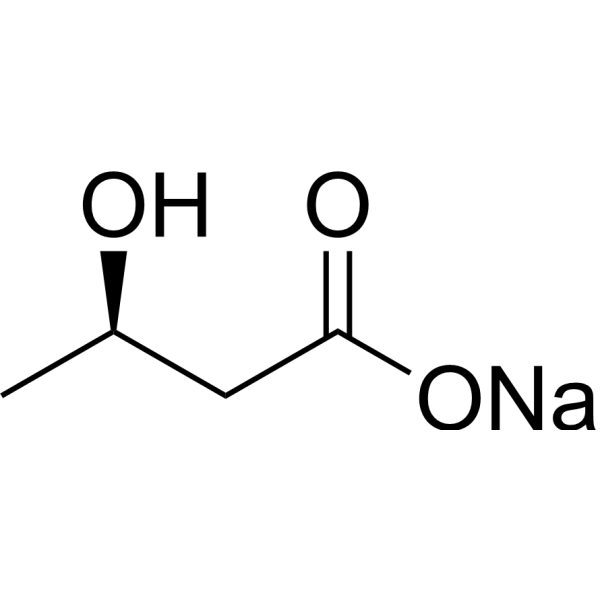
(R)-3-Hydroxybutanoic acid sodium
Based on 7 publication(s) in Google Scholar
(R)-3-Hydroxybutanoic acid ((R)-3-Hydroxybutyric acid) sodium is a metabolite converted from acetoacetic acid catalyzed by 3-hydroxybutyrate dehydrogenase. (R)-3-Hydroxybutanoic acid sodium can function as a nutrition source, and as a precursor for vitamins, antibiotics and pheromones.
For research use only. We do not sell to patients.
- Purity: 99.90%
- CAS No.: 13613-65-5
- Formula: C4H7NaO3
- Molecular Weight:126.09
-
Storage:
4°C, sealed storage, away from moisture
* In solvent : -80°C, 6 months; -20°C, 1 month (sealed storage, away from moisture)

To place orders, for customer services and technical support, please contact: MedChemExpress USA
Tel: 609-228-6898 E-mail: [email protected] [email protected]


-
 Biological Activity
-
Chemical Information
-
Solvent & Solubility
- Purity & Documentation
- References
-
 Help & FAQs


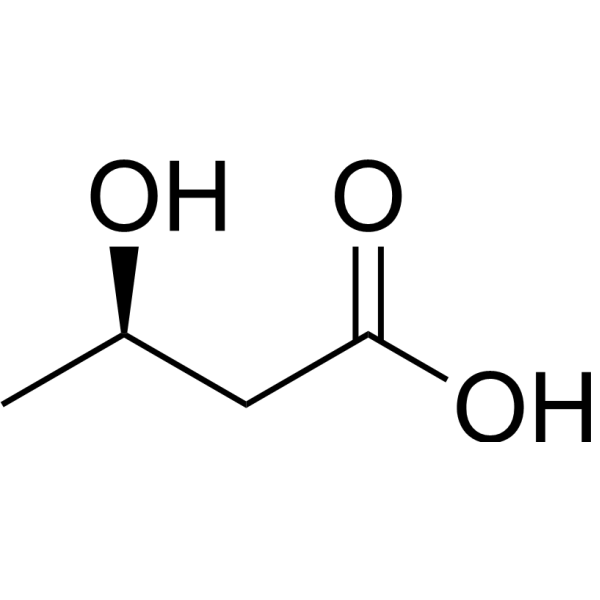
Publications Citing Use of MedChemExpress (MCE) (R)-3-Hydroxybutanoic acid sodium
More- J Nanobiotechnology. 2022 Mar 9;20(1):120. [Abstract]
- Sci Adv. 2024 May 31;10(22):eadk5011. [Abstract]
- Cell Death Dis. 2026 Feb 19;17(1):233. [Abstract]
- Clin Cancer Res. 2026 Apr 17. [Abstract]
- Cell Rep. 2022 Dec 20;41(12):111847. [Abstract]
- Am J Physiol Cell Physiol. 2024 Jun 1;326(6):C1710-C1720. [Abstract]
- Mol Med Rep. 2022 Sep;26(3):279. [Abstract]
 Customer Validation & Images

-
RT-PCR
-
WB
-
Cell Imaging/Staining
-
ELISA
-
Histological Imaging/Staining
All Endogenous Metabolite Isoforms
More

Biological Activity
Description
IC50 & Target
|
Microbial Metabolite |
Human Endogenous Metabolite |
In Vitro
(R)-3-Hydroxybutanoic acid sodium is a metabolite converted from acetoacetic acid. Enhanced hepatic fatty acid oxidation results in the increased production of acetoacetic acid which is in turn converted to (R)-3-Hydroxybutanoic acid sodium by a reaction catalyzed by 3-hydroxybutyrate dehydrogenase[1].
MedChemExpress (MCE) has not independently confirmed the accuracy of these methods. They are for reference only.


Chemical Information
-
CAS No. 13613-65-5
-
Appearance Solid
-
Molecular Weight 126.09
-
Formula C4H7NaO3
-
Color White to off-white
-
SMILES
C[C@H](CC(O[Na])=O)O
-
Synonyms
(R)-(-)-3-Hydroxybutanoic acid sodium; (R)-3-Hydroxybutyric acid sodium
-
Structure Classification
-
Initial Source
-
Shipping
Room temperature in continental US; may vary elsewhere.
-
Storage
4°C, sealed storage, away from moisture
* In solvent : -80°C, 6 months; -20°C, 1 month (sealed storage, away from moisture)


Publications (7)
-
Journal Impact Factor
-
Most Recent
-
J Nanobiotechnology
The ketone body β-hydroxybutyrate alleviates CoCrMo alloy particles induced osteolysis by regulating NLRP3 inflammasome and osteoclast differentiation. [Abstract]2022 Mar 9;20(1):120. PMID: 35264201 -
Sci Adv
Exercise activates interferon response of the liver via Gpld1 to enhance antiviral innate immunity. [Abstract]2024 May 31;10(22):eadk5011. PMID: 38809975
(R)-3-Hydroxybutanoic acid sodium purchased from MedChemExpress. Usage Cited in: Sci Adv. 2024 May 31;10(22):eadk5011. [Abstract]
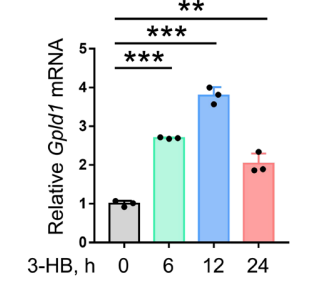
(R)-3-Hydroxybutanoic acid (3-HB) (0.5 mM; 6-24 h) significantly up-regulated the mRNA levels of Gpld1 in HepG2 cells.
(R)-3-Hydroxybutanoic acid sodium purchased from MedChemExpress. Usage Cited in: Sci Adv. 2024 May 31;10(22):eadk5011. [Abstract]
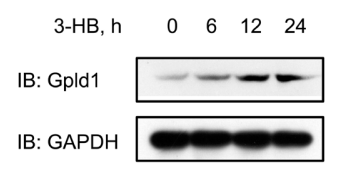
(R)-3-Hydroxybutanoic acid (3-HB) (0.5 mM; 6-24 h) significantly up-regulated the protein level of Gpld1 in HepG2 cells.
(R)-3-Hydroxybutanoic acid sodium purchased from MedChemExpress. Usage Cited in: Sci Adv. 2024 May 31;10(22):eadk5011. [Abstract]
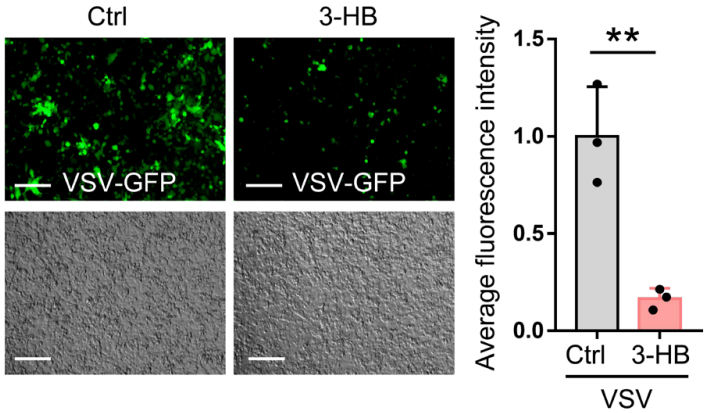
Fluorescence microscopy of VSV-GFP viruses in HepG2 cells treated with PBS (Ctrl) or (R)-3-Hydroxybutanoic acid (3-HB) (5 mM) for 24 hours and then infected with VSV-GFP (MOI = 1.0; 24 hours). Scale bars, 200 μm.
(R)-3-Hydroxybutanoic acid sodium purchased from MedChemExpress. Usage Cited in: Sci Adv. 2024 May 31;10(22):eadk5011. [Abstract]
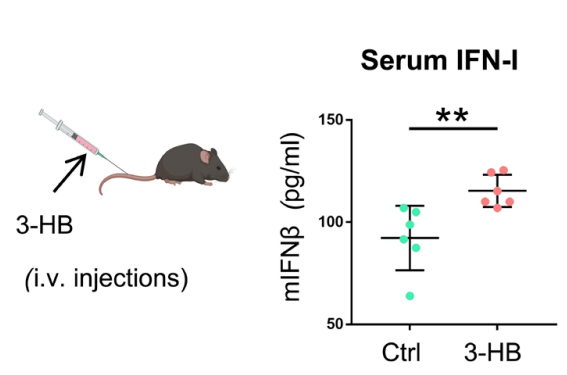
ELISA analysis of mIFN-β protein levels in the serum of mice administrated with (R)-3-Hydroxybutanoic acid (3-HB) (3 mmol/kg, i.v.) or PBS (Ctrl) for 24 hours. The results showed that 3-HB administration up-regulated serum IFN-I levels.
(R)-3-Hydroxybutanoic acid sodium purchased from MedChemExpress. Usage Cited in: Sci Adv. 2024 May 31;10(22):eadk5011. [Abstract]
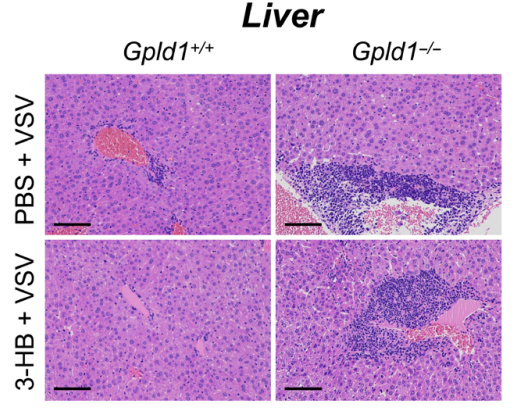
HE staining of the livers from Gpld1+/+ and Gpld1−/− mice was performed. Gpld1+/+ and Gpld1−/− mice were administrated with (R)-3-Hydroxybutanoic acid (3-HB) (3 mmol/kg; i.v.) or PBS for 24 hours, and then infected with VSV (1 × 10⁸ PFU/g of body weight; intranasal) for 48 hours. Scale bar: 100 μm.
-
Cell Death Dis
TIGAR maintains intestinal epithelial regeneration by stabilizing HMGCL and promoting β-catenin β-hydroxybutyrylation in burn-induced sepsis. [Abstract]2026 Feb 19;17(1):233. PMID: 41708588 -
Clin Cancer Res
Lactate-induced lactylation enhances BMAL1 transcription and nuclear translocation, promoting bevacizumab resistance in glioblastoma through VEGFA. [Abstract]2026 Apr 17. PMID: 41995718 -
Cell Rep
β-hydroxybutyrate inhibits ferroptosis-mediated pancreatic damage in acute liver failure through the increase of H3K9bhb. [Abstract]2022 Dec 20;41(12):111847. PMID: 36543135 -
Am J Physiol Cell Physiol
Acetoacetate and D- and L-β-hydroxybutyrate have distinct effects on basal and insulin-stimulated glucose uptake in L6 skeletal muscle cells. [Abstract]2024 Jun 1;326(6):C1710-C1720. PMID: 38708524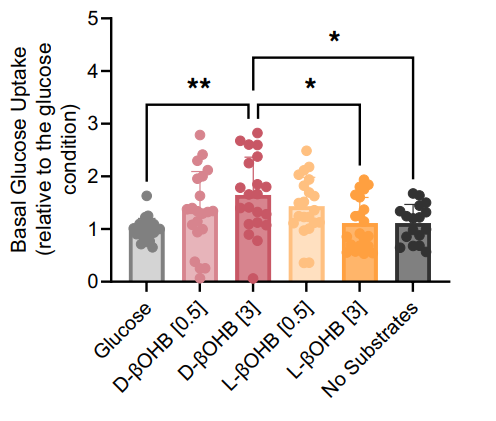
(R)-3-Hydroxybutanoic acid sodium purchased from MedChemExpress. Usage Cited in: Am J Physiol Cell Physiol. 2024 Jun 1;326(6):C1710-C1720. [Abstract]
Exposure to 3 mM (R)-3-Hydroxybutanoic acid sodium (d-βOHB, 3 h) increased basal glucose uptake, significantly higher than in the glucose, substrate-free, and 3 mM 1-βOHB groups.
-
Mol Med Rep
Adipose‑derived mesenchymal stem cell‑derived HCAR1 regulates immune response in the attenuation of sepsis. [Abstract]2022 Sep;26(3):279. PMID: 35856408


Solvent & Solubility
In Vitro:
H2O : 100 mg/mL (793.08 mM; Need ultrasonic)
DMSO : 50 mg/mL (396.54 mM; ultrasonic and warming and heat to 60°C; Hygroscopic DMSO has a significant impact on the solubility of product, please use newly opened DMSO)
Please refer to the solubility information to select the appropriate solvent. Once prepared, please aliquot and store the solution to prevent product inactivation from repeated freeze-thaw cycles.
Storage method and period of stock solution: -80°C, 6 months; -20°C, 1 month (sealed storage, away from moisture). When stored at -80°C, please use it within 6 months. When stored at -20°C, please use it within 1 month.
* Note: If you choose water as the stock solution, please dilute it to the working solution, then filter and sterilize it with a 0.22 μm filter before use.
Please refer to the solubility information to select the appropriate solvent. Once prepared, please aliquot and store the solution to prevent product inactivation from repeated freeze-thaw cycles.
Storage method and period of stock solution: -80°C, 6 months; -20°C, 1 month (sealed storage, away from moisture). When stored at -80°C, please use it within 6 months. When stored at -20°C, please use it within 1 month.
* Note: If you choose water as the stock solution, please dilute it to the working solution, then filter and sterilize it with a 0.22 μm filter before use.
Concentration (start) × Volume (start) = Concentration (final) × Volume (final)
In Vivo:
Select the appropriate dissolution method based on your experimental animal and administration route.
- For the following dissolution methods, please ensure to first prepare a clear stock solution using an In Vitro approach and then sequentially add co-solvents:
- To ensure reliable experimental results, the clarified stock solution can be appropriately stored based on storage conditions. As for the working solution for In Vivo experiments, it is recommended to prepare freshly and use it on the same day.
- The percentages shown for the solvents indicate their volumetric ratio in the final prepared solution. If precipitation or phase separation occurs during preparation, heat and/or sonication can be used to aid dissolution.
Add each solvent one by one: 10% DMSO 40% PEG300 5% Tween-80 45% Saline
Solubility: ≥ 2.5 mg/mL (19.83 mM); Clear solution
This protocol yields a clear solution of ≥ 2.5 mg/mL (saturation unknown).
Taking 1 mL working solution as an example, add 100 μL DMSO stock solution (25.0 mg/mL) to 400 μL PEG300, and mix evenly; then add 50 μL Tween-80 and mix evenly; then add 450 μL Saline to adjust the volume to 1 mL.
Preparation of Saline: Dissolve 0.9 g sodium chloride in ddH₂O and dilute to 100 mL to obtain a clear Saline solution.
Add each solvent one by one: 10% DMSO 90% (20% SBE-β-CD in Saline)
Solubility: ≥ 2.5 mg/mL (19.83 mM); Clear solution
This protocol yields a clear solution of ≥ 2.5 mg/mL (saturation unknown).
Taking 1 mL working solution as an example, add 100 μL DMSO stock solution (25.0 mg/mL) to 900 μL 20% SBE-β-CD in Saline, and mix evenly.
Preparation of 20% SBE-β-CD in Saline (4°C, storage for one week): 2 g SBE-β-CD powder is dissolved in 10 mL Saline, completely dissolve until clear.
For the following dissolution methods, please prepare the working solution directly:
It is recommended to prepare fresh solutions and use them promptly within a short period of time.
The percentages shown for the solvents indicate their volumetric ratio in the final prepared solution. If precipitation or phase separation occurs during preparation, heat and/or sonication can be used to aid dissolution.
Add each solvent one by one: PBS
Solubility: 100 mg/mL (793.08 mM); Clear solution; Need ultrasonic
In Vivo Dissolution Calculator
Please enter the basic information of animal experiments:
-
-
-
-
Recommended: Prepare an additional quantity of animals to account for potential losses during experiments.
Working solution concentration: 0.22 mg/mL
This product has good water solubility, please refer to the measured solubility data in water/PBS/Saline for details.


Purity & Documentation
-
Data Sheet (274 KB)
-
SDS (393 KB)
- English - EN (393 KB)
- Français - FR (393 KB)
- Deutsch - DE (393 KB)
- Norwegian - NO (393 KB)
- Español - ES (393 KB)
- Swedish - SV (393 KB)
- Italian - IT (393 KB)
- Korean - KR (393 KB)
- Portuguese - PT (393 KB)
-
Handling Instructions (2659 KB)
References


Complete Stock Solution Preparation Table
Please refer to the solubility information to select the appropriate solvent. Once prepared, please aliquot and store the solution to prevent product inactivation from repeated freeze-thaw cycles.
Storage method and period of stock solution: -80°C, 6 months; -20°C, 1 month (sealed storage, away from moisture). When stored at -80°C, please use it within 6 months. When stored at -20°C, please use it within 1 month.
| Optional Solvent | Concentration Solvent Mass | 1 mg | 5 mg | 10 mg | 25 mg |
|---|---|---|---|---|---|
| DMSO / H2O | 1 mM | 7.9308 mL | 39.6542 mL | 79.3084 mL | 198.2711 mL |
| 5 mM | 1.5862 mL | 7.9308 mL | 15.8617 mL | 39.6542 mL | |
| 10 mM | 0.7931 mL | 3.9654 mL | 7.9308 mL | 19.8271 mL | |
| 15 mM | 0.5287 mL | 2.6436 mL | 5.2872 mL | 13.2181 mL | |
| 20 mM | 0.3965 mL | 1.9827 mL | 3.9654 mL | 9.9136 mL | |
| 25 mM | 0.3172 mL | 1.5862 mL | 3.1723 mL | 7.9308 mL | |
| 30 mM | 0.2644 mL | 1.3218 mL | 2.6436 mL | 6.6090 mL | |
| 40 mM | 0.1983 mL | 0.9914 mL | 1.9827 mL | 4.9568 mL | |
| 50 mM | 0.1586 mL | 0.7931 mL | 1.5862 mL | 3.9654 mL | |
| 60 mM | 0.1322 mL | 0.6609 mL | 1.3218 mL | 3.3045 mL | |
| 80 mM | 0.0991 mL | 0.4957 mL | 0.9914 mL | 2.4784 mL | |
| 100 mM | 0.0793 mL | 0.3965 mL | 0.7931 mL | 1.9827 mL |
* Note: If you choose water as the stock solution, please dilute it to the working solution, then filter and sterilize it with a 0.22 μm filter before use.


(R)-3-Hydroxybutanoic acid sodium Related Classifications
HY-W015851 Related Classifications
 Powered by Bioz