9 Results for "

293 T-Rex cells

" in MedChemExpress (MCE) Product Catalog:
Products (9)

9 Results for "293 T-Rex cells" in MCE Product Catalog:

6
6 Cited Publications
Cat. No.: HY-19976
CAS No.: 1024448-59-6
Target:  

TRP Channel

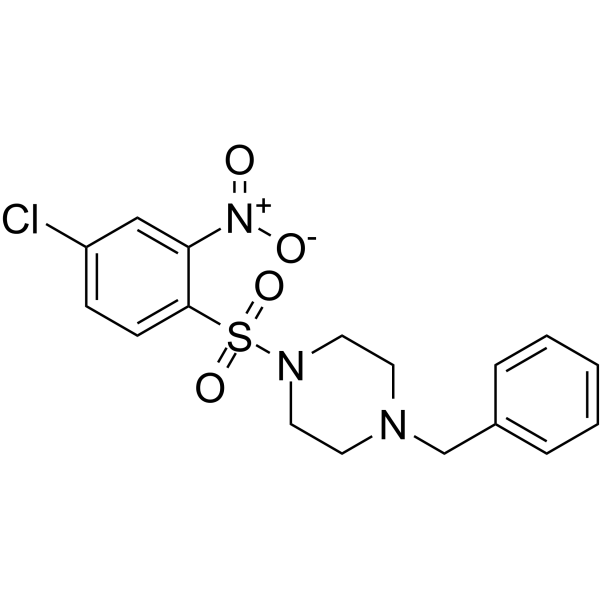
RN-1747 is a selective TRPV4 channel agonist, with EC50 values of 0.77 μM, 4.0 μM and 4.1 μM for hTRPV4, mTRPV4 and rTRPV4, respectively. RN-1747 acts as an antagonist of TRPM8, with an IC50 of 4 μM. Topical cutaneous administration of RN-1747 induces hypothermia, increases tail heat loss via cutaneous vasodilation, and promotes cold-seeking behavior in rats. Intracerebroventricular administration of RN-1747 does not induce hypothermia in rats .
loading...
    loading...
Cat. No.: HY-184953
CAS No.: 3099598-25-8
Research Areas:  

Cancer

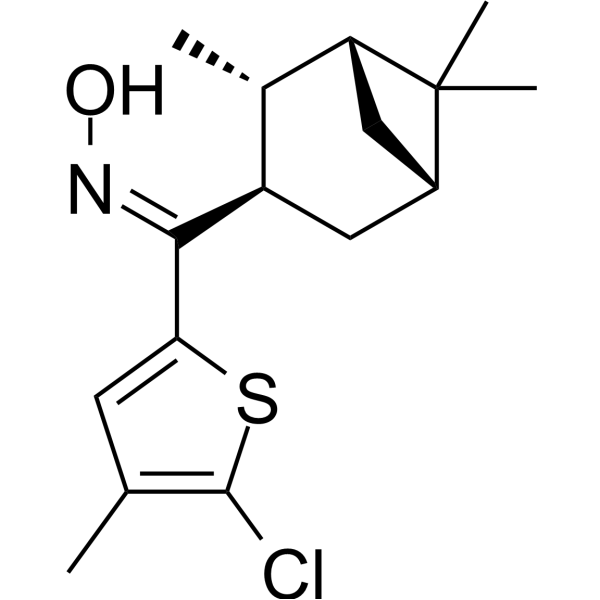
Anticancer agent 345 is a heterobifunctional anticancer compound that exhibits weak antiproliferative activity against both ERα-overexpressing and non-overexpressing T-Rex 293 cells . Anticancer agent 345 can be used in cancer-related research .
loading...
    loading...
Cat. No.: HY-147881
CAS No.: 2481321-20-2
Target:  

Influenza Virus

Research Areas:  

Infection

Anti-Influenza agent 3 (compound 11h) is a potent anti-influenza agent with EC50 values of 3.29, 2.45 µM for A/HK/68 (H3N2, M2-WT), A/WSN/33 (H1N1, M2-S31N) strain, respectively. Anti-Influenza agent 3 shows low cytotoxicity for MDCK epithelial cells. Anti-Influenza agent 3 inhibits the M2 WT and S31N ion channel conductivity .
loading...
    loading...
Cat. No.: HY-184960
CAS No.: 3099599-58-0
Research Areas:  

Cancer

Anticancer agent 352 is a heterobifunctional anticancer compound. Anticancer agent 352 exhibits only weak antiproliferative activity against both ERα-overexpressing and non-overexpressing T-Rex 293 cells induced by Doxorubicin (HY-15142A). Anticancer agent 352 can be used in breast cancer-related research .
loading...
    loading...
Cat. No.: HY-184900
CAS No.: 3099598-43-0
Target:  

Estrogen Receptor/ERR

Research Areas:  

Cancer

Anticancer agent 341 (Compound III-163) is a non-ERα-dependent cytotoxic agent with its GI50 for MCF cells is 0.05-0.5 μΜ. Anticancer agent 341 exhibits GI50 for T-Rex 293 cells regardless of whether Doxycycline (Dox) (HY-N0565) is added of all < 0.05 μΜ. Anticancer agent 341 can be used in breast cancer research .
loading...
    loading...
Cat. No.: HY-184948
CAS No.: 3099595-91-9
Research Areas:  

Cancer

Anticancer agent 347 is a heterobifunctional anticancer inhibitor with inhibitory activity against ERα-overexpressing cells and breast cancer cells. Anticancer agent 347 can be used for the research of breast cancer .
loading...
    loading...
Cat. No.: HY-184952
CAS No.: 3099595-74-8
Target:  

Others

Research Areas:  

Cancer

Anticancer agent 343 is a heterobifunctional anticancer compound and growth inhibitor with moderate cancer cell growth inhibitory activity. Anticancer agent 343 can be used for cancer research .
loading...
    loading...
Cat. No.: HY-182723
CAS No.: 2094630-35-8
Target:  

GPR84

Research Areas:  

Cancer

PSB-16671 is an allosteric agonist of GPR84. PSB-16671 recruits β-arrestins and couples to Gi, enhances the Gi activation potency of orthosteric agonists, and exerts a synergistic effect with orthosteric agonists. PSB-16671 promotes G protein activation and partial chemotaxis independent of GPR84 in mouse neutrophils, maintains the phagocytic function of macrophages against cancer cells without inducing receptor desensitization. PSB-16671 can be used in cancer-related research .
loading...
    loading...
Cat. No.: HY-N20747
CAS No.: 28363-70-4
Synonyms: 4-Hydroxy-N-methyltryptamine; 4-HO-NMT
Norpsilocin (4-hydroxy-N-methyltrypt amine; 4-HO-NMT) is a natural tryptamine alkaloid isolated from the hallucinogenic mushroom Psilocybe cubensis. Norpsilocin activates human 5-HT2 receptors (5-HT2A: EC50 = 8.4 nM; 5-HT2B = 12.8 nM; 5-HT2C = 39.6 nM) and displays binding affinity toward 5-HT1 receptors (5-HT1B: Ki = 212 nM; 5-HT1D = 48.9 nM; 5-HT1E = 81.7 nM). Norpsilocin induces β-arrestin recruitment at the 5-HT1B receptor. Norpsilocin fails to produce psychedelic-like effects in mice, whereas high doses can induce hypothermia in vivo. Norpsilocin acts as an important research tool for exploring the structure–activity relationship of tryptamine hallucinogens and the pharmacology of serotonin receptors .
loading...
    loading...

