13 Results for "

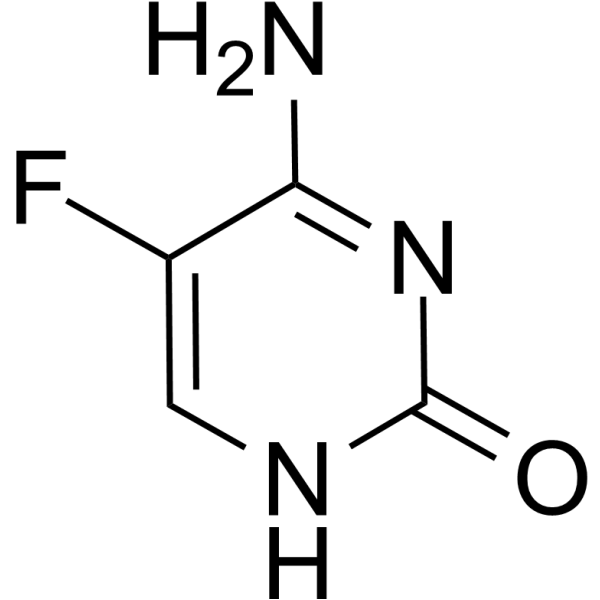
5-FC

" in MedChemExpress (MCE) Product Catalog:
Products (13)

13 Results for "5-FC" in MCE Product Catalog:

3
3 Cited Publications
Cat. No.: HY-B0139
CAS No.: 2022-85-7
Synonyms: 5-Fluorocytosine; NSC 103805; Ro 2-9915
Target:  

Fungal Antibiotic

Research Areas:  

Infection Cancer

Flucytosine (5-Fluorocytosine) is an antifungal compound with oral activity. Flucytosine is a widely used cytotoxic drug that, after further metabolism, produces fluorinated ribonucleotides and deoxyribonucleotides, inhibits DNA and protein synthesis, and has multiple effects such as inhibiting candida and candida neoplasm infection and producies cytotoxicity to cancer cells .
loading...
    loading...
2
2 Cited Publications
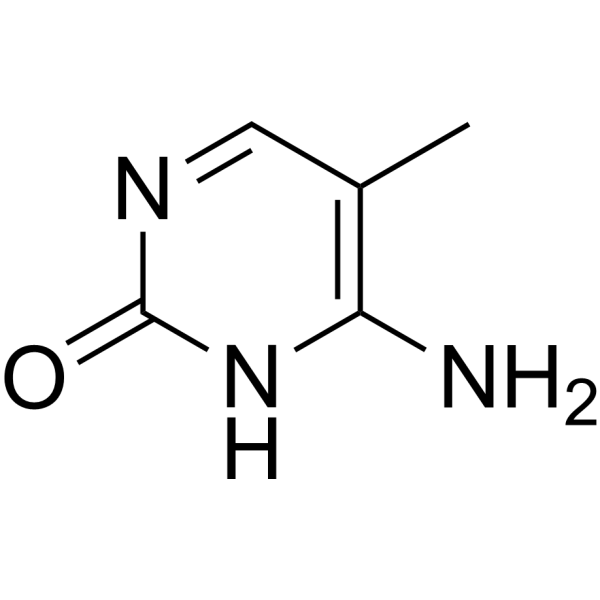
Cat. No.: HY-W008091
CAS No.: 554-01-8
5-Methylcytosine is a well-characterized DNA modification in prokaryotes and eukaryotes. 5-Methylcytosine forms symmetrical methylation on CpG dinucleotides in DNA, stabilizes tRNA/rRNA structure in RNA, and affects mRNA translation. 5-Methylcytosine can be oxidized to generate 5hmC, 5fC, and 5caC. 5-Methylcytosine can be used in epigenetics, developmental biology, and the study of diseases such as colorectal cancer and hepatocellular carcinoma .
loading...
    loading...
2
2 Cited Publications
Cat. No.: HY-W008091R
CAS No.: 554-01-8
5-Methylcytosine (Standard) is the analytical standard of 5-Methylcytosine (HY-W008091). This product is intended for research and analytical applications. 5-Methylcytosine is a well-characterized DNA modification in prokaryotes and eukaryotes. 5-Methylcytosine forms symmetrical methylation on CpG dinucleotides in DNA, stabilizes tRNA/rRNA structure in RNA, and affects mRNA translation. 5-Methylcytosine can be oxidized to generate 5hmC, 5fC, and 5caC. 5-Methylcytosine can be used in epigenetics, developmental biology, and the study of diseases such as colorectal cancer and hepatocellular carcinoma .
loading...
    loading...
2
2 Cited Publications
Cat. No.: HY-W008091A
CAS No.: 58366-64-6
Research Areas:  

Cancer

5-Methylcytosine hydrochloride is a well-characterized DNA modification in prokaryotes and eukaryotes. 5-Methylcytosine hydrochloride forms symmetrical methylation on CpG dinucleotides in DNA, stabilizes tRNA/rRNA structure in RNA, and affects mRNA translation. 5-Methylcytosine hydrochloride can be oxidized to generate 5hmC, 5fC, and 5caC. 5-Methylcytosine hydrochloride can be used in epigenetics, developmental biology, and the study of diseases such as colorectal cancer and hepatocellular carcinoma .
loading...
    loading...
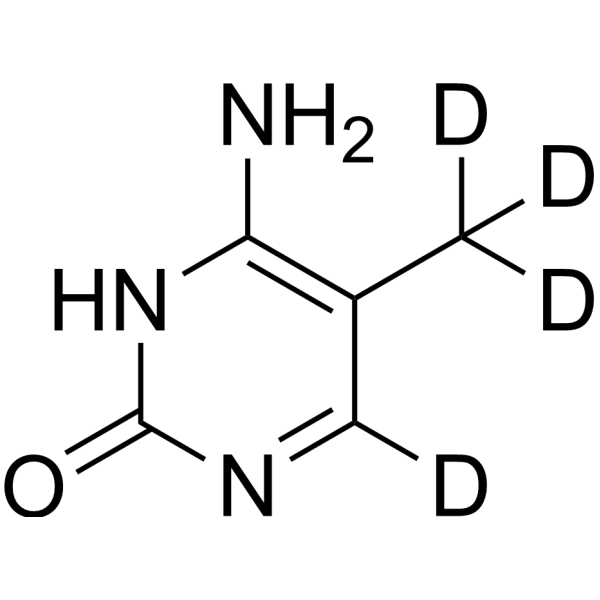
Cat. No.: HY-W008091S
CAS No.: 1219795-15-9
5-Methylcytosine-d4 is the deuterium labeled 5-Methylcytosine (HY-W008091). 5-Methylcytosine is a well-characterized DNA modification in prokaryotes and eukaryotes. 5-Methylcytosine forms symmetrical methylation on CpG dinucleotides in DNA, stabilizes tRNA/rRNA structure in RNA, and affects mRNA translation. 5-Methylcytosine can be oxidized to generate 5hmC, 5fC, and 5caC. 5-Methylcytosine can be used in epigenetics, developmental biology, and the study of diseases such as colorectal cancer and hepatocellular carcinoma .
loading...
    loading...
Cat. No.: HY-126181
CAS No.: 4425-59-6
Target:  

Endogenous Metabolite

Research Areas:  

Others

5-Formylcytosine is a modified base, which is oxidized from 5-methylcytosine. 5-Formylcytosine is a intermediate of in the active DNA demethylation .
loading...
    loading...
Cat. No.: HY-E70583
Target:  

TET Protein

Research Areas:  

Others

Recombinant Ten-Eleven Translocase is a recombinant Fe(II)- and α-ketoglutarate-dependent dioxygenase. Recombinant Ten-Eleven Translocase converts 5-methylcytosine (5mC) to 5-hydroxymethylcytosine (5hmC), and then to 5-formylcytosine (5fC) and 5-carboxycytosine (5caC) through a series of oxidation reactions. Then, 5caC is further converted into uracil (U) through the action of a conversion agent or enzyme, and uracil (U) is converted into thymine (T) through PCR, thereby achieving single-base resolution and high-accuracy identification of DNA methylation sites .
loading...
    loading...
Cat. No.: HY-B0723S2
Synonyms: FC-1271a-d5
Ospemifene-d5 (FC-1271a-d5) is deuterium labeled Ospemifene. Ospemifene is a non-estrogen selective estrogen receptor modulator (SERM), with Kis of 380 and 410 nM for estrogen receptor α (ERα) and ERβ, respectively. Ospemifene can be used for the research of vaginal atrophy and breast cancer .
loading...
    loading...
Cat. No.: HY-P700302
Purity:  > 95%, as determined by Bis-Tris PAGE.
Synonyms: FCRL5; FCR-Like Protein 5; FC Receptor Like 5; Immunoglobulin Superfamily Receptor Translocation Associated 2 (IRTA2); BXMAS1; FC Receptor-Like 5; FCRH5; CD307e Antigen; IRTA2; PRO820; CD307e; CD307; Immune Receptor Translocation-Associated Protein 2; FCR
Species:  
Source:  
loading...
    loading...
Cat. No.: HY-P77652
Purity:  ≥ 95%, as determined by Bis-Tris PAGE.
Synonyms: FCRL5; FCR-Like Protein 5; FC Receptor Like 5; Immunoglobulin Superfamily Receptor Translocation Associated 2 (IRTA2); BXMAS1; FC Receptor-Like 5; FCRH5; CD307e Antigen; IRTA2; PRO820; CD307e; CD307; Immune Receptor Translocation-Associated Protein 2; FCR
Species:  
Source:  
loading...
    loading...
Cat. No.: HY-P703727
Purity:  ≥ 95%, as determined by reducing SDS-PAGE.
Synonyms: FCRL5; FCR-Like Protein 5; FC Receptor Like 5; Immunoglobulin Superfamily Receptor Translocation Associated 2 (IRTA2); BXMAS1; FC Receptor-Like 5; FCRH5; CD307e Antigen; IRTA2; PRO820; CD307e; CD307; Immune Receptor Translocation-Associated Protein 2; FCR
Species:  
Source:  
loading...
    loading...
Cat. No.: HY-P702590
Purity:  ≥ 95%, as determined by reducing SDS-PAGE.
Synonyms: FCRL5; FCR-Like Protein 5; FC Receptor Like 5; Immunoglobulin Superfamily Receptor Translocation Associated 2 (IRTA2); BXMAS1; FC Receptor-Like 5; FCRH5; CD307e Antigen; IRTA2; PRO820; CD307e; CD307; Immune Receptor Translocation-Associated Protein 2; FCR
Species:  
Source:  
loading...
    loading...
Cat. No.: HY-P703957
Purity:  ≥ 95%, as determined by Bis-Tris PAGE.
Synonyms: FCRL5; FCR-Like Protein 5; FC Receptor Like 5; Immunoglobulin Superfamily Receptor Translocation Associated 2 (IRTA2); BXMAS1; FC Receptor-Like 5; FCRH5; CD307e Antigen; IRTA2; PRO820; CD307e; CD307; Immune Receptor Translocation-Associated Protein 2; FCR
Species:  
Source:  
loading...
    loading...
  • 1

