
12 Results for "

Acacia

" in MedChemExpress (MCE) Product Catalog:
Products (12)

12 Results for "Acacia" in MCE Product Catalog:

Cat. No.: HY-N6664
CAS No.: 9000-01-5
Synonyms: Arabic gum
Gum Arabic is an orally active complex branched polysaccharide. Gum Arabic can be isolated from the Acacia senegal tree. Gum Arabic upregulates the expression of maturation markers (CD86, CD40, and CD54), promotes ERK1/2 phosphorylation, and inhibits Apoptosis. Gum Arabic exhibits antimalarial effects against Plasmodium berghei ANKA. Gum Arabic exhibits hepatoprotective, renal, and cardiovascular protective activities. Gum Arabic improves obesity. Gum Arabic is commonly used as a stabilizer and thickener. Gum Arabic can be used in the research of brain tumor imaging .
loading...
    loading...
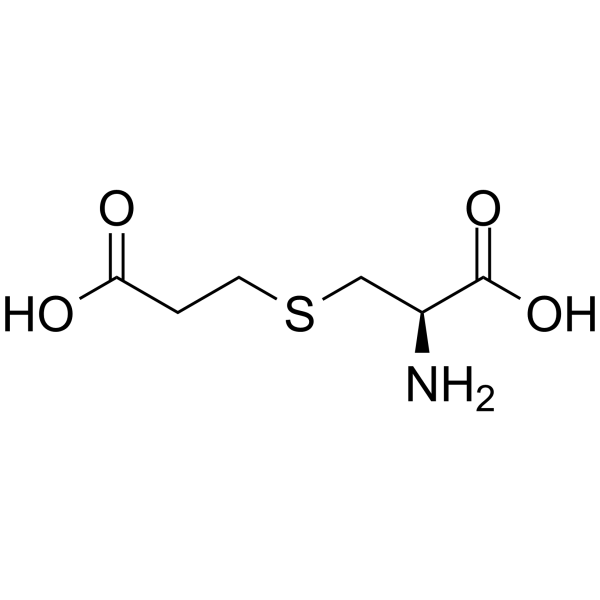
Cat. No.: HY-W141774
CAS No.: 4033-46-9
Synonyms: S-Carboxyethylcysteine
Research Areas:  

Metabolic Disease

S-(2-Carboxyethyl)-L-cysteine (S-Carboxyethylcysteine) is a non-protein (modified) sulfur amino acid. S-(2-Carboxyethyl)-L-cysteine is present in Acacia seed. S-(2-Carboxyethyl)-L-cysteine can affect the seed’s protein use in rats. S-(2-Carboxyethyl)-L-cysteine suppresses the methionine-induced growth rate, and has a negative effect on the plasma amino acid levels in rats .
loading...
    loading...
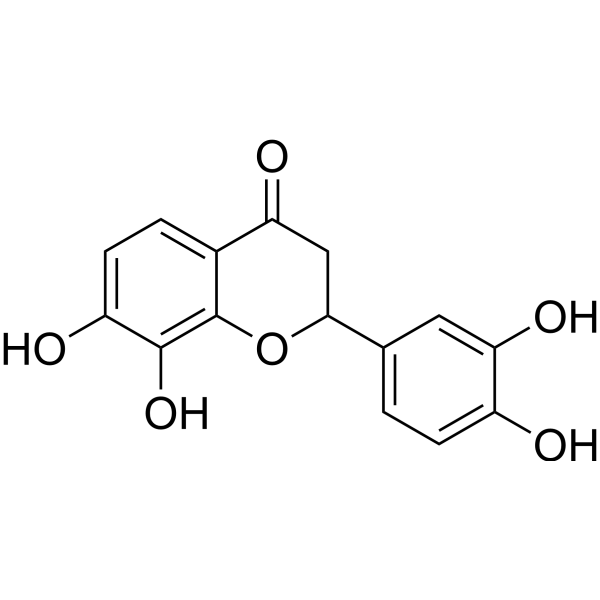
Cat. No.: HY-N9909
CAS No.: 489-73-6
7,8,3',4'-Tetrahydroxyflavanone is a flavonoid can be extracted from Acacia confusa .
loading...
    loading...
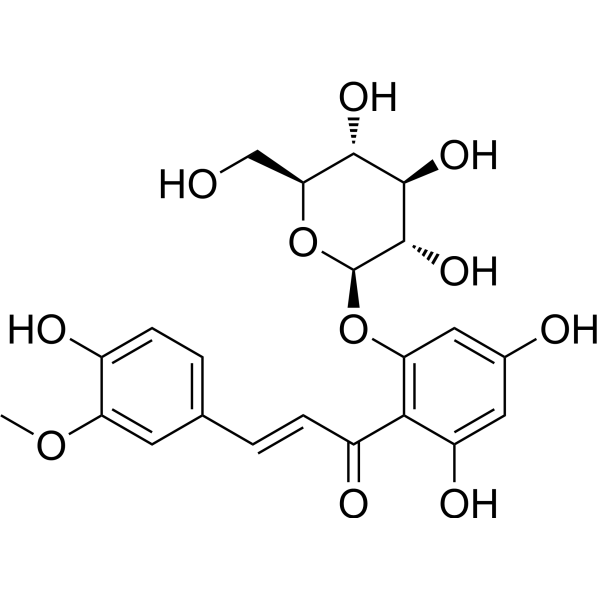
Cat. No.: HY-N11129
CAS No.: 80830-19-9
3',4,4',6-Tetrahydroxyaurone 4-O-β-D-glucoside is a chalcone glucoside that can be found in Acacia dealbata .
loading...
    loading...
Cat. No.: HY-N2655
CAS No.: 105330-59-4
5,7,4'-Tri-O-methylcatechin is a Flavonoids product that can be isolated from the wood of Acacia catechu (L.F.) Willd. .
loading...
    loading...
Cat. No.: HY-N20357
Category:  

Extract

Target:  

Bacterial

Acacia farnesiana extract is an extract of Acacia farnesiana that can inhibit Mycobacterium tuberculosis and Shigella dysenteriae.
loading...
    loading...
Cat. No.: HY-N18659
CAS No.: 202148-87-6
Category:  

Extract

Target:  

Others

Acacia concinna extract, derived from the pods and leaves of the acacia tree, effectively removes dirt and excess oil from the scalp and hair while preserving the hair's natural oils.
loading...
    loading...
Cat. No.: HY-N19050
Category:  

Extract

Target:  

Bacterial

Acacia catechu extract is rich in bioactive components such as catechins, tannins, and flavonoids, and has astringent, anti-inflammatory, antioxidant, and antibacterial properties.
loading...
    loading...
Cat. No.: HY-N17637
CAS No.: 511-81-9
Machaeric acid is a triterpenoid and triterpene sapogenin, which serves as the aglycone of Senegaloside A; it can be isolated from the seeds of Caragana microphylla Lam. and Acacia senegal(Mimosaceae). Machaeric acid exhibits remarkable biosafety, and even at concentrations as high as 200 μM, it does not induce cytotoxicity or reduce the viability of H4IIE rat hepatoma cells .
loading...
    loading...
Cat. No.: HY-119958
CAS No.: 74161-27-6
Target:  

Drug Intermediate

Research Areas:  

Inflammation/Immunology

Acamelin is a Benzofuranoquinone compound that acts as a contact sensitizer. It can be isolated from the heartwood of Acacia melanoxylon R. Br., an Australian blackwood. Acamelin induces positive skin reactions and contact allergy in guinea pigs. It is applicable to research related to allergic contact dermatitis .
loading...
    loading...
Cat. No.: HY-W722084
CAS No.: 17302-32-8
3,7-Dimethylnonane is a saturated aliphatic hydrocarbon compound found in the leaves of silver acacia (Leucaena leucocephala (Lam.) De Wit) .
loading...
    loading...
Cat. No.: HY-184081
CAS No.: 5118-17-2
Target:  

Bacterial

Research Areas:  

Infection

Furazolium hydrochloride is a broad-spectrum antibacterial agent with inhibitory activity against a variety of Gram-positive and Gram-negative Bacterial strains. In a gelatin-acacia complex coacervate system, Furazolium hydrochloride exhibits protein-binding properties, where protein binding dominates at low concentrations, while micellization occurs at high concentrations. Furazolium hydrochloride does not alter the water permeability of cellulose membranes, and it can induce delayed-type hypersensitivity reactions in guinea pigs, with cross-reactivity observed in animals sensitized with aflatoxin B1. Furazolium hydrochloride can be used in studies related to bacterial infections and local wound infections .
loading...
    loading...
  • 1

