

16 Results for "

Active pharmaceutical ingredient

" in MedChemExpress (MCE) Product Catalog:
Products (16)

16 Results for "Active pharmaceutical ingredient" in MCE Product Catalog:

10
10 Publications Verification
Cat. No.: HY-N1132
CAS No.: 99-20-7
Synonyms: D-Trehalose; α,α-Trehalose
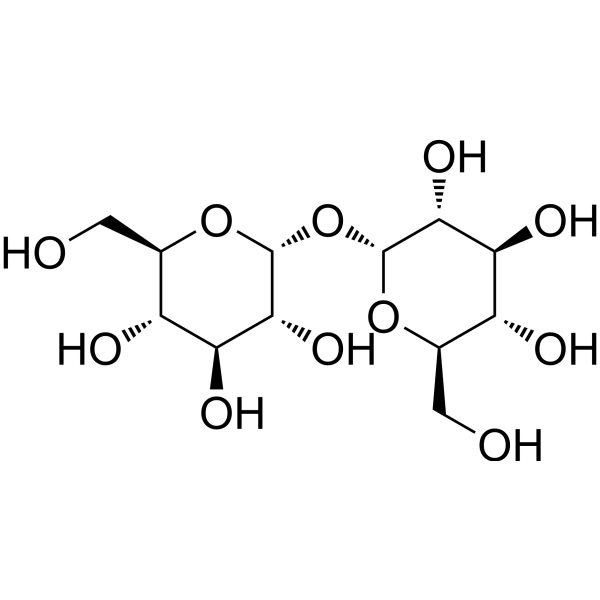
D-(+)-Trehalose (α,α-Trehalose) is an orally active disaccharide, showing anti-desiccant and cryopreservative activities. D-(+)-Trehalose acts as an osmolyte, and stress protectant and helps in the storage and transport of carbon. D-(+)-Trehalose can be used as a food ingredient and pharmaceutical excipient .
loading...
    loading...
7
7 Cited Publications
Cat. No.: HY-P99974
Synonyms: Nanoparticle albumin-bound Paclitaxel; Nanoparticle albumin-bound ABI-007

Research Areas:  

Cancer

Nab-Paclitaxel (Nanoparticle albumin-bound Paclitaxel) is an albumin-bound nanoparticle formulation of Paclitaxel (HY-B0015). Nab-Paclitaxel is composed of albumin and the active pharmaceutical ingredient Paclitaxel, in which human albumin is used as an excipient to disperse and stabilize particles and carry the main drug. Nab-Paclitaxel is a solvent-free taxane with higher response rates and improved tolerability. Nab-Paclitaxel displays less toxicity and greater antitumor activity. Nab-Paclitaxel is more readily available for tumor cell uptake in three rhabdomyosarcoma, seven neuroblastoma cell lines, and one ostersarcoma cell line Nab-Paclitaxel can be studied in cancer research for example breast cancer and solid tumors. (The product specifications below only indicate the effective content of Paditaxel, the actual albumin quality depends on the batch; the ratio of each ingredient in this product is Paditaxel: albumin -1:7~1:11) .
loading...
    loading...
3
3 Cited Publications
Cat. No.: HY-Y1316
CAS No.: 532-32-1
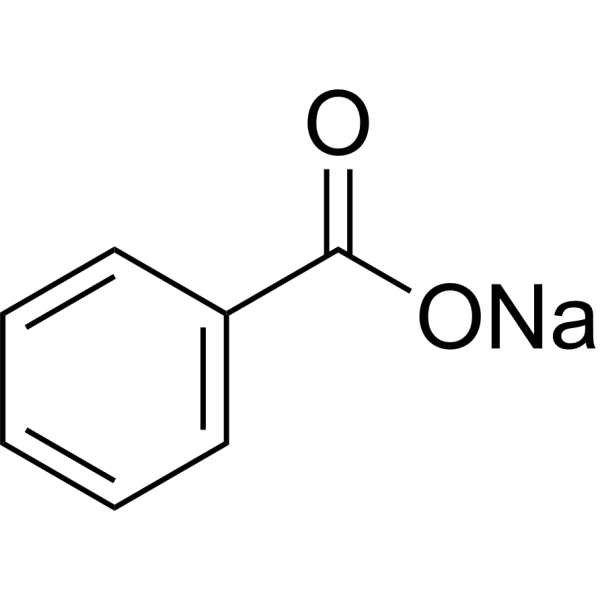
Sodium benzoate is an orally active pharmaceutical excipient, such as an antibacterial agent, preservative, lubricant, etc. Pharmaceutical excipients, or pharmaceutical auxiliaries, refer to other chemical substances used in the pharmaceutical process other than pharmaceutical ingredients. Pharmaceutical excipients generally refer to inactive ingredients in pharmaceutical preparations, which can improve the stability, solubility and processability of pharmaceutical preparations. Pharmaceutical excipients also affect the absorption, distribution, metabolism, and elimination (ADME) processes of co-administered drugs.Sodium benzoate activates NF-κB and induces Apoptosis. Sodium benzoate induces immune suppression and produces reproductively toxic. Sodium benzoate can be used for colon cancer and immune disease research .
loading...
    loading...
Cat. No.: HY-W051271
CAS No.: 13463-67-7
Synonyms: Titanium dioxide
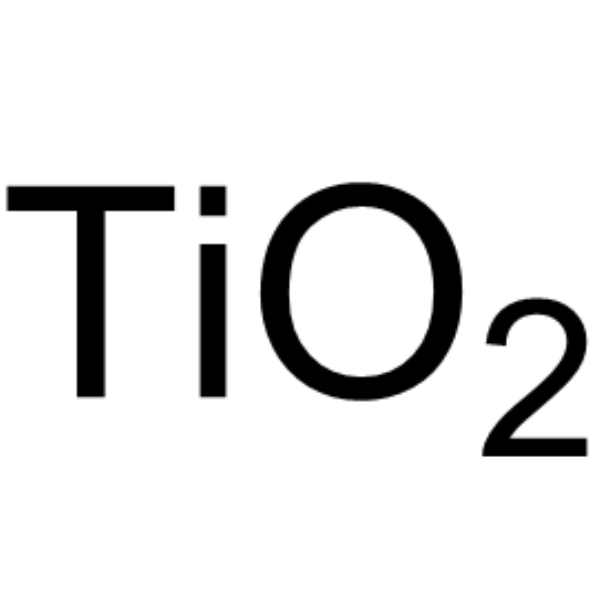
Titanium(IV) oxide is a photosensitizer and photocatalyst. Titanium(IV) oxide can be used as a pharmaceutical excipient such as a flow aid, coating agent, sunscreen, colorant, etc. Pharmaceutical excipients or pharmaceutical excipients refer to other chemical substances used in the pharmaceutical process other than the drug ingredients. Pharmaceutical excipients generally refer to inactive ingredients in pharmaceutical preparations that can improve the stability, solubility and processability of pharmaceutical preparations. Pharmaceutical excipients also affect the absorption, distribution, metabolism and elimination (ADME) process of co-administered drugs. Titanium(IV) oxide can use light energy to generate electron-hole pairs to degrade pollutants. Photons excite electrons in TiO2 to generate active oxygen species (such as ·OH and ·O2 -), thereby oxidizing and mineralizing pollutants such as organic compounds and heavy metals. TiO2 can be used in the research of environmental remediation fields such as water treatment, air purification and self-cleaning materials .
loading...
    loading...
Cat. No.: HY-W115746
CAS No.: 9004-57-3
Synonyms: Ethyl cellulose N-200
Research Areas:  

Others

Ethyl cellulose (Ethyl cellulose N-200) is a non-toxic cellulose derivative with unique properties including oil gel formation, active ingredient delivery and film-forming ability. Ethyl cellulose can serve as a pharmaceutical excipient, such as a coating agent, flavoring agent, tablet filler, etc. .
loading...
    loading...
Cat. No.: HY-78509
CAS No.: 1210-35-1
Dibenzosuberone is a tricyclic compound, commonly referred to as a tricyclic antidepressant (TCA), and is widely used in research on migraine, tension-type headache, anxiety disorder and schizophrenia. Dibenzosuberone also serves as a key intermediate for the synthesis of various active pharmaceutical ingredients (APIs) (e.g., amitriptyline (HY-B0527), nortriptyline (HY-118620), nortriptyline or cyproheptadine (HY-B1622)) .
loading...
    loading...
Cat. No.: HY-W021016
CAS No.: 824395-67-7
Synonyms: (S,S)-Ph-BPE
Research Areas:  

Others

(+)-1,2-Bis ((2S,5S)-2,5-diphenylphospholano)ethane ((S,S)-Ph-BPE) is a chiral bisphosphine ligand and catalyst. (+)-1,2-Bis ((2S,5S)-2,5-diphenylphospholano)ethane acts as a chiral ligand in rhodium-catalyzed reductive hydroformylation of alkenyl boronic esters, enabling enantiodivergent synthesis of chiral γ-boryl alcohols. (+)-1,2-Bis ((2S,5S)-2,5-diphenylphospholano)ethane forms chiral nickel-phosphine complexes to mediate asymmetric hydrogenation of aliphatic γ- and δ-keto acids; protons promote substrate C=O bond activation and stereoselectivity control via hydrogen bonding. (+)-1,2-Bis ((2S,5S)-2,5-diphenylphospholano)ethane forms a monodentate nickel complex, which serves as the active species for asymmetric hydrogenation of aliphatic keto acids .
loading...
    loading...
Cat. No.: HY-W115746A
CAS No.: 9004-57-3
Ethyl cellulose (viscosity 10 cP) is a non-toxic, biodegradable polymer with unique properties such as oleogel formation, active ingredient delivery, and film-forming ability in the food and pharmaceutical fields. Ethyl cellulose (viscosity 10 cP) can serve as a pharmaceutical excipient, including as a coating agent, flavoring agent, and tablet filler .
loading...
    loading...
Cat. No.: HY-W115746B
CAS No.: 9004-57-3
Ethyl cellulose (viscosity 300 cP) is a non-toxic cellulose derivative with unique properties including oil gel formation, active ingredient delivery and film-forming ability . Ethyl cellulose (viscosity 300 cP) can serve as a pharmaceutical excipient, such as a coating agent, flavoring agent, tablet filler, etc. .
loading...
    loading...
Cat. No.: HY-W069177
CAS No.: 6336-50-1
Synonyms: 6-Benzyl-2-thiouracil
Target:  

TSH Receptor

Research Areas:  

Others

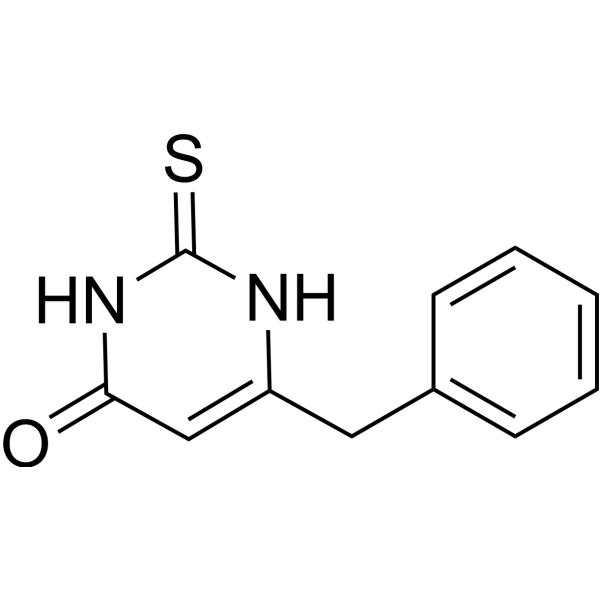
Benzylthiouracil is an active pharmaceutical ingredient against hyperthyroidism .
loading...
    loading...
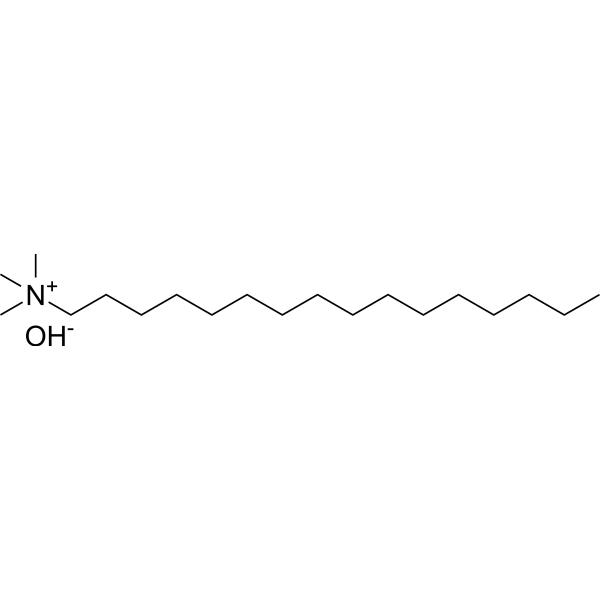
Cat. No.: HY-122407
CAS No.: 505-86-2
Synonyms: Cetyltrimethylammonium hydroxide
Hexadecyltrimethylammonium hydroxide, a quaternary ammonium compound, is commonly used as an emulsifier, detergent, and surfactant in various industrial processes, especially in the production of cosmetics, pharmaceuticals, and textiles. Hexadecyltrimethylammonium hydroxide has unique chemical properties that make it an active ingredient in many applications requiring strong surface activity and solubility.
loading...
    loading...
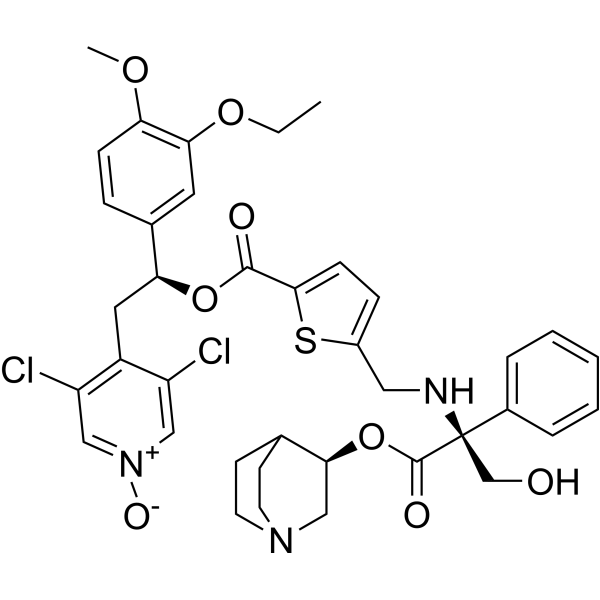
Cat. No.: HY-155819
Research Areas:  

Inflammation/Immunology

M3/PDE4 modulator-1 (compound 10f) is a bifunctional molecule that is an M3 mAChR antagonist and a PDE4 inhibitor. M3/PDE4 modulator-1 (10-1000 nM/kg; iv) reduces cysteine eosinophil influx in the OVA rat model .
loading...
    loading...
Cat. No.: HY-158569
CAS No.: 958853-11-7
Target:  

Endogenous Metabolite

Research Areas:  

Others

SAR114137 is a highly effective drug with potent biological activity. SAR114137 exhibits altered amorphous content characteristics during physical processing of the crystalline active pharmaceutical ingredient. The amorphous API content of SAR114137 is significantly reduced when processed by different jet grinding techniques. SAR114137 exhibits good chemical stability in pharmaceutical formulations .
loading...
    loading...
Cat. No.: HY-167663
CAS No.: 149494-37-1
Target:  

5-HT Receptor

Research Areas:  

Neurological Disease

Ebalzotan is a 5-HT1A receptor agonist with activity in the study of depression. Ebalzotan can serve as a precursor to important active pharmaceutical ingredients. The synthesis of Ebalzotan involves a multi-enzyme catalyzed reduction reaction to obtain saturated primary or secondary alcohols in high yields and high enantioselectivity .
loading...
    loading...
Cat. No.: HY-167663A
CAS No.: 294843-95-1
Target:  

5-HT Receptor

Research Areas:  

Neurological Disease

(S)-Ebalzotan is the S-form of Ebalzotan (HY-167663). Ebalzotan is a 5-HT1A receptor agonist with activity in the study of depression. Ebalzotan can serve as a precursor to important active pharmaceutical ingredients. The synthesis of Ebalzotan involves a multi-enzyme catalyzed reduction reaction to obtain saturated primary or secondary alcohols in high yields and high enantioselectivity .
loading...
    loading...
Cat. No.: HY-L096
179 compounds

An inactive ingredient is any component of a drug product other than the active ingredient. Inactive ingredients are added during the manufacturing process of pharmaceutical products such as tablets, capsules, suppositories, and injections. In new drug development, once an inactive ingredient has appeared in an approved drug product for a particular route of administration, the inactive ingredient is not considered new and may require a less extensive review the next time it is included in a new drug product.

MCE offers a unique collection of 179 inactive ingredients, which only contain inactive ingredients of the final dosage forms of the drug. MCE Inactive Ingredient library is a powerful tool for aiding in the development of the drug and saving unnecessary time.

  • 1

