1. Search Result
Search Result
Results for "

Antiproliferative ability

" in MedChemExpress (MCE) Product Catalog:

16

Inhibitors & Agonists

1

Isotope-Labeled Compounds

Cat. No. Product Name Target Research Areas Chemical Structure
  • HY-145426

    HDAC Cancer
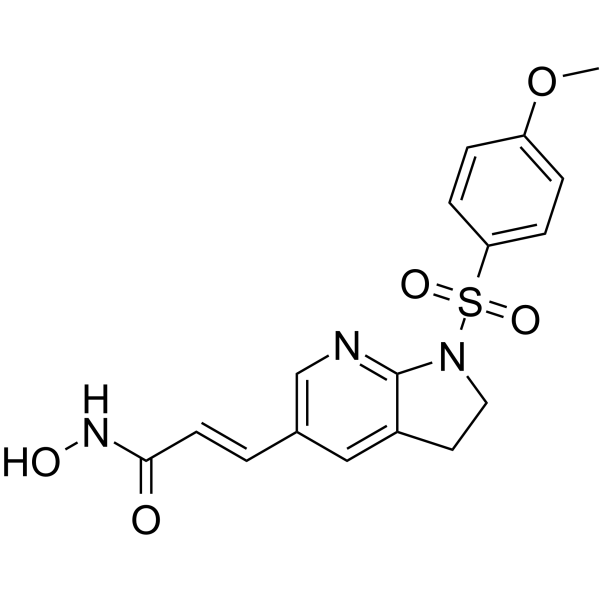
    MPT0B390 is an arylsulfonamide-based derivative with potent HDAC inhibitory ability. MPT0B390, TIMP3 inducer, inhibits tumor growth, metastasis and angiogenesis. MPT0B390 shows antiproliferative activity against human colon cancer cell line HCT116 with the GI50 of 0.03 μM .
    MPT0B390
  • HY-152758

    Apoptosis Caspase Cancer
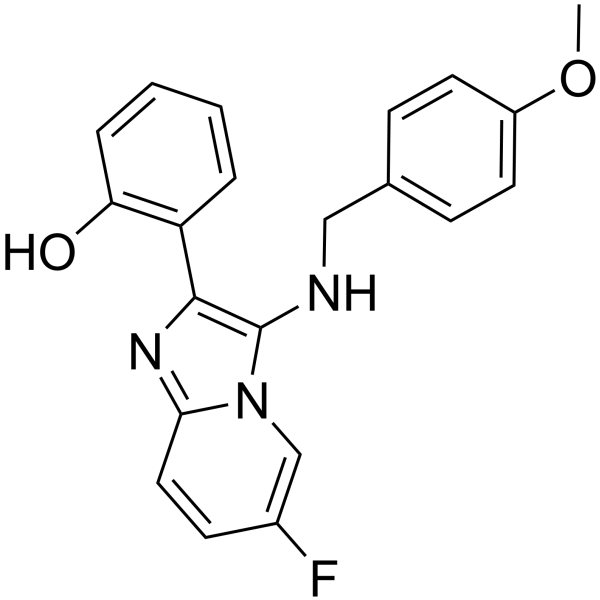
    Caspase-3/7 activator 3 is an effective activator of Caspase-3/7. Caspase-3/7 activator 3 has tumor selectivity, anti-proliferative activity and high Apoptosis-inducing ability .
    Caspase-3/7 activator 3
  • HY-W783415

    FAK Cancer
    STARD3-IN-1 (Compound VS1) is a STARD3 inhibitor with an IC₅₀ of 35 μM. STARD3 is a protein that is overexpressed in various cancers and is involved in cholesterol transport. STARD3-IN-1 exhibits anti-proliferative activity in breast cancer and colon cancer cells, significantly weakening the clonogenic ability of cancer cells. STARD3-IN-1 increases the protein levels of FAK and pTyr397-FAK. STARD3-IN-1 can be used for research on breast cancer and colon cancer .
    STARD3-IN-1
  • HY-148265

    Microtubule/Tubulin Cancer
    Antiproliferative agent-14 (compound 3b) a potent tubulin polymerization inhibitor, with an IC50 of 3.41 μM. Antiproliferative agent-14 has excellent antiproliferative activity. Antiproliferative agent-14 possess the ability to arrest cells at G2/M phases of the cell cycle .
    Antiproliferative agent-14
  • HY-168587

    Drug Derivative Cancer
    Antitumor agent-189 (Compound DN4) is a potent antitumor agent, and a 4-oxobutanamide derivative. Antitumor agent-189 inhibits A498 cells proliferation, adhesion and invasion with an IC50 of 1.94 μM. Antitumor agent-189 also inhibits angiogenesis and tumor growth in the xenograft model of A498 cells .
    Antitumor agent-189
  • HY-152756

    Apoptosis Caspase Cancer
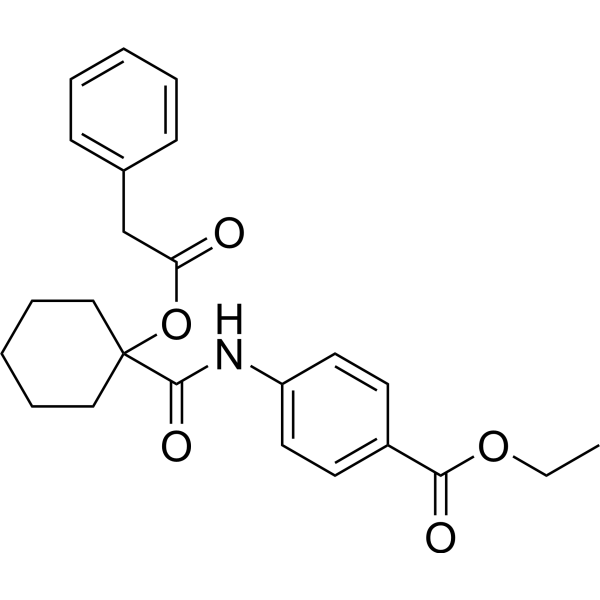
    Caspase-3/7 activator 2 is an effective activator of Caspase-3/7. Caspase-3/7 activator 2 has tumor selectivity, anti-proliferative activity and high Apoptosis-inducing ability .
    Caspase-3/7 activator 2
  • HY-152748

    Apoptosis Caspase Cancer
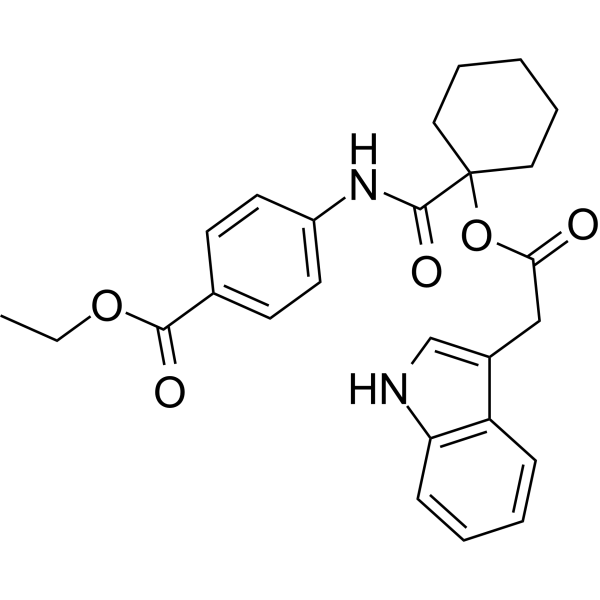
    Caspase-3/7 activator 1 is an effective activator of Caspase-3/7. Caspase-3/7 activator 1 has tumor selectivity, anti-proliferative activity and high Apoptosis-inducing ability .
    Caspase-3/7 activator 1
  • HY-W040293

    PE(6:0/6:0); 1,2-Dihexanoyl-sn-glycero-3-phosphoethanolamine

    Apoptosis Cancer
    06:0 PE (PE(6:0/6:0)) is a water-soluble phospholipid characterized by its short acyl chains, exhibiting notable antitumor activity and the ability to inhibit tumor progression in vivo, alongside antiproliferative and proapoptotic effects, while serving as a precursor for phosphatidylcholine and phosphatidylethanolamine.
    06:0 PE
  • HY-173151

    Reactive Oxygen Species (ROS) Cancer
    BRCA2-IN-1 (Compound 3j) is a potential BRCA2 inhibitor that exhibits antiproliferative activity against the breast cancer MCF-7 cell lines. BRCA2-IN-1 also demonstrates DPPH radical scavenging ability, with an IC50 of 12.36 µM .
    BRCA2-IN-1
  • HY-159512

    EGFR Apoptosis Cancer
    EGFR kinase inhibitor 7 (compound 18i) is an EGFR inhibitor (IC50=42.3 nM) with anticancer activity. EGFR kinase inhibitor 7 has significant in vitro cytotoxicity and apoptosis induction ability. EGFR kinase inhibitor 7 has antiproliferative activity against human colon cancer cell line HCT116 and human non-small cell lung cancer cell line A549, with IC50 values ​​of 4.82 µM and 1.43 µM, respectively .
    EGFR kinase inhibitor 7
  • HY-169400

    HDAC Histone Methyltransferase Apoptosis Cancer
    HDACs/EZH2-IN-1 (Compound 22a) is a HDACs/EZH2 inhibitor (EZH2 Y641N inhibition rate at 50 nM: 98%), with selective inhibition against HDAC1 and HDAC6 (IC50: 0.23 μM and 0.07 μM, respectively). HDACs/EZH2-IN-1 exerts a antiproliferative effect on diffuse large B-cell lymphoma cells harboring an EZH2 mutation and on various acute myeloid leukemia cells. HDACs/EZH2-IN-1 has the ability to induce cell differentiation and Apoptosis .
    HDACs/EZH2-IN-1
  • HY-W040293S

    PE(6:0/6:0)-d22; 1,2-Dihexanoyl-sn-glycero-3-phosphoethanolamine-d22

    Isotope-Labeled Compounds Cancer
    06:0 PE-d22 (PE(6:0/6:0)-d22) is the deuterium labeled 06:0 PE (HY-W040293). 06:0 PE (PE(6:0/6:0)) is a water-soluble phospholipid characterized by its short acyl chains, exhibiting notable antitumor activity and the ability to inhibit tumor progression in vivo, alongside antiproliferative and proapoptotic effects, while serving as a precursor for phosphatidylcholine and phosphatidylethanolamine.
    06:0 PE-d22
  • HY-180848

    Bcl-2 Family Apoptosis Cancer
    Bcl-2-IN-24 (Compound 11g) is an efficient and selective Bcl-2 inhibitor with a Kd value of 11.3 μM. Bcl-2-IN-24 exhibits anti-proliferative activity against HCT-116 cells and A549 cells. Bcl-2-IN-24 effectively inhibits the colony-forming ability of tumor cells and induces cell apoptosis. Bcl-2-IN-24 can be used for research on colon cancer and lung cancer .
    Bcl-2-IN-24
  • HY-182789

    VEGFR CDK Cancer
    VEGFR2-IN-86 is a dual VEGFR2/CDK2 inhibitor, with an IC50 of 0.06 μM against VEGFR2 and an IC50 of 0.78 μM against CDK2. VEGFR2-IN-86 induces G-phase cell cycle arrest, reduces colony-forming ability and tumor cell migration capacity, and exerts antiproliferative activity in cancer cells. VEGFR2-IN-86 can be used for the research of breast cancer and prostate cancer .
    VEGFR2-IN-86
  • HY-180193

    Microtubule/Tubulin Apoptosis Cancer
    Tubulin polymerization-IN-86 (Compound B6) is an effective inhibitor of tubulin polymerization. Tubulin polymerization-IN-86 effectively inhibits microtubulin polymerization by binding to the colchicine binding sites on microtubulin, thereby disrupting the microtubule cytoskeleton within the cell. Tubulin polymerization-IN-86 exhibits potent anti-proliferative activity against a variety of cancer cell lines. Tubulin polymerization-IN-86 induces cell cycle arrest, apoptosis, inhibits cell migration, invasion, and long-term survival ability. Tubulin polymerization-IN-86 inhibits tumor growth in mice and can be used for the study of melanoma .
    Tubulin polymerization-IN-86
  • HY-183783

    PROTACs RET STAT ERK Apoptosis Endocrinology Cancer
    PROTAC RET Degrader 2 is a RET degrader with a target IC50 of 0.36 nM. PROTAC RET Degrader 2 is mainly composed of RET-IN-34 (HY-183729) and Thalidomide (HY-14658). PROTAC RET Degrader 2 mediates RET degradation via the ubiquitin-proteasome system. PROTAC RET Degrader 2 induces apoptosis, inhibits colony-forming ability, and exhibits antiproliferative activity in cancer cells. PROTAC RET Degrader 2 suppresses tumor growth in xenograft models. PROTAC RET Degrader 2 can be used in research related to medullary thyroid carcinoma, papillary thyroid carcinoma, and RET fusion-positive lung adenocarcinoma .
    PROTAC RET Degrader 2

Inquiry Online

Your information is safe with us. * Required Fields.

Salutation


Country or Region *

Applicant Name *


Organization Name *

Department *


Email Address *


Product Name *

Cat. No.


Requested quantity *

Phone Number *


Remarks

Inquiry Online

Inquiry Information

Product Name:
Cat. No.:
Quantity:
MCE Japan Authorized Agent:

