



Antiproliferative agent-14

Based on 1 Customer Validation
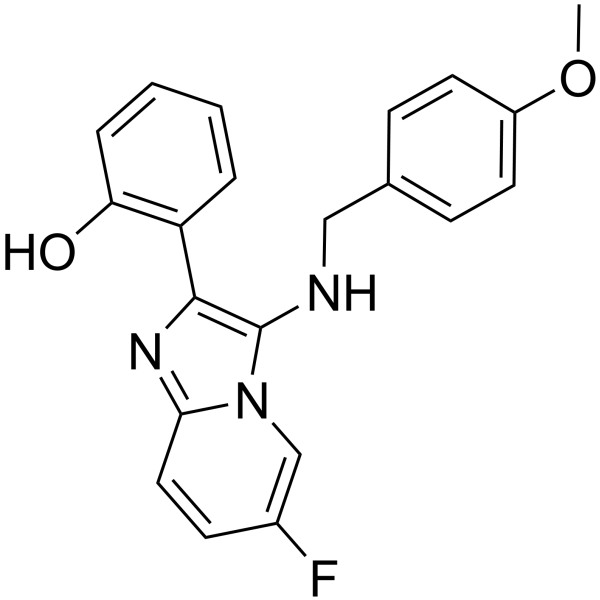
Antiproliferative agent-14 (compound 3b) a potent tubulin polymerization inhibitor, with an IC50 of 3.41 μM. Antiproliferative agent-14 has excellent antiproliferative activity. Antiproliferative agent-14 possess the ability to arrest cells at G2/M phases of the cell cycle.
For research use only. We do not sell to patients.
- Purity : 98.76%
- CAS No.: 1885900-35-5
- Formula: C21H18FN3O2
- Molecular Weight:363.38
-
Storage:
4°C, protect from light
* In solvent : -80°C, 6 months; -20°C, 1 month (protect from light)

To place orders, for customer services and technical support, please contact: MedChemExpress USA
Tel: 609-228-6898 E-mail: [email protected] [email protected]


-
 Biological Activity
-
Chemical Information
-
Solvent & Solubility
- Protocols
- Purity & Documentation
- References
-
 Help & FAQs




Biological Activity
Description
Cellular Effect
|
Cell Line

|
Type | Value | Description | References |
|---|---|---|---|---|
| HeLa | IC50 |
0.013 μM
Compound: 3b
|
Cytotoxicity against human HeLa cells after 3 days by SRB assay
Cytotoxicity against human HeLa cells after 3 days by SRB assay
|
[PMID: 26927488] |
In Vitro
Antiproliferative agent-14 (compound 3b) shows antiproliferative activity against HeLa cell (IC50=13 nM)[1].
Antiproliferative agent-14 shows inhibition of colchicine binding activity, with 72.2% inhibitory percentage[1].
MedChemExpress (MCE) has not independently confirmed the accuracy of these methods. They are for reference only. Further protocols information, click here.


Chemical Information
-
CAS No. 1885900-35-5
-
Appearance Solid
-
Molecular Weight 363.38
-
Formula C21H18FN3O2
-
Color Light yellow to yellow
-
SMILES
COC1=CC=C(C=C1)CNC2=C(N=C3C=CC(F)=CN32)C4=C(C=CC=C4)O
-
Shipping
Room temperature in continental US; may vary elsewhere.
-
Storage
4°C, protect from light
* In solvent : -80°C, 6 months; -20°C, 1 month (protect from light)


Solvent & Solubility
In Vitro:
DMSO : ≥ 100 mg/mL (275.19 mM; Hygroscopic DMSO has a significant impact on the solubility of product, please use newly opened DMSO)
* "≥" means soluble, but saturation unknown.
Please refer to the solubility information to select the appropriate solvent. Once prepared, please aliquot and store the solution to prevent product inactivation from repeated freeze-thaw cycles.
Storage method and period of stock solution: -80°C, 6 months; -20°C, 1 month (protect from light). When stored at -80°C, please use it within 6 months. When stored at -20°C, please use it within 1 month.
Please refer to the solubility information to select the appropriate solvent. Once prepared, please aliquot and store the solution to prevent product inactivation from repeated freeze-thaw cycles.
Storage method and period of stock solution: -80°C, 6 months; -20°C, 1 month (protect from light). When stored at -80°C, please use it within 6 months. When stored at -20°C, please use it within 1 month.
Concentration (start) × Volume (start) = Concentration (final) × Volume (final)

Protocols
-
Flow cytometric DNA-content cell-cycle staining
Flow cytometric DNA-content cell-cycle staining measures the fluorescence intensity of DNA-bound fluorochromes in single cells or nuclei to estimate DNA content distributions, allowing assignment of populations to G0/G1, S, and G2/M phases by DNA histogram deconvolution. Propidium iodide (PI) intercalates into DNA, and PI fluorescence is proportional to cellular DNA content when staining is performed under conditions that make DNA accessible and minimize non-DNA signal. Cells with G2/M DNA content are expected to show approximately twice the fluorescence intensity of G0/G1 cells, while S-phase cells occupy intermediate fluorescence values. PI-based DNA-content analysis can also detect cells with fractional DNA content, often reported as sub-G1, when DNA fragmentation and extraction during staining reduce retained DNA signal in apoptotic cells. DAPI is an alternative DNA fluorochrome for univariate DNA-content analysis, while bivariate approaches combining DNA content with proliferation
-
BrdU Incorporation Assay
Bromodeoxyuridine (BrdU) incorporation assay is based on the principle that BrdU, a thymidine analog, is incorporated into newly synthesized DNA during the S phase of the cell cycle, thereby serving as a marker of DNA replication and cellular proliferation. Incorporated BrdU can be detected using anti-BrdU antibodies following DNA denaturation, enabling visualization or quantification of proliferating cells through immunochemical detection methods such as immunofluorescence or immunohistochemistry.
-
Protocol for Cell Cycle
Cell-cycle analysis by flow cytometry measures DNA content in single cells to estimate the fraction of cells in G0/G1, S, and G2/M phases. Propidium iodide intercalates into DNA, and after RNA removal with RNase, fluorescence intensity reflects cellular DNA content: 2N cells are assigned to G0/G1, cells between 2N and 4N to S phase, and 4N cells to G2/M. DNA-content analysis alone cannot reliably separate G0 from G1 or G2 from M. Ki-67 can distinguish quiescent G0 cells from cycling cells, EdU or BrdU incorporation marks active DNA synthesis in S phase, and phospho-histone H3 staining identifies mitotic cells within the 4N population.
-
Cell Viability Determination by MTT Colorimetric Assay
The following protocol uses the MTT colorimetric assay as a classic literature-established method for assessing cell viability/metabolic activity in cultured mammalian cells. MTT[3-(4,5-dimethylthiazol-2-yl)-2,5-diphenyltetrazolium bromide] is reduced by metabolically active cells to a colored formazan product; the amount of formazan is quantified spectrophotometrically and provides an indirect measure of metabolically active viable cells. Importantly, MTT reduction reflects cellular oxidoreductase/metabolic activity rather than an absolute direct count of living cells, so changes in cellular metabolism can alter the signal independently of cell number.


Purity & Documentation
-
Data Sheet (278 KB)
-
SDS (251 KB)
- English - EN (251 KB)
- Français - FR (251 KB)
- Deutsch - DE (251 KB)
- Norwegian - NO (251 KB)
- Español - ES (251 KB)
- Swedish - SV (251 KB)
- Italian - IT (251 KB)
- Korean - KR (251 KB)
- Portuguese - PT (251 KB)
-
Handling Instructions (2659 KB)
References


Complete Stock Solution Preparation Table
Please refer to the solubility information to select the appropriate solvent. Once prepared, please aliquot and store the solution to prevent product inactivation from repeated freeze-thaw cycles.
Storage method and period of stock solution: -80°C, 6 months; -20°C, 1 month (protect from light). When stored at -80°C, please use it within 6 months. When stored at -20°C, please use it within 1 month.
| Optional Solvent | Concentration Solvent Mass | 1 mg | 5 mg | 10 mg | 25 mg |
|---|---|---|---|---|---|
| DMSO | 1 mM | 2.7519 mL | 13.7597 mL | 27.5194 mL | 68.7985 mL |
| 5 mM | 0.5504 mL | 2.7519 mL | 5.5039 mL | 13.7597 mL | |
| 10 mM | 0.2752 mL | 1.3760 mL | 2.7519 mL | 6.8799 mL | |
| 15 mM | 0.1835 mL | 0.9173 mL | 1.8346 mL | 4.5866 mL | |
| 20 mM | 0.1376 mL | 0.6880 mL | 1.3760 mL | 3.4399 mL | |
| 25 mM | 0.1101 mL | 0.5504 mL | 1.1008 mL | 2.7519 mL | |
| 30 mM | 0.0917 mL | 0.4587 mL | 0.9173 mL | 2.2933 mL | |
| 40 mM | 0.0688 mL | 0.3440 mL | 0.6880 mL | 1.7200 mL | |
| 50 mM | 0.0550 mL | 0.2752 mL | 0.5504 mL | 1.3760 mL | |
| 60 mM | 0.0459 mL | 0.2293 mL | 0.4587 mL | 1.1466 mL | |
| 80 mM | 0.0344 mL | 0.1720 mL | 0.3440 mL | 0.8600 mL | |
| 100 mM | 0.0275 mL | 0.1376 mL | 0.2752 mL | 0.6880 mL |


Antiproliferative agent-14 Related Classifications
HY-148265 Related Classifications
 Powered by Bioz