

1. Search Result
Search Result
Results for "

CRISPR

" in MedChemExpress (MCE) Product Catalog:

12

Inhibitors & Agonists

2

Screening Libraries

4

Peptides

2

MCE Kits

4

Oligonucleotides

Cat. No. Product Name Target Research Areas Chemical Structure
  • HY-P5307

    INF7-A5K-TAT

    Biochemical Assay Reagents Others
    Peptide A5K (INF7-A5K-TAT) is an amphiphilic peptide derived from the HA2-TAT fusion scaffold. Peptide A5K can non-covalently bind to CRISPR ribonucleoproteins and efficiently deliver them to cells, such as primary human T cells, B cells, and NK cells. Peptide A5K enables low-toxicity, precise, and multiplex genome editing, holding great application potential in the field of cell therapy .
    Peptide A5K
  • HY-159078

    DNA/RNA Synthesis Cancer
    PolQi1 is a selective inhibitor targeting the Polθ domain of DNA polymerase. PolQi1 inhibits the Polθ-mediated microhomology end joining (TMEJ/alt-EJ) pathway, reducing insertion/deletion (Indels) and imprecise editing events during DNA repair. PolQi1 can enhance the efficiency and accuracy of homology-directed repair (HDR) or Prime editing, and reduce off-target effects; and in combination with DNA-PK inhibitor AZD-7648 (HY-111783), exert efficient genome editing capabilities with dual pathway regulation. PolQi1 can be mainly used in gene editing research (such as CRISPR-Cas9 or Prime editing system optimization) to improve the precision editing efficiency of difficult-to-edit cells (such as primary hepatocytes and mouse embryos) .
    PolQi1
  • HY-159579

    PROTACs Epigenetic Reader Domain Cancer
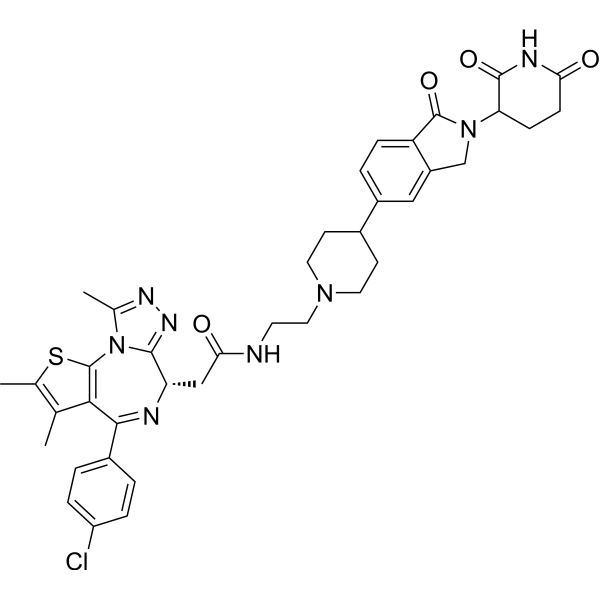
    CW-3308 is an orally active BRD9 PROTAC degrader with an DC50 of 92 nM. CW-3308 forms a ternary complex with BRD9 and cereblon to mediate BRD9 degradation. CW-3308 inhibits the viability of synovial sarcoma and rhabdoid tumor cells. CW-3308 reduces BRD9 protein levels in xenograft tumor tissues and suppresses tumor growth in xenograft models. CW-3308 can be used for the research of synovial sarcoma and rhabdoid tumors .
    CW-3308
  • HY-159709

    Liposome Metabolic Disease
    VL-422 is an ionizable cationic lipid. VL-422 delivers CRISPR complementary single-guide RNA (sgRNA) and Cas9 mRNA to enable in vitro and in vivo gene editing. LNPs containing VL-422 loaded with Cas9 mRNA and sgRNA targeting the ANGPTL3 gene induce the deletion of premature stop codons within the ANGPTL3 gene in the liver of cynomolgus monkeys. Loss-of-function of ANGPTL3 leads to decreased levels of LDL, HDL and cholesterol in plasma. The VL-422 delivery system can be used for the research of gene editing strategies targeting lipid metabolism diseases .
    VL-422
  • HY-P5307A

    INF7-A5K-TAT acetate

    Biochemical Assay Reagents Others
    Peptide A5K (INF7-A5K-TAT) acetate is an amphiphilic peptide derived from the HA2-TAT fusion scaffold. Peptide A5K acetate can non-covalently bind to CRISPR ribonucleoproteins and efficiently deliver them to cells, such as primary human T cells, B cells, and NK cells. Peptide A5K acetate enables low-toxicity, precise, and multiplex genome editing, holding great application potential in the field of cell therapy .
    Peptide A5K acetate
  • HY-P10999

    P55

    Drug Derivative Biochemical Assay Reagents Others
    INF7TAT-P55 (P55) is a polypeptide derived from INF7TAT (HY-P11000) with G1K, G20L and Y22N mutations. INF7TAT-P55 serves as a delivery carrier to deliver preassembled CRISPR ribonucleases into cells for genome editing .
    INF7TAT-P55
  • HY-174499

    mRNA Others
    Cas9 Nickase D10A mRNA expresses a version of the Streptococcus pyogenes SF370 Cas9 protein (CRISPR Associated Protein 9) that contains a D10A amino acid substitution. This mRNA also contains a C-terminal nuclear localization signal followed by a HA tag.Cas9 functions as part of the CRISPR (clustered regularly interspaced short palindromic repeats) genome editing system. In the CRISPR system, an RNA guide sequence targets the site of interest and the Cas9 protein is employed to perform the DNA cleavage. While wild-type Cas9 creates a double-stranded break at the target site, Cas9 nickase creates a single-stranded break. This favors homology-directed repair and decreases the occurrence of non-homologous end joining.
    Cas9 Nickase D10A mRNA (5moU)
  • HY-171953

    Liposome Others
    THP1 Lipid is an ionizable lipidoid. THP1 Lipid can be used to synthesize lipid nanoparticles (LNPs) for delivering mRNA to muscles with minimal toxicity and editing genes in specific liver tissues in tdTomato transgenic mice model. THP1 Lipid can be used for vaccine delivery and CRISPR/Cas9-mediated gene editing research .
    THP1 Lipid
  • HY-171904

    Liposome Others
    BCP-NC2-C12 is an ionizable cationic lipid. BCP-NC2-C12 can be used to generate lipid nanoparticles (LNPs) for in vivo delivery of mRNA. BCP-NC2-C12 LNPs mediated an approximately 90% reduction in PCSK9 serum protein levels via CRISPR/Cas9 gene knockout .
    BCP-NC2-C12
  • HY-165603

    Liposome VEGFR FGFR Cardiovascular Disease Inflammation/Immunology Cancer
    Si5-N14 is a key component of siloxane-incorporated lipid nanoparticles (SiLNP), possessing pro-vascular repair and anti-tumor activities. In the transgenic GFP mouse model, Si5-N14 can mediate CRISPR-Cas9 editing. In the Lewis lung carcinoma (LLC) tumor-bearing mouse model, Si5-N14 can knock out the expression of Vascular Endothelial Growth Factor Receptor 2 (VEGFR2) to exert an anti-tumor effect. In a mouse model of lung injury induced by viral infection, the delivery of Fibroblast Growth Factor-2 (FGF-2) mRNA via Si5-N14 can promote vascular repair, increase blood oxygen levels, and improve lung function. Si5-N14 shows promise for research in the fields of oncology, pneumonia, and cardiovascular diseases .
    Si5-N14
  • HY-185504

    Others Others
    Nexiguran is one component of Nexiguran ziclumeran and also an sgRNA targeting the human TTR gene. Nexiguran ziclumeran (NTLA-2001) is a CRISPR gene-editing therapy that targets hepatic TTR, and it can also be used for research on transthyretin amyloidosis .
    Nexiguran
  • HY-P10999A

    P55 acetate

    Drug Derivative Biochemical Assay Reagents Others
    INF7TAT-P55 acetate (P55 acetate) is a polypeptide derived from INF7TAT (HY-P11000) with G1K, G20L and Y22N mutations. INF7TAT-P55 acetate serves as a delivery carrier to deliver preassembled CRISPR ribonucleases into cells for genome editing .
    INF7TAT-P55 acetate

Inquiry Online

Your information is safe with us. * Required Fields.

Salutation


Country or Region *

Applicant Name *


Organization Name *

Department *


Email Address *


Product Name *

Cat. No.


Requested quantity *

Phone Number *


Remarks

Inquiry Online

Inquiry Information

Product Name:
Cat. No.:
Quantity:
MCE Japan Authorized Agent:

