






23 Results for "

DOPE-PEG2000-FITC

" in MedChemExpress (MCE) Product Catalog:
Products (23)

23 Results for "DOPE-PEG2000-FITC" in MCE Product Catalog:

Cat. No.: HY-P5096
CAS No.: 1802087-77-9
Target:  

Amyloid-β

Research Areas:  

Neurological Disease

FITC-β-Ala-Amyloid β-Protein (1-42) is a FITC tagged Aβ1-42 peptide. Aβ1-42 plays a key role in the pathogenesis of Alzheimer’s disease .
loading...
    loading...
Cat. No.: HY-P10392AF
Target:  

Wnt β-catenin

Research Areas:  

Cancer

fStAx-35R TFA is the hydrocarbon-stapled peptide. fStAx-35R TFA inhibits Wnt/β-catenin signaling pathway by disrupting the β-catenin-TCF interaction. fStAx-35R TFA can be used in cancer research .
loading...
    loading...
Cat. No.: HY-P0128F
Target:  

Amyloid-β

Research Areas:  

Neurological Disease

FITC-β-Amyloid (25-35) is a FITC (HY-66019) labeled β-Amyloid (25-35) (HY-P0128)
loading...
    loading...
Cat. No.: HY-P4125A
Target:  

HIV Fluorescent Dye

Research Areas:  

Others

FITC-LC-TAT (47-57) acetate is a FITC-labeled TAT peptide (HY-P0281) (λex: 493 nm, λem: 522 nm). Derived from the trans-activator of transcription (TAT) of immunodeficiency virus (HIV-1), TAT enhances the yield of heterologous proteins .
loading...
    loading...
Cat. No.: HY-166846
DOPE-PEG2000-FITC is a phospholipid. Phospholipids have good biocompatibility and significant amphiphilic characteristics, making them the main and suitable dosage form or excipient in drug formulations, thereby achieving better therapeutic effects. DOPE-PEG2000-FITCcan be used in drug delivery research .
loading...
    loading...
Cat. No.: HY-P11057
Target:  

Fluorescent Dye

Research Areas:  

Others

FGGH is a water-soluble peptide-based probe. FGGH performs the sequential detection of Cu 2+ and S 2- by fluorescence and colorimetry with high sensitivity (LOD: 1.42 and 22.2 nM for Cu 2+ and S 2-, respectively) (Ex=488 nm, Em=525 nm), and images both two ions in living cells and zebrafish models with low cytotoxicity. FGGH can be used for in vivo imaging and environmental pollution monitoring research .
loading...
    loading...
Cat. No.: HY-P2292
Target:  

Bacterial Fungal

Research Areas:  

Infection

Omiganan, FITC labeled is a peptide-FITC complex composed of Omiganan and a FITC. Omiganan is a bactericidal and fungicidal cationic peptide being developed as a topical gel for prevention of catheter-associated infections. FITC is a derivative of fluorescein for the labeling of amines .
loading...
    loading...
Cat. No.: HY-P10896
CAS No.: 1446005-10-2
Target:  

Bombesin Receptor

Research Areas:  

Cancer

NOTA-P2-RM26 is an antagonist of Bombesin (HY-P0195) analogs, and the gastrin-releasing peptide receptor (GRPR/BB2) is a molecular target for prostate cancer visualization. NOTA-P2-RM26 is labeled with 111In and 68Ga for prostate cancer imaging studies using PET and SPECT/CT .
loading...
    loading...
Cat. No.: HY-P1188
CAS No.: 1207610-07-8
Target:  

Integrin

Research Areas:  

Cancer

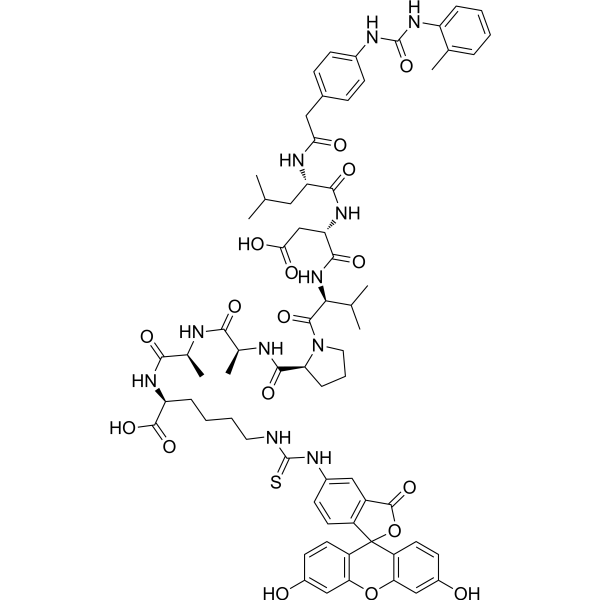
LDV-FITC, a fluorescent peptide, is a FITC-conjugated LDV peptide (HY-P2267). LDV-FITC binds to the α4β1 integrin with high affinity (Kd: 0.3 nM and 12 nM for binding to U937 cells in the presence and absence of Mn 2+ respectively). LDV-FITC can be used to detect α4β1 integrin affinity .
loading...
    loading...
Cat. No.: HY-P4125
Target:  

HIV Fluorescent Dye

Research Areas:  

Infection

FITC-LC-TAT (47-57) is a FITC-labeled TAT peptide (HY-P0281) (λex: 493 nm, λem: 522 nm). Derived from the trans-activator of transcription (TAT) of human immunodeficiency virus (HIV-1), TAT enhances the yield of heterologous proteins .
loading...
    loading...
Cat. No.: HY-P0128F1
Target:  

Amyloid-β

Research Areas:  

Neurological Disease

FITC-β-Ala-β-Amyloid (25-35) is a fluorescent product labeled by FITC that can be used in Alzheimer's disease research .
loading...
    loading...
Cat. No.: HY-169232
Target:  

PROTACs PD-1/PD-L1

Research Areas:  

Cancer

PCC16 chloride is a dual PROTAC degrader targeting DHHC3 and PD-L1, with a DC50 of 0.103 μM for PD-L1 degradation. PCC16 chloride induces DHHC3 degradation via the ubiquitin-proteasome pathway by recruiting the CRBN E3 ubiquitin ligase (E3 ubiquitin ligase). By targeting DHHC3-which is essential for PD-L1 palmitoylation and membrane stability-PCC16 chloride reduces PD-L1 levels, decreases PD-L1 membrane retention time, and impairs its immunosuppressive function. PCC16 chloride enhances anti-tumor immunity by disrupting PD-L1-mediated immunosuppression. PCC16 chloride can be used in the research of immune checkpoint blockade-resistant cancers .
loading...
    loading...
Cat. No.: HY-P1459
Target:  

Bacterial

Research Areas:  

Infection

Sphistin Synthetic Peptide (12-38, Fitc in N-Terminal-Fluorescently Labeled Peptide) is a truncated fragments of Sphistin Synthetic Peptide that shows potent antimicrobial activity.
loading...
    loading...
Cat. No.: HY-P2292A
Target:  

Bacterial Fungal

Research Areas:  

Infection

Omiganan, FITC labeled TFA is a peptide-FITC complex composed of Omiganan and a FITC. Omiganan is a bactericidal and fungicidal cationic peptide being developed as a topical gel for prevention of catheter-associated infections .
loading...
    loading...
Cat. No.: HY-P4135
Target:  

Fluorescent Dye

Research Areas:  

Others

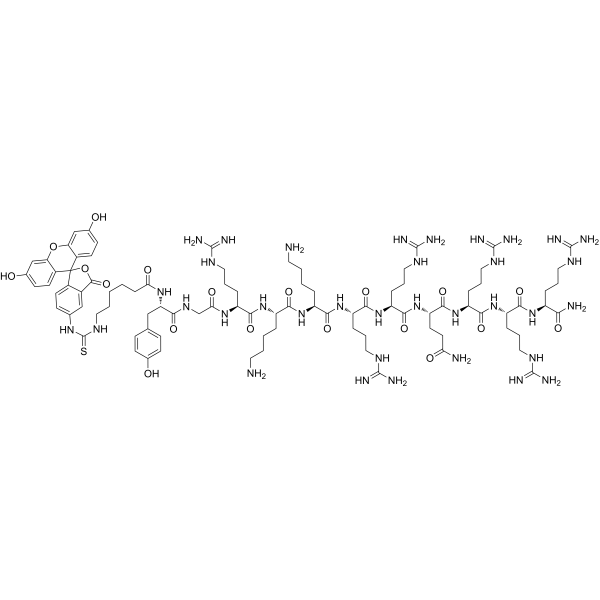
FITC-LC-Antennapedia Peptide is a FITC labeled Antennapedia Peptide (HY-P0307). Antennapedia Peptide is a cellular-membrane permeable peptides (CPP). FITC-LC-Antennapedia Peptide has good penetration in 3T3 cell line, which was rapidly accumulated into nuclei .
loading...
    loading...
Cat. No.: HY-P1188A
Target:  

Integrin

Research Areas:  

Cancer

LDV-FITC TFA, a fluorescent peptide, is a FITC-conjugated LDV peptide (HY-P2267). LDV-FITC TFA binds to the α4β1 integrin with high affinity (Kd: 0.3 nM and 12 nM for binding to U937 cells in the presence and absence of Mn 2+ respectively). LDV-FITC TFA can be used to detect α4β1 integrin affinity .
loading...
    loading...
Cat. No.: HY-P11481
Research Areas:  

Others

FITC-Acp-RpYTPEP-NH2 is a potent fluorescent tracer. FITC-Acp-RpYTPEP-NH2 shows a binding affinity (Kd = 0.07 μM) for the Cbl-b SH2 domain. Fluorescence polarization assay based on FITC-Acp-RpYTPEP-NH2 can be for evaluating Cbl-b SH2 domain inhibitors .
loading...
    loading...
Cat. No.: HY-P11625
Target:  

RXFP Receptor

Research Areas:  

Cardiovascular Disease

R9-13 is a fatty acid-conjugated relaxin and an agonist of LGR7 (RXFP1). R9-13 induces sustained pubic symphysis elongation in estrogen-pretreated mice. R9-13 exhibits long-acting pharmacokinetic profiles in rodents, with in vivo activity lasting up to one week after administration. R9-13 can be used in studies related to acute heart failure .
loading...
    loading...
Cat. No.: HY-114118F4
Synonyms: Semaglutide-Lys(FITC)
Semaglutide-FITC (Semaglutide-Lys(FITC)) is a fluorescent tracer probe (Ex/Em = 495/520 nm) obtained by covalently coupling the green fluorescent dye fluorescein isothiocyanate (FITC) (HY-66019) to the long-acting analogue of GLP-1, Semaglutide (HY-114118). Semaglutide-FITC can be used for studies on Semaglutide receptor binding (GLP-1R), cell uptake and endocytosis, in vivo tissue distribution, and the targeting efficiency of delivery systems .
loading...
    loading...
Cat. No.: HY-P11830
Target:  

Amylin Receptor

Research Areas:  

Metabolic Disease

UDA-6 is a potent calcitonin and amylin receptor agonist (DACRA). UDA-6 induces weight loss, improves metabolic and hepatic parameters, and stabilizes active receptor states in obesity rats. UDA-6 can be used for the research of obesity .
loading...
    loading...

