11 Results for "

DPP II

" in MedChemExpress (MCE) Product Catalog:
Products (11)

11 Results for "DPP II" in MCE Product Catalog:

11
11 Cited Publications
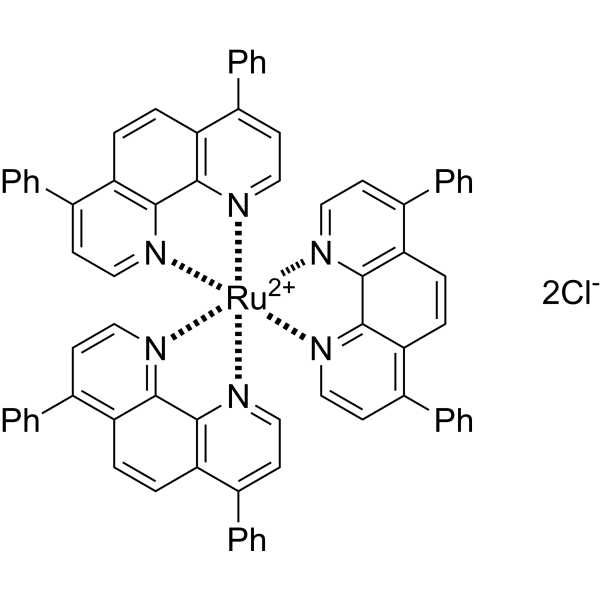
Cat. No.: HY-W074143
CAS No.: 36309-88-3
Synonyms: [Ru(DPP)3]Cl2
Tris(4,7-diphenyl-1,10-phenanthroline)ruthenium(II) dichloride ([Ru(dpp)3] 2+) is an electrochemiluminescent (ECL) probe and oxygen-sensitive sensor. Tris(4,7-diphenyl-1,10-phenanthroline)ruthenium(II) dichloride can be used to modify electrode surfaces for the detection of sulfates (S2O8 2-) and oxalates, based on electrochemical reactions that generate excited-state species, releasing photons through irreversible redox reactions. Tris(4,7-diphenyl-1,10-phenanthroline)ruthenium(II) dichloride utilizes the oxygen quenching of fluorescence mechanism, where fluorescence intensity reflects the metabolic rate of living microorganisms or oxygen levels within cells/tumors, allowing for real-time detection. Tris(4,7-diphenyl-1,10-phenanthroline)ruthenium(II) dichloride's main applications include microbial detection, antibacterial activity studies, and tumor microenvironment research .
loading...
    loading...
1
1 Cited Publications
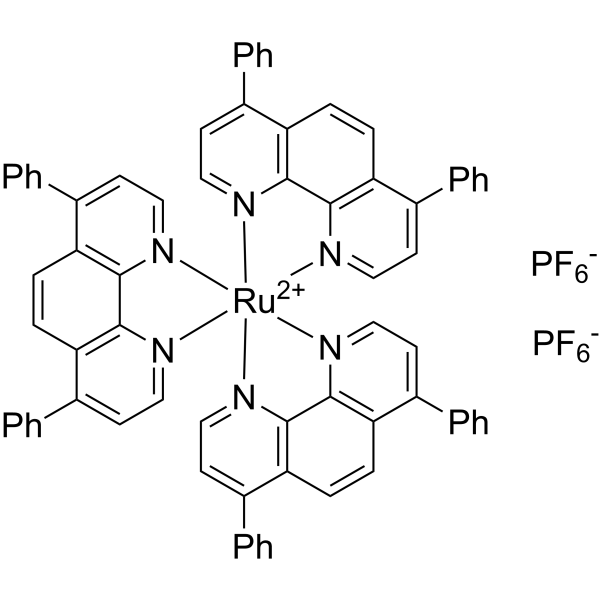
Cat. No.: HY-W127832
CAS No.: 123148-15-2
Ru(dpp)3(PF6)2 is a ruthenium (II) polypyridine complex and oxygen-sensing luminophore with excellent photostability and bright orange emission properties based on metal-to-ligand charge transfer (MLCT). Ru(dpp)3(PF6)2 undergoes oxygen-induced collisional luminescence quenching following the Stern-Volmer relationship, and can also engage in Förster-type resonance energy transfer with closed-form BTF6. Featuring excellent photophysical and electrochemical properties, Ru(dpp)3(PF6)2 is applied in studies on quenching-type oxygen sensors based on fluorinated ORMOSIL/xerogels and solid-state light-emitting devices .
loading...
    loading...
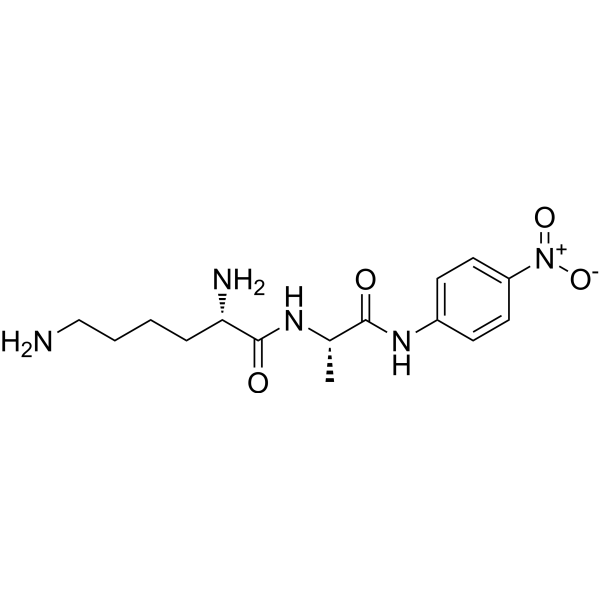
Cat. No.: HY-P4468
CAS No.: 115846-24-7
Target:  

Dipeptidyl Peptidase

Research Areas:  

Others

Lys-Ala-pNA is hydrolytic substrate the of dipeptidyl peptidase (DPP) II with Km of 0.42 mM .
loading...
    loading...
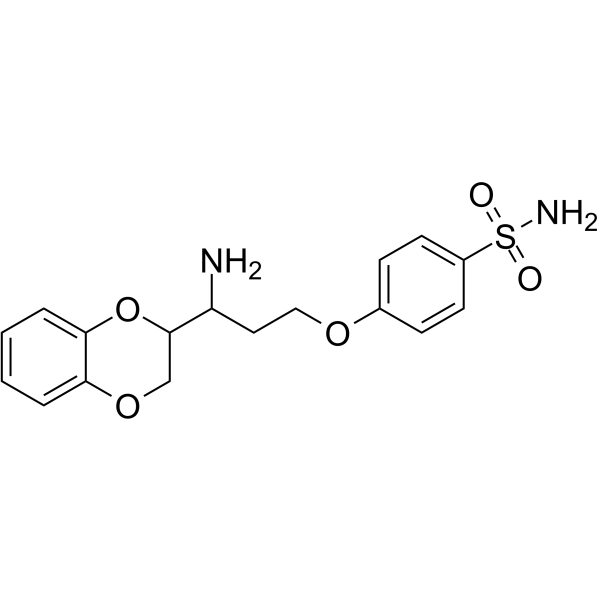
Cat. No.: HY-151578
CAS No.: 2836996-95-1
DPP IV/hCA II-IN-1 is a potent and selective dipeptidyl peptidase IV (DPP IV) and carbonic anhydrase (CA) inhibitor with an IC50 value of 0.049 μM for DPP IV and with Ki values of 0.0361, 0.0428, 0.0941, 0.1328, 0.2615, and 3.034 μM for CA II, CA VB, CA VA, CA IX, CA I, and CA IV, respectively .
loading...
    loading...
Cat. No.: HY-19859
CAS No.: 1163719-08-1
Target:  

Dipeptidyl Peptidase

Research Areas:  

Metabolic Disease

AMG-222 (tosylate) is a DPP-IV inhibitor that can be used in the research of type II diabete .
loading...
    loading...
Cat. No.: HY-RS03967
Research Areas:  

Others

DPP7 Human Pre-designed siRNA Set A contains three designed siRNAs for DPP7 gene (Human), as well as a negative control, a positive control, and a FAM-labeled negative control.

loading...
    loading...
Cat. No.: HY-182374
CAS No.: 928161-33-5
Research Areas:  

Cancer

AX8819 is a selective dipeptidyl peptidase II (DPP II) inhibitor with an IC50 of 0.88 nM. AX8819 induces caspase-dependent apoptosis. AX8819 exhibits low non-specific toxicity toward proliferating T cells. AX8819 can be used for the research of B cell chronic lymphocytic leukemia .
loading...
    loading...
Cat. No.: HY-P75712
Purity:  ≥ 95%, as determined by reducing SDS-PAGE.
Synonyms: Dipeptidyl peptidase 2; Dipeptidyl peptidase 7; DPP II; DPP7; DPP2; QPP
Species:  
Source:  
loading...
    loading...
Cat. No.: HY-P75280
Purity:  ≥ 95%, as determined by reducing SDS-PAGE.
Synonyms: Dipeptidyl peptidase 2; Dipeptidyl peptidase 7; DPP II; DPP7; DPP2; QPP
Species:  
Source:  
loading...
    loading...
Cat. No.: HY-RS18350
Research Areas:  

Others

Dpp7 Mouse Pre-designed siRNA Set A contains three designed siRNAs for Dpp7 gene (Mouse), as well as a negative control, a positive control, and a FAM-labeled negative control.

loading...
    loading...
Cat. No.: HY-L040
1,149 compounds

Diabetes mellitus, usually called diabetes, is a group of metabolic disorders characterized by a high blood sugar level over a prolonged period of time. The most common types are Type I and Type II. Type I diabetes (T1D), also called juvenile onset diabetes mellitus or insulin-dependent diabetes mellitus, is characterized by destruction of the β-cells of the pancreas and insulin is not produced, whereas type II diabetes (T2D), also called non-insulin-dependent diabetes mellitus, is characterized by a progressive impairment of insulin secretion and relative decreased sensitivity of target tissues to the action of this hormone. Type 2 diabetes accounts for the vast majority of all diabetes mellitus. Diabetes of all types can lead to complications in many parts of the body and can increase the overall risk of dying prematurely. Possible complications include kidney failure, leg amputation, vision loss and nerve damage.

The pathogenesis of diabetes is complicated, and development of the safe and effective drugs against diabetes is full of challenge. Increasing studies have confirmed that the pathogenesis of diabetes is related to various signaling pathways, such as insulin signaling pathway, AMPK pathway, PPAR regulation and chromatin modification pathways. These signaling pathways have thus become the major source of the promising novel drug targets to treat metabolic diseases and diabetes.

MCE Anti-diabetic Compound Library owns a unique collection of 1,149 compounds, which mainly target SGLT, PPAR, DPP-4, AMPK, Dipeptidyl Peptidase, Glucagon Receptor, etc. This library is a useful tool for discovery anti-diabetes drugs.

  • 1

