



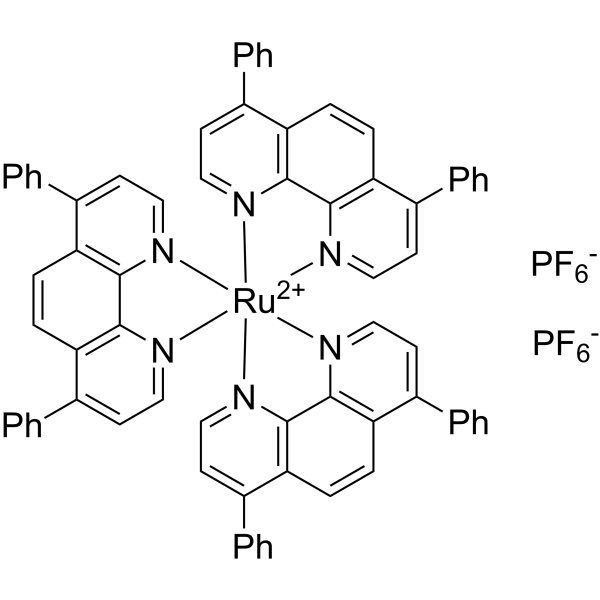
Ru(dpp)3(PF6)2
Based on 1 publication(s) in Google Scholar
Ru(dpp)3(PF6)2 is a ruthenium (II) polypyridine complex and oxygen-sensing luminophore with excellent photostability and bright orange emission properties based on metal-to-ligand charge transfer (MLCT). Ru(dpp)3(PF6)2 undergoes oxygen-induced collisional luminescence quenching following the Stern-Volmer relationship, and can also engage in Förster-type resonance energy transfer with closed-form BTF6. Featuring excellent photophysical and electrochemical properties, Ru(dpp)3(PF6)2 is applied in studies on quenching-type oxygen sensors based on fluorinated ORMOSIL/xerogels and solid-state light-emitting devices.
For research use only. We do not sell to patients.
- Purity : 98.20%
- CAS No.: 123148-15-2
- Formula: C72H48F12N6P2Ru
- Molecular Weight:1388.19
-
Storage:
RT, protect from light, stored under nitrogen.
In solvent -80°C, 1 year , -20°C, 6 months

To place orders, for customer services and technical support, please contact: MedChemExpress USA
Tel: 609-228-6898 E-mail: [email protected] [email protected]


-
 Biological Activity
-
Chemical Information
-
Solvent & Solubility
- Purity & Documentation
- References
-
 Help & FAQs


Publications Citing Use of MedChemExpress (MCE) Ru(dpp)3(PF6)2
More

Biological Activity
Description
In Vitro
Ru(dpp)3(PF6)2 displays solution-phase electrochemical and spectroscopic properties typical of ruthenium tris-diimine complexes, with a Ru2+/Ru3+ formal potential of 0.85 V vs. ferrocene, an MLCT absorption at 464 nm, and emission at 616 nm[3].
Ru(dpp)3(PF6)2 (1.5×10⁻⁹ mol cm-2; 1 cycle scanned at 10 mV s-1, up to 120 s potential pulsed) immobilized as microparticles on ITO electrodes undergo reversible, exhaustive oxidation of Ru2+ to Ru3+, characterized by a decrease in the 464 nm MLCT absorbance, growth of a 380 nm MC absorbance, an isosbestic point at 400 nm, and solid-state emission at 637 nm[3].
MedChemExpress (MCE) has not independently confirmed the accuracy of these methods. They are for reference only.


Chemical Information
-
CAS No. 123148-15-2
-
Appearance Solid
-
Molecular Weight 1388.19
-
Formula C72H48F12N6P2Ru
-
Color Orange to red
-
SMILES
F[P-](F)(F)(F)(F)F.F[P-](F)(F)(F)(F)F.[N]12=CC=C(C3=CC=CC=C3)C(C=C4)=C1C5=C4C(C6=CC=CC=C6)=CC=[N]5[Ru+2]278([N]9=CC=C(C%10=CC=CC=C%10)C(C=C%11)=C9C%12=C%11C(C%13=CC=CC=C%13)=CC=[N]8%12)[N]%14=CC=C(C%15=CC=CC=C%15)C(C=C%16)=C%14C%17=C%16C(C%18=CC=CC=C%18)=CC=[N]7%17
-
Shipping
Room temperature in continental US; may vary elsewhere.
-
Storage
RT, protect from light, stored under nitrogen
In solvent -80°C 1 year -20°C 6 months


Publications (1)
-
Journal Impact Factor
-
Most Recent
-
Adv Sci (Weinh)
Structure-Tailoring Cerium Nanozymes with Self-Cascade ROS Scavenging Catalysis Modulate the Microbiota-Gut-Joint Axis for Rheumatoid Arthritis Therapy. [Abstract]2025 Sep 29:e12281. PMID: 41024355


Solvent & Solubility
In Vitro:
DMSO : ≥ 100 mg/mL (72.04 mM; Hygroscopic DMSO has a significant impact on the solubility of product, please use newly opened DMSO)
* "≥" means soluble, but saturation unknown.
Please refer to the solubility information to select the appropriate solvent. Once prepared, please aliquot and store the solution to prevent product inactivation from repeated freeze-thaw cycles.
Storage method and period of stock solution: -80°C, 1 year; -20°C, 6 months. When stored at -80°C, please use it within 1 year. When stored at -20°C, please use it within 6 months.
Please refer to the solubility information to select the appropriate solvent. Once prepared, please aliquot and store the solution to prevent product inactivation from repeated freeze-thaw cycles.
Storage method and period of stock solution: -80°C, 1 year; -20°C, 6 months. When stored at -80°C, please use it within 1 year. When stored at -20°C, please use it within 6 months.
Concentration (start) × Volume (start) = Concentration (final) × Volume (final)
In Vivo:
Select the appropriate dissolution method based on your experimental animal and administration route.
- For the following dissolution methods, please ensure to first prepare a clear stock solution using an In Vitro approach and then sequentially add co-solvents:
- To ensure reliable experimental results, the clarified stock solution can be appropriately stored based on storage conditions. As for the working solution for In Vivo experiments, it is recommended to prepare freshly and use it on the same day.
- The percentages shown for the solvents indicate their volumetric ratio in the final prepared solution. If precipitation or phase separation occurs during preparation, heat and/or sonication can be used to aid dissolution.
Add each solvent one by one: 10% DMSO 90% (20% SBE-β-CD in Saline)
Solubility: 2.5 mg/mL (1.80 mM); Suspended solution; Need ultrasonic
This protocol yields a suspended solution of 2.5 mg/mL. Suspended solution can be used for oral and intraperitoneal injection.
Taking 1 mL working solution as an example, add 100 μL DMSO stock solution (25.0 mg/mL) to 900 μL 20% SBE-β-CD in Saline, and mix evenly.
Preparation of 20% SBE-β-CD in Saline (4°C, storage for one week): 2 g SBE-β-CD powder is dissolved in 10 mL Saline, completely dissolve until clear.
In Vivo Dissolution Calculator
Please enter the basic information of animal experiments:
-
-
-
-
Recommended: Prepare an additional quantity of animals to account for potential losses during experiments.
Please enter your animal formula composition:
-
%DMSO +
Recommended: Keep the proportion of DMSO in working solution below 2% if your animal is weak.
-
%+
-
+%Tween-80 + +
-
%Saline +
The co-solvents required include: DMSO, . All of co-solvents are available by MedChemExpress (MCE). , Tween 80. All of co-solvents are available by MedChemExpress (MCE).
Working solution concentration: 0.22 mg/mL
Method for preparing stock solution: mg drug dissolved in μL DMSO. Stock solution concentration: mg/mL.
1. Take μL DMSO stock solution;
2. Add μL .
μL , mix evenly;
3. Then add μL Tween 80, mix evenly;
4. Then add μL
Please ensure that the stock solution in the first step is dissolved to a clear state, and add co-solvents in sequence. You can use ultrasonic heating (ultrasonic cleaner, recommended frequency 20-40 kHz), vortexing, etc. to assist dissolution.


Purity & Documentation
-
Data Sheet (283 KB)
-
SDS (392 KB)
- English - EN (392 KB)
- Français - FR (392 KB)
- Deutsch - DE (392 KB)
- Norwegian - NO (392 KB)
- Español - ES (392 KB)
- Swedish - SV (392 KB)
- Italian - IT (392 KB)
- Korean - KR (392 KB)
- Portuguese - PT (392 KB)
-
Handling Instructions (2659 KB)
References


Complete Stock Solution Preparation Table
Please refer to the solubility information to select the appropriate solvent. Once prepared, please aliquot and store the solution to prevent product inactivation from repeated freeze-thaw cycles.
Storage method and period of stock solution: -80°C, 1 year; -20°C, 6 months. When stored at -80°C, please use it within 1 year. When stored at -20°C, please use it within 6 months.
| Optional Solvent | Concentration Solvent Mass | 1 mg | 5 mg | 10 mg | 25 mg |
|---|---|---|---|---|---|
| DMSO | 1 mM | 0.7204 mL | 3.6018 mL | 7.2036 mL | 18.0091 mL |
| 5 mM | 0.1441 mL | 0.7204 mL | 1.4407 mL | 3.6018 mL | |
| 10 mM | 0.0720 mL | 0.3602 mL | 0.7204 mL | 1.8009 mL | |
| 15 mM | 0.0480 mL | 0.2401 mL | 0.4802 mL | 1.2006 mL | |
| 20 mM | 0.0360 mL | 0.1801 mL | 0.3602 mL | 0.9005 mL | |
| 25 mM | 0.0288 mL | 0.1441 mL | 0.2881 mL | 0.7204 mL | |
| 30 mM | 0.0240 mL | 0.1201 mL | 0.2401 mL | 0.6003 mL | |
| 40 mM | 0.0180 mL | 0.0900 mL | 0.1801 mL | 0.4502 mL | |
| 50 mM | 0.0144 mL | 0.0720 mL | 0.1441 mL | 0.3602 mL | |
| 60 mM | 0.0120 mL | 0.0600 mL | 0.1201 mL | 0.3002 mL |


Ru(dpp)3(PF6)2 Related Classifications
HY-W127832 Related Classifications
 Powered by Bioz
Keywords
- Ru(dpp)3(PF6)2
- 123148-15-2
- Fluorescent Dye
- MLCT
- ruthenium(II) polypyridyl complex
- ITO electrodes
- ruthenium tris-diimine complexes
- F?rster-type resonance energy transfer
- Stern-Volmer relationship
- BTF6
- oxygen-sensing luminophore
- solid state light-emitting devices
- ORMOSIL/xerogel-based quenchometric oxygen sensors
- Inhibitor
- inhibitor
- inhibit