1. Search Result
Search Result
Results for "

Fluorescence lifetime

" in MedChemExpress (MCE) Product Catalog:

14

Inhibitors & Agonists

9

Fluorescent Dye

1

Oligonucleotides

Cat. No. Product Name Target Research Areas Chemical Structure
  • HY-D0823
    CY3-SE
    1 Publications Verification

    Sulfo-Cy3 NHS ester; Sulfo Cyanine3 NHS ester

    Fluorescent Dye Others
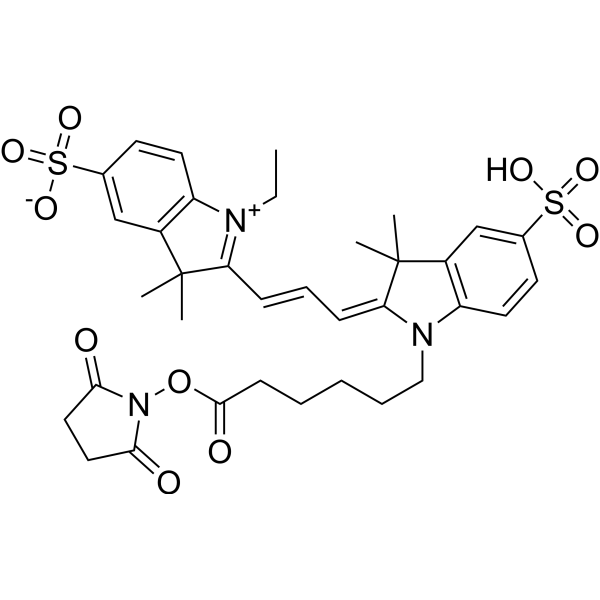
    Cy3-SE (Sulfo-Cy3 NHS ester; Sulfo Cyanine3 NHS ester) is a sulfonated cyanine dye-derived fluorescent labeling reagent with λex of about 515 nm and λem of about 568 nm. Cy3-SE can interact with the π-π stacking of biomolecules (e.g., nucleoside monophosphates, proteins), inhibiting the photoisomerization process and increasing the fluorescence quantum yield and lifetime .
    CY3-SE
  • HY-W089353
    8-Phenyl-BODIPY 505/515
    1 Publications Verification

    MOFs Fluorescent Dye Others
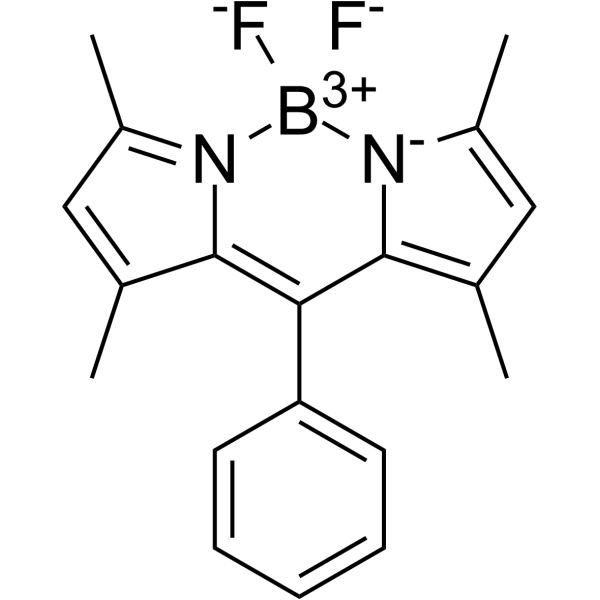
    8-Phenyl-BODIPY 505/515 is a molecular rotor based on the BODIPY scaffold, specifically used as a microviscosity probe. The working principle of 8-Phenyl-BODIPY 505/515 is based on the restriction of molecular motion by viscosity: in a high-viscosity environment, the rotational freedom of its chemical bonds is inhibited, which leads to a significant extension of fluorescence lifetime. This property makes 8-Phenyl-BODIPY 505/515 an effective tool for monitoring changes in the viscosity of intracellular microenvironments via fluorescence lifetime imaging (FLIM) technology .
    8-Phenyl-BODIPY 505/515
  • HY-W103047

    Fluorescent Dye Reactive Oxygen Species (ROS) Others
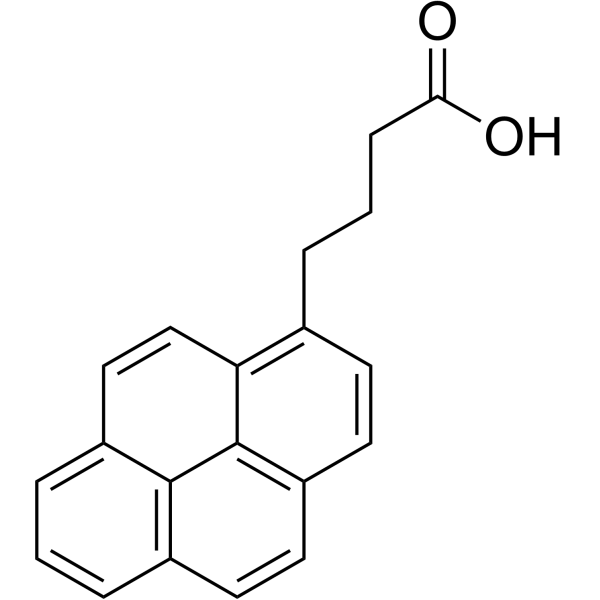
    1-Pyrenebutyric acid is a fluorescence probe whose fluorescence lifetime depends on local oxygen and free radical concentrations. 1-Pyrenebutyric acid is used in fluorescence determination of DNA. 1-Pyrenebutyric acid can be used as a linker for biomolecules to form a self-assembled monolayer on grapheme. 1-Pyrenebutyric acid can also be used for the measurement of free radicals in solution and in living cells .
    1-Pyrenebutyric acid
  • HY-149028

    Fluorescent Dye Others
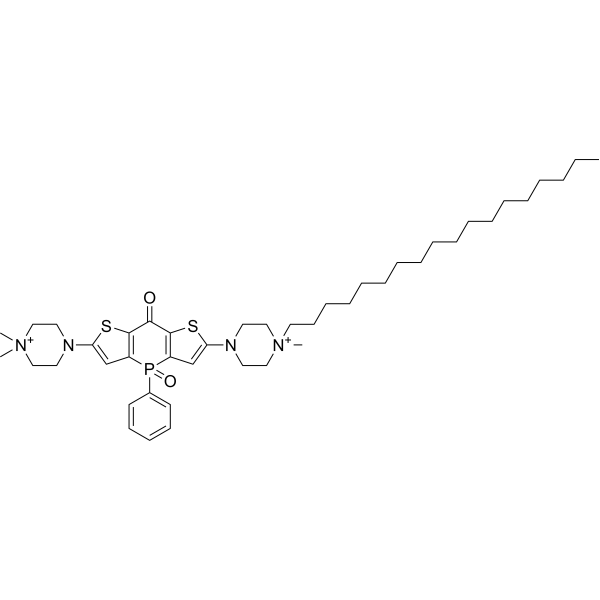
    Mem-C1C18 is a polarity-sensitive fluorescent probe with excellent plasma membrane anchoring, high brightness and a sensitive response to environmental polarity by altering the fluorescence lifetime. Mem-C1C18 can be used to quantify changes in the polarity of the plasma membrane during iron death .
    Mem-C1C18
  • HY-D1419

    Fluorescent Dye Others
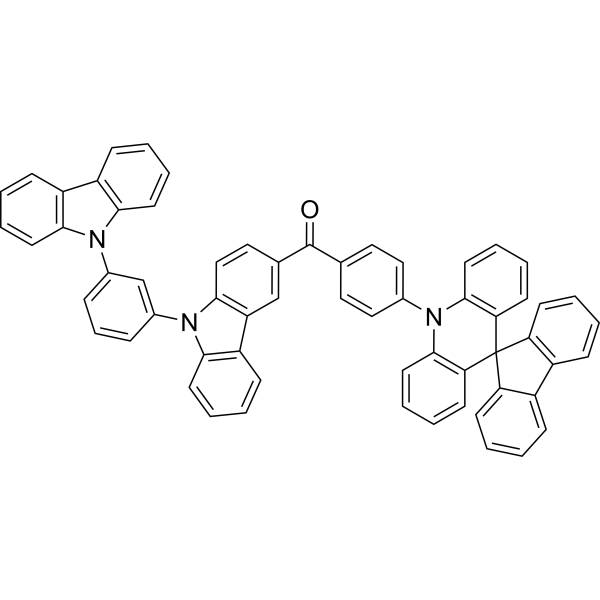
    mCP-BP-SFAC is a luminogenic molecule. mCP-BP-SFAC exhibits strong sky-blue delayed fluorescence in neat films, with photoluminescence (PL) peaks at ~483 nm and delayed fluorescence lifetimes of 5.4 to 5.7 μs .
    mCP-BP-SFAC
  • HY-D1420

    Fluorescent Dye Others
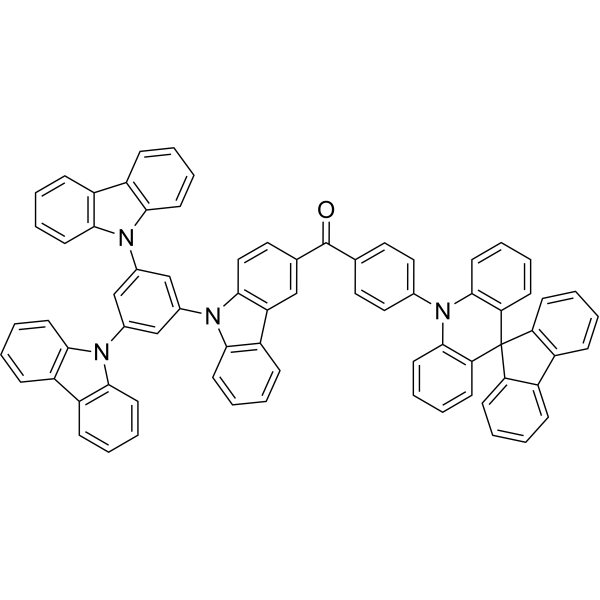
    TCP-BP-SFAC is a luminogenic molecule. TCP-BP-SFAC exhibits strong sky-blue delayed fluorescence in neat films, with photoluminescence (PL) peaks at ~483 nm and delayed fluorescence lifetimes of 5.4 to 5.7 μs .
    TCP-BP-SFAC
  • HY-172508

    Fluorescent Dye Phosphoramidites Others
    Perylene dU phosphoramidite is a bright and extremely photostable fluorescent polycyclic aromatic hydrocarbon (PAH) label with a quantum yield approaching quantitative. Due to the low lifetime of fluorescence, this probe does not form excimers.With this phosphoramidite, perylene can be introduced into DNA by automated oligonucleotide synthesis.
    Perylene dU phosphoramidite
  • HY-147181

    Fluorescent Dye Others
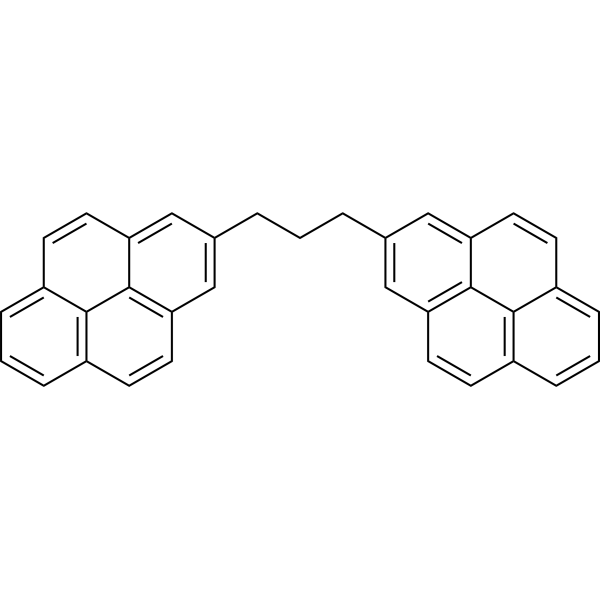
    1,3-Di-(2-pyrenyl)propane is a fluorescent indicator. 1,3-Di-(2-pyrenyl)propane can be used in fluidity of bacterial membrane lipids monitored by intramolecular excimerization. 1,3-Di-(2-pyrenyl)propane shows temperature dependence of fluorescence lifetime distributions .
    1,3-Di-(2-pyrenyl)propane
  • HY-203233

    Fluorescent Dye Others
    Rhodamine-DHPE is a fluorescently labeled phosphatidylethanolamine lipid that labels phospholipid bilayers. Rhodamine-DHPE serves as a fluorescence quenching substrate and membrane stain. The fluorescence lifetime of Rhodamine-DHPE decreases significantly in the presence of Cu 2+-PS complexes. Rhodamine-DHPE effectively stains the membranes of human red blood cells and mouse fibroblasts, and supports lifetime-resolved imaging via pump-probe fluorescence microscopy .
    Rhodamine-DHPE
  • HY-D3012

    Fluorescent Dye Others
    12-AS is a 9-anthracenoxy fatty acid probe. 12-AS’s fluorescence decay is not a single index, and its lifetime increases with the red shift of the emission wavelength .
    12-AS
  • HY-D3404

    DNA Stain Others
    BODi-1 is a fluorescent modulator targeting dsDNA, which binds to dsDNA via a bis-intercalation mechanism (Ex=465 nm, Em=490 nm). BODi-1 exhibits a fluorescence enhancement effect upon binding to nucleic acids, but its fluorescence intensity, anisotropy and average lifetime decrease at higher dye/DNA ratios. When BODi-1 binds to DNA in liposome complexes, it also shows red-shifted emission spectra, along with reduced quantum yield and average lifetime. BODi-1 does not induce significant DNA conformational changes when the dye/DNA ratio is below 0.01. BODi-1 can be used as a fluorescent probe for the characterization of liposome complexes and FRET studies at this ratio .
    BODi-1
  • HY-D2942

    Fluorescent Dye Others
    BDP-V BG-BODIPY is a SNAP tag fluorescent probe labeled with a BODIPY molecular motor. BDP-V BG-BODIPY contains a BODIPY molecular rotor that functions as a viscosity-sensitive fluorophore, which is highly responsive to local viscosity changes and enables the specific monitoring of the local microviscosity of proteins. BDP-V BG-BODIPY supports one-photon and two-photon imaging, with an excitation wavelength (Ex) of 488 nm (for one-photon excitation) and 850 nm (for two-photon excitation), and an emission wavelength (Em) of 500-600 nm .
    BDP-V BG-BODIPY
  • HY-D3415

    Fluorescent Dye G-quadruplex Cancer
    TOR-G4 is a Fluorescent probe that binds to G-quadruplex (G4) nucleic acid structures. TOR-G4 exhibits a unique fluorescence lifetime when bound to G4 compared to other structures, enabling sensitive discrimination between G4-bound and non-G4-bound states. TOR-G4 mainly colocalizes with RNA in the cytoplasm and nucleolus. TOR-G4 can be used to investigate the roles of RNA G4 in cells. TOR-G4 shows cytotoxicity against osteosarcoma cells .
    TOR-G4
  • HY-D3230

    Fluorescent Dye Others
    FLCS1 is a BODIPY-based Fluorescent probe and selective copper (I) ion binder (λex = 630 nm, λemis = 660 nm). Binding of FLCS1 to copper (I) ions induces fluorescence turn-on. Addition of copper (I) to a methanolic solution of FLCS1 causes a slight red shift (4 nm) in the maximum absorption wavelength (λmax) in the UV-Vis spectrum .
    FLCS1

Inquiry Online

Your information is safe with us. * Required Fields.

Salutation


Country or Region *

Applicant Name *


Organization Name *

Department *


Email Address *


Product Name *

Cat. No.


Requested quantity *

Phone Number *


Remarks

Inquiry Online

Inquiry Information

Product Name:
Cat. No.:
Quantity:
MCE Japan Authorized Agent:

