Search Result
Results for "
Fmoc protecting groups
" in MedChemExpress (MCE) Product Catalog:
19
Biochemical Assay Reagents
7
Isotope-Labeled Compounds
| Cat. No. |
Product Name |
Target |
Research Areas |
Chemical Structure |
-
- HY-Y1636
-
-
-
- HY-Y1169
-
|
4-tert-Butyl N-(fluoren-9-ylmethoxycarbonyl)-L-aspartate; Fmoc-L-Asp(OtBu)-OH
|
Amino Acid Derivatives
|
Others
|
|
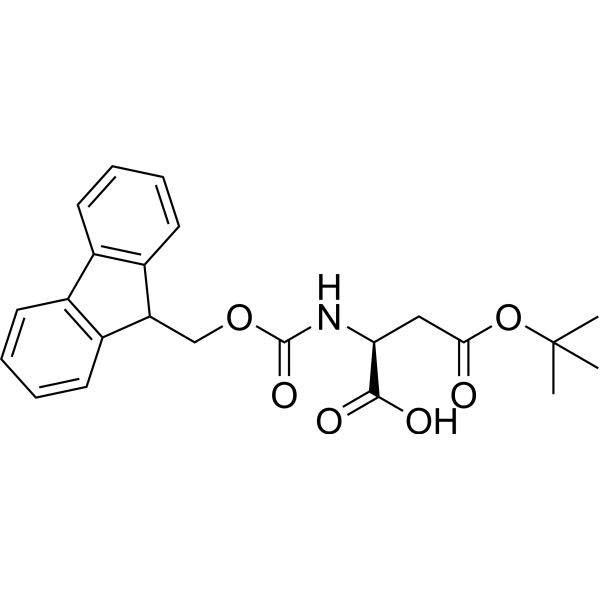
Fmoc-Asp(OtBu)-OH (4-tert-Butyl N-(fluoren-9-ylmethoxycarbonyl)-L-aspartate) is an aspartate derivative containing amine protecting group Fmoc. Fmoc-Asp(OtBu)-OH can be used for peptide synthesis .
|
-
-
- HY-W010712
-
|
|
Amino Acid Derivatives
|
Others
|
|
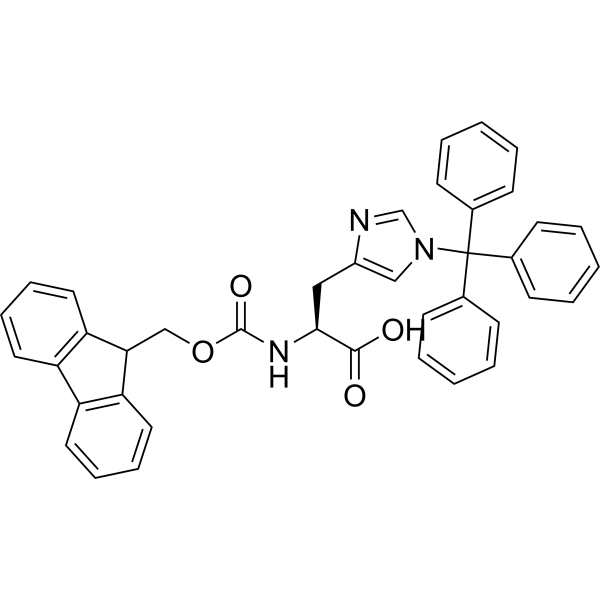
Fmoc-His(Trt)-OH is a histidine derivative with a trityl (Trt) group protecting the His side chain. Fmoc-His(Trt)-OH also has an Fmoc group protecting the α-NH2 group. Fmoc-His(Trt)-OH can be used in solid-phase peptide synthesis to prevent racemization and byproduct formation. Fmoc-His(Trt)-OH acts as a protected histidine precursor in solid-phase peptide synthesis (SPPS), participating in peptide chain construction through amide bond formation. Fmoc-His(Trt)-OH can be precisely incorporated into the target peptide sequence, ensuring correct peptide chain synthesis and reducing impurity formation. Fmoc-His(Trt)-OH is mainly used in the solid-phase synthesis research of pharmaceutical peptides and bioactive peptides, and is particularly suitable for the preparation of peptide drugs requiring precise control of histidine configuration .
|
-
-
- HY-79647
-
|
N-(Fmoc-oxy)succinimide
|
Biochemical Assay Reagents
|
Others
|
|
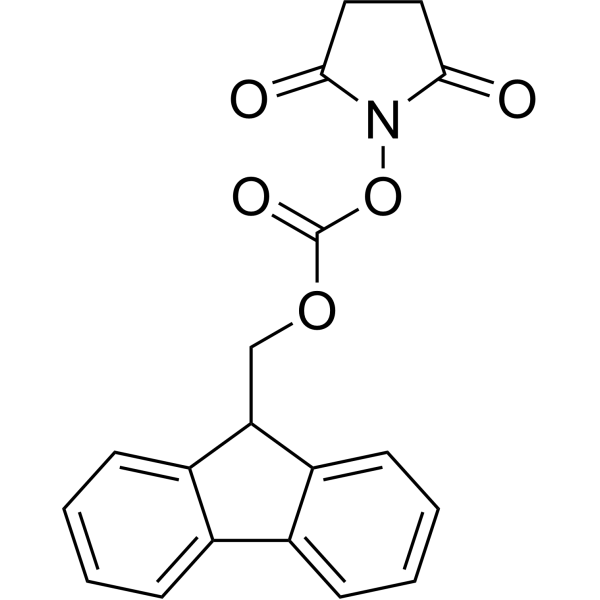
Fmoc-OSu (N-(Fmoc-oxy)succinimide) is an acylating agent that targets amino groups (-NH2). It can selectively protect the amino groups of amino acids by covalently binding with primary or secondary amines through nucleophilic substitution reactions. Fmoc-OSu forms a stable amide bond with the amino group to avoid side reactions of the amino group in peptide synthesis. It can also be used as a fluorescent labeling reagent to react with glycosylamines for efficient labeling of N-sugar chains. Fmoc-OSu can be used as an Fmoc protection strategy in peptide synthesis, and as a fluorescent labeling and analysis method for N-sugar chains .
|
-
-
- HY-W013081
-
|
|
Amino Acid Derivatives
|
Others
|
|
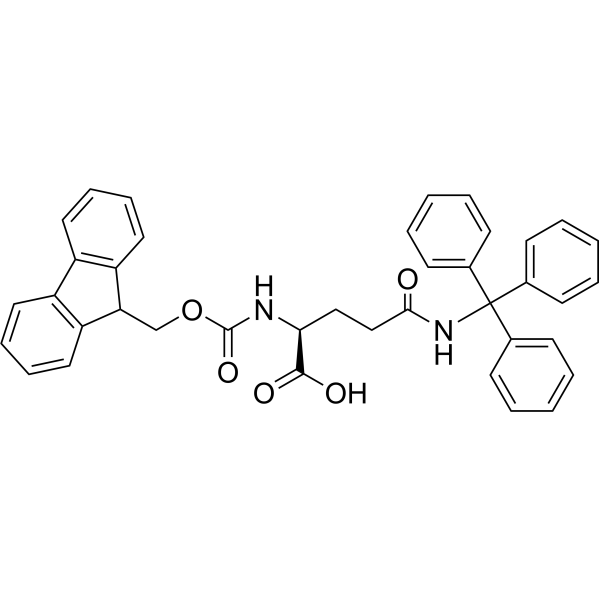
Fmoc-Gln(Trt)-OH is a glutamine derivative containing amine protecting group Fmoc. Fmoc-Gln(Trt)-OH can be used in solid-phase peptide synthesis .
|
-
-
- HY-W048739
-
|
|
Amino Acid Derivatives
|
Others
|
|
Fmoc-α-Me-Leu-OH is a leucine derivative with an Fmoc protecting group, which can be used to synthesize peptides with oxytocin receptor agonist activity .
|
-
-
- HY-W048688
-
|
|
Amino Acid Derivatives
|
Others
|
|
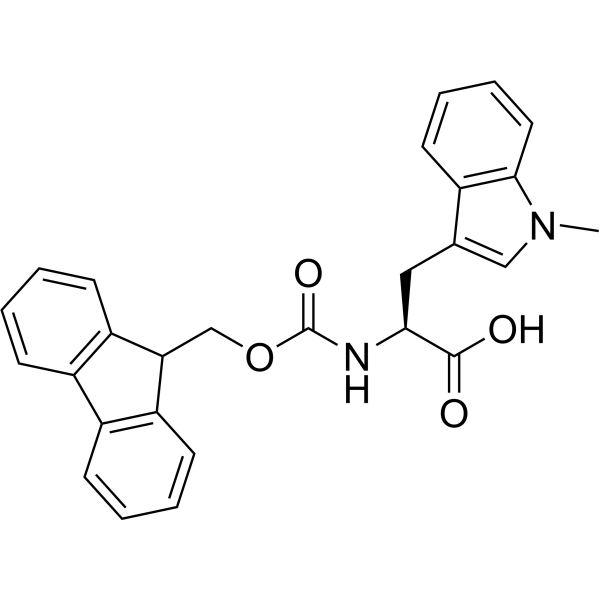
Fmoc-Trp(Me)-OH is an amino acid derivative. Fmoc-Trp(Me)-OH is formed by introducing a methyl group onto the nitrogen atom (N-1 position) of the indole ring of tryptophan (Trp) and protecting the amino group with Fmoc (9-fluorenylmethyloxycarbonyl). Fmoc-Trp(Me)-OH can be used in the synthesis of proteins or peptides .
|
-
-
- HY-78933
-
|
|
Microtubule/Tubulin
ADC Payload
|
Cancer
|
|
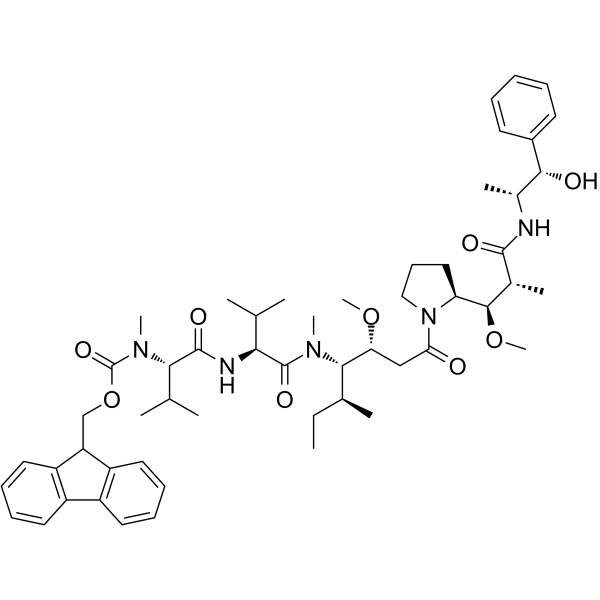
Fmoc-MMAE is a protective group-conjugated monomethyl auristatin E (MMAE), which is a potent tubulin inhibitor. Fmoc-MMAE can be used in the synthesis of ADC .
|
-
-
- HY-W008876
-
-
-
- HY-137002
-
|
|
Amino Acid Derivatives
Biochemical Assay Reagents
|
Others
|
|
Fmoc-N-Me-Arg(Pbf)-OH is an amino acid derivative containing a guanidinium protecting group on the arginine side chain. Fmoc-N-Me-Arg(Pbf)-OH is used in the synthesis of neurotensin-derived NTS1 ligands for PET imaging .
|
-
-
- HY-W010922
-
|
|
Amino Acid Derivatives
|
Others
|
|
Fmoc-Dap(Boc)-OH is an amino acid derivative with an Fmoc protecting group, which can be used to synthesize bicyclic peptide tachykinin NK2 antagonists .
|
-
-
- HY-W007056
-
-
-
- HY-W008064
-
|
Fmoc-L-Citrulline
|
Amino Acid Derivatives
|
Cancer
|
|
Fmoc-Cit-OH (Fmoc-L-Citrulline) is an amino acid derivative with an Fmoc protecting group, which can be used to synthesize a degradable ADC linker composed of a valine-citrulline (Val-Cit) motif .
|
-
-
- HY-W425682
-
|
|
Drug Intermediate
|
Others
|
|
Fmoc-L-Penicillamine is formed by the connection of the Fmoc protecting group and L-Penicillamine through a specific chemical bond. Fmoc-L-Penicillamine plays an important role in organic synthesis, especially in the field of peptide synthesis .
|
-
-
- HY-W009118
-
|
|
Amino Acid Derivatives
|
Others
|
|
Fmoc-5-Ava-OH is an amino acid derivative with an Fmoc protecting group, which can be used to synthesize fatty acid-based dimeric peptides with PSD-95 inhibitory activity .
|
-
-
- HY-W019032
-
|
|
Amino Acid Derivatives
|
Others
|
|
Fmoc-D-Dab(Boc)-OH is an amino acid derivative with an Fmoc protecting group, which can be used to synthesize peptides with antibacterial activity .
|
-
-
- HY-W013154
-
|
|
Amino Acid Derivatives
|
Others
|
|
Fmoc-Tic-OH is an amino acid derivative with an Fmoc protecting group, which can be used to synthesize bioactive peptide mimetics, such as the biotinylated derivative of the opioid receptor antagonist TIPP .
|
-
-
- HY-79255
-
|
|
ADC Payload
Microtubule/Tubulin
|
Cancer
|
|
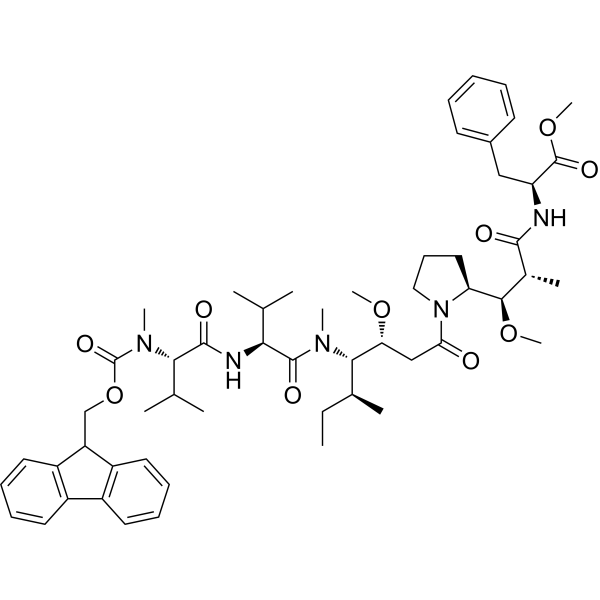
Fmoc-MMAF-OMe is an anticancer agent and tubulin polymerization inhibitor with an Fmoc protecting group. The active ingredient of Fmoc-MMAF-OMe, MMAF (HY-15579), is the cytotoxic (ADC Cytotoxin) component of classic antibody drug conjugates (ADCs) .
|
-
-
- HY-W015987
-
|
Fmoc-NH2
|
Biochemical Assay Reagents
|
Others
|
|
9-Fluorenylmethyl carbamate (Fmoc-NH2) is an amide compound with an Fmoc protecting group, which can be used as a photobase initiator to prepare organosilane-based proton exchange membranes .
|
-
-
- HY-W048697
-
|
|
Amino Acid Derivatives
|
Others
|
|
Fmoc-D-Pen(Trt)-OH is an amino acid derivative with an Fmoc protecting group, which can be used to synthesize analogs of cyclic lanthionine enkephalin, a δ-opioid receptor selective ligand .
|
-
-
- HY-W097128
-
|
|
PROTAC Linkers
|
Cancer
|
|
Fmoc-12-aminododecanoic acid is an alkane chain with terminal Fmoc-protected amine and carboxylic acid groups. The compound can be used as a PROTAC linker in the synthesis of PROTACs. The Fmoc group can be deprotected under basic condition to obtain the free amine which can be used for further conjugations. The terminal carboxylic acid can react with primary amine groups in the presence of activators (e.g. EDC, or HATU) to form a stable amide bond.
|
-
-
- HY-W008024
-
|
|
Amino Acid Derivatives
|
Others
|
|
Fmoc-Dab(Boc)-OH is an amino acid derivative with an Fmoc protecting group that can be used to synthesize somatostatin analogs that inhibit neointima formation induced by balloon injury in rats without altering growth hormone release. Fmoc-Dab(Boc)-OH can be used for the synthesis of peptides .
|
-
-
- HY-164732
-
|
|
Amino Acid Derivatives
Biochemical Assay Reagents
|
Others
|
|
Fmoc-Lys (DOTA)-OH is an Fmoc-protected Lysine derivative with metal-chelating properties, containing the macrocyclic chelator DOTA. Fmoc-Lys (DOTA)-OH undergoes metallation with Tb or Lu. Fmoc-Lys (DOTA)-OH utilizes metal coordination to protect the carboxyl groups of DOTA. Fmoc-Lys (DOTA)-OH can be used in solid-phase peptide synthesis research .
|
-
-
- HY-W048722
-
|
Fmoc-D-2-Thienylalanine
|
Amino Acid Derivatives
|
Others
|
|
Fmoc-D-Thi-OH (Fmoc-D-2-Thienylalanine) is an amino acid derivative with an Fmoc protecting group, which can be used to synthesize AS-Z-P with thrombin inhibitory activity .
|
-
-
- HY-W009056
-
|
|
PROTAC Linkers
|
Cancer
|
|
Fmoc-7-amino-heptanoic acid is an alkane chain with terminal Fmoc-protected amine and carboxylic acid groups. Fmoc-7-amino-heptanoic acid can be used as a PROTAC linker in the synthesis of PROTACs. The Fmoc group can be deprotected under basic condition to obtain the free amine which can be used for further conjugations. The terminal carboxylic acid can react with primary amine groups in the presence of activators (e.g. EDC, or HATU) to form a stable amide bond.
|
-
-
- HY-W046355
-
-
-
- HY-W041989
-
-
-
- HY-W048730
-
|
|
Amino Acid Derivatives
|
Others
|
|
Fmoc-Phe(4-tBu)-OH is an amino acid derivative with an Fmoc protecting group, which can be used to synthesize rOicPaPhe(p-Me)-NH(2) with platelet aggregation activation inhibitory activity .
|
-
-
- HY-W009030
-
|
|
PROTAC Linkers
|
Cancer
|
|
N-Fmoc-8-aminooctanoic acid can be used as a PROTAC linker in the synthesis of PROTACs. N-Fmoc-8-aminooctanoic acid is an alkane chain with terminal Fmoc-protected amine and carboxylic acid groups. The Fmoc group can be deprotected under basic condition to obtain the free amine which can be used for further conjugations. The terminal carboxylic acid can react with primary amine groups in the presence of activators (e.g. EDC, or HATU) to form a stable amide bond.
|
-
-
- HY-Y1636S
-
-
-
- HY-151748
-
|
|
ADC Linker
|
Others
|
|
N3-L-Orn(Fmoc)-OH is a Fmoc-protected ornithine derivative, can be used as a click chemistry reagent. It contains an azide group and can undergo copper-catalyzed azide-alkyne cycloaddition (CuAAc) with molecules containing alkyne groups. It can also undergo ring strain-promoted alkyne-azide cycloaddition (SPAAC) with molecules containing DBCO or BCN groups.
|
-
-
- HY-W419374
-
|
|
Amino Acid Derivatives
|
Others
|
|
ivDde-Lys(Fmoc)-OH is a derivative of amino acid with protecting groups. ivDde-Lys(Fmoc)-OH can be used for peptide synthesis .
|
-
-
- HY-W101305
-
|
|
Amino Acid Derivatives
|
Others
|
|
Fmoc-Pen(Acm)-OH is an amino acid derivative with an Fmoc protecting group that can be used to synthesize chemically modified cyclic peptides containing cell adhesion recognition (CAR) sequences .
|
-
-
- HY-PS0011
-
|
|
Drug Intermediate
|
Others
|
|
Fmoc-Gly-Wang resin is a resin containing a glycine protecting group and can be used for the synthesis of peptides .
|
-
-
- HY-W047799
-
|
|
Amino Acid Derivatives
|
Others
|
|
Fmoc-Phe(4-CONH2)-OH is an amino acid derivative with an Fmoc protecting group, which can be used to synthesize a small-sized HTLV-I protease inhibitor with hydrophilicity .
|
-
-
- HY-W013081S
-
|
|
Isotope-Labeled Compounds
Amino Acid Derivatives
|
Others
|
|
Fmoc-Gln(Trt)-OH- 13C5, 15N2 is the 13C-labeled and 15N-labeled Fmoc-Gln(Trt)-OH (HY-W013081). Fmoc-Gln(Trt)-OH is a glutamine derivative containing amine protecting group Fmoc. Fmoc-Gln(Trt)-OH can be used in solid-phase peptide synthesis .
|
-
-
- HY-W088805
-
|
Fmoc-3-carboxypiperidine
|
Amino Acid Derivatives
|
Others
|
|
Fmoc-NIP-OH (Fmoc-3-carboxypiperidine) is a Fmoc-protected amino acid derivative commonly used in peptide synthesis .
|
-
-
- HY-W097054
-
|
|
Amino Acid Derivatives
|
Others
|
|
Fmoc-L-cysteic acid is an amino acid derivative with an Fmoc protecting group, which can be used to synthesize triarylsulfonium compounds for radiolabeling of peptides .
|
-
-
- HY-W141765
-
|
|
Biochemical Assay Reagents
|
Others
|
|
Fmoc-Cit-PAB-OH is a peptide linker containing an Fmoc-protected amine and citrulline residue. The Fmoc group can be deprotected under basic conditions to obtain the free amine, which can be used for further conjugations.
|
-
-
- HY-W048718
-
|
Fmoc-D-α-t-butylglycine
|
Amino Acid Derivatives
|
Others
|
|
Fmoc-D-Tle-OH (Fmoc-D-α-t-butylglycine) is an amino acid derivative with an Fmoc protecting group, which can be used to synthesize chelating agents that can form a single stereoisomer-enriched form after coordination with metal centers .
|
-
-
- HY-W013153
-
|
|
Amino Acid Derivatives
|
Others
|
|
Fmoc-D-Tic-OH is an amino acid derivative with an Fmoc protecting group, which can be used to synthesize bioactive peptide mimetics, such as [desArg 10]HOE 140, which has bradykinin B1 antagonist activity .
|
-
-
- HY-151640
-
|
|
ADC Linker
|
Others
|
|
Fmoc-DAP-N3 is a click chemistry reagent containing an azide group. Fmoc-DAP-N3 is a short, linear spacer molecule with Fmoc protected amino function. Fmoc-DAP-N3 can be used in click conjugation and amid bond formation either with small molecules or for bioconjugation with proteins and antibodies . It contains an azide group and can undergo copper-catalyzed azide-alkyne cycloaddition (CuAAc) with molecules containing alkyne groups. It can also undergo ring strain-promoted alkyne-azide cycloaddition (SPAAC) with molecules containing DBCO or BCN groups.
|
-
-
- HY-174931
-
|
|
Biochemical Assay Reagents
|
Others
|
|
HO-PEG1000-NH-Fmoc is a PEG derivative with an Fmoc protecting group and a hydroxyl (OH) reactive group. Fmoc is a commonly used amino protecting group that protects the amino group from unwanted reactions until it is removed for a specific coupling reaction.
|
-
-
- HY-174949B
-
|
Fmoc-NH-PEG3400-Thiol
|
Biochemical Assay Reagents
|
Others
|
|
FMOC-NH-PEG3400-SH (FMOC-NH-PEG3400-Thiol) is a PEG derivative with an Fmoc protecting group and a thiol (-SH) reactive group. The thiol group is a highly reactive chemical group that can react specifically with a variety of molecules to form stable covalent bonds. Fmoc is a commonly used amino protecting group that protects the amino group from unwanted reactions until it is removed when a specific coupling reaction is required.
|
-
-
- HY-174961C
-
|
Fmoc-NH-PEG5000-Mal
|
Biochemical Assay Reagents
|
Others
|
|
Fmoc-PEG5000-Maleimide (Fmoc-NH-PEG5000-Mal) is a PEG derivative with an Fmoc protecting group and a Maleimide (HY-W007324) reactive group. Fmoc is a commonly used amino protecting group that protects the amino group from unwanted reactions until it is removed for a specific coupling reaction. Maleimide forms a stable thioether bond with sulfhydryl (-SH) groups. PEG modification can improve solubility and stability and reduce the immunogenicity of proteins and peptides .
|
-
-
- HY-174961
-
|
Fmoc-NH-PEG1000-Mal
|
Biochemical Assay Reagents
|
Others
|
|
Fmoc-PEG1000-Maleimide (Fmoc-NH-PEG1000-Mal) is a PEG derivative with an Fmoc protecting group and a Maleimide (HY-W007324) reactive group. Fmoc is a commonly used amino protecting group that protects the amino group from unwanted reactions until it is removed for a specific coupling reaction. Maleimide forms a stable thioether bond with sulfhydryl (-SH) groups. PEG modification can improve solubility and stability and reduce the immunogenicity of proteins and peptides .
|
-
-
- HY-174896A
-
|
|
Biochemical Assay Reagents
|
Others
|
|
DSPE-PEG2000-Fmoc is a lipid-containing PEG derivative that can be used to form micelles as nanoparticles for drug delivery . Fmoc is a commonly used amino protecting group that protects the amino group from unwanted reactions until it is removed when a specific coupling reaction is required.
|
-
-
- HY-43781
-
|
|
Biochemical Assay Reagents
|
Others
|
|
Fmoc-Lys(Boc)-PAB-OH is a peptide linker containing an Fmoc-protected amine and a Boc-protected lysine residue. The Fmoc group can be deprotected under basic condition to obtain the free amine which can be used for further conjugations.
|
-
-
- HY-W338516
-
|
|
Amino Acid Derivatives
|
Others
|
|
Fmoc-L-Homoarginine hydrochloride is a derivative of amino acid with protecting groups. Fmoc-L-Homoarginine hydrochloride can be used for synthesis of homoarginine containing peptide .
|
-
-
- HY-W010712S1
-
|
|
Isotope-Labeled Compounds
Amino Acid Derivatives
|
Others
|
|
Fmoc-His(Trt)-OH- 15N3 is the 15N labeled Fmoc-His(Trt)-OH (HY-W010712). Fmoc-His (Trt)-OH is a histidine derivative. Fmoc-His(Trt)-OH has trityl (Trt) group to protect the side-chain of His. Fmoc-His(Trt)-OH has Fmoc group to protect -αNH2. Fmoc-His(Trt)-OH can be used for solid phase synthesis of peptides, providing protection against racemization and by-product formation .
|
-
- HY-W800846
-
|
|
Biochemical Assay Reagents
|
Others
|
|
Fmoc-Amido-Tri-(carboxyethoxymethyl)-methane is a multifunctional reagent containing three carboxylic acids and a primary amine that is Fmoc-protected. The carboxylic acids can react with primary amine groups to form stable amide bonds. The Fmoc protecting group can be removed using piperidine, freeing up the amine for a variety of uses such as coupling with carboxylic acids to form amide bonds.
|
-
- HY-W591439
-
|
|
Biochemical Assay Reagents
|
Others
|
|
Fmoc-Lys(Boc)-PAB-PNP is a Boc-protected Lysine linked to 4-aminobenzoiate (PAB) with terminal Fmoc and PNP groups. The Fmoc group can be deprotected under basic conditions to release the free amine which can be used for further conjugations.
|
-
- HY-W106325
-
|
|
Amino Acid Derivatives
|
Others
|
|
Fmoc-N-Me-D-Trp(Boc)-OH is an amino acid derivative with an Fmoc protecting group, which can be used to synthesize somatostatin-dopamine chimeric analogs .
|
-
- HY-W548477
-
|
|
Amino Acid Derivatives
|
Others
|
|
H-Lys(Fmoc)-OH hydrochloride is an amino acid derivative with an Fmoc protecting group, which can be used to synthesize diacylated GLP-1 derivatives with antidiabetic activity .
|
-
- HY-W109214
-
|
|
Amino Acid Derivatives
|
Others
|
|
Fmoc-L-Dap(Boc,Me)-OH is a derivative of amino acid with protecting groups. Fmoc-L-Dap(Boc,Me)-OH can be used for synthesis of diaminopropionic acid containing peptide .
|
-
- HY-W337644
-
|
|
Amino Acid Derivatives
|
Others
|
|
Fmoc-L-Homoarg(Et)2-OH hydrochloride is a derivative of amino acid with protecting groups. Fmoc-L-Dap(Boc,Me)-OH can be used for synthesis of homoarginine containing peptide .
|
-
- HY-W097110
-
|
|
PROTAC Linkers
|
Cancer
|
|
Fmoc-11-aminoundecanoic acid can be used as a PROTAC linker in the synthesis of PROTACs and other conjugation applications. Fmoc-11-aminoundecanoic acid is an alkane chain with terminal Fmoc-protected amine and carboxylic acid groups. The Fmoc group can be deprotected under basic condition to obtain the free amine which can be used for further conjugations. The terminal carboxylic acid can react with primary amine groups in the presence of activators (e.g. EDC, or HATU) to form a stable amide bond.
|
-
- HY-W006937
-
|
Boc-p-amino-D-Phe(Fmoc)-OH; Boc-D-phe(4-NH-Fmoc)-OH
|
Amino Acid Derivatives
|
Others
|
|
Boc-D-(4-fmoc)-aminophenylalanine (Boc-p-amino-D-Phe(Fmoc)-OH) is an amino acid derivative with an Fmoc protecting group, which can be used to synthesize peptides with gonadotropin-releasing hormone antagonist activity .
|
-
- HY-PS0015
-
-
- HY-Y1636S1
-
-
- HY-W111228
-
|
|
PROTAC Linkers
|
Cancer
|
|
Fmoc-9-aminononanoic acid is an alkane chain with terminal Fmoc-protected amine and carboxylic acid groups. The compound can be used as a PROTAC linker in the synthesis of PROTACs and and other conjugation applications. The Fmoc group can be deprotected under basic condition to obtain the free amine which can be used for further conjugations. The terminal carboxylic acid can react with primary amine groups in the presence of activators (e.g. EDC, or HATU) to form a stable amide bond.
|
-
- HY-W591968
-
|
|
PROTAC Linkers
|
Cancer
|
|
14-(Fmoc-amino)-tetradecanoic acid can be used as a PROTAC linker in the synthesis of PROTACs. 14-(Fmoc-amino)-tetradecanoic acid is an alkane chain with terminal Fmoc-protected amine and carboxylic acid groups. The Fmoc group can be deprotected under basic condition to obtain the free amine which can be used for further conjugations. The terminal carboxylic acid can react with primary amine groups in the presence of activators (e.g. EDC, or HATU) to form a stable amide bond.
|
-
- HY-Y1169S1
-
|
|
Isotope-Labeled Compounds
|
Others
|
|
Fmoc-Asp(OtBu)-OH- 13C4, 15N is the 13C and 15N labeled Fmoc-Asp(OtBu)-OH . Fmoc-Asp(OtBu)-OH (4-tert-Butyl N-(fluoren-9-ylmethoxycarbonyl)-L-aspartate) is a aspartate derivative containing amine protecting group Fmoc. Fmoc-Asp(OtBu)-OH can be used for peptide synthesis .
|
-
- HY-W800622
-
|
|
ADC Linker
|
Cancer
|
|
Fmoc-PEG4-Val-Cit-PAB-OH is an enzyme-cleavable ADC linker featuring a Boc-protected amine, a hydrophilic PEG spacer, and a Val-Cit-PAB dipeptide. The benzylic alcohol on the PAB can be used to attach with reactive groups such as PNP for conjugation with drug payloads. The Fmoc protecting group may be removed with piperidine to reveal a primary amine which may be used in coupling reactions to form amides. The Val-Cit-PAB is cleaved by cellular proteases for efficient release of payloads to the cell.
|
-
- HY-W800621
-
|
|
ADC Linker
|
Cancer
|
|
Fmoc-PEG2-Val-Cit-PAB-OH is an enzyme-cleavable ADC linker featuring a Boc-protected amine, a hydrophilic PEG spacer, and a Val-Cit-PAB dipeptide. The benzylic alcohol on the PAB can be used to attach with reactive groups such as PNP for conjugation with drug payloads. The Fmoc protecting group may be removed with piperidine to reveal a primary amine for use in coupling reactions to form amides. The Val-Cit-PAB is cleaved by cellular proteases for efficient release of payloads to the cell.
|
-
- HY-W800623
-
|
|
ADC Linker
|
Cancer
|
|
Fmoc-PEG6-Val-Cit-PAB-OH is an enzyme-cleavable ADC linker featuring a Boc-protected amine, a hydrophilic PEG spacer, and a Val-Cit-PAB dipeptide. The benzylic alcohol on the PAB can be used to attach with reactive groups such as PNP for conjugation with drug payloads. The Fmoc protecting group may be removed with piperidine to reveal a primary amine which may be used in coupling reactions to form amides. The Val-Cit-PAB is cleaved by cellular proteases for efficient release of payloads to the cell.
|
-
- HY-403689
-
|
|
Biochemical Assay Reagents
|
Others
|
|
Fmoc-PNA-J(Boc)-OH is a nucleobase-modified PNA monomer (2-aminopyridine PNA monomer M) with Fmoc and Boc protecting groups, used for solid-phase synthesis of PNAs that form stable Hoogsteen triple helices with double-stranded RNA at physiologically relevant conditions .
|
-
- HY-174931B
-
|
|
Biochemical Assay Reagents
|
Others
|
|
HO-PEG3400-NH-Fmoc is a PEG derivative with an Fmoc protecting group and a hydroxyl (OH) reactive group. Fmoc is a commonly used amino protecting group that protects the amino group from unwanted reactions until it is removed for a specific coupling reaction.
|
-
- HY-174931C
-
|
|
Biochemical Assay Reagents
|
Others
|
|
HO-PEG5000-NH-Fmoc is a PEG derivative with an Fmoc protecting group and a hydroxyl (OH) reactive group. Fmoc is a commonly used amino protecting group that protects the amino group from unwanted reactions until it is removed for a specific coupling reaction.
|
-
- HY-174931A
-
|
|
Biochemical Assay Reagents
|
Others
|
|
HO-PEG2000-NH-Fmoc is a PEG derivative with an Fmoc protecting group and a hydroxyl (OH) reactive group. Fmoc is a commonly used amino protecting group that protects the amino group from unwanted reactions until it is removed for a specific coupling reaction.
|
-
- HY-172719
-
|
|
Biochemical Assay Reagents
|
Others
|
|
Fmoc-PEG9-alcohol is a heterobifunctional PEG linker featuring a Fmoc-protected primary amine and an alcohol group. The hydroxy group is a versatile functionality while the Fmoc protecting group can be removed with base to reveal a primary amine.
|
-
- HY-174949C
-
|
Fmoc-NH-PEG5000-Thiol
|
Biochemical Assay Reagents
|
Others
|
|
FMOC-NH-PEG5000-SH (FMOC-NH-PEG5000-Thiol) is a PEG derivative with an Fmoc protecting group and a thiol (-SH) reactive group. The thiol group is a highly reactive chemical group that can react specifically with a variety of molecules to form stable covalent bonds. Fmoc is a commonly used amino protecting group that protects the amino group from unwanted reactions until it is removed when a specific coupling reaction is required.
|
-
- HY-174949D
-
|
Fmoc-NH-PEG10000-Thiol
|
Biochemical Assay Reagents
|
Others
|
|
FMOC-NH-PEG10000-SH (FMOC-NH-PEG10000-Thiol) is a PEG derivative with an Fmoc protecting group and a thiol (-SH) reactive group. The thiol group is a highly reactive chemical group that can react specifically with a variety of molecules to form stable covalent bonds. Fmoc is a commonly used amino protecting group that protects the amino group from unwanted reactions until it is removed when a specific coupling reaction is required.
|
-
- HY-174949
-
|
Fmoc-NH-PEG1000-Thiol
|
Biochemical Assay Reagents
|
Others
|
|
FMOC-NH-PEG1000-SH (FMOC-NH-PEG1000-Thiol) is a PEG derivative with an Fmoc protecting group and a thiol (-SH) reactive group. The thiol group is a highly reactive chemical group that can react specifically with a variety of molecules to form stable covalent bonds. Fmoc is a commonly used amino protecting group that protects the amino group from unwanted reactions until it is removed when a specific coupling reaction is required.
|
-
- HY-174949A
-
|
Fmoc-NH-PEG2000-Thiol
|
Biochemical Assay Reagents
|
Others
|
|
FMOC-NH-PEG2000-SH (FMOC-NH-PEG2000-Thiol) is a PEG derivative with an Fmoc protecting group and a thiol (-SH) reactive group. The thiol group is a highly reactive chemical group that can react specifically with a variety of molecules to form stable covalent bonds. Fmoc is a commonly used amino protecting group that protects the amino group from unwanted reactions until it is removed when a specific coupling reaction is required.
|
-
- HY-P11689
-
|
|
Biochemical Assay Reagents
|
Others
|
|
Fmoc-PNA-J (Bhoc)-OH is a protected peptide nucleic acid (PNA) monomer building block used for solid-phase synthesis of PNA oligomers. Fmoc-PNA-J (Bhoc)-OH carries Fmoc/Bhoc protecting groups and functions as a standard Fmoc-protected PNA monomer .
|
-
- HY-174961B
-
|
Fmoc-NH-PEG3400-Mal
|
Biochemical Assay Reagents
|
Others
|
|
Fmoc-PEG3400-Maleimide (Fmoc-NH-PEG3400-Mal) is a PEG derivative with an Fmoc protecting group and a Maleimide (HY-W007324) reactive group. Fmoc is a commonly used amino protecting group that protects the amino group from unwanted reactions until it is removed for a specific coupling reaction. Maleimide forms a stable thioether bond with sulfhydryl (-SH) groups. PEG modification can improve solubility and stability and reduce the immunogenicity of proteins and peptides .
|
-
- HY-174961A
-
|
Fmoc-NH-PEG2000-Mal
|
Biochemical Assay Reagents
|
Others
|
|
Fmoc-PEG2000-Maleimide (Fmoc-NH-PEG2000-Mal) is a PEG derivative with an Fmoc protecting group and a Maleimide (HY-W007324) reactive group. Fmoc is a commonly used amino protecting group that protects the amino group from unwanted reactions until it is removed for a specific coupling reaction. Maleimide forms a stable thioether bond with sulfhydryl (-SH) groups. PEG modification can improve solubility and stability and reduce the immunogenicity of proteins and peptides .
|
-
- HY-174896
-
|
|
Biochemical Assay Reagents
|
Others
|
|
DSPE-PEG1000-Fmoc is a lipid-containing PEG derivative that can be used to form micelles as nanoparticles for drug delivery . Fmoc is a commonly used amino protecting group that protects the amino group from unwanted reactions until it is removed when a specific coupling reaction is required.
|
-
- HY-174896B
-
|
|
Biochemical Assay Reagents
|
Others
|
|
DSPE-PEG3400-Fmoc is a lipid-containing PEG derivative that can be used to form micelles as nanoparticles for drug delivery . Fmoc is a commonly used amino protecting group that protects the amino group from unwanted reactions until it is removed when a specific coupling reaction is required.
|
-
- HY-174896C
-
|
|
Biochemical Assay Reagents
|
Others
|
|
DSPE-PEG5000-Fmoc is a lipid-containing PEG derivative that can be used to form micelles as nanoparticles for drug delivery . Fmoc is a commonly used amino protecting group that protects the amino group from unwanted reactions until it is removed when a specific coupling reaction is required.
|
-
- HY-W590561
-
|
|
Biochemical Assay Reagents
|
Others
|
|
Fmoc-Asp(biotinyl-PEG)-OH is a biotinylation reagent with a Fmoc-protected amino group. The Fmoc group can be deprotected under basic conditions to obtain the free amine which can be used for further conjugations.
|
-
- HY-P11696
-
|
|
Drug Intermediate
|
Others
|
|
H-Aeg(Fmoc)-OH hydrochloride is an Fmoc-protected aminoethylglycine monomer with a free carboxyl group and can be used for peptide nucleic acid synthesis.
|
-
- HY-P11694
-
|
|
Biochemical Assay Reagents
|
Neurological Disease
|
|
Alloc-Aeg (Fmoc)-OH is a protected serine triphosphate building block and an Nα-Fmoc protected amino acid. Alloc-Aeg (Fmoc)-OH contains serine protected by α-N-allyloxycarbonyl (Alloc) and bis (allyl) phosphate groups, and it can be used in the synthesis of peptide nucleic acids (PNAs). Alloc-Aeg (Fmoc)-OH is applicable to research related to Alzheimer's disease .
|
-
- HY-P11684
-
|
|
DNA/RNA Synthesis
|
Others
|
|
Fmoc-PNA-C(Boc)-OH is a protected peptide nucleic acid (PNA) monomer for solid-phase synthesis. Fmoc-PNA-C(Boc)-OH possesses Fmoc-protected skeletal amino groups and Boc-protected cytosine bases, designed to construct stable synthetic DNA analogs. Fmoc-PNA-C(Boc)-OH can be used to prepare highly specific, enzyme-stable antisense probes and diagnostic probes.
|
-
- HY-160513
-
|
|
DNA/RNA Synthesis
|
Others
|
|
Fmoc‑PNA‑Abasic(Boc)‑OH is a synthetic peptide nucleic acid modified with Fmoc and Boc protecting groups. Fmoc‑PNA‑Abasic(Boc)‑OH can be used in molecular biology research.
|
-
- HY-P11687
-
|
|
Drug Intermediate
|
Others
|
|
Fmoc-PNA-M(Boc)-OH is a peptide nucleic acid monomer with Fmoc and Boc protecting groups. Fmoc-PNA-M(Boc)-OH can be used for synthesis of peptide nucleic acid .
|
-
- HY-P11691
-
|
|
Biochemical Assay Reagents
|
Others
|
|
Fmoc-PNA-D (tetraBoc)-OH is an Fmoc/Boc-protected diaminopurine peptide nucleic acid (PNA) monomer suitable for standard Fmoc solid-phase synthesis. Fmoc-PNA-D (tetraBoc)-OH carries Boc-protected exocyclic amino groups and can be incorporated into pseudo-complementary PNA oligomers for applications in antigenic peptide nucleic acid and DNA nanotechnology research .
|
-
- HY-W479025
-
|
|
Biochemical Assay Reagents
|
Others
|
|
Fmoc-DODA hydrochloride is a linker with an Fmoc-protected amine and a terminal amine group. The Fmoc group can be deprotected under basic condition to obtain the free amine which can be used for further conjugations. The amino group is reactive with carboxylic acids, activated NHS esters, carbonyls (ketone, aldehyde) etc.
|
-
- HY-P11685
-
|
|
DNA/RNA Synthesis
|
Others
|
|
Fmoc-PNA-thioU(PMB)-OH is a nucleobase-modified peptide nucleic acid (PNA) monomer used in solid-phase synthesis. Fmoc-PNA-thioU(PMB)-OH features a thiouracil base protected with a p-methoxybenzyl (PMB) group on an Fmoc-protected backbone, designed for incorporating modified PNA bases into oligonucleotides to study binding properties.
|
-
- HY-P11695
-
|
|
Biochemical Assay Reagents
|
Others
|
|
Fmoc-Aeg (Dde) is a protected aminoethylglycine (AEG) monomer used for solid-phase synthesis of peptide nucleic acids (PNAs). Fmoc-Aeg (Dde) contains the fluorenylmethoxycarbonyl (Fmoc) and 1-(4,4-dimethyl-2,6-dioxocyclohex-1-ylidene) ethyl (Dde) protecting groups .
|
-
- HY-W800804
-
|
|
Biochemical Assay Reagents
|
Others
|
|
Fmoc-Ala-PAB-OH is a peptide linker containing an Fmoc-protected amine and an alanine residue. The Fmoc group can be deprotected under basic condition to obtain the free amine which can be used for further conjugations.
|
-
- HY-P11688
-
|
|
Biochemical Assay Reagents
|
Others
|
Fmoc-PNA-M (Bhoc)-OH is a standard peptide nucleic acid (PNA) monomer building block. Fmoc-PNA-M (Bhoc)-OH carries two protecting groups, Fmoc and Bhoc, and is specifically designed for solid-phase and automated PNA synthesis. Fmoc-PNA-M (Bhoc)-OH efficiently participates in the construction of sequence-specific PNA probes. Through its protecting group strategy, Fmoc-PNA-M (Bhoc)-OH ensures the accuracy and efficiency of PNA synthesis, and is one of the important raw materials for PNA synthesis at present .
|
-
- HY-P11697
-
|
|
Drug Intermediate
|
Others
|
|
Fmoc-PNA-maleimide-OH is a Fmoc-protected functionalized peptide nucleic acid monomer featuring a maleimide group for thiol-reactive conjugation. Fmoc-PNA-maleimide-OH can be used in constructing PNA conjugates for molecular assembly applications.
|
-
- HY-W190720
-
|
|
Biochemical Assay Reagents
|
Others
|
|
Fmoc-NH-PEG4-HZ-BOC is a PEG reagent containing an Fmoc-protected amine and a Boc-protected hydrazide. The Fmoc group can be deprotected under basic condition to obtain the free amine which can be used for further conjugations. The hydrophilic PEG spacer increases solubility in aqueous media. The Boc can be deprotected under mild acidic conditions to form a reactive hydrazide, which can then be coupled with various carbonyl groups.
|
-
- HY-W025936
-
|
|
Drug Intermediate
|
Others
|
|
Fmoc‑PNA‑G (Bhoc)‑OH is a guanine-containing peptide nucleic acid monomer, in which both Bhoc on the nucleobase and Fmoc on the backbone serve as protecting groups. Fmoc‑PNA‑G (Bhoc)‑OH is applicable for the synthesis of peptide nucleic acids .
|
-
- HY-W800656
-
|
|
Biochemical Assay Reagents
|
Others
|
|
Fmoc-PEG4-hydroxy is a PEG linker containing an Fmoc-protected amine and a hydroxyl group. The hydrophilic PEG spacer increases solubility in aqueous media. The Fmoc group can be deprotected under basic condition to obtain the free amine which can be used for further conjugations. The hydroxyl group enables further derivatization or replacement with other reactive functional groups.
|
-
- HY-W190934
-
|
|
Biochemical Assay Reagents
|
Others
|
|
Fmoc-Ala-Pro-OH is a linker with an Fmoc-protected amine and a terminal carboxylic acid. The Fmoc group can be deprotected under basic condition to obtain the free amine which can be used for further conjugations. The terminal carboxylic acid can be reacted with primary amine groups in the presence of activators (e.g. EDC, or HATU) to form a stable amide bond.
|
-
- HY-Y1169S
-
|
|
Isotope-Labeled Compounds
Amino Acid Derivatives
|
Others
|
|
Fmoc-Asp(OtBu)-OH- 15N is the 15N-labeled Fmoc-Asp(OtBu)-OH (HY-Y1169). Fmoc-Asp(OtBu)-OH (4-tert-Butyl N-(fluoren-9-ylmethoxycarbonyl)-L-aspartate) is an aspartate derivative containing amine protecting group Fmoc. Fmoc-Asp(OtBu)-OH can be used for peptide synthesis .
|
-
- HY-P11686
-
|
|
DNA/RNA Synthesis
|
Others
|
|
Fmoc-PNA-G(Boc)-OH is a synthetic peptide nucleic acid (PNA) modified with Fmoc and Boc protecting groups, designed for precise synthesis and targeted binding to complementary DNA or RNA sequences. Fmoc-PNA-G(Boc)-OH serves as a versatile tool in molecular biology, offering robustness, specificity, and applicability across various research and diagnostic fields.
|
-
- HY-W540123
-
|
|
Biochemical Assay Reagents
|
Cancer
|
Fmoc-PNA-A(Bhoc)-OH is a protected peptide nucleic acid (PNA) monomer carrying an adenine base. Fmoc-PNA-A(Bhoc)-OH contains Fmoc and benzhydryloxycarbonyl (Bhoc) protecting groups, and serves as a standard building block designed specifically for solid-phase PNA synthesis. Fmoc-PNA-A(Bhoc)-OH can be efficiently used to synthesize PNA-based sequence-specific hybridization probes. These probes have broad applications in molecular biology research; for example, they can be used in HER2-expressing tumor-related studies, providing tools for disease diagnosis and mechanism exploration .
|
-
- HY-Y1169S2
-
|
4-tert-Butyl N-(fluoren-9-ylmethoxycarbonyl)-L-aspartate-d3; Fmoc-L-Asp(OtBu)-OH-d3
|
Isotope-Labeled Compounds
Amino Acid Derivatives
|
Others
|
|
Fmoc-Asp(OtBu)-OH-d3 (4-tert-Butyl N-(fluoren-9-ylmethoxycarbonyl)-L-aspartate-d3) is deuterium labeled Fmoc-Asp(OtBu)-OH. Fmoc-Asp(OtBu)-OH (4-tert-Butyl N-(fluoren-9-ylmethoxycarbonyl)-L-aspartate) is a aspartate derivative containing amine protecting group Fmoc. Fmoc-Asp(OtBu)-OH can be used for peptide synthesis .
|
-
- HY-W108867
-
|
|
Drug Intermediate
|
|
|
N-Fmoc-ethylenediamine hydrobromide is an important chemical reagent with the activity of promoting organic synthesis reactions. N-Fmoc-ethylenediamine hydrobromide is often used in the synthesis of peptides and other amino compounds in the field of biochemistry because it can effectively protect the amino group and provide good reactivity. The application of N-Fmoc-ethylenediamine hydrobromide helps to improve the efficiency and selectivity of synthesis and becomes a key component in organic synthesis.
|
-
- HY-151825
-
|
|
ADC Linker
|
Others
|
|
Fmoc-L-Phe(4-NH-Poc)-OH is a click chemistry reagent containing an azide group. Used as an orthogonally protected building block in solid-phase peptide synthesis. Poc-group can be further modified using Click-chemistry .
|
-
- HY-151715
-
|
|
Biochemical Assay Reagents
|
Others
|
|
N3-D-Dap(Fmoc)-OH is a click chemistry reagent. N3-D-Dap(Fmoc)-OH can be used as a component for coupling by click reaction and as an orthogonally protected diaminocarboxylic acid derivative. N3-D-Dap(Fmoc)-OH contains an azide group and can undergo copper-catalyzed azide-alkyne cycloaddition (CuAAc) with molecules containing alkyne groups. N3-D-Dap(Fmoc)-OH can also undergo ring strain-promoted alkyne-azide cycloaddition (SPAAC) with molecules containing DBCO or BCN groups .
|
-
- HY-W089230
-
|
N,N'-Di-tert-butoxycarbonyl-L-histidine
|
Amino Acid Derivatives
|
Others
|
|
Boc-His(Boc)-OH (N,N'-Di-tert-butoxycarbonyl-L-histidine) is an amino acid derivative with an Fmoc protecting group, which can be used to synthesize the dodecapeptide α-mating factor of Saccharomyces cerevisiae .
|
-
- HY-179477
-
|
|
Amino Acid Derivatives
Drug Intermediate
|
Others
|
|
Fmoc-β-Ala-Asp(OMpe)-OH is a specialized amino acid derivative used in solid-phase peptide synthesis (SPPS). Fmoc-β-Ala-Asp(OMpe)-OH consists of a beta-alanine spacer linked to an aspartic acid residue, where the beta-carboxyl group is protected with a 3-methylpentyl ester (OMpe) to prevent aspartimide formation during synthesis. Fmoc-β-Ala-Asp(OMpe)-OH a useful building block for creating peptides that contain aspartic acid, as the OMpe group is designed to minimize unwanted side reactions .
|
-
- HY-151687
-
|
|
ADC Linker
|
Others
|
|
Fmoc-L-Tyr(2-azidoethyl)-OH is a click chemistry reagent containing an azide group. Fmoc-L-Tyr(2-azidoethyl)-OH is unnatural Fmoc-protected Tyrosine derivative bears an azidoethyl substitution as reactive handle e.g. for biorthogonal conjugations, via a Cu(I)-catalyzed 1,3-dipolar Click cycloaddition with alkynes. And azido-UAAs can be employed as IR reporters . It contains an azide group and can undergo copper-catalyzed azide-alkyne cycloaddition (CuAAc) with molecules containing alkyne groups. It can also undergo ring strain-promoted alkyne-azide cycloaddition (SPAAC) with molecules containing DBCO or BCN groups.
|
-
- HY-138106
-
|
|
Amino Acid Derivatives
|
Others
|
|
Fmoc-D-Cit-OH is citrulline with an Fmoc protecting group, which can be used to synthesize bioactive peptide mimetics, such as H-Dmt-D-Cit-Aba-b-Ala-NMe-30,50-(CF3)2-Bn and H-Dmt-D-Cit-Aba-b-Ala-NMe-Bn with neurokinin-1 antagonist activity .
|
-
- HY-177894
-
|
|
Drug Intermediate
|
Others
|
|
Fmoc-Asp(OMpe)-Cbz is a drug intermediate that can be used for the synthesis of Fmoc-Asp(OMpe)-OH.
|
-
- HY-W044285
-
|
|
Amino Acid Derivatives
|
Others
|
|
Fmoc-D-4-Aph(cBm)-OH is an amino acid derivative with an Fmoc protecting group, which can be used to synthesize biologically active peptide mimetics, such as Ac-D2Nal-D4Cpa-D3Pal-Ser-4Aph/4Amf(P)-D4Aph/D4Amf(Q)-Leu-ILys-Pro-DAla-NH2 with gonadotropin-releasing hormone (GnRH) antagonist activity .
|
-
| Cat. No. |
Product Name |
Type |
-
- HY-79647
-
|
N-(Fmoc-oxy)succinimide
|
Biochemical Assay Reagents
|
|
Fmoc-OSu (N-(Fmoc-oxy)succinimide) is an acylating agent that targets amino groups (-NH2). It can selectively protect the amino groups of amino acids by covalently binding with primary or secondary amines through nucleophilic substitution reactions. Fmoc-OSu forms a stable amide bond with the amino group to avoid side reactions of the amino group in peptide synthesis. It can also be used as a fluorescent labeling reagent to react with glycosylamines for efficient labeling of N-sugar chains. Fmoc-OSu can be used as an Fmoc protection strategy in peptide synthesis, and as a fluorescent labeling and analysis method for N-sugar chains .
|
-
- HY-W013081
-
|
|
Biochemical Assay Reagents
|
|
Fmoc-Gln(Trt)-OH is a glutamine derivative containing amine protecting group Fmoc. Fmoc-Gln(Trt)-OH can be used in solid-phase peptide synthesis .
|
-
- HY-174931
-
|
|
Biochemical Assay Reagents
|
|
HO-PEG1000-NH-Fmoc is a PEG derivative with an Fmoc protecting group and a hydroxyl (OH) reactive group. Fmoc is a commonly used amino protecting group that protects the amino group from unwanted reactions until it is removed for a specific coupling reaction.
|
-
- HY-174949B
-
|
Fmoc-NH-PEG3400-Thiol
|
Biochemical Assay Reagents
|
|
FMOC-NH-PEG3400-SH (FMOC-NH-PEG3400-Thiol) is a PEG derivative with an Fmoc protecting group and a thiol (-SH) reactive group. The thiol group is a highly reactive chemical group that can react specifically with a variety of molecules to form stable covalent bonds. Fmoc is a commonly used amino protecting group that protects the amino group from unwanted reactions until it is removed when a specific coupling reaction is required.
|
-
- HY-174961C
-
|
Fmoc-NH-PEG5000-Mal
|
Biochemical Assay Reagents
|
|
Fmoc-PEG5000-Maleimide (Fmoc-NH-PEG5000-Mal) is a PEG derivative with an Fmoc protecting group and a Maleimide (HY-W007324) reactive group. Fmoc is a commonly used amino protecting group that protects the amino group from unwanted reactions until it is removed for a specific coupling reaction. Maleimide forms a stable thioether bond with sulfhydryl (-SH) groups. PEG modification can improve solubility and stability and reduce the immunogenicity of proteins and peptides .
|
-
- HY-174961
-
|
Fmoc-NH-PEG1000-Mal
|
Biochemical Assay Reagents
|
|
Fmoc-PEG1000-Maleimide (Fmoc-NH-PEG1000-Mal) is a PEG derivative with an Fmoc protecting group and a Maleimide (HY-W007324) reactive group. Fmoc is a commonly used amino protecting group that protects the amino group from unwanted reactions until it is removed for a specific coupling reaction. Maleimide forms a stable thioether bond with sulfhydryl (-SH) groups. PEG modification can improve solubility and stability and reduce the immunogenicity of proteins and peptides .
|
-
- HY-174896A
-
|
|
Biochemical Assay Reagents
|
|
DSPE-PEG2000-Fmoc is a lipid-containing PEG derivative that can be used to form micelles as nanoparticles for drug delivery . Fmoc is a commonly used amino protecting group that protects the amino group from unwanted reactions until it is removed when a specific coupling reaction is required.
|
-
- HY-174931B
-
|
|
Biochemical Assay Reagents
|
|
HO-PEG3400-NH-Fmoc is a PEG derivative with an Fmoc protecting group and a hydroxyl (OH) reactive group. Fmoc is a commonly used amino protecting group that protects the amino group from unwanted reactions until it is removed for a specific coupling reaction.
|
-
- HY-174931C
-
|
|
Biochemical Assay Reagents
|
|
HO-PEG5000-NH-Fmoc is a PEG derivative with an Fmoc protecting group and a hydroxyl (OH) reactive group. Fmoc is a commonly used amino protecting group that protects the amino group from unwanted reactions until it is removed for a specific coupling reaction.
|
-
- HY-174931A
-
|
|
Biochemical Assay Reagents
|
|
HO-PEG2000-NH-Fmoc is a PEG derivative with an Fmoc protecting group and a hydroxyl (OH) reactive group. Fmoc is a commonly used amino protecting group that protects the amino group from unwanted reactions until it is removed for a specific coupling reaction.
|
-
- HY-174949C
-
|
Fmoc-NH-PEG5000-Thiol
|
Biochemical Assay Reagents
|
|
FMOC-NH-PEG5000-SH (FMOC-NH-PEG5000-Thiol) is a PEG derivative with an Fmoc protecting group and a thiol (-SH) reactive group. The thiol group is a highly reactive chemical group that can react specifically with a variety of molecules to form stable covalent bonds. Fmoc is a commonly used amino protecting group that protects the amino group from unwanted reactions until it is removed when a specific coupling reaction is required.
|
-
- HY-174949D
-
|
Fmoc-NH-PEG10000-Thiol
|
Biochemical Assay Reagents
|
|
FMOC-NH-PEG10000-SH (FMOC-NH-PEG10000-Thiol) is a PEG derivative with an Fmoc protecting group and a thiol (-SH) reactive group. The thiol group is a highly reactive chemical group that can react specifically with a variety of molecules to form stable covalent bonds. Fmoc is a commonly used amino protecting group that protects the amino group from unwanted reactions until it is removed when a specific coupling reaction is required.
|
-
- HY-174949
-
|
Fmoc-NH-PEG1000-Thiol
|
Biochemical Assay Reagents
|
|
FMOC-NH-PEG1000-SH (FMOC-NH-PEG1000-Thiol) is a PEG derivative with an Fmoc protecting group and a thiol (-SH) reactive group. The thiol group is a highly reactive chemical group that can react specifically with a variety of molecules to form stable covalent bonds. Fmoc is a commonly used amino protecting group that protects the amino group from unwanted reactions until it is removed when a specific coupling reaction is required.
|
-
- HY-174949A
-
|
Fmoc-NH-PEG2000-Thiol
|
Biochemical Assay Reagents
|
|
FMOC-NH-PEG2000-SH (FMOC-NH-PEG2000-Thiol) is a PEG derivative with an Fmoc protecting group and a thiol (-SH) reactive group. The thiol group is a highly reactive chemical group that can react specifically with a variety of molecules to form stable covalent bonds. Fmoc is a commonly used amino protecting group that protects the amino group from unwanted reactions until it is removed when a specific coupling reaction is required.
|
-
- HY-174961B
-
|
Fmoc-NH-PEG3400-Mal
|
Biochemical Assay Reagents
|
|
Fmoc-PEG3400-Maleimide (Fmoc-NH-PEG3400-Mal) is a PEG derivative with an Fmoc protecting group and a Maleimide (HY-W007324) reactive group. Fmoc is a commonly used amino protecting group that protects the amino group from unwanted reactions until it is removed for a specific coupling reaction. Maleimide forms a stable thioether bond with sulfhydryl (-SH) groups. PEG modification can improve solubility and stability and reduce the immunogenicity of proteins and peptides .
|
-
- HY-174961A
-
|
Fmoc-NH-PEG2000-Mal
|
Biochemical Assay Reagents
|
|
Fmoc-PEG2000-Maleimide (Fmoc-NH-PEG2000-Mal) is a PEG derivative with an Fmoc protecting group and a Maleimide (HY-W007324) reactive group. Fmoc is a commonly used amino protecting group that protects the amino group from unwanted reactions until it is removed for a specific coupling reaction. Maleimide forms a stable thioether bond with sulfhydryl (-SH) groups. PEG modification can improve solubility and stability and reduce the immunogenicity of proteins and peptides .
|
-
- HY-174896
-
|
|
Biochemical Assay Reagents
|
|
DSPE-PEG1000-Fmoc is a lipid-containing PEG derivative that can be used to form micelles as nanoparticles for drug delivery . Fmoc is a commonly used amino protecting group that protects the amino group from unwanted reactions until it is removed when a specific coupling reaction is required.
|
-
- HY-174896B
-
|
|
Biochemical Assay Reagents
|
|
DSPE-PEG3400-Fmoc is a lipid-containing PEG derivative that can be used to form micelles as nanoparticles for drug delivery . Fmoc is a commonly used amino protecting group that protects the amino group from unwanted reactions until it is removed when a specific coupling reaction is required.
|
-
- HY-174896C
-
|
|
Biochemical Assay Reagents
|
|
DSPE-PEG5000-Fmoc is a lipid-containing PEG derivative that can be used to form micelles as nanoparticles for drug delivery . Fmoc is a commonly used amino protecting group that protects the amino group from unwanted reactions until it is removed when a specific coupling reaction is required.
|
| Cat. No. |
Product Name |
Target |
Research Area |
-
- HY-Y1636
-
-
- HY-Y1169
-
|
4-tert-Butyl N-(fluoren-9-ylmethoxycarbonyl)-L-aspartate; Fmoc-L-Asp(OtBu)-OH
|
Amino Acid Derivatives
|
Others
|
|
Fmoc-Asp(OtBu)-OH (4-tert-Butyl N-(fluoren-9-ylmethoxycarbonyl)-L-aspartate) is an aspartate derivative containing amine protecting group Fmoc. Fmoc-Asp(OtBu)-OH can be used for peptide synthesis .
|
-
- HY-W010712
-
|
|
Amino Acid Derivatives
|
Others
|
|
Fmoc-His(Trt)-OH is a histidine derivative with a trityl (Trt) group protecting the His side chain. Fmoc-His(Trt)-OH also has an Fmoc group protecting the α-NH2 group. Fmoc-His(Trt)-OH can be used in solid-phase peptide synthesis to prevent racemization and byproduct formation. Fmoc-His(Trt)-OH acts as a protected histidine precursor in solid-phase peptide synthesis (SPPS), participating in peptide chain construction through amide bond formation. Fmoc-His(Trt)-OH can be precisely incorporated into the target peptide sequence, ensuring correct peptide chain synthesis and reducing impurity formation. Fmoc-His(Trt)-OH is mainly used in the solid-phase synthesis research of pharmaceutical peptides and bioactive peptides, and is particularly suitable for the preparation of peptide drugs requiring precise control of histidine configuration .
|
-
- HY-W048739
-
|
|
Amino Acid Derivatives
|
Others
|
|
Fmoc-α-Me-Leu-OH is a leucine derivative with an Fmoc protecting group, which can be used to synthesize peptides with oxytocin receptor agonist activity .
|
-
- HY-W008876
-
-
- HY-137002
-
|
|
Amino Acid Derivatives
Biochemical Assay Reagents
|
Others
|
|
Fmoc-N-Me-Arg(Pbf)-OH is an amino acid derivative containing a guanidinium protecting group on the arginine side chain. Fmoc-N-Me-Arg(Pbf)-OH is used in the synthesis of neurotensin-derived NTS1 ligands for PET imaging .
|
-
- HY-W010922
-
|
|
Amino Acid Derivatives
|
Others
|
|
Fmoc-Dap(Boc)-OH is an amino acid derivative with an Fmoc protecting group, which can be used to synthesize bicyclic peptide tachykinin NK2 antagonists .
|
-
- HY-W007056
-
-
- HY-W008064
-
|
Fmoc-L-Citrulline
|
Amino Acid Derivatives
|
Cancer
|
|
Fmoc-Cit-OH (Fmoc-L-Citrulline) is an amino acid derivative with an Fmoc protecting group, which can be used to synthesize a degradable ADC linker composed of a valine-citrulline (Val-Cit) motif .
|
-
- HY-W009118
-
|
|
Amino Acid Derivatives
|
Others
|
|
Fmoc-5-Ava-OH is an amino acid derivative with an Fmoc protecting group, which can be used to synthesize fatty acid-based dimeric peptides with PSD-95 inhibitory activity .
|
-
- HY-W019032
-
|
|
Amino Acid Derivatives
|
Others
|
|
Fmoc-D-Dab(Boc)-OH is an amino acid derivative with an Fmoc protecting group, which can be used to synthesize peptides with antibacterial activity .
|
-
- HY-W013154
-
|
|
Amino Acid Derivatives
|
Others
|
|
Fmoc-Tic-OH is an amino acid derivative with an Fmoc protecting group, which can be used to synthesize bioactive peptide mimetics, such as the biotinylated derivative of the opioid receptor antagonist TIPP .
|
-
- HY-W015987
-
|
Fmoc-NH2
|
Biochemical Assay Reagents
|
Others
|
|
9-Fluorenylmethyl carbamate (Fmoc-NH2) is an amide compound with an Fmoc protecting group, which can be used as a photobase initiator to prepare organosilane-based proton exchange membranes .
|
-
- HY-W048697
-
|
|
Amino Acid Derivatives
|
Others
|
|
Fmoc-D-Pen(Trt)-OH is an amino acid derivative with an Fmoc protecting group, which can be used to synthesize analogs of cyclic lanthionine enkephalin, a δ-opioid receptor selective ligand .
|
-
- HY-W008024
-
|
|
Amino Acid Derivatives
|
Others
|
|
Fmoc-Dab(Boc)-OH is an amino acid derivative with an Fmoc protecting group that can be used to synthesize somatostatin analogs that inhibit neointima formation induced by balloon injury in rats without altering growth hormone release. Fmoc-Dab(Boc)-OH can be used for the synthesis of peptides .
|
-
- HY-W048722
-
|
Fmoc-D-2-Thienylalanine
|
Amino Acid Derivatives
|
Others
|
|
Fmoc-D-Thi-OH (Fmoc-D-2-Thienylalanine) is an amino acid derivative with an Fmoc protecting group, which can be used to synthesize AS-Z-P with thrombin inhibitory activity .
|
-
- HY-W046355
-
-
- HY-W041989
-
-
- HY-W048730
-
|
|
Amino Acid Derivatives
|
Others
|
|
Fmoc-Phe(4-tBu)-OH is an amino acid derivative with an Fmoc protecting group, which can be used to synthesize rOicPaPhe(p-Me)-NH(2) with platelet aggregation activation inhibitory activity .
|
-
- HY-W419374
-
|
|
Amino Acid Derivatives
|
Others
|
|
ivDde-Lys(Fmoc)-OH is a derivative of amino acid with protecting groups. ivDde-Lys(Fmoc)-OH can be used for peptide synthesis .
|
-
- HY-W101305
-
|
|
Amino Acid Derivatives
|
Others
|
|
Fmoc-Pen(Acm)-OH is an amino acid derivative with an Fmoc protecting group that can be used to synthesize chemically modified cyclic peptides containing cell adhesion recognition (CAR) sequences .
|
-
- HY-PS0011
-
|
|
Drug Intermediate
|
Others
|
|
Fmoc-Gly-Wang resin is a resin containing a glycine protecting group and can be used for the synthesis of peptides .
|
-
- HY-W047799
-
|
|
Amino Acid Derivatives
|
Others
|
|
Fmoc-Phe(4-CONH2)-OH is an amino acid derivative with an Fmoc protecting group, which can be used to synthesize a small-sized HTLV-I protease inhibitor with hydrophilicity .
|
-
- HY-W089230
-
|
N,N'-Di-tert-butoxycarbonyl-L-histidine
|
Amino Acid Derivatives
|
Others
|
|
Boc-His(Boc)-OH (N,N'-Di-tert-butoxycarbonyl-L-histidine) is an amino acid derivative with an Fmoc protecting group, which can be used to synthesize the dodecapeptide α-mating factor of Saccharomyces cerevisiae .
|
-
- HY-W097054
-
|
|
Amino Acid Derivatives
|
Others
|
|
Fmoc-L-cysteic acid is an amino acid derivative with an Fmoc protecting group, which can be used to synthesize triarylsulfonium compounds for radiolabeling of peptides .
|
-
- HY-W048718
-
|
Fmoc-D-α-t-butylglycine
|
Amino Acid Derivatives
|
Others
|
|
Fmoc-D-Tle-OH (Fmoc-D-α-t-butylglycine) is an amino acid derivative with an Fmoc protecting group, which can be used to synthesize chelating agents that can form a single stereoisomer-enriched form after coordination with metal centers .
|
-
- HY-W013153
-
|
|
Amino Acid Derivatives
|
Others
|
|
Fmoc-D-Tic-OH is an amino acid derivative with an Fmoc protecting group, which can be used to synthesize bioactive peptide mimetics, such as [desArg 10]HOE 140, which has bradykinin B1 antagonist activity .
|
-
- HY-138106
-
|
|
Amino Acid Derivatives
|
Others
|
|
Fmoc-D-Cit-OH is citrulline with an Fmoc protecting group, which can be used to synthesize bioactive peptide mimetics, such as H-Dmt-D-Cit-Aba-b-Ala-NMe-30,50-(CF3)2-Bn and H-Dmt-D-Cit-Aba-b-Ala-NMe-Bn with neurokinin-1 antagonist activity .
|
-
- HY-W044285
-
|
|
Amino Acid Derivatives
|
Others
|
|
Fmoc-D-4-Aph(cBm)-OH is an amino acid derivative with an Fmoc protecting group, which can be used to synthesize biologically active peptide mimetics, such as Ac-D2Nal-D4Cpa-D3Pal-Ser-4Aph/4Amf(P)-D4Aph/D4Amf(Q)-Leu-ILys-Pro-DAla-NH2 with gonadotropin-releasing hormone (GnRH) antagonist activity .
|
-
- HY-W338516
-
|
|
Amino Acid Derivatives
|
Others
|
|
Fmoc-L-Homoarginine hydrochloride is a derivative of amino acid with protecting groups. Fmoc-L-Homoarginine hydrochloride can be used for synthesis of homoarginine containing peptide .
|
-
- HY-W106325
-
|
|
Amino Acid Derivatives
|
Others
|
|
Fmoc-N-Me-D-Trp(Boc)-OH is an amino acid derivative with an Fmoc protecting group, which can be used to synthesize somatostatin-dopamine chimeric analogs .
|
-
- HY-W548477
-
|
|
Amino Acid Derivatives
|
Others
|
|
H-Lys(Fmoc)-OH hydrochloride is an amino acid derivative with an Fmoc protecting group, which can be used to synthesize diacylated GLP-1 derivatives with antidiabetic activity .
|
-
- HY-W109214
-
|
|
Amino Acid Derivatives
|
Others
|
|
Fmoc-L-Dap(Boc,Me)-OH is a derivative of amino acid with protecting groups. Fmoc-L-Dap(Boc,Me)-OH can be used for synthesis of diaminopropionic acid containing peptide .
|
-
- HY-W337644
-
|
|
Amino Acid Derivatives
|
Others
|
|
Fmoc-L-Homoarg(Et)2-OH hydrochloride is a derivative of amino acid with protecting groups. Fmoc-L-Dap(Boc,Me)-OH can be used for synthesis of homoarginine containing peptide .
|
-
- HY-W006937
-
|
Boc-p-amino-D-Phe(Fmoc)-OH; Boc-D-phe(4-NH-Fmoc)-OH
|
Amino Acid Derivatives
|
Others
|
|
Boc-D-(4-fmoc)-aminophenylalanine (Boc-p-amino-D-Phe(Fmoc)-OH) is an amino acid derivative with an Fmoc protecting group, which can be used to synthesize peptides with gonadotropin-releasing hormone antagonist activity .
|
-
- HY-PS0005
-
|
|
Peptides
|
Others
|
|
Fmoc-Arg(Pbf)-Wang resin is a resin containing an arginine protecting group and can be used for the synthesis of peptides .
|
-
- HY-PS0015
-
-
- HY-PS0002
-
|
|
Peptides
|
Others
|
|
Fmoc-Ala-Wang resin is a resin containing an alanine amino protecting group and can be used for peptide synthesis .
|
-
- HY-403689
-
|
|
Biochemical Assay Reagents
|
Others
|
|
Fmoc-PNA-J(Boc)-OH is a nucleobase-modified PNA monomer (2-aminopyridine PNA monomer M) with Fmoc and Boc protecting groups, used for solid-phase synthesis of PNAs that form stable Hoogsteen triple helices with double-stranded RNA at physiologically relevant conditions .
|
-
- HY-P11689
-
|
|
Biochemical Assay Reagents
|
Others
|
|
Fmoc-PNA-J (Bhoc)-OH is a protected peptide nucleic acid (PNA) monomer building block used for solid-phase synthesis of PNA oligomers. Fmoc-PNA-J (Bhoc)-OH carries Fmoc/Bhoc protecting groups and functions as a standard Fmoc-protected PNA monomer .
|
-
- HY-P11696
-
|
|
Drug Intermediate
|
Others
|
|
H-Aeg(Fmoc)-OH hydrochloride is an Fmoc-protected aminoethylglycine monomer with a free carboxyl group and can be used for peptide nucleic acid synthesis.
|
-
- HY-P11694
-
|
|
Biochemical Assay Reagents
|
Neurological Disease
|
|
Alloc-Aeg (Fmoc)-OH is a protected serine triphosphate building block and an Nα-Fmoc protected amino acid. Alloc-Aeg (Fmoc)-OH contains serine protected by α-N-allyloxycarbonyl (Alloc) and bis (allyl) phosphate groups, and it can be used in the synthesis of peptide nucleic acids (PNAs). Alloc-Aeg (Fmoc)-OH is applicable to research related to Alzheimer's disease .
|
-
- HY-P11684
-
|
|
DNA/RNA Synthesis
|
Others
|
|
Fmoc-PNA-C(Boc)-OH is a protected peptide nucleic acid (PNA) monomer for solid-phase synthesis. Fmoc-PNA-C(Boc)-OH possesses Fmoc-protected skeletal amino groups and Boc-protected cytosine bases, designed to construct stable synthetic DNA analogs. Fmoc-PNA-C(Boc)-OH can be used to prepare highly specific, enzyme-stable antisense probes and diagnostic probes.
|
-
- HY-160513
-
|
|
DNA/RNA Synthesis
|
Others
|
|
Fmoc‑PNA‑Abasic(Boc)‑OH is a synthetic peptide nucleic acid modified with Fmoc and Boc protecting groups. Fmoc‑PNA‑Abasic(Boc)‑OH can be used in molecular biology research.
|
-
- HY-P11687
-
|
|
Drug Intermediate
|
Others
|
|
Fmoc-PNA-M(Boc)-OH is a peptide nucleic acid monomer with Fmoc and Boc protecting groups. Fmoc-PNA-M(Boc)-OH can be used for synthesis of peptide nucleic acid .
|
-
- HY-P11691
-
|
|
Biochemical Assay Reagents
|
Others
|
|
Fmoc-PNA-D (tetraBoc)-OH is an Fmoc/Boc-protected diaminopurine peptide nucleic acid (PNA) monomer suitable for standard Fmoc solid-phase synthesis. Fmoc-PNA-D (tetraBoc)-OH carries Boc-protected exocyclic amino groups and can be incorporated into pseudo-complementary PNA oligomers for applications in antigenic peptide nucleic acid and DNA nanotechnology research .
|
-
- HY-P11685
-
|
|
DNA/RNA Synthesis
|
Others
|
|
Fmoc-PNA-thioU(PMB)-OH is a nucleobase-modified peptide nucleic acid (PNA) monomer used in solid-phase synthesis. Fmoc-PNA-thioU(PMB)-OH features a thiouracil base protected with a p-methoxybenzyl (PMB) group on an Fmoc-protected backbone, designed for incorporating modified PNA bases into oligonucleotides to study binding properties.
|
-
- HY-P11695
-
|
|
Biochemical Assay Reagents
|
Others
|
|
Fmoc-Aeg (Dde) is a protected aminoethylglycine (AEG) monomer used for solid-phase synthesis of peptide nucleic acids (PNAs). Fmoc-Aeg (Dde) contains the fluorenylmethoxycarbonyl (Fmoc) and 1-(4,4-dimethyl-2,6-dioxocyclohex-1-ylidene) ethyl (Dde) protecting groups .
|
-
- HY-P11688
-
|
|
Biochemical Assay Reagents
|
Others
|
Fmoc-PNA-M (Bhoc)-OH is a standard peptide nucleic acid (PNA) monomer building block. Fmoc-PNA-M (Bhoc)-OH carries two protecting groups, Fmoc and Bhoc, and is specifically designed for solid-phase and automated PNA synthesis. Fmoc-PNA-M (Bhoc)-OH efficiently participates in the construction of sequence-specific PNA probes. Through its protecting group strategy, Fmoc-PNA-M (Bhoc)-OH ensures the accuracy and efficiency of PNA synthesis, and is one of the important raw materials for PNA synthesis at present .
|
-
- HY-P11697
-
|
|
Drug Intermediate
|
Others
|
|
Fmoc-PNA-maleimide-OH is a Fmoc-protected functionalized peptide nucleic acid monomer featuring a maleimide group for thiol-reactive conjugation. Fmoc-PNA-maleimide-OH can be used in constructing PNA conjugates for molecular assembly applications.
|
- HY-W025936
-
|
|
Drug Intermediate
|
Others
|
|
Fmoc‑PNA‑G (Bhoc)‑OH is a guanine-containing peptide nucleic acid monomer, in which both Bhoc on the nucleobase and Fmoc on the backbone serve as protecting groups. Fmoc‑PNA‑G (Bhoc)‑OH is applicable for the synthesis of peptide nucleic acids .
|
- HY-P11686
-
|
|
DNA/RNA Synthesis
|
Others
|
|
Fmoc-PNA-G(Boc)-OH is a synthetic peptide nucleic acid (PNA) modified with Fmoc and Boc protecting groups, designed for precise synthesis and targeted binding to complementary DNA or RNA sequences. Fmoc-PNA-G(Boc)-OH serves as a versatile tool in molecular biology, offering robustness, specificity, and applicability across various research and diagnostic fields.
|
- HY-W540123
-
|
|
Biochemical Assay Reagents
|
Cancer
|
Fmoc-PNA-A(Bhoc)-OH is a protected peptide nucleic acid (PNA) monomer carrying an adenine base. Fmoc-PNA-A(Bhoc)-OH contains Fmoc and benzhydryloxycarbonyl (Bhoc) protecting groups, and serves as a standard building block designed specifically for solid-phase PNA synthesis. Fmoc-PNA-A(Bhoc)-OH can be efficiently used to synthesize PNA-based sequence-specific hybridization probes. These probes have broad applications in molecular biology research; for example, they can be used in HER2-expressing tumor-related studies, providing tools for disease diagnosis and mechanism exploration .
|
| Cat. No. |
Product Name |
Chemical Structure |
-
- HY-Y1636S
-
|
|
|
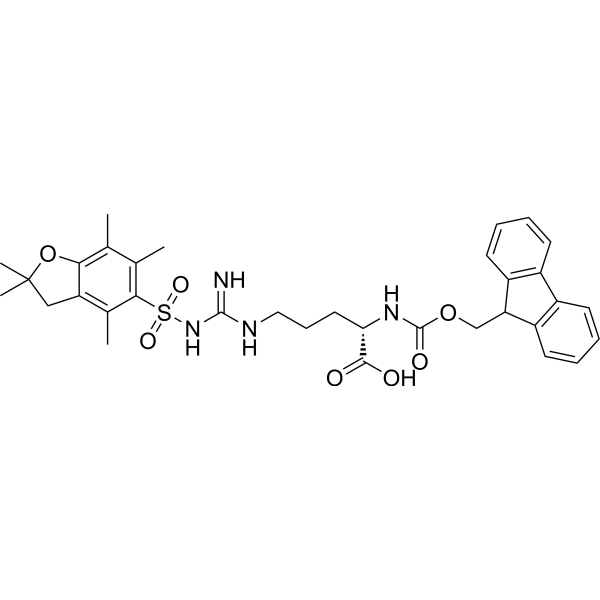
Fmoc-Arg(Pbf)-OH- 13C6, 15N4 is the 13C-labeled and 15N-labeled Fmoc-Arg(Pbf)-OH (HY-Y1636). Fmoc-Arg(Pbf)-OH is an arginine derivative containing amine protecting group Fmoc. Fmoc-Arg(Pbf)-OH is a building block for the introduction of Arg into SPPS (Solid-Phase Peptide Synthesis) .
|
-
-
- HY-W013081S
-
|
|
|
Fmoc-Gln(Trt)-OH- 13C5, 15N2 is the 13C-labeled and 15N-labeled Fmoc-Gln(Trt)-OH (HY-W013081). Fmoc-Gln(Trt)-OH is a glutamine derivative containing amine protecting group Fmoc. Fmoc-Gln(Trt)-OH can be used in solid-phase peptide synthesis .
|
-
-
- HY-W010712S1
-
|
|
|
Fmoc-His(Trt)-OH- 15N3 is the 15N labeled Fmoc-His(Trt)-OH (HY-W010712). Fmoc-His (Trt)-OH is a histidine derivative. Fmoc-His(Trt)-OH has trityl (Trt) group to protect the side-chain of His. Fmoc-His(Trt)-OH has Fmoc group to protect -αNH2. Fmoc-His(Trt)-OH can be used for solid phase synthesis of peptides, providing protection against racemization and by-product formation .
|
-
-
- HY-Y1636S1
-
|
|
|
Fmoc-Arg(Pbf)-OH- 13C6 is the 13C labeled Fmoc-Arg(Pbf)-OH . Fmoc-Arg(Pbf)-OH is an arginine derivative containing amine protecting group Fmoc. Fmoc-Arg(Pbf)-OH is a building block for the introduction of Arg into SPPS (Solid-Phase Peptide Synthesis) .
|
-
-
- HY-Y1169S1
-
|
|
|
Fmoc-Asp(OtBu)-OH- 13C4, 15N is the 13C and 15N labeled Fmoc-Asp(OtBu)-OH . Fmoc-Asp(OtBu)-OH (4-tert-Butyl N-(fluoren-9-ylmethoxycarbonyl)-L-aspartate) is a aspartate derivative containing amine protecting group Fmoc. Fmoc-Asp(OtBu)-OH can be used for peptide synthesis .
|
-
-
- HY-Y1169S2
-
|
|
|
Fmoc-Asp(OtBu)-OH-d3 (4-tert-Butyl N-(fluoren-9-ylmethoxycarbonyl)-L-aspartate-d3) is deuterium labeled Fmoc-Asp(OtBu)-OH. Fmoc-Asp(OtBu)-OH (4-tert-Butyl N-(fluoren-9-ylmethoxycarbonyl)-L-aspartate) is a aspartate derivative containing amine protecting group Fmoc. Fmoc-Asp(OtBu)-OH can be used for peptide synthesis .
|
-
-
- HY-Y1169S
-
|
|
|
Fmoc-Asp(OtBu)-OH- 15N is the 15N-labeled Fmoc-Asp(OtBu)-OH (HY-Y1169). Fmoc-Asp(OtBu)-OH (4-tert-Butyl N-(fluoren-9-ylmethoxycarbonyl)-L-aspartate) is an aspartate derivative containing amine protecting group Fmoc. Fmoc-Asp(OtBu)-OH can be used for peptide synthesis .
|
-
| Cat. No. |
Product Name |
|
Classification |
-
- HY-151748
-
|
|
|
Azide
|
|
N3-L-Orn(Fmoc)-OH is a Fmoc-protected ornithine derivative, can be used as a click chemistry reagent. It contains an azide group and can undergo copper-catalyzed azide-alkyne cycloaddition (CuAAc) with molecules containing alkyne groups. It can also undergo ring strain-promoted alkyne-azide cycloaddition (SPAAC) with molecules containing DBCO or BCN groups.
|
-
- HY-151715
-
|
|
|
Azide
|
|
N3-D-Dap(Fmoc)-OH is a click chemistry reagent. N3-D-Dap(Fmoc)-OH can be used as a component for coupling by click reaction and as an orthogonally protected diaminocarboxylic acid derivative. N3-D-Dap(Fmoc)-OH contains an azide group and can undergo copper-catalyzed azide-alkyne cycloaddition (CuAAc) with molecules containing alkyne groups. N3-D-Dap(Fmoc)-OH can also undergo ring strain-promoted alkyne-azide cycloaddition (SPAAC) with molecules containing DBCO or BCN groups .
|
-
- HY-151640
-
|
|
|
Azide
|
|
Fmoc-DAP-N3 is a click chemistry reagent containing an azide group. Fmoc-DAP-N3 is a short, linear spacer molecule with Fmoc protected amino function. Fmoc-DAP-N3 can be used in click conjugation and amid bond formation either with small molecules or for bioconjugation with proteins and antibodies . It contains an azide group and can undergo copper-catalyzed azide-alkyne cycloaddition (CuAAc) with molecules containing alkyne groups. It can also undergo ring strain-promoted alkyne-azide cycloaddition (SPAAC) with molecules containing DBCO or BCN groups.
|
-
- HY-151687
-
|
|
|
Azide
|
|
Fmoc-L-Tyr(2-azidoethyl)-OH is a click chemistry reagent containing an azide group. Fmoc-L-Tyr(2-azidoethyl)-OH is unnatural Fmoc-protected Tyrosine derivative bears an azidoethyl substitution as reactive handle e.g. for biorthogonal conjugations, via a Cu(I)-catalyzed 1,3-dipolar Click cycloaddition with alkynes. And azido-UAAs can be employed as IR reporters . It contains an azide group and can undergo copper-catalyzed azide-alkyne cycloaddition (CuAAc) with molecules containing alkyne groups. It can also undergo ring strain-promoted alkyne-azide cycloaddition (SPAAC) with molecules containing DBCO or BCN groups.
|
-
- HY-151825
-
|
|
|
Alkynes
|
|
Fmoc-L-Phe(4-NH-Poc)-OH is a click chemistry reagent containing an azide group. Used as an orthogonally protected building block in solid-phase peptide synthesis. Poc-group can be further modified using Click-chemistry .
|
Your information is safe with us. * Required Fields.
Inquiry Information
- Product Name:
- Cat. No.:
- Quantity:
- MCE Japan Authorized Agent:

