15 Results for "

Folate-PEG2000-Cholesterol

" in MedChemExpress (MCE) Product Catalog:
Products (15)

15 Results for "Folate-PEG2000-Cholesterol" in MCE Product Catalog:

Cat. No.: HY-134124
CAS No.: 92614-59-0
Purity:  95.8%
Research Areas:  

Metabolic Disease

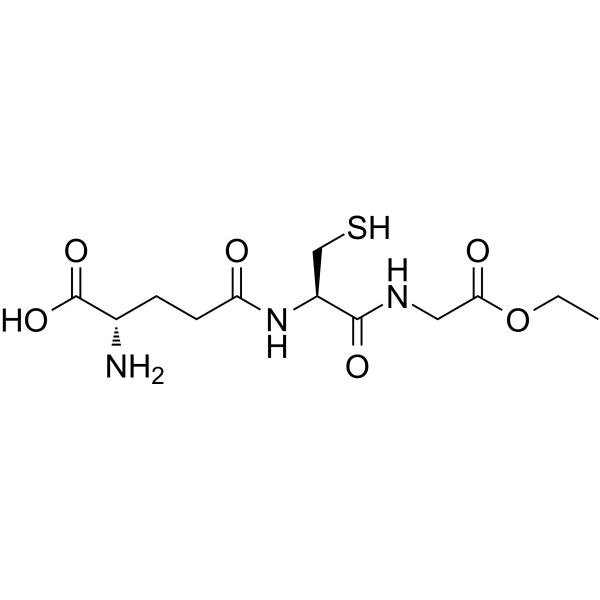
Glutathione ethyl ester is a cell-permeable GSH donor and provides an efficient supply of GSH to the oocyte. Glutathione ethyl ester shows positive effect on the in vitro production of embryos by enhancement of the antioxidative defense .
loading...
    loading...
Cat. No.: HY-P10392AF
Target:  

Wnt β-catenin

Research Areas:  

Cancer

fStAx-35R TFA is the hydrocarbon-stapled peptide. fStAx-35R TFA inhibits Wnt/β-catenin signaling pathway by disrupting the β-catenin-TCF interaction. fStAx-35R TFA can be used in cancer research .
loading...
    loading...
Cat. No.: HY-P10896
CAS No.: 1446005-10-2
Target:  

Bombesin Receptor

Research Areas:  

Cancer

NOTA-P2-RM26 is an antagonist of Bombesin (HY-P0195) analogs, and the gastrin-releasing peptide receptor (GRPR/BB2) is a molecular target for prostate cancer visualization. NOTA-P2-RM26 is labeled with 111In and 68Ga for prostate cancer imaging studies using PET and SPECT/CT .
loading...
    loading...
Cat. No.: HY-W1052178
Synonyms: Folate-PEG2000-Cholesterol
FA-PEG2000-Cholesterol (Folate-PEG2000-Cholesterol) is a multifunctional drug delivery system composed of Folic acid (HY-16637), polyethylene glycol (PEG), and Cholesterol (HY-N0322). Folic acid (FA) has a high affinity for folic acid receptors and can be used to target cell membrane receptors for drug delivery. Cholesterol can improve the circulation time of encapsulated drugs .
loading...
    loading...
Cat. No.: HY-169232
Target:  

PROTACs PD-1/PD-L1

Research Areas:  

Cancer

PCC16 chloride is a dual PROTAC degrader targeting DHHC3 and PD-L1, with a DC50 of 0.103 μM for PD-L1 degradation. PCC16 chloride induces DHHC3 degradation via the ubiquitin-proteasome pathway by recruiting the CRBN E3 ubiquitin ligase (E3 ubiquitin ligase). By targeting DHHC3-which is essential for PD-L1 palmitoylation and membrane stability-PCC16 chloride reduces PD-L1 levels, decreases PD-L1 membrane retention time, and impairs its immunosuppressive function. PCC16 chloride enhances anti-tumor immunity by disrupting PD-L1-mediated immunosuppression. PCC16 chloride can be used in the research of immune checkpoint blockade-resistant cancers .
loading...
    loading...
Cat. No.: HY-P2424
CAS No.: 144396-38-3
Synonyms: CCK-J
Target:  

Calcium Channel

Research Areas:  

Others

Cholecystokinin-J (CCK-J), a cholecystokinin, stimulates Ca 2+ release .
loading...
    loading...
Cat. No.: HY-P10872
Target:  

SARS-CoV

Research Areas:  

Infection

P315V3 is an pan inhibitor for coronavirus, that inhibits SARS-CoV-2 prototypePT, Delta, BA.1 and BA.4 strain with IC50s of 10.9, 8.9, 8.6, and 2.7 nM. P315V3 exhibits cytotoxicity in Vero cell with CC50 of 4.3 μM. P315V3 exhibits anti-infectious efficacy in mouse models .
loading...
    loading...
Cat. No.: HY-P10906
CAS No.: 2868285-05-4
Research Areas:  

Others

Talovirtide is a peptide containing L-valyl .
loading...
    loading...
Cat. No.: HY-P11455
Target:  

Liposome

Research Areas:  

Others

Lipopeptide CPE4 is a PEG-modified peptide E4 [(EIAALEK) 4]. Lipopeptide CPE4 is capable of coiled-coil formation when attached to liposomes. Lipopeptide CPE4 triggers membrane fusion between liposomes and living cells with concomitant efficient cytosolic delivery of a variety of compounds such as fluorescent dyes Propidium Iodide (PI) (HY-D0815) and TO-PRO-3 iodide (HY-117070), and Doxorubicin (DOX) (HY-15142A). Lipopeptide CPE4 can be used for drug delivery research .
loading...
    loading...
Cat. No.: HY-P11766
Synonyms: GALA-Cholesterol
Research Areas:  

Cancer

GALA-chol is a cholesterol-conjugated pH-responsive fusion peptide that can serve as a delivery adjuvant. GALA-chol enhances the endocytosis of siRNA RET/PTC1-SQ nanoparticles, inhibits cell viability, and undergoes pH-responsive charge conversion in the acidic lysosomal environment, thereby promoting lysosomal escape of small extracellular vesicle (sEV) cargo. GALA-chol anchors to the sEV membrane and maintains the structural integrity and intrinsic homing activity of sEVs. GALA-chol can be used in studies related to adjuvant delivery .
loading...
    loading...
Cat. No.: HY-P11625
Target:  

RXFP Receptor

Research Areas:  

Cardiovascular Disease

R9-13 is a fatty acid-conjugated relaxin and an agonist of LGR7 (RXFP1). R9-13 induces sustained pubic symphysis elongation in estrogen-pretreated mice. R9-13 exhibits long-acting pharmacokinetic profiles in rodents, with in vivo activity lasting up to one week after administration. R9-13 can be used in studies related to acute heart failure .
loading...
    loading...
Cat. No.: HY-P11830
Target:  

Amylin Receptor

Research Areas:  

Metabolic Disease

UDA-6 is a potent calcitonin and amylin receptor agonist (DACRA). UDA-6 induces weight loss, improves metabolic and hepatic parameters, and stabilizes active receptor states in obesity rats. UDA-6 can be used for the research of obesity .
loading...
    loading...
Cat. No.: HY-P11596
CAS No.: 3107808-75-0
Target:  

Integrin

Research Areas:  

Cancer

NOTA-Asp2-αvβ6L is an integrin αvβ6 binder with selective accumulation in αvβ6-positive pancreatic cancer cells and tumors. NOTA-Asp2-αvβ6L can be used as a PET/CT tracer for imaging pancreatic ductal adenocarcinoma (PDAC) .
loading...
    loading...
Cat. No.: HY-P11846
Target:  

ADAMTS

Research Areas:  

Cardiovascular Disease

ADA2 is an ADAMTS4-binding peptide and imaging agent with a human ADAMTS4 Ka of 5.3 nM and reduced renal uptake compared to related tracers. ADA2 accumulates in dilated aortic regions in aortic aneurysm mouse models. ADA2 exhibits an in vivo safety profile. ADA2 can be used for the research of aortic aneurysm .
loading...
    loading...
Cat. No.: HY-P3252AS
Pegcetacoplan- 13C3, 15N TFA is the 13C- and 15N-labeled Pegcetacoplan TFA. Pegcetacoplan is a pegylated complement C3/C3b inhibitor. Pegcetacoplan acts by specifically binding to and inhibiting C3 and C3b, thereby suppressing the complement cascade at its proximal stage. Pegcetacoplan is not a known inhibitor or inducer of CYP450 isoenzymes. Pegcetacoplan can be used for the research of complement-mediated diseases, including paroxysmal nocturnal hemoglobinuria (PNH) and age-related macular degeneration (AMD).
loading...
    loading...
  • 1

