5 Results for "

GSDMD-N

" in MedChemExpress (MCE) Product Catalog:
Products (5)

5 Results for "GSDMD-N" in MCE Product Catalog:

2
2 Cited Publications
Cat. No.: HY-P85810
Synonyms: GSDMDc1, GSDMD, Gasdermin-D, Gasdermin domain-containing protein 1

Host:  

Mouse

Application:  

WB, ICC/IF, ELISA

Reactivity:  

Human, Mouse, Rat

loading...
    loading...
1
1 Cited Publications
Cat. No.: HY-N0218
CAS No.: 63238-67-5
Synonyms: Mesaconine 14-benzoate
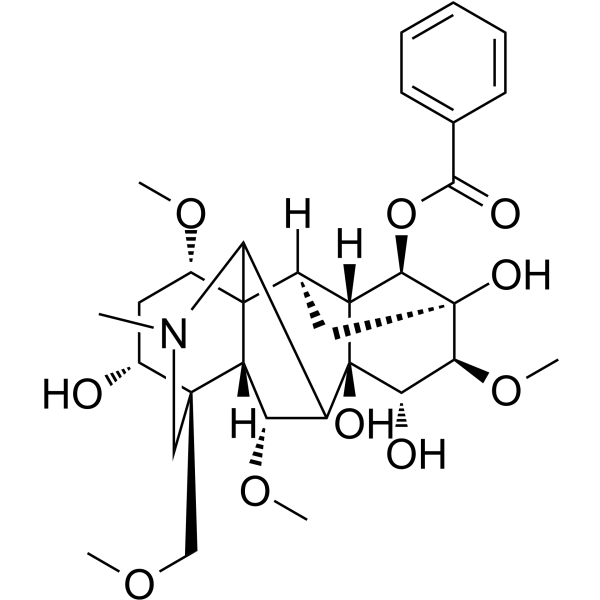
Benzoylmesaconine is a monoester-type alkaloid and is the most abundant component of Wutou decoction, which is widely used in China for rheumatoid arthritis. Benzoylmesaconine exhibits potent anti-inflammatory properties by inhibiting NF-κB. Benzoylmesaconine can suppress NLRP3 inflammasome activation by inhibiting IL-1β secretion and GSDMD-N protein expression. Benzoylmesaconine reduces intracellular K + efflux and disrupts NLRP3 inflammasome assembly .
loading...
    loading...
Cat. No.: HY-154795
CAS No.: 658701-67-8
Purity:  99.81%
Synonyms: 18α-Glycyrrhizic acid Magnesium hydrate; 18α-GA Magnesium hydrate; 18α-Licorice-saponin H2 Magnesium hydrate
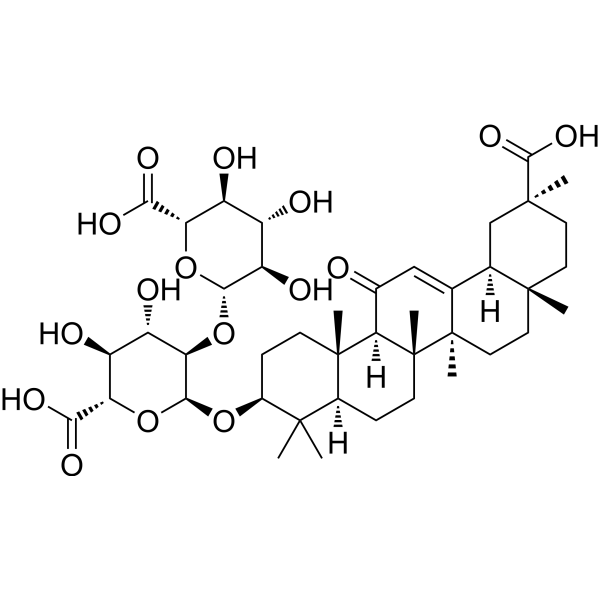
Magnesium isoglycyrrhizinate hydrate (18α-Glycyrrhizic acid Magnesium hydrate; 18α-GA Magnesium hydrate; 18α-Licorice-saponin H2 Magnesium hydrate) is a derivative of glycyrrhizic acid with oral activity. Magnesium isoglycyrrhizinate hydrate exhibits antioxidant, anti-inflammatory, hepatoprotective and cardioprotective activities. Magnesium isoglycyrrhizinate hydrate protects against ethanol-induced alcoholic liver disease in rats by upregulating the expression levels of SOD, GSH, PPAR-α and CPT-1 . Magnesium isoglycyrrhizinate hydrate shows cytotoxicity against T lymphocytes and inhibits HIV-1 replication in these cells . Magnesium isoglycyrrhizinate hydrate alleviates oxidative stress by reducing the levels of ROS, Nrf2, HO-1 and p-P65, and alleviates pyroptosis by downregulating the expression levels of NLRP3, GSDMD-N, P20 and c-IL-1β. Magnesium isoglycyrrhizinate hydrate inhibits autophagy, colonic fibrosis and myocardial fibrosis, and regulates intestinal barrier integrity. Magnesium isoglycyrrhizinate hydrate can be used in research related to alcoholic liver disease, HIV-1 infection, hepatotoxicity, acute liver failure, inflammatory bowel disease and myocardial fibrosis .
loading...
    loading...
Cat. No.: HY-N6911A
CAS No.: 83896-44-0
Synonyms: 18α-GA; Isoglycyrrhizinic acid; 18α-Glycyrrhizic acid
18α-Glycyrrhizic acid (18α-GA; Isoglycyrrhizinic acid; 18α-Glycyrrhizic acid) is a derivative of glycyrrhizic acid with oral activity. 18α-Glycyrrhizic acid exhibits antioxidant, anti-inflammatory, hepatoprotective and cardioprotective activities. 18α-Glycyrrhizic acid protects against ethanol-induced alcoholic liver disease in rats by upregulating the expression levels of SOD, GSH, PPAR-α and CPT-1 . 18α-Glycyrrhizic acid shows cytotoxicity against T lymphocytes and inhibits HIV-1 replication in these cells . 18α-Glycyrrhizic acid alleviates oxidative stress by reducing the levels of ROS, Nrf2, HO-1 and p-P65, and alleviates pyroptosis by downregulating the expression levels of NLRP3, GSDMD-N, P20 and c-IL-1β. 18α-Glycyrrhizic acid inhibits autophagy, colonic fibrosis and myocardial fibrosis, and regulates intestinal barrier integrity. 18α-Glycyrrhizic acid can be used in research related to alcoholic liver disease, HIV-1 infection, hepatotoxicity, acute liver failure, inflammatory bowel disease and myocardial fibrosis .
loading...
    loading...
Cat. No.: HY-182066
Target:  

PANoptosis

Research Areas:  

Cancer

Photosensitizer-9 is an iridium (III)-based photosensitizer with anti-melanoma activity. Photosensitizer-9 exhibits significant phototoxicity (IC50=0.98 μM) and an ideal phototoxicity index (PI=3.05). Under light irradiation, Photosensitizer-9 generates large amounts of intracellular •OH in an oxygen-independent manner. Photosensitizer-9 mediates photodynamic therapy under hypoxic conditions and synergistically activates PANoptosis (by upregulating cleaved Caspase-3, GSDMD-N, p-MLKL), ferroptosis (by disrupting the GSH-GPX4-LPO axis), apoptosis, pyroptosis and necroptosis in melanoma cells. Photosensitizer-9 induces immunogenic cell death by promoting the release of damage-associated molecular patterns under hypoxic conditions and increases the maturation rate of dendritic cells. Photosensitizer-9 reduces tumor volume in melanoma-bearing mice. Photosensitizer-9 is applicable to relevant studies on melanoma .
loading...
    loading...

