



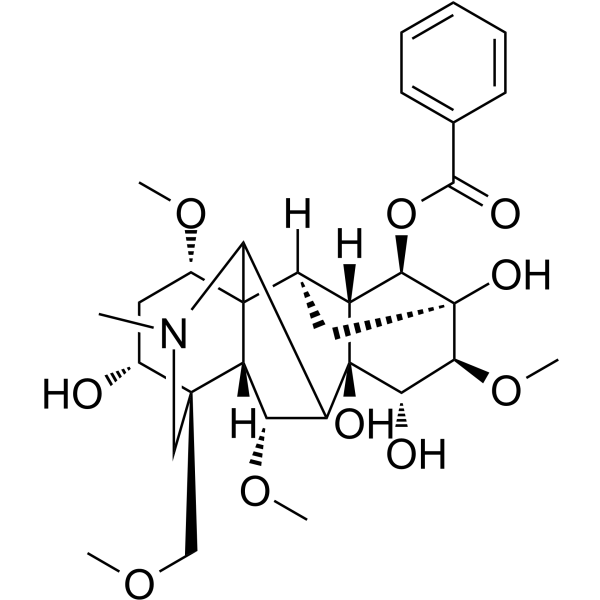
Benzoylmesaconine
Based on 1 publication(s) in Google Scholar
Benzoylmesaconine is a monoester-type alkaloid and is the most abundant component of Wutou decoction, which is widely used in China for rheumatoid arthritis. Benzoylmesaconine exhibits potent anti-inflammatory properties by inhibiting NF-κB. Benzoylmesaconine can suppress NLRP3 inflammasome activation by inhibiting IL-1β secretion and GSDMD-N protein expression. Benzoylmesaconine reduces intracellular K+ efflux and disrupts NLRP3 inflammasome assembly.
For research use only. We do not sell to patients.
- Purity : 99.56%
- CAS No.: 63238-67-5
- Formula: C31H43NO10
- Molecular Weight:589.67
-
Storage:Powder -20°C, 3 years , 4°C, 2 years ; In solvent -80°C, 6 months , -20°C, 1 month

To place orders, for customer services and technical support, please contact: MedChemExpress USA
Tel: 609-228-6898 E-mail: [email protected] [email protected]


-
 Biological Activity
-
Chemical Information
-
Solvent & Solubility
- Protocols
- Purity & Documentation
- References
-
 Help & FAQs


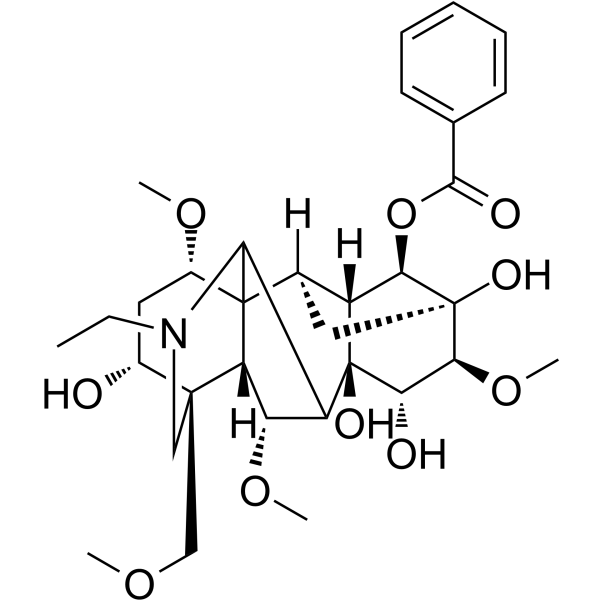
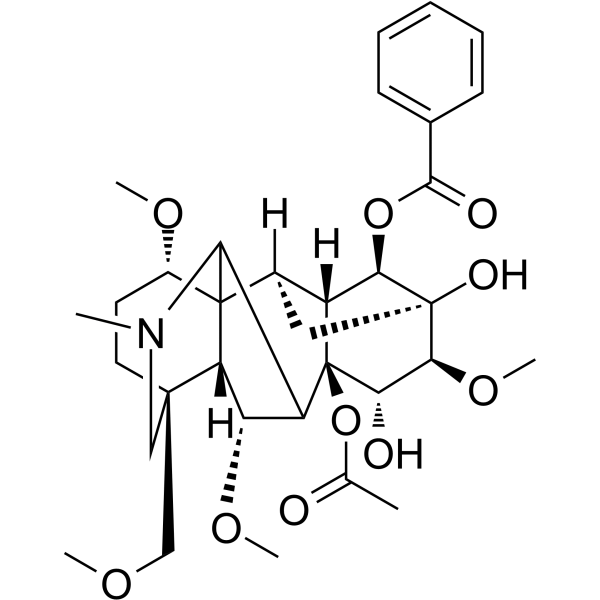
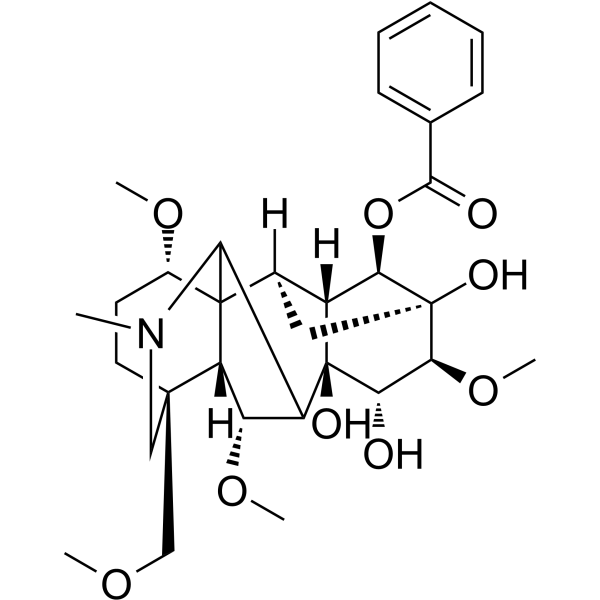

Publications Citing Use of MedChemExpress (MCE) Benzoylmesaconine
More

Biological Activity
Description
In Vitro
Benzoylmesaconine (Compound BMA) (0-160 μM) effectively suppresses nigericin-induced IL-1β release in LPS-primed BMDMs in a concentration-dependent manner in bone marrow-derived macrophages (BMDMs)[3].
Benzoylmesaconine (0-80 μM, 30 min) significantly inhibits the activation of caspase-1 and the secretion of IL-1β and key downstream effectors of the NLRP3 inflammasome in BMDMs[3].
Benzoylmesaconine (0-80 μM) significantly reduces lactate dehydrogenase release and cell death, suggesting its ability to inhibit pyroptosis[3].
MedChemExpress (MCE) has not independently confirmed the accuracy of these methods. They are for reference only.
-
Cell Line:(HY-D1056)-primed bone marrow-derived macrophages (BMDMs) stimulated with Nigericin (HY-127019)
-
Concentration:0, 20, 40, 80 μM
-
Incubation Time:30 min
-
Result:Had inhibitory effect on IL-1β release.
In Vivo
Benzoylmesaconine (5-20 mg/kg, i.p., single dose) significantly inhibits DSS-induced colitis in mice model[3].
Benzoylmesaconine (5-20 mg/kg, i.p., single dose) inhibits air pouch inflammation in MSU crystal induced air pouch mouse model[3].
MedChemExpress (MCE) has not independently confirmed the accuracy of these methods. They are for reference only.
-
Animal Model:MSU-induced acute gouty arthritis mice[3]
-
Dosage:5, 10, 20 mg/kg
-
Administration:Intraperitoneal injection (i.p.)
-
Result:Suppressed pro-inflammatory cytokine production.
Significantly reduced left hindfoot swelling.
Significantly reduced inflammatory cell infiltration.
-
Animal Model:MSU crystal induced air pouch mouse model[3]
-
Dosage:5, 10, 20 mg/kg
-
Administration:Intraperitoneal injection (i.p.)
-
Result:Effectively inhibited NLRP3 protein expression , caspase-1 cleavage and IL-1β release.
Significantly alleviated mucosal thickening and inflammatory cell infiltration.


Chemical Information
-
CAS No. 63238-67-5
-
Appearance Solid
-
Molecular Weight 589.67
-
Formula C31H43NO10
-
Color White to off-white
-
SMILES
CO[C@@H]1C2([C@@](C[C@@]3(O)[C@@H]4OC(C5=CC=CC=C5)=O)([H])[C@@]4([H])[C@](O)([C@@H](O)[C@@H]3OC)C6C2N(C)C7)[C@@]([C@H]6OC)([H])[C@@]7(COC)[C@H](O)C1
-
Synonyms
Mesaconine 14-benzoate
-
Structure Classification
-
Initial Source
-
Shipping
Room temperature in continental US; may vary elsewhere.
-
Storage
Powder -20°C 3 years 4°C 2 years In solvent -80°C 6 months -20°C 1 month


Publications (1)
-
Journal Impact Factor
-
Most Recent


Solvent & Solubility
In Vitro:
DMSO : 100 mg/mL (169.59 mM; Need ultrasonic; Hygroscopic DMSO has a significant impact on the solubility of product, please use newly opened DMSO)
H2O : 12.5 mg/mL (21.20 mM; Need ultrasonic)
Please refer to the solubility information to select the appropriate solvent. Once prepared, please aliquot and store the solution to prevent product inactivation from repeated freeze-thaw cycles.
Storage method and period of stock solution: -80°C, 6 months; -20°C, 1 month. When stored at -80°C, please use it within 6 months. When stored at -20°C, please use it within 1 month.
* Note: If you choose water as the stock solution, please dilute it to the working solution, then filter and sterilize it with a 0.22 μm filter before use.
Please refer to the solubility information to select the appropriate solvent. Once prepared, please aliquot and store the solution to prevent product inactivation from repeated freeze-thaw cycles.
Storage method and period of stock solution: -80°C, 6 months; -20°C, 1 month. When stored at -80°C, please use it within 6 months. When stored at -20°C, please use it within 1 month.
* Note: If you choose water as the stock solution, please dilute it to the working solution, then filter and sterilize it with a 0.22 μm filter before use.
Concentration (start) × Volume (start) = Concentration (final) × Volume (final)
In Vivo:
Select the appropriate dissolution method based on your experimental animal and administration route.
- For the following dissolution methods, please ensure to first prepare a clear stock solution using an In Vitro approach and then sequentially add co-solvents:
- To ensure reliable experimental results, the clarified stock solution can be appropriately stored based on storage conditions. As for the working solution for In Vivo experiments, it is recommended to prepare freshly and use it on the same day.
- The percentages shown for the solvents indicate their volumetric ratio in the final prepared solution. If precipitation or phase separation occurs during preparation, heat and/or sonication can be used to aid dissolution.
Add each solvent one by one: 10% DMSO 40% PEG300 5% Tween-80 45% Saline
Solubility: ≥ 2.5 mg/mL (4.24 mM); Clear solution
This protocol yields a clear solution of ≥ 2.5 mg/mL (saturation unknown).
Taking 1 mL working solution as an example, add 100 μL DMSO stock solution (25.0 mg/mL) to 400 μL PEG300, and mix evenly; then add 50 μL Tween-80 and mix evenly; then add 450 μL Saline to adjust the volume to 1 mL.
Preparation of Saline: Dissolve 0.9 g sodium chloride in ddH₂O and dilute to 100 mL to obtain a clear Saline solution.
Add each solvent one by one: 10% DMSO 90% (20% SBE-β-CD in Saline)
Solubility: ≥ 2.5 mg/mL (4.24 mM); Clear solution
This protocol yields a clear solution of ≥ 2.5 mg/mL (saturation unknown).
Taking 1 mL working solution as an example, add 100 μL DMSO stock solution (25.0 mg/mL) to 900 μL 20% SBE-β-CD in Saline, and mix evenly.
Preparation of 20% SBE-β-CD in Saline (4°C, storage for one week): 2 g SBE-β-CD powder is dissolved in 10 mL Saline, completely dissolve until clear.
In Vivo Dissolution Calculator
Please enter the basic information of animal experiments:
-
-
-
-
Recommended: Prepare an additional quantity of animals to account for potential losses during experiments.
Please enter your animal formula composition:
-
%DMSO +
Recommended: Keep the proportion of DMSO in working solution below 2% if your animal is weak.
-
%+
-
+%Tween-80 + +
-
%Saline +
The co-solvents required include: DMSO, . All of co-solvents are available by MedChemExpress (MCE). , Tween 80. All of co-solvents are available by MedChemExpress (MCE).
Working solution concentration: 0.22 mg/mL
Method for preparing stock solution: mg drug dissolved in μL DMSO. Stock solution concentration: mg/mL.
1. Take μL DMSO stock solution;
2. Add μL .
μL , mix evenly;
3. Then add μL Tween 80, mix evenly;
4. Then add μL
Please ensure that the stock solution in the first step is dissolved to a clear state, and add co-solvents in sequence. You can use ultrasonic heating (ultrasonic cleaner, recommended frequency 20-40 kHz), vortexing, etc. to assist dissolution.


Purity & Documentation
-
Data Sheet (290 KB)
-
SDS (396 KB)
- English - EN (396 KB)
- Français - FR (396 KB)
- Deutsch - DE (396 KB)
- Norwegian - NO (396 KB)
- Español - ES (396 KB)
- Swedish - SV (396 KB)
- Italian - IT (396 KB)
- Korean - KR (396 KB)
- Portuguese - PT (396 KB)
-
Handling Instructions (2659 KB)
References
[1]. Dai PM, et al. Pharmacokinetic comparisons of benzoylmesaconine in rats using ultra-performance liquid chromatography-tandem mass spectrometry after administration of pure benzoylmesaconine and Wutou decoction. Molecules. 2014 Oct 17;19(10):16757-69. [Content Brief]
[2]. Ye L, et al. Monoester-Diterpene Aconitum Alkaloid Metabolism in Human Liver Microsomes: Predominant Role of CYP3A4 and CYP3A5. Evid Based Complement Alternat Med. 2013;2013:941093. [Content Brief]
[3]. Zhang, Z., et al., (2024). Benzoylmesaconine mitigates NLRP3 inflammasome-related diseases by reducing intracellular K+ efflux and disrupting NLRP3 inflammasome assembly. Phytomedicine : international journal of phytotherapy and phytopharmacology, 135, 156154. [Content Brief]


Complete Stock Solution Preparation Table
Please refer to the solubility information to select the appropriate solvent. Once prepared, please aliquot and store the solution to prevent product inactivation from repeated freeze-thaw cycles.
Storage method and period of stock solution: -80°C, 6 months; -20°C, 1 month. When stored at -80°C, please use it within 6 months. When stored at -20°C, please use it within 1 month.
| Optional Solvent | Concentration Solvent Mass | 1 mg | 5 mg | 10 mg | 25 mg |
|---|---|---|---|---|---|
| H2O / DMSO | 1 mM | 1.6959 mL | 8.4793 mL | 16.9585 mL | 42.3963 mL |
| 5 mM | 0.3392 mL | 1.6959 mL | 3.3917 mL | 8.4793 mL | |
| 10 mM | 0.1696 mL | 0.8479 mL | 1.6959 mL | 4.2396 mL | |
| 15 mM | 0.1131 mL | 0.5653 mL | 1.1306 mL | 2.8264 mL | |
| 20 mM | 0.0848 mL | 0.4240 mL | 0.8479 mL | 2.1198 mL | |
| DMSO | 25 mM | 0.0678 mL | 0.3392 mL | 0.6783 mL | 1.6959 mL |
| 30 mM | 0.0565 mL | 0.2826 mL | 0.5653 mL | 1.4132 mL | |
| 40 mM | 0.0424 mL | 0.2120 mL | 0.4240 mL | 1.0599 mL | |
| 50 mM | 0.0339 mL | 0.1696 mL | 0.3392 mL | 0.8479 mL | |
| 60 mM | 0.0283 mL | 0.1413 mL | 0.2826 mL | 0.7066 mL | |
| 80 mM | 0.0212 mL | 0.1060 mL | 0.2120 mL | 0.5300 mL | |
| 100 mM | 0.0170 mL | 0.0848 mL | 0.1696 mL | 0.4240 mL |
* Note: If you choose water as the stock solution, please dilute it to the working solution, then filter and sterilize it with a 0.22 μm filter before use.


Benzoylmesaconine Related Classifications
HY-N0218 Related Classifications
 Powered by Bioz