
1. Search Result
Search Result
Pathways Recommended: Stem Cell/Wnt Cell Cycle/DNA Damage
Results for "

Huh7.5 cells

" in MedChemExpress (MCE) Product Catalog:

16

Inhibitors & Agonists

1

Biochemical Assay Reagents

1

Natural
Products

1

Oligonucleotides

Cat. No. Nombre del producto Target Áreas de investigación Chemical Structure
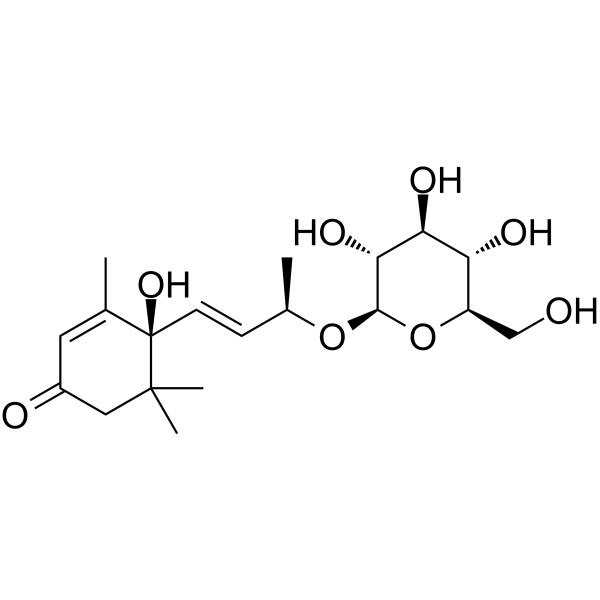
  • HY-N1341

    HCV HCV Protease DNA/RNA Synthesis Bacterial Infection
    Roseoside is an inhibitor of DNA gyrase and HAV 3C protease, and also inhibits HCV NS5A/B replicase in human systems with an IC50 of 20 μM. Roseoside binds to the active site of enzymes and stabilizes the interaction by forming hydrogen bonds with key amino acid residues. Roseoside inhibits the growth of Gram-positive bacteria, Gram-negative bacteria, and Candida albicans, and interferes with HCV RNA replication in vitro by inhibiting HCV NS5A/B replicase (IC50=20 μM). Roseoside shows no cytotoxicity and serves as a research tool for studies related to bacterial infections, candidiasis, HAV and HCV .
    Roseoside
  • HY-142989

    Liposome HIV HCV HBV Infection Cancer
    1,2-Didocosahexaenoyl-sn-glycero-3-phosphocholine is a polyunsaturated phospholipid that serves as a component of lipid monolayers and small unilamellar vesicles. 1,2-Didocosahexaenoyl-sn-glycero-3-phosphocholine can be used to prepare endoplasmic reticulum-targeted liposomes (PERLs), which are composed of 1,2-didocosahexaenoyl-sn-glycero-3-phosphoethanolamine, l-α-phosphatidylinositol and l-α-phosphatidylserine at a molar ratio of 1.5:1.5:1:1. PERLs reduce cholesterol levels in human peripheral blood mononuclear cells (PBMCs) and decrease HIV-1 particle secretion from HIV-1-infected PBMCs. Liposomes formed from 1,2-Didocosahexaenoyl-sn-glycero-3-phosphocholine exhibit cytotoxicity against leukemia cells. 1,2-Didocosahexaenoyl-sn-glycero-3-phosphocholine is applicable to studies related to hepatitis C virus infection, HIV infection, hepatitis B virus infection and leukemia .
    1,2-Didocosahexaenoyl-sn-glycero-3-phosphocholine
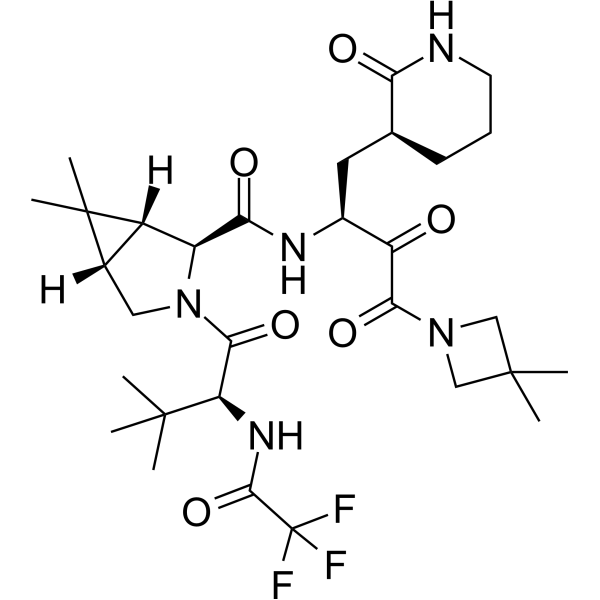
  • HY-158073

    SARS-CoV Infection
    ML2006a4 is an orally active inhibitor for SARS-CoV-2 main protease (M pro) with IC50 in picomolare value. ML2006a4 is cell permeable and antiviral active, that inhibits replication in SARS-CoV-2 in cells Huh7.5.1-ACE2-TMPRSS2 (Huh7.5.1++) in picomolare level
    ML2006a4
  • HY-161806

    PROTACs Dengue Virus Infection
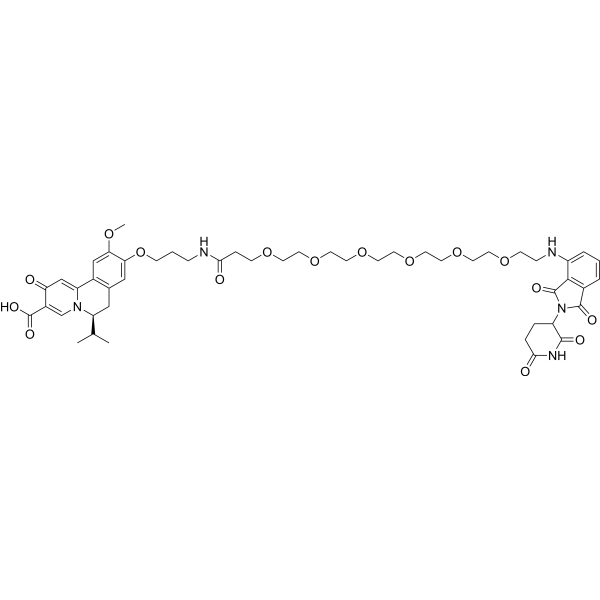
    ZXH-8-004 (2-12-2-deg) is a potent DENV E PROTAC degrader with an DC50 value of 0.21 µM. ZXH-8-004 shows exhibit antiviral potencies (Blue: E3 ligase (HY-103596), Black: linker (HY-42149); Pink: DENV E ligand (HY-161807)) .
    ZXH-8-004
  • HY-161628

    Topoisomerase Cancer
    Tapcin is a dual inhibitor for topoisomerase I and topoisomerase II, with IC50 of 203 and 71 nM. Tapcin inhibits proliferations of cancer cells A-375, HeLa, Huh7.5, U2-OS, A549, Caco-2 and HT29, with IC50s of 441, 1.04, 40.5, 0.002, 0.006, 0.287 and 0.842 nM, respectively. Tapcin exhibits antitumor activity in HT29 xenograft model .
    Tapcin
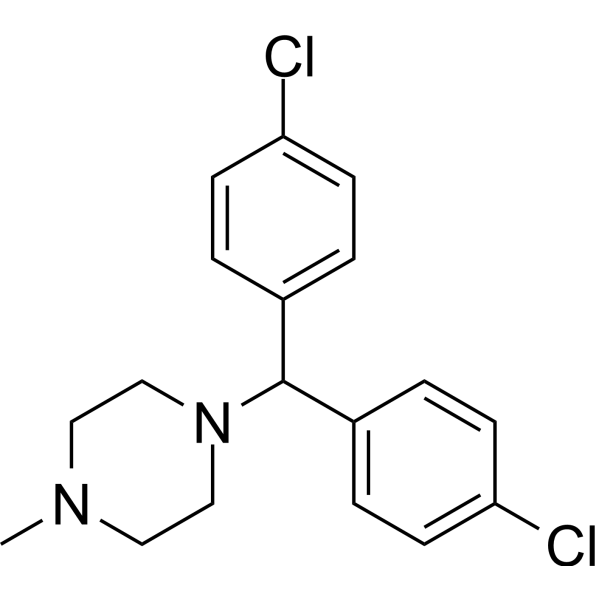
  • HY-113860

    HCV Infection
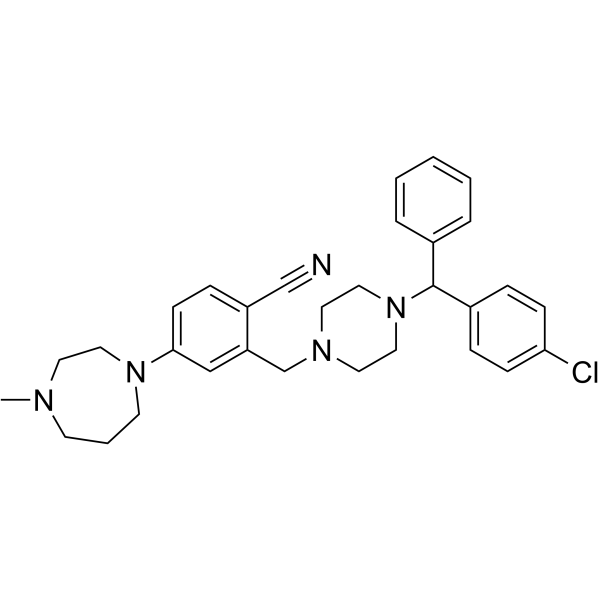
    Antiviral agent 52 (Compound 30) is a Chlorcyclizine (HY-112067) derivative that exhibits antiviral activity against hepatitic C virus (HCV) with an EC50 of 17 nM. Antiviral agent 52 reveals cytotoxicity in cell Huh7.5.1 with CC50 of 21.3 μM .
    Antiviral agent 52
  • HY-181927

    SARS-CoV Virus Protease Infection
    SARS-CoV-2 PLpro-IN-7 (Compound 18) is a selective SARS-CoV-2 PLpro inhibitor with an IC50 of 13.3 μM. SARS-CoV-2 PLpro-IN-7 exerts antiviral activity against SARS-CoV-2 (with an EC50 of 11 μM for SARS-CoV-2 in Huh7.5 cells). SARS-CoV-2 PLpro-IN-7 is applicable to research related to COVID-19 .
    SARS-CoV-2 PLpro-IN-7
  • HY-144109

    HCV Infection
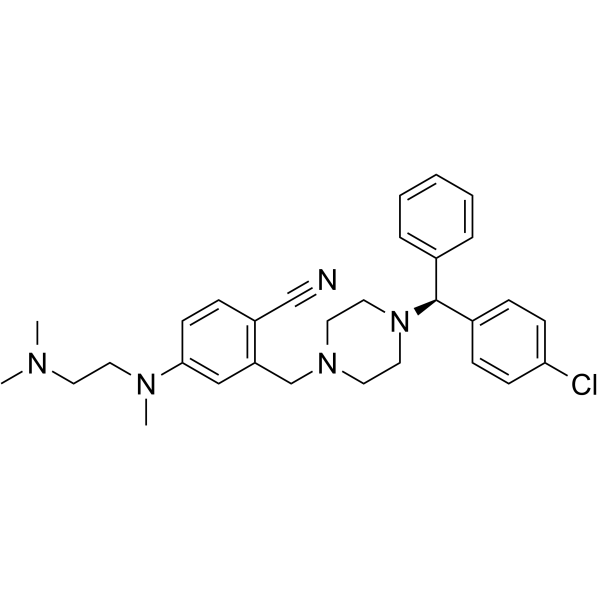
    HCV-IN-36 (compound (S)-3h) is an orally active and potent HCV entry inhibitor. HCV-IN-36 shows excellent antiviral activity, with an EC50 of 0.016 μM and a CC50 (half-maximal cytotoxic concentration) of 8.78 μM .
    HCV-IN-36
  • HY-144107

    HCV Infection
    HCV-IN-34 (compound 3i) is an orally active and potent HCV entry inhibitor. HCV-IN-35 shows excellent antiviral activity, with an EC50 of 0.010 μM and a CC50 (half-maximal cytotoxic concentration) of 8.23 μM .
    HCV-IN-34
  • HY-115989

    HCV Infection
    HCV-IN-38 is a potent, selective and orally active HCV inhibitor (EC50=15 nM, SI=431). HCV-IN-38 has high anti-HCV activity and low cytotoxicity. HCV-IN-38 has a good safety and oral pharmacokinetic profile .
    HCV-IN-38
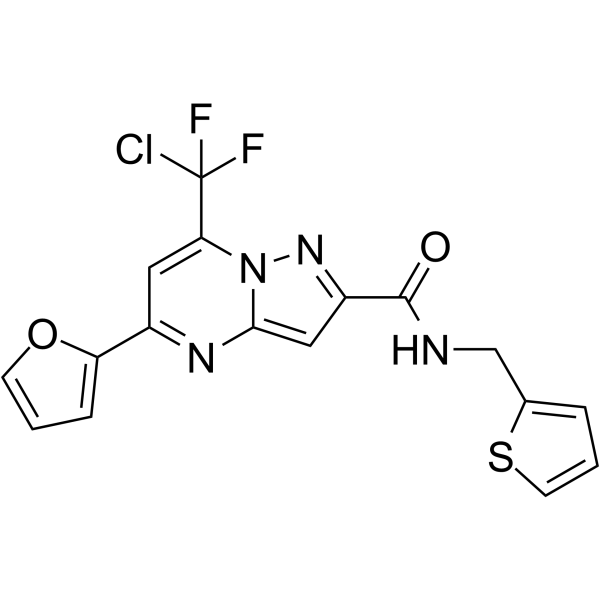
  • HY-13321
    Anguizole
    2 Publications Verification

    HCV Infection
    Anguizole is an HCV NS4B inhibitor. Anguizole interacts with NS4B-AH2, inhibits AH2 lipid vesicle aggregation, disrupts NS4B dimerization/multimerization and impairs NS4B-NS5A interaction. Anguizole exhibits little host cell toxicity. Anguizole can be used for the research of HCV infection .
    Anguizole
  • HY-183873

    SARS-CoV Flavivirus Infection
    HLB-0532247 is a cell-permeable phosphoramidate prodrug of 3'-deoxy-3',4'-didehydrocytidine (ddhC). HLB-0532247 increases the intracellular level of the endogenous antiviral nucleotide ddhCTP. HLB-0532247 reduces the titers of Zika virus and West Nile virus in cell cultures. HLB-0532247 can be used in studies related to Zika virus infection, West Nile virus infection, and coronavirus infection .
    HLB-0532247
  • HY-181920

    PROTACs Dengue Virus Infection
    RPG-01-132 is a DENV capsid protein PROTAC degrader, with a DC50 of 2.4 μM. RPG-01-132 blocks viral assembly, eliminates viral particles, and interferes with the non-structural functions of capsid protein. RPG-01-132 exhibits significant antiviral activity against all four DENV serotypes and the ST148 (HY-121663)-resistant DENV2 mutant strain. RPG-01-132 is applicable to research related to dengue virus infection .
    RPG-01-132
  • HY-N17997

    Others Infection
    Pilosulyne D is a polyyne found in the roots of Codonopsis pilosula .
    Pilosulyne D
  • HY-117802

    DNA/RNA Synthesis HCV HCV Protease Infection
    CID-50930756 is an HCV NS3 helicase inhibitor with an IC50 of 22 μM.CID-50930756 inhibits HCV NS3 helicase-catalyzed nucleic acid unwinding.CID-50930756 inhibits HCV replication in hepatoma cells harboring a stably transfected subgenomic HCV replicon.CID-50930756 does not exhibit toxicity to hepatoma cells at 10 μM.CID-50930756 shows weak DNA-binding activity, displacing less than 20% of SYBR Green I from DNA at 100 μM.CID-50930756 can be used for the research of hepatitis c .
    CID-50930756
  • HY-182679

    HCV Infection
    L0909 is an HCV inhibitor with an EC50 of 0.022 μM. L0909 blocks HCV replication by inhibiting E1-mediated viral entry. L0909 exhibits sensitivity to clinical resistant HCV mutants. L0909 displays synergistic effects with clinical HCV drugs. L0909 can be used for the research of hepatitis c virus (HCV) infection .
    L0909

Consulta en línea

Your information is safe with us. * Required Fields.

Saludo


Country or Region *

Nombre del solicitante *


Nombre de la Organizaciòn *

Department *


Direcciòn del E-mail *


Nombre del producto *

Cat. No.


Requested quantity *

Número de teléfono *


Observaciones

Consulta en línea

Inquiry Information

Nombre del producto:
Cat. No.:
Cantidad:
MCE Japan Authorized Agent:

