
1. Search Result
Search Result
Results for "

Lead (II)

" in MedChemExpress (MCE) Product Catalog:

9

Inhibitors & Agonists

1

Screening Libraries

3

Biochemical Assay Reagents

1

Isotope-Labeled Compounds

1

Click Chemistry

Targets Recommended:
Cat. No. Product Name Target Research Areas Chemical Structure
  • HY-123972
    SEC inhibitor KL-2
    1 Publications Verification

    KL-2

    DNA/RNA Synthesis Cancer
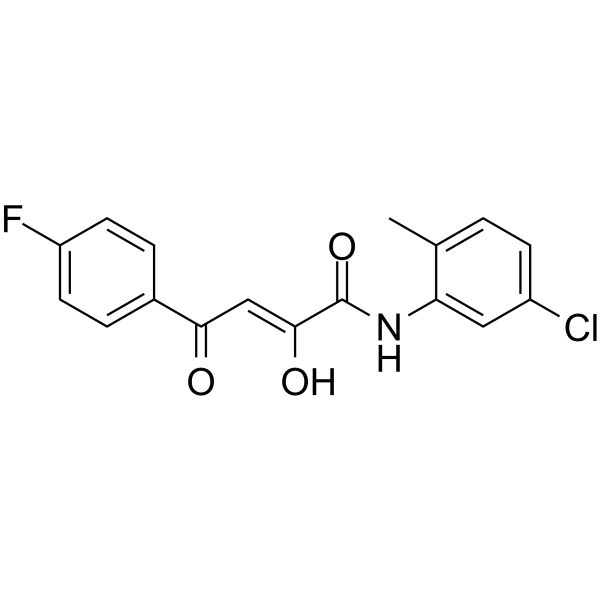
    SEC inhibitor KL-2 (KL-2), a peptidomimetic lead compound, is a potent, selective super elongation complex (SEC) inhibitor and disrupts the interaction between the SEC scaffolding protein AFF4 and P-TEFb, resulting in impaired release of Pol II from promoter-proximal pause sites and a reduced average rate of processive transcription elongation. SEC inhibitor KL-2 exhibits an dose-dependent inhibitory effect on AFF4-CCNT1 interaction with a Ki of 1.50 μM .
    SEC inhibitor KL-2
  • HY-W115721

    Sodium rhodizonate dibasic

    Reactive Oxygen Species (ROS) DNA/RNA Synthesis Others
    Rhodizonic acid disodium (Sodium rhodizonate dibasic) is a transition metal-dependent pro-oxidant and lead detection agent that induces reactive oxygen species generation, DNA damage, and inhibits Aconitase activity. Rhodizonic acid disodium generates superoxide anion radicals in an iron (II)-dependent manner, leading to aconitase inactivation. Rhodizonic acid disodium also triggers hydroxyl radical-mediated DNA strand breaks and 8-OHdG formation via copper ion reduction. Rhodizonic acid disodium reacts with lead to form a scarlet precipitate, with the color intensity proportional to lead content, enabling qualitative or quantitative analysis of lead. Rhodizonic acid disodium can also be used for real-time visualization of the dynamic process of lead sequestration in the plant rhizosphere and evaluation of the effects of environmental factors such as soil type on the stability of lead-sequestering structures .
    Rhodizonic acid disodium
  • HY-137466

    Topoisomerase Cancer
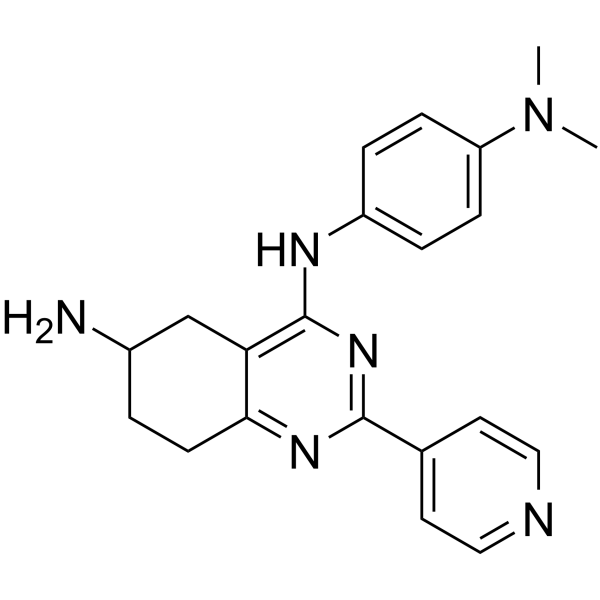
    ARN-21934 is a potent, highly selective, blood-brain barrier (BBB) penetrant inhibitor for human topoisomerase II α over β. ARN-21934 inhibits DNA relaxation with an IC50 of 2 μM as compared to the anticancer agent Etoposide (IC50=120 μM). ARN-21934 exhibits a favorable in vivo pharmacokinetic profile and is a promising lead compound for anticancer research .
    ARN-21934
  • HY-Y1877

    Biochemical Assay Reagents
    Lead carbonate(II) is a kind of biochemical reagent.
    Lead carbonate(II)
  • HY-142956

    Reactive Oxygen Species (ROS) Cancer
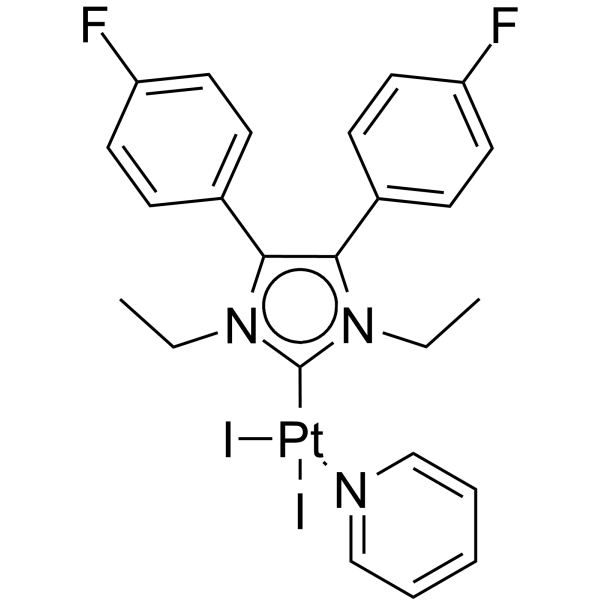
    ROS-ERS inducer 1 is a type II ICD (immunogenic cell death) inducer. ROS-ERS inducer 1 is a Pt(II)-N-heterocyclic carbene (Pt(II)-NHC) complex derived from 4,5-diarylimidazole. ROS-ERS inducer 1 successfully induces endoplasmic reticulum stress (ERS) accompanied by reactive oxygen species (ROS) generation and finally lead to the release of damage-associated molecular patterns (DAMPs) in HCC cells. ROS-ERS inducer 1 displays much higher anticancer activities than Cisplatin .
    ROS-ERS inducer 1
  • HY-W076166C

    Biochemical Assay Reagents Others
    Lead (II) iodide can be used as detector material for photocell X-ray and γ-ray detection .
    Lead (II) iodide
  • HY-W016773

    MHC Transmembrane Glycoprotein Metabolic Disease Inflammation/Immunology
    1,10-Decanediol is a diol compound that can react with α-ketoglutarate (aKG) to generate polymeric microparticles (termed paKG MPs) for the sustained release of aKG, thereby promoting immunosuppressive regulation. Additionally, paKG MPs can bind to dendritic cells (DCs), reducing their glycolysis and mitochondrial respiration in vitro. These metabolic changes lead to the modulation of MHC-II and CD86 expression in DCs and alter the frequency of regulatory T cells (Tregs) as well as T-helper type 1/2/17 cells in vitro. 1,10-Decanediol can be used in research within the field of immunometabolism. can be used as a surfactant/stabilizer in the synthesis of nanomaterials .
    1,10-Decanediol
  • HY-W016773S

    Isotope-Labeled Compounds Others
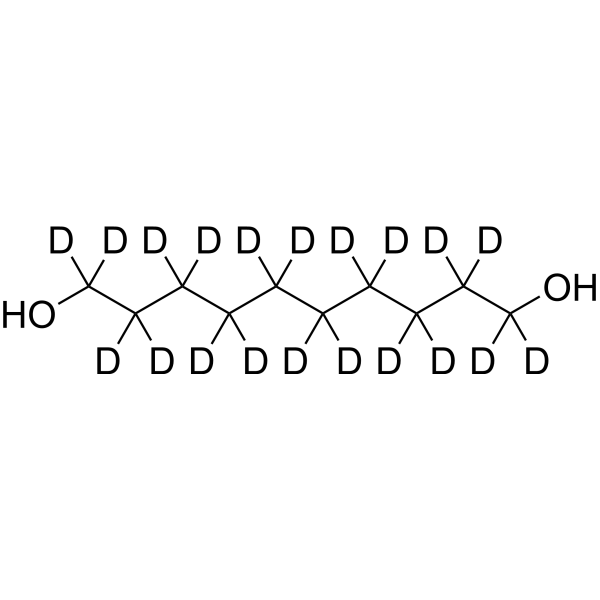
    1,10-Decanediol-d20 is the deuterium labeled 1,10-Decanediol . 1,10-Decanediol is a diol compound that can react with α-ketoglutarate (aKG) to generate polymeric microparticles (termed paKG MPs) for the sustained release of aKG, thereby promoting immunosuppressive regulation. Additionally, paKG MPs can bind to dendritic cells (DCs), reducing their glycolysis and mitochondrial respiration in vitro. These metabolic changes lead to the modulation of MHC-II and CD86 expression in DCs and alter the frequency of regulatory T cells (Tregs) as well as T-helper type 1/2/17 cells in vitro. 1,10-Decanediol can be used in research within the field of immunometabolism. can be used as a surfactant/stabilizer in the synthesis of nanomaterials .
    1,10-Decanediol-d20
  • HY-183549

    Apoptosis Ferroptosis Cancer
    Ferroptosis/apoptosis inducer-4 is a pyridine-hydrazone-derived Cu (II) complex and a synergistic inducer of ferroptosis and apoptosis. Ferroptosis/apoptosis inducer-4 exerts anti-tumor proliferation and anti-metastasis effects with extremely low systemic toxicity. Ferroptosis/apoptosis inducer-4 disrupts cellular redox homeostasis by depleting glutathione and generating hydroxyl radicals through the Cu 2+/Cu + redox cycle. Ferroptosis/apoptosis inducer-4 also triggers mitochondrial dysfunction and endoplasmic reticulum stress, which in turn lead to Ca 2+ release, mitochondrial Ca 2+ overload, and the formation of a ROS−Ca 2+ self-amplifying feedback loop. Ferroptosis/apoptosis inducer-4 can be used in studies related to cervical cancer .
    Ferroptosis/apoptosis inducer-4

Inquiry Online

Your information is safe with us. * Required Fields.

Salutation


Country or Region *

Applicant Name *


Organization Name *

Department *


Email Address *


Product Name *

Cat. No.


Requested quantity *

Phone Number *


Remarks

Inquiry Online

Inquiry Information

Product Name:
Cat. No.:
Quantity:
MCE Japan Authorized Agent:

