11 Results for "

MCAO rat model

" in MedChemExpress (MCE) Product Catalog:
Products (11)

11 Results for "MCAO rat model" in MCE Product Catalog:

Cat. No.: HY-N3847
CAS No.: 38965-51-4
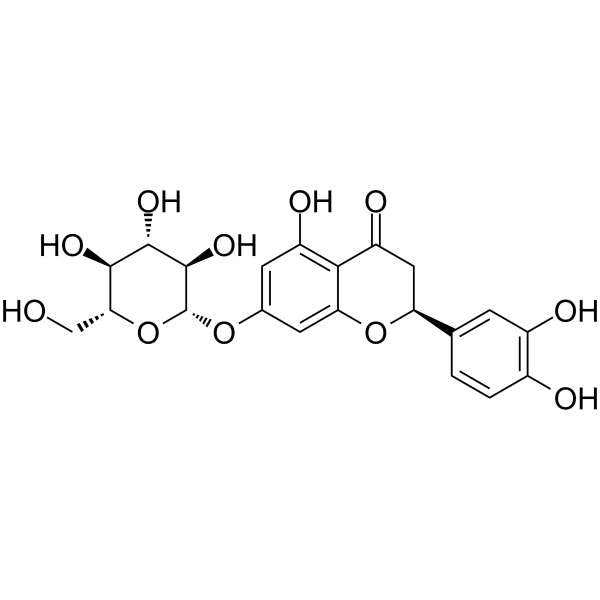
Synonyms: Eriodictyol 7-O-β-D-glucoside
Eriodictyol-7-O-glucoside (Eriodictyol 7-O-β-D-glucoside), a flavonoid, is an Nrf2 activator. Eriodictyol-7-O-glucoside exhibits significant scavenging effects on both hydroxyl radicals and superoxide anions, with IC50 values of 0.28 mM and 0.30 mM, respectively. Eriodictyol-7-O-glucoside increases the nuclear localization of Nrf2 and induces the expression of the Nrf2/ARE-dependent genes. Eriodictyol-7-O-glucoside provides protection against oxygen and glucose deprivation (OGD)-induced oxidative insult. Eriodictyol-7-O-glucoside demonstrates neuroprotective efficacy in a rat model of focal cerebral ischemia (MCAO). Eriodictyol-7-O-glucoside can be used for the study of stroke .
loading...
    loading...
Cat. No.: HY-N7905
CAS No.: 520-14-9
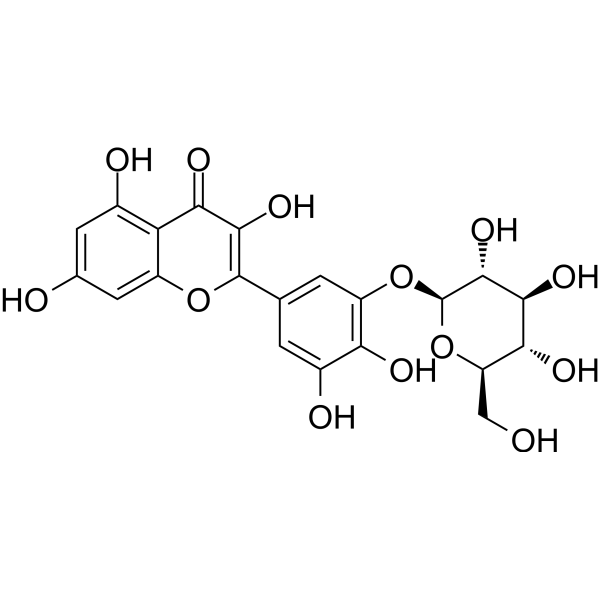
Myricetin 3'-glucoside is an orally active glycosylated flavonoid. Myricetin 3'-glucoside inhibits the cerebral ischemia-induced elevation of inflammatory cytokine levels, including TNF-α, IL-6 and IL-1β. Myricetin 3'-glucoside reverses the cerebral ischemia-mediated downregulation of Bcl-2 protein levels and reduces the cerebral ischemia-induced upregulation of Bax protein levels. Myricetin 3'-glucoside reduces cerebral infarct volume, increases the number of Nissl bodies, and improves neurological function scores in a rat model of middle cerebral artery occlusion (MCAO). Myricetin 3'-glucoside can be used in cerebral ischemia-related research .

loading...
    loading...
Cat. No.: HY-119495
CAS No.: 148152-77-6
Research Areas:  

Neurological Disease

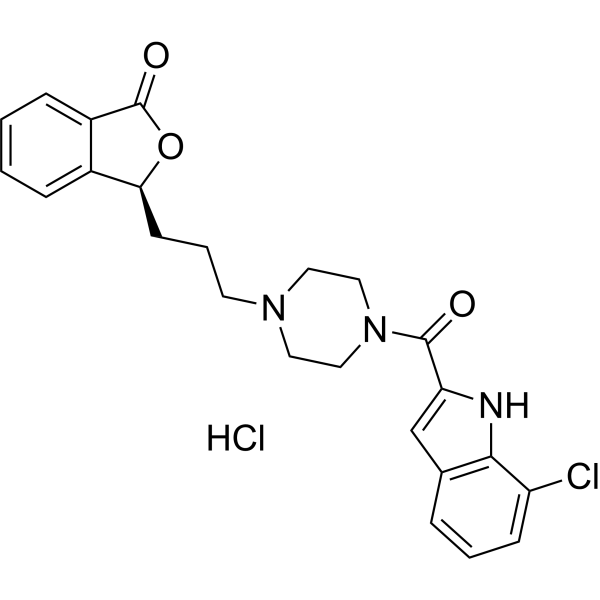
JTP 2942 is a thyrotropin-releasing hormone analogue. JTP 2942 can promote the release of Acetylcholine in the hippocampus and frontal cortex of rats. JTP 2942 possesses neuroprotective and cognitive-improving activities. JTP 2942 dose-dependently improves motor and neurological deficits in rat models of chronic focal cerebral ischemia. JTP 2942 can be used for the research of cerebral ischemia, motor neuron diseases, and other related conditions .
loading...
    loading...
Cat. No.: HY-178464
CAS No.: 3065634-19-4
RIPK1-IN-34 is a selective, brain-penetrant RIPK1 inhibitor (IC50 = 126.70 nM) with almost no inhibitory effect on RIPK3 (IC50 > 10, 000 nM). RIPK1-IN-34 offers substantial neuroprotection by inhibiting the phosphorylation of RIPK1, RIPK3, and mixed lineage kinase domain-like pseudokinase (MLKL) within the necroptosis pathway. RIPK1-IN-34 shows the neuroprotective effect in a rat middle cerebral artery occlusion (MCAO) model. RIPK1-IN-34 can be used for the study of anti-acute ischemic stroke (AIS) .
loading...
    loading...
Cat. No.: HY-174127
Target:  

P2Y Receptor

Research Areas:  

Neurological Disease

P2Y1 antagonist 3 (compound 36b) is a blood-brain barrier (BBB)-penetrant P2Y1 antagonist with an IC50 of 0.50 μM. P2Y1 antagonist 3 exhibits protective effects in a rat middle cerebral artery occlusion (MCAO) model and demonstrates neuroprotective activity against oxidative stress by upregulating nuclear Nrf2 protein levels .
loading...
    loading...
Cat. No.: HY-159928
Neuroprotective agent 8 (compound AA-9) is an oral active neuroprotective agent by anti-oxidative stress and anti-inflammation. Neuroprotective agent 8 activates PGC-1α and inhibits NLRP3 in the rat MCAO ischemic stroke model .
loading...
    loading...
Cat. No.: HY-157936
CAS No.: 3034593-10-4
Target:  

iGluR

Research Areas:  

Neurological Disease

GluN2B-NMDAR antagonist-2 (compound S-58) is a potent, selective and cross the blood-brain barrier NMDAR-GluN2B antagonist with an IC50 value of 74.01, nM. GluN2B-NMDAR antagonist-2 shows mild cytotoxicity. GluN2B-NMDAR antagonist-2 decreases the cerebral infarction rates and neurologic deficit scores. GluN2B-NMDAR antagonist-2 has the potential for the research of stroke .
loading...
    loading...
Cat. No.: HY-100458
CAS No.: 2185855-51-8
Target:  

NO Synthase

Research Areas:  

Neurological Disease

SCR-4026 is a neuroprotective agent with blood-brain barrier penetration ability. SCR-4026 exerts neuroprotective effects by disrupting the interaction between neuronal nNOS and PSD9, with an IC50 of 6.3 μM. SCR-4026 alleviates N-methyl-D-aspartate (NMDA)-induced excitotoxic damage in primary cortical neurons, and also protects neurons in the oxygen-glucose deprivation (OGD) model. SCR-4026 can reduce the cerebral infarct volume in the rat middle cerebral artery occlusion (MCAO) reperfusion model. SCR-4026 can be used for the study of stroke .
loading...
    loading...
Cat. No.: HY-173142
Target:  

Drug Derivative

Research Areas:  

Neurological Disease

Neuroprotective agent 7 (Compound 13) is a BBB-penetrable neuroprotective agent. Neuroprotective agent 7 has a powerful neuroprotective effect and can reduce the cerebral infarct area in the MCAO rat model. Neuroprotective agent 7 can be used in the research of diseases such as cerebral ischemia .
loading...
    loading...
Cat. No.: HY-182068
Target:  

iGluR

NFI23 is a blood-brain barrier-penetrant GluN2B-NMDAR inhibitor, with an IC50 of 1.31 μM and a Ki of 5.98 nM against GluN2B-NMDAR. NFI23 reduces NMDA-induced Ca 2+ influx and ROS production, maintains mitochondrial membrane potential, inhibits neuronal apoptosis, and restores the expression of p-ERK1/2. NFI23 exerts neuroprotective effects against NMDA-induced cytotoxicity and in the rat middle cerebral artery occlusion (MCAO) model. NFI23 can be used for the research of ischemic stroke .
loading...
    loading...
Cat. No.: HY-180806
CAS No.: 3065634-42-3
RIPK1-IN-39 (compound 2) is a potent and selective RIPK1 inhibitor (IC50 = 69.40 nM) exhibiting >100-fold selectivity over RIPK3 (IC50 = 6946 nM). RIPK1-IN-39 protects HT-22 and HT-29 cells from necroptosis by inhibiting the phosphorylation and activation of the RIPK1-RIPK3-MLKL pathway. RIPK1-IN-39 demonstrates neuroprotective effects in a rat model of middle cerebral artery occlusion (MCAO). RIPK1-IN-39 can be used for acute ischemic stroke (AIS) research .
loading...
    loading...
  • 1

