



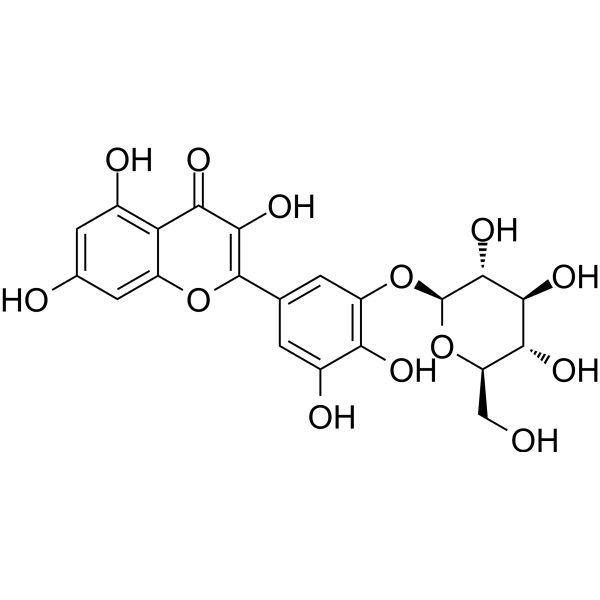
Myricetin 3'-glucoside

Based on 1 Customer Validation
Myricetin 3'-glucoside is an orally active glycosylated flavonoid. Myricetin 3'-glucoside inhibits the cerebral ischemia-induced elevation of inflammatory cytokine levels, including TNF-α, IL-6 and IL-1β. Myricetin 3'-glucoside reverses the cerebral ischemia-mediated downregulation of Bcl-2 protein levels and reduces the cerebral ischemia-induced upregulation of Bax protein levels. Myricetin 3'-glucoside reduces cerebral infarct volume, increases the number of Nissl bodies, and improves neurological function scores in a rat model of middle cerebral artery occlusion (MCAO). Myricetin 3'-glucoside can be used in cerebral ischemia-related research.
For research use only. We do not sell to patients.
- Purity : 99.98%
- CAS No.: 520-14-9
- Formula: C21H20O13
- Molecular Weight:480.38
-
Storage:Powder -20°C, 3 years , 4°C, 2 years ; In solvent -80°C, 6 months , -20°C, 1 month

To place orders, for customer services and technical support, please contact: MedChemExpress USA
Tel: 609-228-6898 E-mail: [email protected] [email protected]


-
 Biological Activity
-
Chemical Information
-
Solvent & Solubility
- Protocols
- Purity & Documentation
- References
-
 Help & FAQs




Biological Activity
Description
IC50 & Target
[1]|
Bcl-2 |
Bax |
IL-6 |
IL-1β |
In Vivo
MedChemExpress (MCE) has not independently confirmed the accuracy of these methods. They are for reference only.
-
Animal Model:Male Sprague-Dawley rats, 9 weeks old, with a body weight ranging from 230 to 255 grams.[1]
-
Dosage:5 mg/kg
-
Administration:i.g.; single administration
-
Result:Reduced the volume of cerebral infarction.
Improved neurological deficits, manifested as improved walking, balance and sensory reflexes.
Protected neurons, manifested by an increase in Nissl bodies.
Inhibited TNF-α, IL-6, and IL-1β, upregulate Bcl-2, downregulate Bax, and restore the ratio of Bcl-2/Bax.


Chemical Information
-
CAS No. 520-14-9
-
Appearance Solid
-
Molecular Weight 480.38
-
Formula C21H20O13
-
Color Off-white to light yellow
-
SMILES
O=C1C(C(OC(C(C=C2O)=CC(O[C@@H]([C@@H]([C@H]3O)O)O[C@@H]([C@H]3O)CO)=C2O)=C1O)=CC(O)=C4)=C4O
-
Structure Classification
-
Initial Source
-
Shipping
Room temperature in continental US; may vary elsewhere.
-
Storage
Powder -20°C 3 years 4°C 2 years In solvent -80°C 6 months -20°C 1 month


Solvent & Solubility
In Vitro:
DMSO : 50 mg/mL (104.08 mM; Need ultrasonic; Hygroscopic DMSO has a significant impact on the solubility of product, please use newly opened DMSO)
Please refer to the solubility information to select the appropriate solvent. Once prepared, please aliquot and store the solution to prevent product inactivation from repeated freeze-thaw cycles.
Storage method and period of stock solution: -80°C, 6 months; -20°C, 1 month. When stored at -80°C, please use it within 6 months. When stored at -20°C, please use it within 1 month.
Please refer to the solubility information to select the appropriate solvent. Once prepared, please aliquot and store the solution to prevent product inactivation from repeated freeze-thaw cycles.
Storage method and period of stock solution: -80°C, 6 months; -20°C, 1 month. When stored at -80°C, please use it within 6 months. When stored at -20°C, please use it within 1 month.
Concentration (start) × Volume (start) = Concentration (final) × Volume (final)

Protocols
-
How to Select a Suitable Non-Mouse Animal Model
Selecting a suitable non-mouse animal model is a structured decision based on the research question, required anatomy or physiology, disease mechanism, endpoint feasibility, translational relevance, and ethical justification. Non-mouse models are preferred when mice cannot reproduce key human-relevant features, such as organ size, surgical anatomy, cardiovascular physiology, neuroanatomy, immune features, pharmacology, toxicology, or long-term clinical procedures. Candidate species may include rats, rabbits, guinea pigs, ferrets, zebrafish, pigs, sheep, goats, dogs, cats, horses, and non-human primates, but each species must be justified by its specific scientific advantage rather than convenience or tradition. Unresolved questions include how to quantify translational superiority across species, how to balance increased biological relevance against higher ethical burden, and when human-derived systems or new approach methodologies should replace animal use.
-
Research Protocol for Inflammation-related Diseases
The NLRP3 inflammasome is a cytosolic innate immune signaling platform that integrates priming signals and danger-signal activation to promote caspase-1 activation, maturation of IL-1β and IL-18, and gasdermin D-mediated pyroptotic cell death. The core experimental logic is to determine whether inflammatory disease phenotypes are driven by increased NLRP3 expression, ASC-containing inflammasome assembly, caspase-1 cleavage, GSDMD cleavage, and extracellular release of IL-1β/IL-18 rather than by nonspecific cell injury alone. The pathway is strongly linked to inflammation-related disease phenotypes because monosodium urate crystals activate NALP3/NLRP3 inflammasome signaling in gout-like crystal inflammation, cholesterol crystals activate NLRP3 inflammasomes in atherogenesis models, and DSS-induced intestinal inflammation has been reported to involve NLRP3 inflammasome activity. However, experimental colitis studies also show context-dependent protective effects of NLRP3 inflammasome co
-
Pyroptosis Solutions
Pyroptosis is a lytic inflammatory cell-death pathway executed by gasdermin pores, most classically through inflammasome-mediated activation of caspase-1, cleavage of gasdermin D, membrane pore formation, LDH release, and secretion of IL-1β and IL-18. The canonical pathway is commonly modeled by priming cells with an inflammatory signal such as LPS to induce pro-IL-1β and inflammasome components, followed by an activation signal such as ATP or nigericin to activate NLRP3, ASC speck formation, caspase-1 cleavage, GSDMD cleavage, cytokine release, and pyroptotic membrane rupture. The non-canonical pathway is triggered when cytosolic LPS activates mouse caspase-11 or human caspase-4/5, leading to GSDMD cleavage and pyroptosis, and this can secondarily activate NLRP3-dependent IL-1β release. Pyroptosis is linked to inflammatory injury, infection, cancer, liver disease, ocular disease, placental inflammation, and other disease phenotypes, but unresolved questions include which gasdermin fam
-
How to Choose the Right Model Animal
Choosing the right model animal is a validity-driven decision in which the species, strain, sex, age, genetic background, disease-induction method, outcome measures, and welfare burden must match the scientific question rather than laboratory tradition or convenience. A model should be selected by judging face validity, construct validity, and predictive validity: whether it resembles the human phenotype, whether it reproduces relevant mechanisms, and whether results are likely to predict human biology or treatment response. Animal studies often fail to translate because of species differences, weak disease resemblance, poor experimental design, inadequate reporting, publication bias, and underuse of randomization, blinding, and sample-size justification. Unresolved questions include how to rank competing models objectively, how much human-disease complexity must be reproduced for a given objective, and when non-animal systems such as organoids, ex vivo tissue, or computational models


Purity & Documentation
-
Data Sheet (275 KB)
-
SDS (254 KB)
- English - EN (254 KB)
- Français - FR (254 KB)
- Deutsch - DE (254 KB)
- Norwegian - NO (254 KB)
- Español - ES (254 KB)
- Swedish - SV (254 KB)
- Italian - IT (254 KB)
- Korean - KR (254 KB)
- Portuguese - PT (254 KB)
-
Handling Instructions (2659 KB)
References


Complete Stock Solution Preparation Table
Please refer to the solubility information to select the appropriate solvent. Once prepared, please aliquot and store the solution to prevent product inactivation from repeated freeze-thaw cycles.
Storage method and period of stock solution: -80°C, 6 months; -20°C, 1 month. When stored at -80°C, please use it within 6 months. When stored at -20°C, please use it within 1 month.
| Optional Solvent | Concentration Solvent Mass | 1 mg | 5 mg | 10 mg | 25 mg |
|---|---|---|---|---|---|
| DMSO | 1 mM | 2.0817 mL | 10.4084 mL | 20.8169 mL | 52.0421 mL |
| 5 mM | 0.4163 mL | 2.0817 mL | 4.1634 mL | 10.4084 mL | |
| 10 mM | 0.2082 mL | 1.0408 mL | 2.0817 mL | 5.2042 mL | |
| 15 mM | 0.1388 mL | 0.6939 mL | 1.3878 mL | 3.4695 mL | |
| 20 mM | 0.1041 mL | 0.5204 mL | 1.0408 mL | 2.6021 mL | |
| 25 mM | 0.0833 mL | 0.4163 mL | 0.8327 mL | 2.0817 mL | |
| 30 mM | 0.0694 mL | 0.3469 mL | 0.6939 mL | 1.7347 mL | |
| 40 mM | 0.0520 mL | 0.2602 mL | 0.5204 mL | 1.3011 mL | |
| 50 mM | 0.0416 mL | 0.2082 mL | 0.4163 mL | 1.0408 mL | |
| 60 mM | 0.0347 mL | 0.1735 mL | 0.3469 mL | 0.8674 mL | |
| 80 mM | 0.0260 mL | 0.1301 mL | 0.2602 mL | 0.6505 mL | |
| 100 mM | 0.0208 mL | 0.1041 mL | 0.2082 mL | 0.5204 mL |


Myricetin 3'-glucoside Related Classifications
HY-N7905 Related Classifications
 Powered by Bioz