1. Search Result
Search Result
Results for "

Organ protective

" in MedChemExpress (MCE) Product Catalog:

12

Inhibitors & Agonists

3

Peptides

3

Natural
Products

Cat. No. Product Name Target Research Areas Chemical Structure
  • HY-135005A
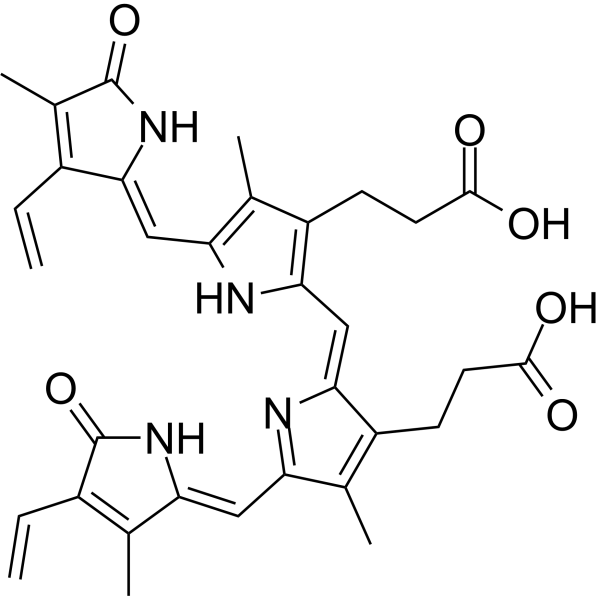
    Biliverdin
    1 Publications Verification

    Endogenous Metabolite Inflammation/Immunology
    Biliverdin, a tetrapyrrolic pigment, is a product of heme catabolism. Heme is broken down into Biliverdin and carbon monoxide and iron by heme oxidase. Biliverdin is then quickly broken down to bilirubin by Biliverdin reductase. Biliverdin can mediate the protective effects of HO-1 in many disease models including IRI and organ transplantation. Biliverdin exhibits anti-mutagenic, an antioxidant, anti-inflammatory, and immunosuppressant properties .
    Biliverdin
  • HY-178159

    RNA MTase Inflammation/Immunology
    SA91-0178 is a METTL1 inhibitor. SA91-0178 inhibits m 7G methylation of RNA, reduces SARM1 stability, mitigates NAD + depletion and metabolic reprogramming in macrophages. SA91-0178 demonstrates excellent protective efficacy against multiple organ injury in cecal ligation and puncture (CLP)-induced and ischemia/reperfusion (I/R)-induced mice. SA91-0178 can be used for the study of systemic inflammatory diseases .
    SA91-0178
  • HY-W062700

    JAK Erythropoietin Receptor (EpoR) Neurological Disease
    STS-E412 is a selective activator of tissue-protective EPO receptor (including EPOR and CD131). STS-E412 can be used for research of neurodegenerative diseases and organ protection .
    STS-E412
  • HY-P10208A
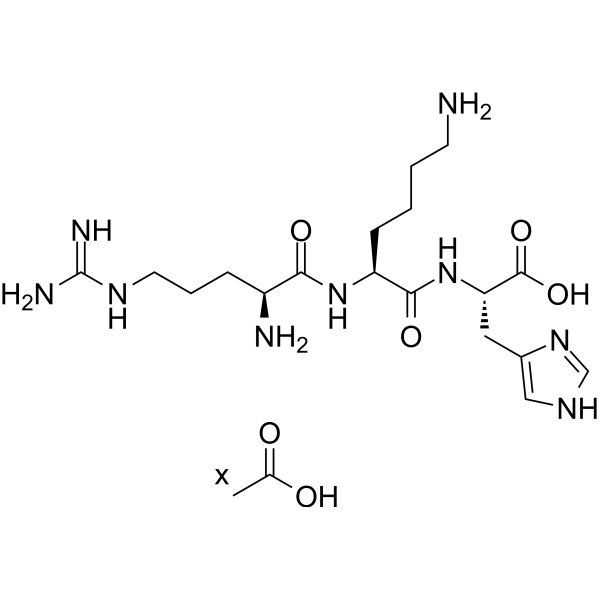
    RKH acetate
    1 Publications Verification

    Toll-like Receptor (TLR) Infection Inflammation/Immunology
    RKH acetate exerts protective effects against sepsis-induced death and organ damage. RKH acetate can directly bind to Toll-like receptor 4 (TLR4) and block TLR4 signal transduction in immune cells .
    RKH acetate
  • HY-105305

    ABT-719; AP-214

    Melanocortin Receptor Inflammation/Immunology
    Modimelanotide (ABT-719) is an α-melanocyte-stimulating hormone analog. Modimelanotide has high specific binding ability to melanocortin receptors (MCR1, 3, 4, 5). Modimelanotide possesses anti-inflammatory and organ-protective effects. Modimelanotide can be used in the research of diseases such as acute kidney injury .
    Modimelanotide
  • HY-W740088

    S-Adchnone

    Adrenergic Receptor Cardiovascular Disease
    Adrenochrome monoguanylhydrazone methanesulfonate (S-Adchnone) is an adrenochrome derivative that has a protective effect against radiation-induced damage of hematopoietic organs .
    Adrenochrome monoguanylhydrazone methanesulfonate
  • HY-172316

    Factor Xa Cardiovascular Disease
    BAY 3389934 is a selective dual inhibitor of factor IIa and factor Xa, with an IC50 of 4.9 nM for factor IIa and an IC50 of 0.66 nM for factor Xa. BAY 3389934 directly inhibits the activities of factor IIa and factor Xa and regulates the common coagulation pathway. BAY 3389934 exhibits anticoagulant and organ-protective effects. BAY 3389934 can be used in the research of sepsis and coagulopathy .
    BAY 3389934
  • HY-N15662

    Drug Intermediate Infection Neurological Disease Inflammation/Immunology Cancer
    Coumestan is a secondary metabolite found in leguminous plants and can be used as drug intermediate Coumestan can be used to synthesize various coumarin compounds such as Coumestrol (HY-N2335), Glytabastan B, and Coumestan Pks13 inhibitor. Coumestans can be used for the study of anti-cancer, anti-inflammatory, anti-oxidative, antibacterial, neuroprotective and organ protective .
    Coumestan
  • HY-105305A

    ABT-719 acetate; AP-214 acetate

    Melanocortin Receptor Endocrinology
    Modimelanotide (ABT-719) acetate is an α-melanocyte-stimulating hormone analog. Modimelanotide acetate has high specific binding ability to melanocortin receptors (MCR1, 3, 4, 5). Modimelanotide acetate possesses anti-inflammatory and organ-protective effects. Modimelanotide acetate can be used in the research of diseases such as acute kidney injury .
    Modimelanotide acetate
  • HY-119348

    NCX-701

    Interleukin Related TNF Receptor COX NO Synthase Neurological Disease Inflammation/Immunology
    Nitroparacetamol (NCX-701) is a nitric oxide (NO) donor-non-steroidal anti-inflammatory agent (NO-NSAID). Nitroparacetamol is formed by the ester linkage of Acetaminophen (HY-66005) and Nitrooxybutyroyl, aiming to combine the analgesic advantage of Acetaminophen with the organ-protective effect of nitric oxide, while expanding its anti-inflammatory activity. The analgesic spectrum of Nitroparacetamol is broader, and it is effective for painful pathological pain, and significantly reduces hepatotoxicity. Nitroparacetamol can reduce the expressions of IL-1β, TNF-α, COX-2, and iNOS.
    Nitroparacetamol
  • HY-181526

    IFNAR STING Inflammation/Immunology
    Sim-9 is a covalent allosteric inhibitor of interferon regulatory factor 3 (IRF3). Sim-9 binds covalently to the Cys222 residue of IRF3, induces its conformational change, blocks its interactions with TRIF, MAVS and STING, and inhibits IRF3 homodimerization and type I interferon response. Sim-9 exhibits significant anti-inflammatory, organ-protective and survival benefits in mouse models of sepsis and acute pancreatitis. Sim-9 can be used for research related to inflammatory diseases .
    Sim-9
  • HY-N18905

    Apoptosis Bcl-2 Family Caspase SOD Endocrinology
    α-D-Glucosyl hesperidin is an orally effective structural modification derivative of Hesperidin (HY-15337) with anti-apoptotic (apoptosis) and antioxidant activities. α-D-Glucosyl hesperidin upregulates the expression of the Bcl-2 gene, while downregulating the expressions of the Bax and caspase-3 genes. α-D-Glucosyl hesperidin increases total antioxidant capacity, SOD and catalase levels, and decreases malondialdehyde and glutathione levels. α-D-Glucosyl hesperidin improves sperm motility, viability and plasma membrane function, while restoring reproductive organ weight and seminiferous tubule structure. α-D-Glucosyl hesperidin increases fertility index and exerts a synergistic protective effect with Proanthocyanidins (HY-N0794) in male rats with testicular ischemia-reperfusion injury. α-D-Glucosyl hesperidin can be used in the research of testicular ischemia-reperfusion injury .
    α-D-Glucosyl hesperidin

Inquiry Online

Your information is safe with us. * Required Fields.

Salutation


Country or Region *

Applicant Name *


Organization Name *

Department *


Email Address *


Product Name *

Cat. No.


Requested quantity *

Phone Number *


Remarks

Inquiry Online

Inquiry Information

Product Name:
Cat. No.:
Quantity:
MCE Japan Authorized Agent:

