12 Results for "

Pork

" in MedChemExpress (MCE) Product Catalog:
Products (12)

12 Results for "Pork" in MCE Product Catalog:

Cat. No.: HY-Y1220J
CAS No.: 584-08-7
Potassium carbonate, with a purity of 99%, is an inorganic compound. At low concentrations, potassium carbonate can be used as an alkaline treatment agent and feed buffer in pork processing, as well as to inhibit the synthesis of milk fat in dairy cows .
loading...
    loading...
Cat. No.: HY-151226
CAS No.: 31566-31-1
Purity:  ≥98.0%
Synonyms: GMS
Research Areas:  

Others

Glyceryl monostearate (GMS) is a type of monoglyceride. Glyceryl monostearateGlyceryl monostearate can serve as a core lipid material for constructing solid lipid nanoparticles in the field of drug delivery. Glyceryl monostearate can be used as a gelling agent to structure liquid vegetable oils into semi-solid oleogels, so as to replace animal fat in meat products .
loading...
    loading...
Cat. No.: HY-NP002E
CAS No.: 9048-46-8
Synonyms: Porcine Serum Albumin
PSA Protein (Porcine) (Porcine Serum Albumin) is a serum albumin protein that contains a flexible C-terminal region. PSA Protein (Porcine) can serve both as a pork allergen and as a biomarker for detecting pork .
loading...
    loading...
Cat. No.: HY-P11056
CAS No.: 1198397-79-3
Target:  

MDM-2/p53

Research Areas:  

Others

REF1 peptide is a PORK1 agonist with an EC50 of 0.028 nM in tomato. REF1 peptide binds to the extracellular domain of PORK1, triggers receptor autophosphorylation, and drives downstream MPK3/MPK6 activation, thereby initiating defense and regeneration signaling cascades. REF1 peptide induces callus formation, inhibits shoot regeneration upon continuous exposure, and enhances the regeneration and transformation efficiency of recalcitrant dicotyledonous and monocotyledonous crops .
loading...
    loading...
Cat. No.: HY-Y1885
CAS No.: 7722-88-5
Tetrasodium pyrophosphate is a water-soluble inorganic salt commonly used as a buffering agent, emulsifier, and sequestrant. Tetrasodium pyrophosphate is an antimicrobial agent that can reduce microbial colonization. Tetrasodium pyrophosphate blocks IPP translocation, enhances astaxanthin, phenol, flavonoid, and H2O2 levels, activates PAL and DPPH scavenging activity. Tetrasodium pyrophosphate can be used for the research of alleviating symptoms post COVID-19 .
loading...
    loading...
Cat. No.: HY-128371
CAS No.: 4536-23-6
Purity:  ≥98.0%
Research Areas:  

Others

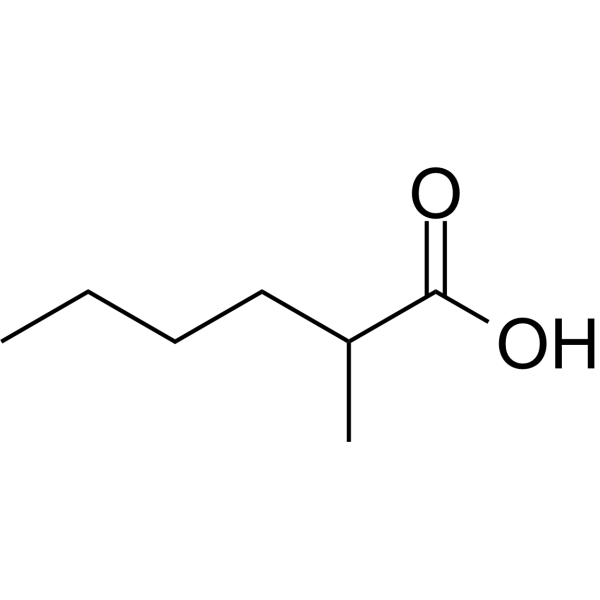
2-Methylhexanoic acid is a saturated branched-chain carboxylic acid with a strong "fatty" or "oily" odor. At high concentrations, it is often described as having the smell of lard, chicken fat or sweat; when diluted, it exhibits a dairy, cream or cheese aroma. Therefore, it is commonly used in the formulation of milk, meat (pork/chicken) and baked food flavors. 2-Methylhexanoic acid occurs naturally in fresh apples, cheese, grape brandy, lamb, potatoes and tea .
loading...
    loading...
Cat. No.: HY-W010594
CAS No.: 1003-04-9
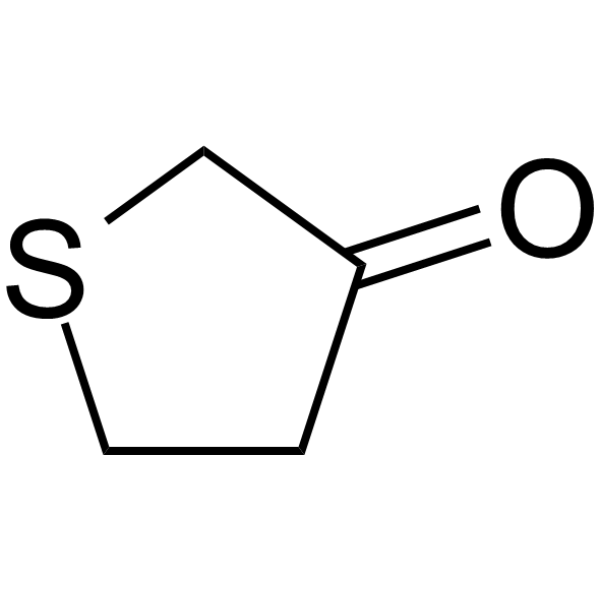
Tetrahydrothiophen-3-one is an endogenous metabolite . Tetrahydrothiophen-3-one scavenges DPPH free radicals. Tetrahydrothiophen-3-one can be used in studies related to Candida infections .
loading...
    loading...
Cat. No.: HY-N20205
Synonyms: Pork liver extract; Pig's liver extract
Category:  

Extract

Target:  

Others

Swine's liver extract (Pork liver extract) is a type of pork liver extract containing a variety of bioactive components.
loading...
    loading...
Cat. No.: HY-W010594R
CAS No.: 1003-04-9
Tetrahydrothiophen-3-one (Standard) is the analytical standard of Tetrahydrothiophen-3-one (HY-W010594). This product is intended for research and analytical applications. Tetrahydrothiophen-3-one is an endogenous metabolite . Tetrahydrothiophen-3-one scavenges DPPH free radicals. Tetrahydrothiophen-3-one can be used in studies related to Candida infections .
loading...
    loading...
Cat. No.: HY-W968308
CAS No.: 691-81-6
Research Areas:  

Metabolic Disease

H-Gly-D-Ala-OH is a dipeptide containing D-amino acid. H-Gly-D-Ala-OH can be specifically hydrolyzed by renal dipeptidase, which acts on peptide segments with a D-amino acid at the carboxyl terminus. H-Gly-D-Ala-OH enables highly specific detection of renal dipeptidase activity without interference from other serum or urine aminopeptidases. When used in combination with low-dose Sodium nitrite (HY-N11218), H-Gly-D-Ala-OH inhibits the initial spore growth of Clostridium botulinum in pork homogenate, whereas it has no such effect on its own. H-Gly-D-Ala-OH can be used in research related to chronic renal failure, diabetes mellitus and botulism .
loading...
    loading...
Cat. No.: HY-122429
CAS No.: 25612-46-8
Synonyms: LNL
Research Areas:  

Others

Lysinonorleucine (LNL) is a Schiff base-type protein cross-link. Lysinonorleucine could be used as a potential and specific biomarker to indicate the level of protein oxidation .
loading...
    loading...
Cat. No.: HY-W356181
CAS No.: 95896-78-9
4,8-DiMeIQx is an orally active mutagen, selective dopaminergic neurotoxicant, and DNA damaging agent. 4,8-DiMeIQx can be isolated from cooked beef, sausage, pork, and chicken. 4,8-DiMeIQx induces reverse mutations in *Salmonella typhimurium* TA98 in the presence or absence of S9 mix, and forms DNA adducts in vivo in rat liver. 4,8-DiMeIQx exhibits selective neurotoxicity toward dopaminergic neurons. 4,8-DiMeIQx shows no activity against non-dopaminergic neurons. 4,8-DiMeIQx can be used in studies related to Parkinson's disease and colorectal cancer .
loading...
    loading...
  • 1

