13 Results for "

TCI

" in MedChemExpress (MCE) Product Catalog:
Products (13)

13 Results for "TCI" in MCE Product Catalog:

3
3 Cited Publications
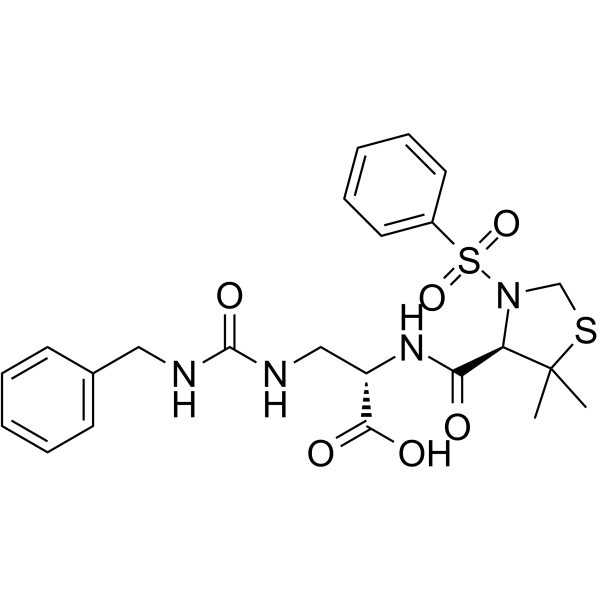
Cat. No.: HY-107588
CAS No.: 916734-43-5
Purity:  99.94%
Target:  

Integrin

Research Areas:  

Cardiovascular Disease

TC-I 15 (TC-I-15) is a type of allosteric collagen-binding integrin α2β1 inhibitor, and it also inhibits α1β1 and α11β1. TC-I 15 inhibits platelet adhesion to collagen and thrombus deposition. TC-I 15 prevents the formation of a pre-metastatic microenvironment by inhibiting the uptake of cancer-associated fibroblast (CAF) extracellular vesicles (EVs) by lung fibroblasts, which reduces the metastasis of salivary gland adenocystic carcinoma (SACC) to the lungs in mouse models, .
loading...
    loading...
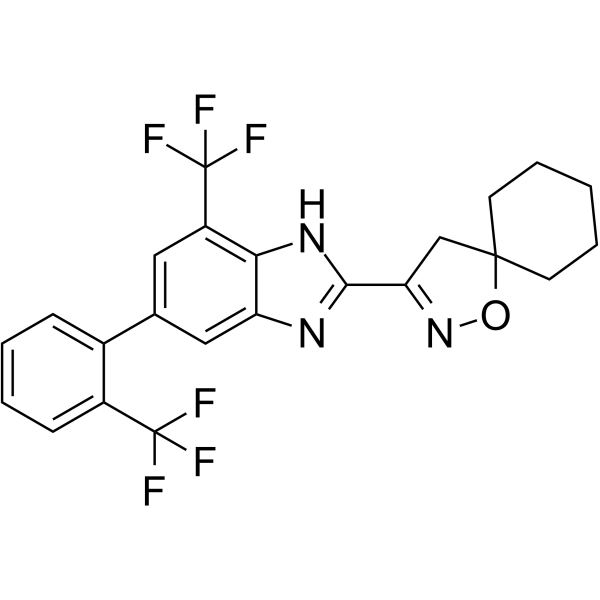
Cat. No.: HY-110199
CAS No.: 1221349-53-6
Purity:  ≥99.0%
Target:  

TRP Channel

Research Areas:  

Neurological Disease

TC-I 2014 (compound 5) is a potent and orally active Benzimidazole-containing transient receptor potential melastatin 8 (TRPM8) antagonist, with IC50 values of 0.8 nM, 3.0 nM and 4.4 nM for canine, human and rat channels respectively. TC-I 2014 exhibits antiallodynic properties in pain models .
loading...
    loading...
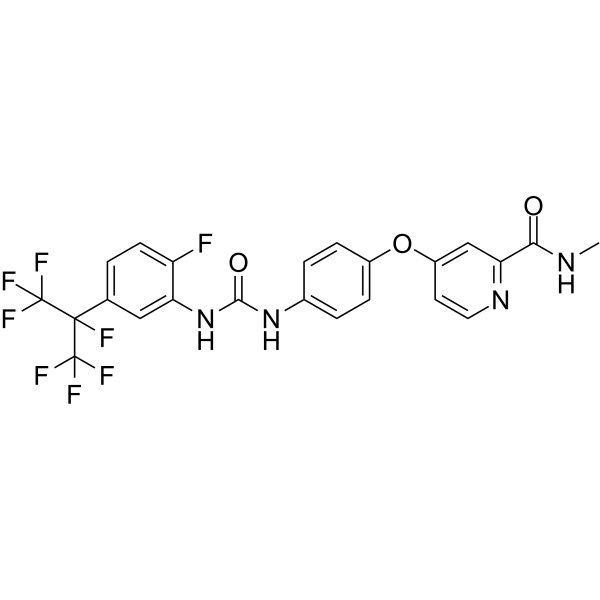
Cat. No.: HY-124944
CAS No.: 2188236-41-9
Purity:  99.58%
Target:  

Ras

Research Areas:  

Cancer

APS6-45 is an orally active tumor-calibrated inhibitor (TCI). APS6-45 inhibits RAS/MAPK signaling and exhibits antitumor activity .
loading...
    loading...
Cat. No.: HY-RS07895
Research Areas:  

Others

LXN Human Pre-designed siRNA Set A contains three designed siRNAs for LXN gene (Human), as well as a negative control, a positive control, and a FAM-labeled negative control.

loading...
    loading...
Cat. No.: HY-RS14318
Research Areas:  

Others

TCN1 Human Pre-designed siRNA Set A contains three designed siRNAs for TCN1 gene (Human), as well as a negative control, a positive control, and a FAM-labeled negative control.

loading...
    loading...
Cat. No.: HY-185764
CAS No.: 2614310-11-9
Target:  

HSP

Research Areas:  

Others

TCI 18 is a ligand of HSP72 with a Ki value of 4.7 μM. TCI 18 forms a covalent bond with Lys56 residue of HSP72 via a process involving initial reversible binding, conversion to a pre-covalent complex, and subsequent covalent bond formation. TCI 18 addresses the undruggable target HSP72 .
loading...
    loading...
Cat. No.: HY-107588R
CAS No.: 916734-43-5
Research Areas:  

Cardiovascular Disease

TC-I 15 (Standard) is the analytical standard of TC-I 15 (HY-107588). This product is intended for research and analytical applications. TC-I 15 (TC-I-15) is a type of allosteric collagen-binding integrin α2β1 inhibitor, and it also inhibits α1β1 and α11β1. TC-I 15 inhibits platelet adhesion to collagen and thrombus deposition. TC-I 15 prevents the formation of a pre-metastatic microenvironment by inhibiting the uptake of cancer-associated fibroblast (CAF) extracellular vesicles (EVs) by lung fibroblasts, which reduces the metastasis of salivary gland adenocystic carcinoma (SACC) to the lungs in mouse models, .
loading...
    loading...
Cat. No.: HY-P73268
Purity:  ≥ 95%, as determined by reducing SDS-PAGE.
Synonyms: Latexin; ECI; TCI; Lxn
Species:  
Source:  
loading...
    loading...
Cat. No.: HY-P73841
Purity:  ≥ 95%, as determined by Bis-Tris PAGE.
Synonyms: ECI; ECIMUM; Latexin; LXN; TCI
Species:  
Source:  
loading...
    loading...
Cat. No.: HY-P73842
Purity:  ≥ 90%, as determined by reducing SDS-PAGE.
Synonyms: ECI; ECIMUM; Latexin; LXN; TCI
Species:  
Source:  
loading...
    loading...
Cat. No.: HY-P88330
Synonyms: ECI; TCI

Host:  

Mouse

Application:  

WB, IHC-P, FC

Reactivity:  

Human, Mouse

loading...
    loading...
Cat. No.: HY-P88330A
Synonyms: ECI; TCI

Host:  

Mouse

Application:  

WB, IHC-P, FC

Reactivity:  

Human, Mouse

loading...
    loading...
Cat. No.: HY-L915
421 compounds

Lysine is the second most common target residue used in the design of TCIs and related covalent ligands. Its appeal lies in its abundance in human proteins, which is approximately three times higher than that of cysteine (5.8% vs. 1.9%). This significantly increases the number of proteins suitable for covalent targeting, especially given that many human proteins lack ligandable cysteine residues. Moreover, it has been suggested that functional lysines have a lower probability of being replaced by mutation, as they often play a crucial role in catalysis by acting as bases or nucleophiles. Additionally, lysines are essential for maintaining the structural integrity of proteins and for regulating post-translational modifications (PTMs). Consequently, targeting lysine has garnered significant interest in recent years.

Through careful selection, we constructed a structural filter containing over 110 electrophilic groups. By analyzing the electrophilic fragments selected by the structural filter, we removed any molecules with trivial or undesirable structural features. Ultimately, we obtained 445 fragment molecules which can target lysine residue and can be used for fragment-based covalent drug discovery.

  • 1

