1. Search Result
Search Result
Results for "

VTA

" in MedChemExpress (MCE) Product Catalog:

15

Inhibitors & Agonists

1

Fluorescent Dyes

1

Oligonucleotides

Cat. No. Product Name Target Research Areas Chemical Structure
  • HY-13409
    SB 242084
    Maximum Cited Publications
    6 Publications Verification

    5-HT Receptor Neurological Disease Metabolic Disease
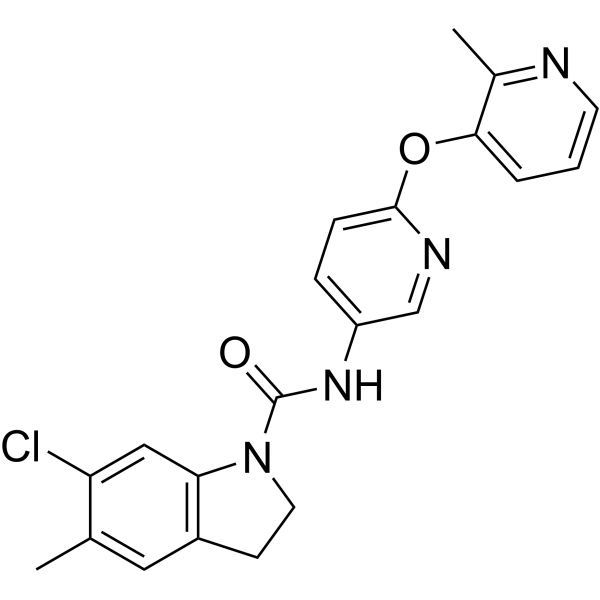
    SB 242084 is a selective, competitive and high-affinity (pKi=9.0) 5-HT2C receptor antagonist (crosses the blood-brain barrier). SB 242084 increases basal activity of dopaminergic neurons in the ventral tegmental area (VTA) of the midbrain and dopamine release in the vomeronasal nucleus. SB 242084 also increases mitochondrial gene expression and oxidative metabolism via 5-HT2A receptor. SB 242084 has good research potential in the negative symptoms of anxiety, depression and schizophrenia, as well as in acute organ damage .
    SB 242084
  • HY-13409A
    SB 242084 dihydrochloride
    Maximum Cited Publications
    6 Publications Verification

    5-HT Receptor Neurological Disease Metabolic Disease
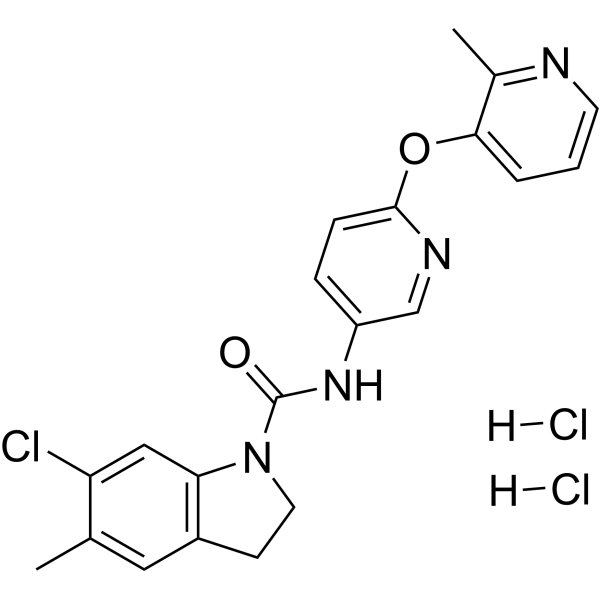
    SB 242084 dihydrochloride is a selective, competitive and high-affinity (pKi=9.0) 5-HT2C receptor antagonist (crosses the blood-brain barrier). SB 242084 dihydrochloride increases basal activity of dopaminergic neurons in the ventral tegmental area (VTA) of the midbrain and dopamine release in the vomeronasal nucleus. SB 242084 dihydrochloride also increases mitochondrial gene expression and oxidative metabolism via 5-HT2A receptor. SB 242084 dihydrochloride has good research potential in the negative symptoms of anxiety, depression and schizophrenia, as well as in acute organ damage .
    SB 242084 dihydrochloride
  • HY-121685A
    Tipepidine hydrochloride
    1 Publications Verification

    Potassium Channel Neurological Disease
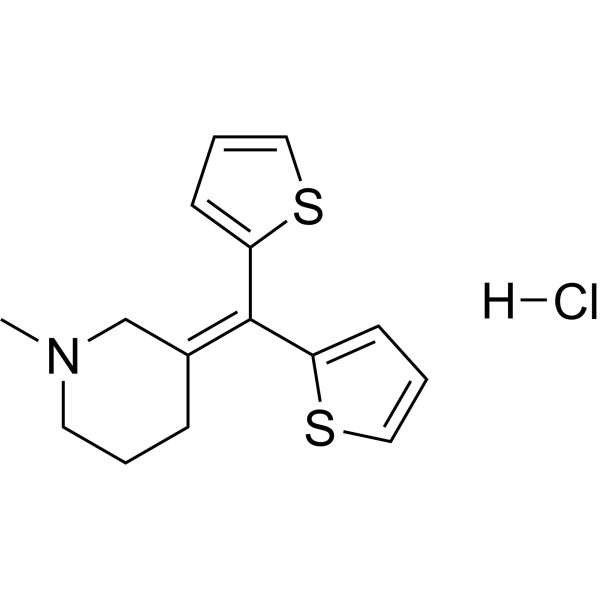
    Tipepidine hydrochloride reversibly inhibits dopamine (DA) D2 receptor-mediated GIRK currents (IDA(GIRK)) with an IC50 of 7.0 μM. Tipepidine hydrochloride subsequently activates VTA dopamine neuron . Tipepidine hydrochloride, a non-narcotic antitussive, exerts an antidepressant-like effect .
    Tipepidine hydrochloride
  • HY-148502
    VU6019650
    2 Publications Verification

    mAChR Neurological Disease
    VU6019650 is a potent and selective orthosteric antagonist of M5 mAChR (IC50=36 nM), can be used for opioid use disorder (OUD) relief. VU6019650 can cross blood brain barrier, potentially modulates the mesolimbic dopaminergic reward circuitry. VU6019650 blocks Oxotremorine M iodide (HY-101372A) induced increases of neuronal firing rates of midbrain dopamine neurons in the ventral tegmental area (VTA) .
    VU6019650
  • HY-147319

    Trace Amine-associated Receptor (TAAR) Neurological Disease
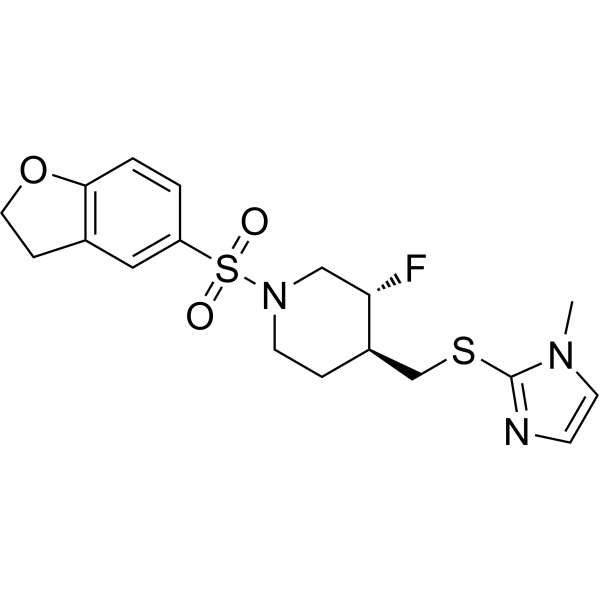
    RTI-7470-44 is a potent, selective and blood-brain barrier (BBB) penetrant human trace amine-associated receptor subtype 1 (hTAAR1) antagonist with an IC50 value of 8.4 nM and a Ki value of 0.3 nM. RTI-7470-44 has moderate metabolic stability, and a favorable preliminary off-target profile. RTI-7470-44 can increase the spontaneous firing rate of mouse ventral tegmental area (VTA) dopaminergic neurons. RTI-7470-44 can be used for researching schizophrenia, agent addiction, and Parkinson’s disease (PD) .
    RTI-7470-44
  • HY-15691

    Opioid Receptor mTOR Neurological Disease Metabolic Disease
    PF-04455242 is an orally bioavailable, blood-brain barrier-permeable κ-opioid receptor (KOR) inhibitor. PF-04455242 blocks in vivo effects induced by KOR and MOR agonists, and elicits KOR-independent outward currents in ventral tegmental area neurons. PF-04455242 promotes energy expenditure and activates the hypothalamic mTOR pathway. PF-04455242 attenuates stress-induced behavioral effects and produces antidepressant-like effects. PF-04455242 can be used in studies related to pain, depression, addictive disorders, and obesity induced by estrogen withdrawal .
    PF-04455242
  • HY-171807

    nAChR STAT Neurological Disease Inflammation/Immunology
    TC-2559 free base is a α4β2 nicotinic acetylcholine receptor (nAChR) agonists with an EC50 of 0.18 μM. TC-2559 free base shows much weaker potencies on the group of b4-containing nAChR subtypes, α2β4, α4β4 and α3β4 receptors, with EC50s in the range of 10-30 µM. TC-2559 free base can increase the discharge of dopamine cells in the ventral tegmental area (VTA) of rats in vitro, enhancing the excitability and aggressive behavior of VTA dopamine neurons. TC-2559 free base inhibits STAT3 to exert anti-inflammatory properties and relieves mice mechanical allodynia and improve rats cognitive deficits. TC-2559 free base can be used for the study of nerve pain .
    TC-2559 free base
  • HY-121685

    Potassium Channel Neurological Disease
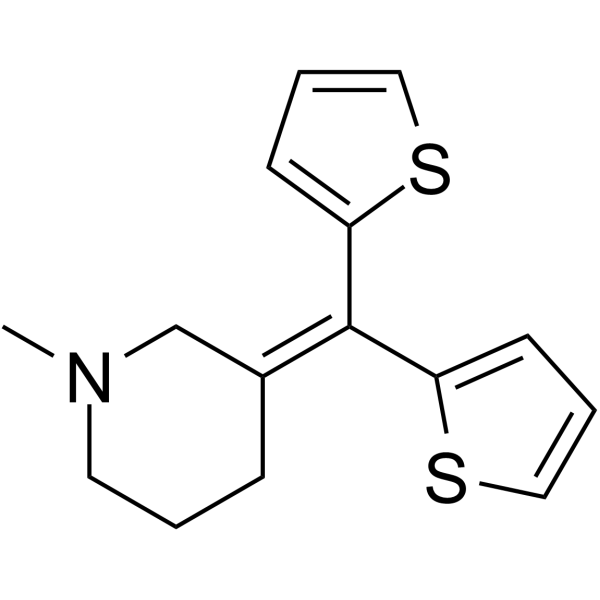
    Tipepidine reversibly inhibits dopamine (DA) D2 receptor-mediated GIRK currents (IDA(GIRK)) with an IC50 of 7.0 μM. Tipepidine subsequently activates VTA dopamine neuron . Tipepidine, a non-narcotic antitussive, exerts an antidepressant-like effect .
    Tipepidine
  • HY-RS15720

    Small Interfering RNA (siRNA) Others

    VTA1 Human Pre-designed siRNA Set A contains three designed siRNAs for VTA1 gene (Human), as well as a negative control, a positive control, and a FAM-labeled negative control.

    VTA1 Human Pre-designed siRNA Set A
    VTA1 Human Pre-designed siRNA Set A
  • HY-13409B

    5-HT Receptor Neurological Disease Metabolic Disease
    SB 242084 monohydrochloride is a selective, competitive and high-affinity (pKi=9.0) 5-HT2C receptor antagonist (crosses the blood-brain barrier). SB 242084 monohydrochloride increases basal activity of dopaminergic neurons in the ventral tegmental area (VTA) of the midbrain and dopamine release in the vomeronasal nucleus. SB 242084 also increases mitochondrial gene expression and oxidative metabolism via 5-HT2A receptor. SB 242084 monohydrochloride has good research potential in the negative symptoms of anxiety, depression and schizophrenia, as well as in acute organ damage .
    SB 242084 monohydrochloride
  • HY-13409AR

    5-HT Receptor Neurological Disease Metabolic Disease
    SB 242084 (dihydrochloride) (Standard) is the analytical standard of SB 242084 (dihydrochloride). This product is intended for research and analytical applications. SB 242084 dihydrochloride is a selective, competitive and high-affinity (pKi=9.0) 5-HT2C receptor antagonist (crosses the blood-brain barrier). SB 242084 dihydrochloride increases basal activity of dopaminergic neurons in the ventral tegmental area (VTA) of the midbrain and dopamine release in the vomeronasal nucleus. SB 242084 dihydrochloride also increases mitochondrial gene expression and oxidative metabolism via 5-HT2A receptor. SB 242084 dihydrochloride has good research potential in the negative symptoms of anxiety, depression and schizophrenia, as well as in acute organ damage .
    SB 242084 dihydrochloride (Standard)
  • HY-13409R

    5-HT Receptor Neurological Disease Metabolic Disease
    SB 242084 (Standard) is the analytical standard of SB 242084. This product is intended for research and analytical applications. SB 242084 is a selective, competitive and high-affinity (pKi=9.0) 5-HT2C receptor antagonist (crosses the blood-brain barrier). SB 242084 increases basal activity of dopaminergic neurons in the ventral tegmental area (VTA) of the midbrain and dopamine release in the vomeronasal nucleus. SB 242084 also increases mitochondrial gene expression and oxidative metabolism via 5-HT2A receptor. SB 242084 has good research potential in the negative symptoms of anxiety, depression and schizophrenia, as well as in acute organ damage .
    SB 242084 (Standard)
  • HY-15691A

    Opioid Receptor mTOR Neurological Disease Metabolic Disease
    PF-4455242 hydrochloride is an orally bioavailable, blood-brain barrier-permeable κ-opioid receptor (KOR) inhibitor. PF-4455242 hydrochloride blocks in vivo effects induced by KOR and MOR agonists, and elicits KOR-independent outward currents in ventral tegmental area neurons. PF-4455242 hydrochloride promotes energy expenditure and activates the hypothalamic mTOR pathway. PF-4455242 hydrochloride attenuates stress-induced behavioral effects and produces antidepressant-like effects. PF-4455242 hydrochloride can be used in studies related to pain, depression, addictive disorders, and obesity induced by estrogen withdrawal .
    PF-4455242 hydrochloride
  • HY-D3420

    Fluorescent Dye Neurological Disease
    Neuro-DiI is a red retrograde Fluorescent tracer. Neuro-DiI is transported retrogradely to the cell bodies in the ventral tegmental area and labels ventral tegmental area neurons with red fluorescence .
    Neuro-DiI
  • HY-B2185

    Dopamine Receptor Potassium Channel AMPK Neurological Disease Metabolic Disease Inflammation/Immunology
    Tipepidine citrate is a non-narcotic antitussive agent. Tipepidine citrate reversibly inhibits dopamine D2 receptor-mediated GIRK current (IDA(GIRK)), thereby activating VTA dopamine neurons, with an IC50 of 7.0 μM for IDA(GIRK). Tipepidine activates AMPK. Tipepidine citrate has antidepressant-like effects. Tipepidine citrate enhances the analgesic effect of Carbamazepine (HY-B0246). Tipepidine citrate improves adipose tissue fibrosis and glucose intolerance in high-fat diet-induced obese mice .
    Tipepidine citrate

Inquiry Online

Your information is safe with us. * Required Fields.

Salutation


Country or Region *

Applicant Name *


Organization Name *

Department *


Email Address *


Product Name *

Cat. No.


Requested quantity *

Phone Number *


Remarks

Inquiry Online

Inquiry Information

Product Name:
Cat. No.:
Quantity:
MCE Japan Authorized Agent:

