



13 Results for "

bivalent antibody

" in MedChemExpress (MCE) Product Catalog:
Products (13)

13 Results for "bivalent antibody" in MCE Product Catalog:

Cat. No.: HY-P99391
CAS No.: 1781223-80-0
Synonyms: ABT-700; ABBV-400 antibody

Target:  

c-Met/HGFR Apoptosis

Research Areas:  

Cancer

Telisotuzumab (ABT-700) is a bivalent humanized IgG1 anti-c-Met monoclonal antibody. Telisotuzumab binds cellular c-Met and disrupts its productive dimerization and activation induced by HGF or by the high density of c-Met on the cell surface independent of ligand. Telisotuzumab induces apoptosis. Telisotuzumab can be used for the study of cancers harboring amplified MET, such as gastric and lung cancers .
loading...
    loading...
Cat. No.: HY-P99192
CAS No.: 1365287-97-3
Synonyms: LY2875358

Target:  

c-Met/HGFR

Research Areas:  

Cancer

Emibetuzumab (LY2875358) is a humanized bivalent MET antibody (IgG4 type). Emibetuzumab shows high neutralization and internalization activities, resulting in inhibition of both HGF-dependent and HGF-independent MET pathway activation and tumor growth. Emibetuzumab can be used in study of cancer .
loading...
    loading...
Cat. No.: HY-P99947
CAS No.: 2540797-21-3
Synonyms: XVR011

Target:  

SARS-CoV

Research Areas:  

Infection

Rimteravimab (XVR011) is a bivalent VHH-Fc antibody with potent neutralizing activity with high stability, broad coverage and silenced Fc effector functions against the disease caused by SARS-CoV-2 .
loading...
    loading...
Cat. No.: HY-P99903
CAS No.: 2378862-90-7
Synonyms: IBI-322

Target:  

PD-1/PD-L1 CD47

Research Areas:  

Inflammation/Immunology Cancer

Simridarlimab (IBI-322) is a bispecific antibody targeting PD-L1 and CD47. Simridarlimab attenuates CD47 activity in monovalent binding and blockes PD-L1 activity in bivalent binding. Simridarlimab selectively binds to CD47+PD-L1+ tumor cells, effectively inhibits CD47-SIRPα signal and triggered strong tumor cell phagocytosis in vitro .
loading...
    loading...
Cat. No.: HY-P991708
CAS No.: 3034664-43-9
Synonyms: REGN-4336

Target:  

PSMA CD3

Research Areas:  

Cancer

Olsutamig is a bivalent humanized IgG4κ monoclonal antibody inhibitor targeting FOLH1/PSMA and CD3E. Olsutamig simultaneously binds to PSMA on the tumor cell surface and CD3E on the T cell surface, markedly activating T cells and thereby specifically killing prostate cancer cells .
loading...
    loading...
Cat. No.: HY-P99391A
CAS No.: 1781223-80-0
Synonyms: ABT-700 (powder)

Target:  

c-Met/HGFR Apoptosis

Research Areas:  

Cancer

Telisotuzumab (ABT-700) (powder) is a bivalent humanized IgG1 anti-c-Met monoclonal antibody. Telisotuzumab (powder) binds cellular c-Met and disrupts its productive dimerization and activation induced by HGF or by the high density of c-Met on the cell surface independent of ligand. Telisotuzumab (powder) induces apoptosis. Telisotuzumab (powder) can be used for the study of cancers harboring amplified MET, such as gastric and lung cancers .
loading...
    loading...
Cat. No.: HY-P991720
CAS No.: 2985643-31-8

Target:  

Interleukin Related

Research Areas:  

Inflammation/Immunology

Tepilukimig is a bivalent humanized IgG1κ monoclonal antibody inhibitor targeting TSLP-IL7Rα and TSLP-CRLF2. Tepilukimig inhibits the binding of TSLP to its receptors (IL7Rα and CRLF2) on the cell surface, thereby completely interrupting the inflammatory signaling pathway driven by TSLP. Tepilukimig can be used for allergic and inflammatory diseases like atopic dermatitis and asthma research .
loading...
    loading...
Cat. No.: HY-155471
CAS No.: 608489-42-5
Research Areas:  

Others

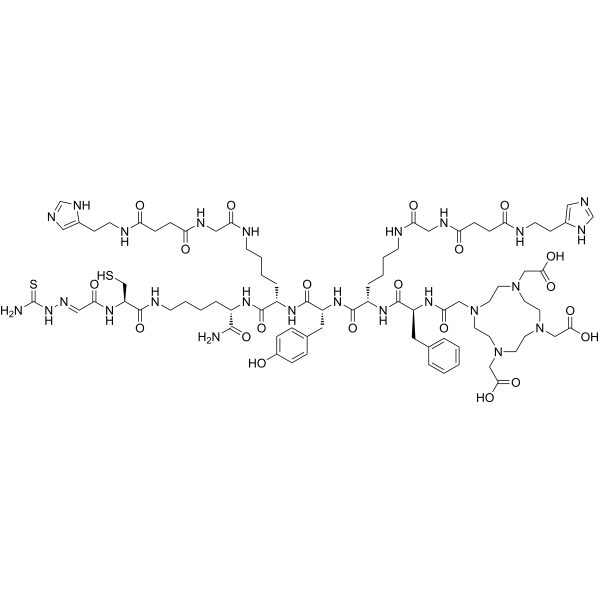
IMP 245 is a symmetric di-HSG bivalent hapten. IMP 245 has low toxicity, high affinity binding to available antibodies and absence of cross reactivity or non-specific binding with body components .
loading...
    loading...
Cat. No.: HY-155470
CAS No.: 391267-29-1
Research Areas:  

Cancer

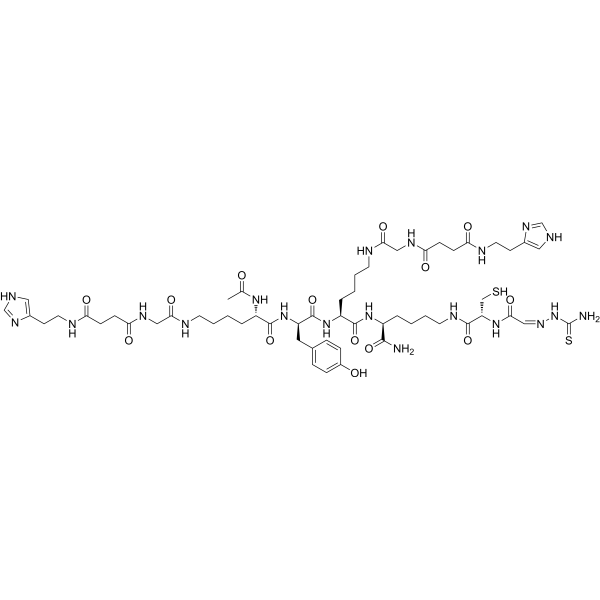
IMP 243 is a symmetric di-HSG (histamine-succinyl-glycine) bivalent hapten containing a Tscg-Cys ligand and two HSG groups. IMP 243 can be radiolabeled with 99mTc-pertechnetate. IMP 243 can be conjugated to other peptides to design bispecific antibodies (bsMAbs) for cancer research .
loading...
    loading...
Cat. No.: HY-155446
Target:  

Hapten

Research Areas:  

Inflammation/Immunology Cancer

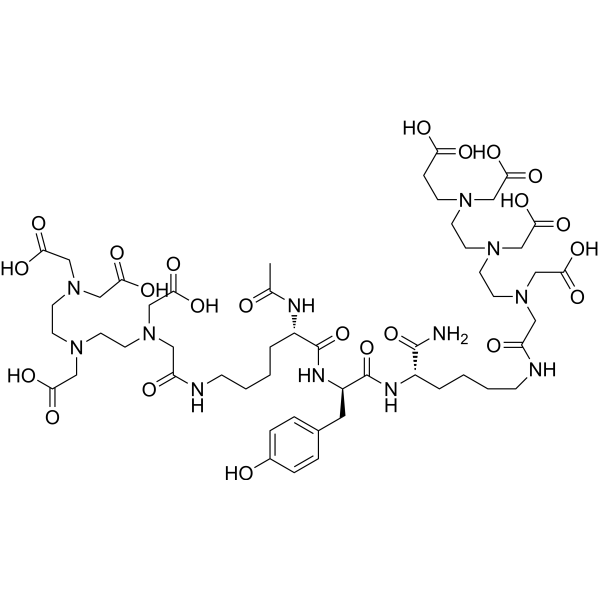
di-DTPA-LTL is a bivalent hapten based on tyrosine-containing polypeptide design. di-DTPA-LTL has good hydrophilia and biological distribution. di-DTPA-LTL is labeled with 111In (indium) and 131I (iodine). di-DTPA-LTL achieves tumor radioimmunoimaging in primary colorectal cancer patients with CEA by injecting a fixed low dose (5 mg) of bispecific antibody (anti-CEA x, anti-DTPA) and di-DTPA antigen peptide (labeled 111In) into the patients .
loading...
    loading...
Cat. No.: HY-P992359
Synonyms: SHR-1905

Target:  

Inhibitory Antibodies

Research Areas:  

Inflammation/Immunology

GSK5784283 (SHR-1905) is a bivalent antibody against TSLP, which is applicable to research related to asthma. GSK5784283 has two Fab arms and is a humanized IgG1κ monoclonal antibody. GSK5784283 effectively reduces the levels of eosinophils, FeNO, TARC and eotaxin-3. GSK5784283 regulates FEV1 (forced expiratory volume in one second) .
loading...
    loading...
Cat. No.: HY-P992339

Research Areas:  

Cancer

cT84.66 is a highly efficient tumor-targeting agent against carcinoembryonic antigen (CEA). cT84.66 engages in bivalent binding with CEA via variable region antigen-binding sites, enabling precise targeting of CEA-producing tumor cells for delivery of therapeutic radiation. cT84.66 exhibits high tumor uptake rate, rapid clearance rate, and excellent tumor-to-blood ratio. With dual functions as an imaging agent and an antibody-directed radiotherapy agent, cT84.66 is widely used in studies of colorectal cancer and metastatic CEA-positive malignancies .
loading...
    loading...
Cat. No.: HY-P992434

Research Areas:  

Cancer

OSE-279 is a high-affinity humanized monoclonal bivalent antibody targeting PD-1, the recommended isotype control is HY-P99003. OSE-279 blocks PD-1 ligand binding, inhibits PDL1-induced SHP1 phosphorylation, restores T cell activation, and promotes reactivation of primary T cell effector functions. OSE-279 binds hFcRn receptor, predicts long half-life, induces CD4 and CD8 T cell proliferation, and promotes interleukin 2 and interferon gamma secretion. OSE-279 can be used for the research of advanced malignancies, colon cancer, hepatocarcinoma, mesothelioma .
loading...
    loading...
  • 1

