

1. Search Result
Search Result
Results for "

broccoli

" in MedChemExpress (MCE) Product Catalog:

14

Inhibitors & Agonists

5

Fluorescent Dye

1

Biochemical Assay Reagents

3

Natural
Products

1

Isotope-Labeled Compounds

2

Oligonucleotides

Cat. No. Product Name Target Research Areas Chemical Structure
  • HY-110251
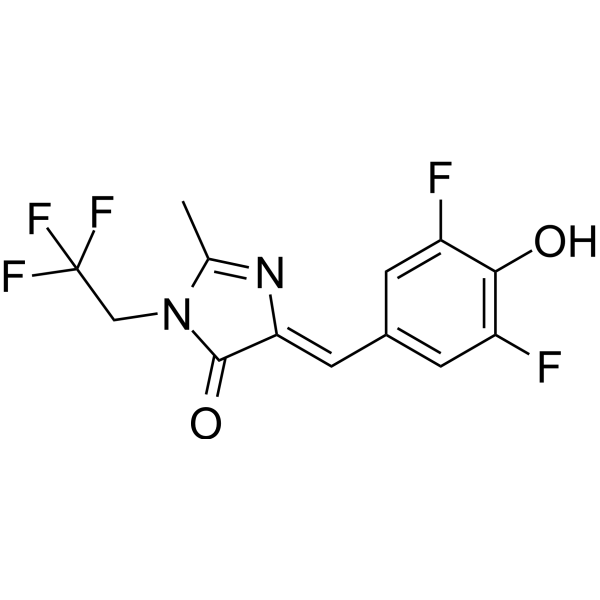
    DFHBI-1T
    15+ Cited Publications

    DNA Stain Others
    DFHBI-1T is a membrane-permeable RNA aptamers-activated fluorescence probe (ex/em=472 nm/507 nm). DFHBI-1T binds to RNA aptamers (Spinach, Spinach2, iSpinach, and Broccoli) and causes specific fluorescence and lower background fluorescence. DFHBI-1T is used to image RNA in live cells .
    DFHBI-1T
  • HY-128454

    Environmental Pollutants Biochemical Assay Reagents Infection Neurological Disease
    Dimethyl trisulfide is a cyanide scavenger. Dimethyl trisulfide can be isolated from garlic, onions, broccoli and similar plants. Dimethyl trisulfide converts cyanide into thiocyanate. Dimethyl trisulfide is used by saprophagous insects to locate breeding sites (decaying organic matter), and is also used by deceptive flowers in brood sites to attract such insects. Dimethyl trisulfide induces electrophysiological responses in houseflies .
    Dimethyl trisulfide
  • HY-153845

    Biochemical Assay Reagents Others
    RNA Aptamer Broccoli sodium is a 49-nucleotide nucleic acid aptamer that is much shorter than Spinach and Spinach2. It exhibits bright green fluorescence when binding to DFHBI or DFHBI-1T (a soluble analog of the green fluorescent protein label). RNA Aptamer Broccoli sodium can be used for RNA expression or localization in living cells .
    RNA Aptamer Broccoli sodium
  • HY-153783

    Fluorescent Dye Others Cancer
    OBI is a Red Broccoli probe with red fluorescence. OBI enables Red Broccoli to be easily detected in living mammalian cells. OBI can be used to monitor intracellular metabolites .
    OBI
  • HY-DY1047

    DNA Stain Others
    DFHBI-1T (solution) is a membrane-permeable RNA aptamers-activated fluorescence probe (ex/em=472 nm/507 nm). DFHBI-1T binds to RNA aptamers (Spinach, Spinach2, iSpinach, and Broccoli) and causes specific fluorescence and lower background fluorescence. DFHBI-1T is used to image RNA in live cells .
    Solvent and concentration: DMSO: 20 mM
    DFHBI-1T (solution)
  • HY-175397

    DFHBI-thalidomide

    PROTACs NF-κB Early 2 Factor (E2F) Bcl-2 Family VEGFR Cancer
    Dth (DFHBI-thalidomide) is an RNA aptamer-based PROTAC degrader. Dth can degrade a variety of endogenous proteins (such as mCherry, p50, p65 and E2F1) by replacing the 3′ module on the RNA scaffold with the RNA aptamer corresponding to the target protein. Dth upregulates IκB-α and Bax, and downregulates Bcl-2 and VEGF. Dth generates green fluorescence upon binding to the Broccoli RNA aptamer, enabling the tracing of RNA scaffolds. Dth can be used in cancer-related research .
    Dth
  • HY-137884

    3-Acetoxyindole

    Biochemical Assay Reagents Others
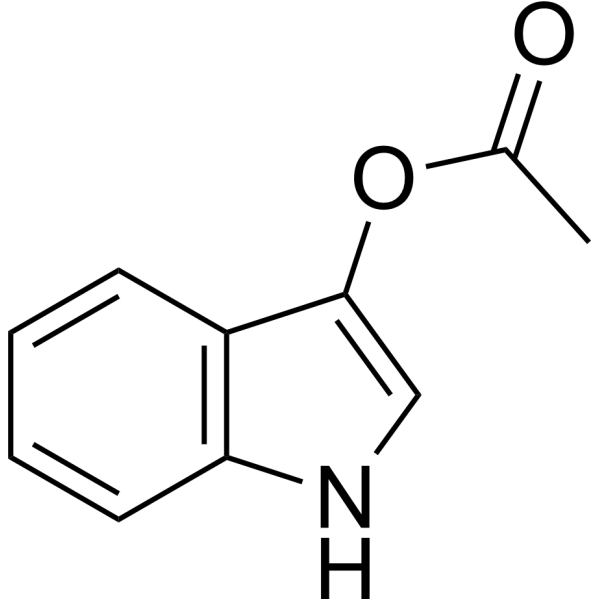
    3-Indolyl acetate is an ester derivative of indole that is ubiquitous in various plant tissues, especially in certain cruciferous vegetables such as broccoli and cabbage. 3-Indolyl acetate has unique chemical properties that make it an important signaling molecule in plants, regulating various physiological processes such as growth and defense against pathogens. It also has potential applications in the pharmaceutical industry, as it has been shown to have antitumor and anti-inflammatory effects in some studies.
    3-Indolyl acetate
  • HY-B2221S5

    Isotope-Labeled Compounds Endogenous Metabolite Others
    U- 13C Cellulose from broccoli is the 13C labeled Cellulose (HY-B2221). Cellulose is a natural high molecular weight polysaccharide found in many plants and organisms. It is widely used in manufacturing industries, such as in paper making, textiles, food and medicine, etc. As a renewable resource, Cellulose is biodegradable and sustainable, and can also be used to manufacture chemicals such as Cellulose Esters, Cellulose Acetate and Cellulose Nitrate. In addition, Cellulose is often used as a food additive to increase the stability and quality of food .
    U-13C Cellulose from broccoli
  • HY-128454R

    Reference Standards Endogenous Metabolite Others
    Dimethyl trisulfide (Standard) is the analytical standard of Dimethyl trisulfide. This product is intended for research and analytical applications. Dimethyl trisulfide is an organic chemical compound and the simplest organic trisulfide found in garlic, onion, broccoli, and similar plants. Dimethyl trisulfide is a cyanide antidote. Dimethyl trisulfide formation requires the thermal degradation of Met .
    Dimethyl trisulfide (Standard)
  • HY-153845B

    Biochemical Assay Reagents Others
    RNA Aptamer Broccoli sodium scrambled negative control is the sequence scrambled negative control of RNA Aptamer Broccoli sodium.
    RNA Aptamer Broccoli sodium scrambled negative control
  • HY-D3387

    Fluorescent Dye Others
    TBI is a fluorescence enhancer with a Kd of 71 nM for the Broccoli fluorogenic RNA aptamer. TBI binds to the Broccoli fluorogenic RNA aptamer to activate its fluorescence.TBI undergoes photobleaching of its trans form, which dissociates rapidly, while cis-TBI from the media replaces the dissociated fluorophore to enable fluorophore recycling.TBI enables enhanced fluorescence of Broccoli during continuous cellular imaging (Ex/Em = 485/527 nm) .
    TBI
  • HY-D3388

    Fluorescent Dye Drug Derivative Others
    BI dihydrochloride is a DFHBI (HY-110250) derivative for imaging of RNA in cells. BI dihydrochloride increases brightness and photostability of Broccoli aptamers in cells. BI dihydrochloride enables imaging of single Broccoli-tagged mRNAs in living cells. BI dihydrochloride exhibits peak excitation of 470 nm and peak fluorescence emission of 505 nm when bound to Broccoli.
    BI dihydrochloride
  • HY-D2282

    Fluorescent Dye Others
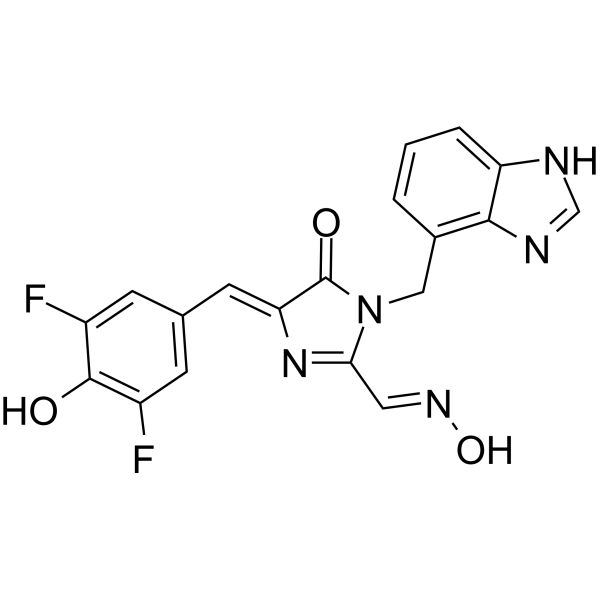
    DFHBI-BI is a mimic of the green fluorescence protein chromophore. DFHBI-BI can be bound and activated by Broccoli ( a fluorogenic RNA aptamer) with higher affinity. DFHBI-BI prevents thermal unfolding of Broccoli at 37°C in mammalian cells, subsequently forming more fluorescent Broccoli-BI complexes. The fluorescence wavelength is 559/635 nm .
    DFHBI-BI
  • HY-N2423B

    (E/Z)-Allyl-glucosinolate free base; (E/Z)-2-Propenyl-glucosinolate free base

    NF-κB p38 MAPK Apoptosis Cardiovascular Disease Infection Inflammation/Immunology Cancer
    (E/Z)-Sinigrin ((E/Z)-Allyl-glucosinolate; (E/Z)-2-Propenyl-glucosinolate) free base is an orally active aliphatic thioglucoside anti-leukemia compound. Allyl isothiocyanate, produced by the hydrolysis of (E/Z)-sinigrin free base by myrosinase, has an IC50 of 2.71 μM against HL60 leukemia cells. The hydrolysis products of (E/Z)-sinigrin free base can further activate apoptosis pathways, inhibit NF-κB and MAPK signaling pathways, and induce phase II metabolic enzyme activity, thus exhibiting anti-cancer, anti-inflammatory, antibacterial, antioxidant, and wound healing activities. (E/Z)-Sinigrin free base can be used in research on cancer, inflammation-related diseases (such as atherosclerosis), and infectious diseases. (E/Z)-Sinigrin free base can be naturally extracted from the seeds of Brassica nigra, Brassica juncea, and other Brassicaceae plants such as broccoli and Brussels sprouts. Methyl pechueloate is a guaiane-type sesquiterpene ester compound and a potential precursor of xerantholide. It is useful in the structural elucidation and biosynthetic pathway studies of sesquiterpenoids. Methyl pechueloate can be naturally extracted from the aerial parts of Pechuel-Loeschea leibnitziae (Kuntze) O. Hoffm .
    (E/Z)-Sinigrin free base

Inquiry Online

Your information is safe with us. * Required Fields.

Salutation


Country or Region *

Applicant Name *


Organization Name *

Department *


Email Address *


Product Name *

Cat. No.


Requested quantity *

Phone Number *


Remarks

Inquiry Online

Inquiry Information

Product Name:
Cat. No.:
Quantity:
MCE Japan Authorized Agent:

