
Search Result
Results for "
dispersing
" in MedChemExpress (MCE) Product Catalog:
5
Biochemical Assay Reagents
2
Isotope-Labeled Compounds
| Cat. No. |
Product Name |
Target |
Research Areas |
Chemical Structure |
-
- HY-P99974
-
|
Nanoparticle albumin-bound Paclitaxel; Nanoparticle albumin-bound ABI-007
|
Microtubule/Tubulin
Apoptosis
Autophagy
|
Cancer
|
|
Nab-Paclitaxel (Nanoparticle albumin-bound Paclitaxel) is an albumin-bound nanoparticle formulation of Paclitaxel (HY-B0015). Nab-Paclitaxel is composed of albumin and the active pharmaceutical ingredient Paclitaxel, in which human albumin is used as an excipient to disperse and stabilize particles and carry the main drug. Nab-Paclitaxel is a solvent-free taxane with higher response rates and improved tolerability. Nab-Paclitaxel displays less toxicity and greater antitumor activity. Nab-Paclitaxel is more readily available for tumor cell uptake in three rhabdomyosarcoma, seven neuroblastoma cell lines, and one ostersarcoma cell line Nab-Paclitaxel can be studied in cancer research for example breast cancer and solid tumors. (The product specifications below only indicate the effective content of Paditaxel, the actual albumin quality depends on the batch; the ratio of each ingredient in this product is Paditaxel: albumin -1:7~1:11) .
|
-
-
- HY-113293B
-
|
|
Endogenous Metabolite
Estrogen Receptor/ERR
|
Metabolic Disease
Cancer
|
|
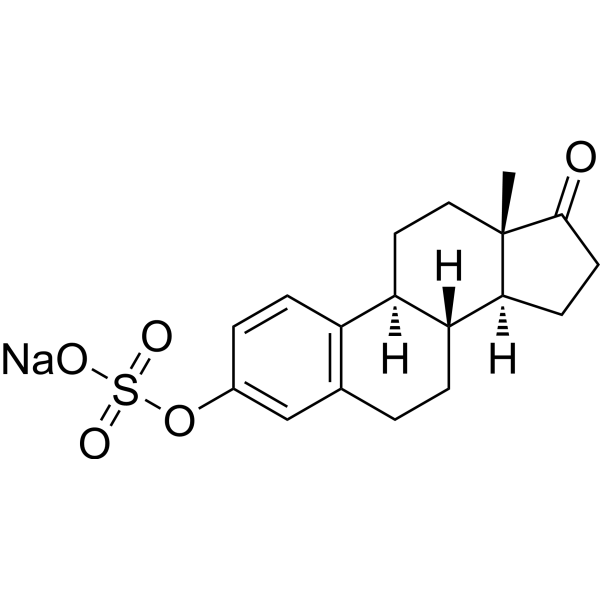
Estrone sulfate sodium is an inactive endogenous estrogen that can be converted into Estrone (HY-B0234) and Estradiol (HY-B0141). Estrone sulfate sodium is also a substrate of the OATP1B3 transporter. Estrone sulfate sodium can be converted into Estrone and Estradiol in normal mammary parenchymal cells. Estrone sulfate sodium stimulates the growth of nitrosomethylurea-induced mammary tumors in ovariectomized rats and the colony formation of dispersed nitrosomethylurea mammary cells, with conversion into Estrone and Estradiol occurring both in vivo and in vitro during this process. Estrone sulfate sodium is applicable to breast cancer-related research .
|
-
-
- HY-B1620B
-
-
-
- HY-108903A
-
|
|
Glycosidase
Biochemical Assay Reagents
|
Endocrinology
|
|
Hyaluronidase, Ovine testes is an endoglycosidase. Hyaluronidase, Ovine testes specifically degrades Hyaluronic acid (HY-B0633A) and Chondroitin sulfate (HY-B2162) by hydrolyzing β-glycosidic bonds in acidic mucopolysaccharides. Hyaluronidase, Ovine testes disperses follicular cells during fertilization by breaking down the hyaluronic acid-rich cumulus. Hyaluronidase, Ovine testes can be used in the study of fertility-related diseases .
|
-
-
- HY-W250168
-
|
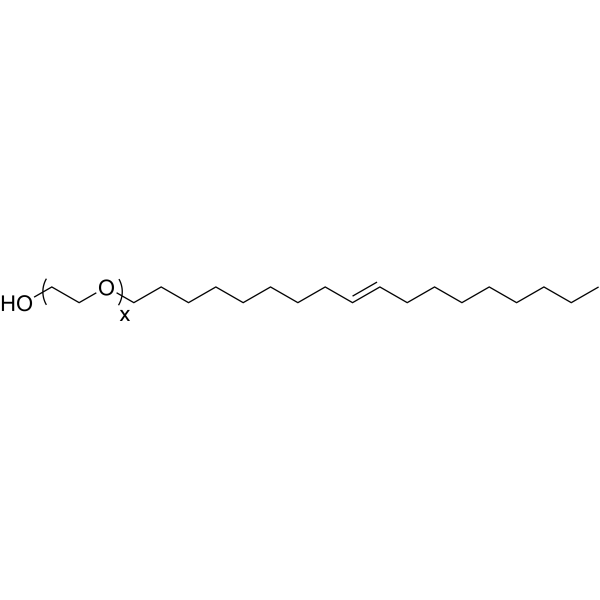
Polyethylene glycol oleyl ether, average Mn~709; Polyethylene glycol monooleyl ether, n~10
|
Environmental Pollutants
Biochemical Assay Reagents
|
Others
|
|
Polyoxyethylene(10) oleyl ether, also known as POE(10) monooleate, is a nonionic surfactant consisting of a polyethylene glycol chain with 10 ethylene oxide units and an oleic acid residue. It has excellent emulsifying, wetting and dispersing properties, making it suitable for a variety of applications including personal care products and pharmaceutical formulations. POE(10) monooleate is commonly used as a solubilizer to improve the solubility and bioavailability of poorly soluble drugs. Furthermore, it is biodegradable and has low toxicity, making it an environmentally friendly ingredient suitable for various industrial applications.
|
-
-
- HY-113293A
-
|
|
Endogenous Metabolite
Estrogen Receptor/ERR
|
Metabolic Disease
Cancer
|
|
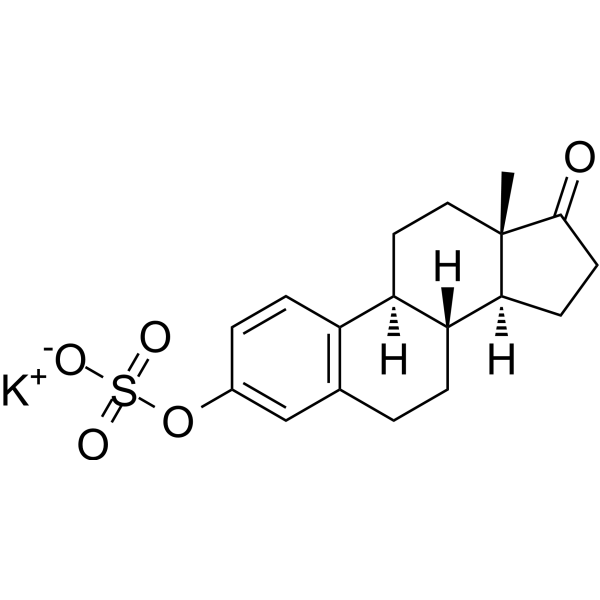
Estrone sulfate potassium is an inactive endogenous estrogen that can be converted into Estrone (HY-B0234) and Estradiol (HY-B0141). Estrone sulfate potassium is also a substrate of the OATP1B3 transporter. Estrone sulfate potassium can be converted into Estrone and Estradiol in normal mammary parenchymal cells. Estrone sulfate potassium stimulates the growth of nitrosomethylurea-induced mammary tumors in ovariectomized rats and the colony formation of dispersed nitrosomethylurea mammary cells, with conversion into Estrone and Estradiol occurring both in vivo and in vitro during this process. Estrone sulfate potassium is applicable to breast cancer-related research .
|
-
-
- HY-D0342
-
|
|
Fluorescent Dye
|
Others
|
|
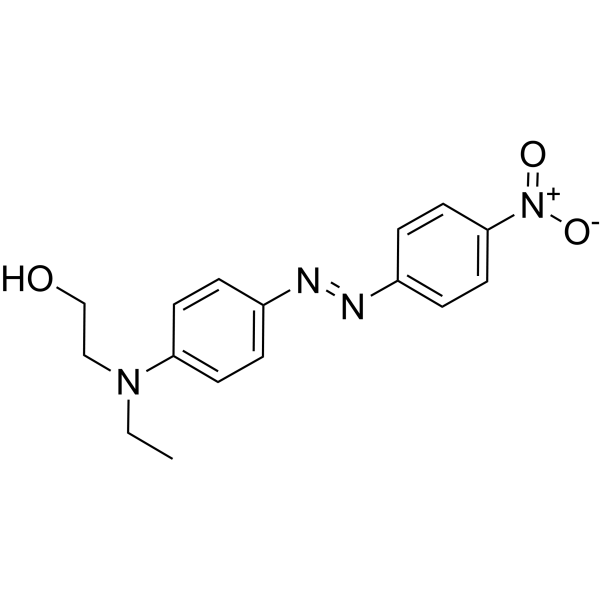
Disperse Red 1, an azobenzene derivative, is an azo textile dye extensively used for dyeing polyester fabrics in textile industry .
|
-
-
- HY-W129593
-
|
Sorbitan monostearate
|
Environmental Pollutants
Biochemical Assay Reagents
|
Others
|
|
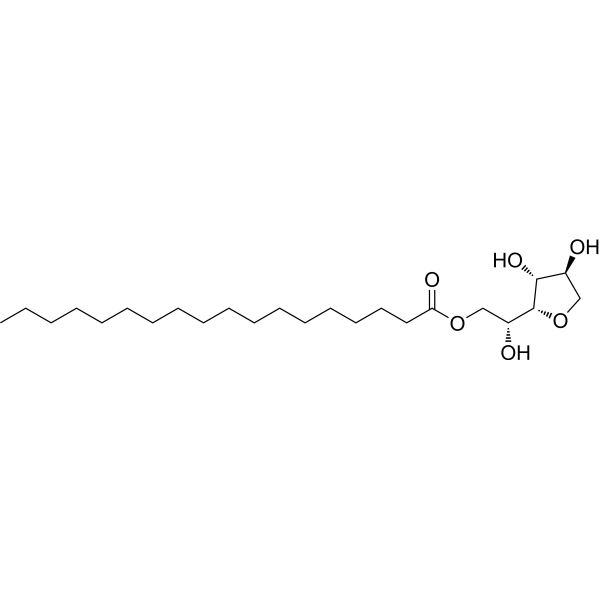
Sorbitan monooctadecanoate (Sorbitan monostearate) is a hydrophobic nonionic surfactant. Sorbitan monooctadecanoate can serve as a pharmaceutical excipient, such as an emulsifier, nonionic surfactant, solubilizer, wetting agent, and dispersing/suspending agent .
|
-
-
- HY-W111692
-
|
|
Biochemical Assay Reagents
|
Others
|
|
Sodium polyphosphate, crystal,+200 mesh, 96% is an inorganic polyphosphate that also serves as a stabilizer, dispersant, chelating agent, and coacervate-forming agent. Sodium polyphosphate provides electrostatic stabilization for mineral and material suspensions, but its dispersing efficacy decreases under acidic pH, high temperature, high calcium concentration, or a combination of these conditions. Sodium polyphosphate can chelate alkaline earth metals, reduce solution pH, and alter the rate of pH decline at a divalent cation/phosphorus molar ratio of 0.18. Sodium polyphosphate forms coacervates with smaller divalent cations and precipitates with larger divalent cations, where the functional requirements of cations depend on polyphosphate concentration, average degree of polymerization, and cation type .
|
-
-
- HY-113293BS1
-
|
|
Isotope-Labeled Compounds
Endogenous Metabolite
Estrogen Receptor/ERR
|
Metabolic Disease
Cancer
|
|
Estrone sulfate-d4 sodium is the deuterium labeled Estrone sulfate sodium (HY-113293B). Estrone sulfate sodium is an inactive endogenous estrogen that can be converted into Estrone (HY-B0234) and Estradiol (HY-B0141). Estrone sulfate sodium is also a substrate of the OATP1B3 transporter. Estrone sulfate sodium can be converted into Estrone and Estradiol in normal mammary parenchymal cells. Estrone sulfate sodium stimulates the growth of nitrosomethylurea-induced mammary tumors in ovariectomized rats and the colony formation of dispersed nitrosomethylurea mammary cells, with conversion into Estrone and Estradiol occurring both in vivo and in vitro during this process. Estrone sulfate sodium is applicable to breast cancer-related research .
|
-
-
- HY-P5815
-
|
Glucagon-like Peptide 1 (1-36) amide (human, rat)
|
GLP Receptor
GCGR
|
Metabolic Disease
|
|
GLP-1 (1-36) amide (human, rat) (Glucagon-like Peptide 1 (1-36) amide (human, rat)
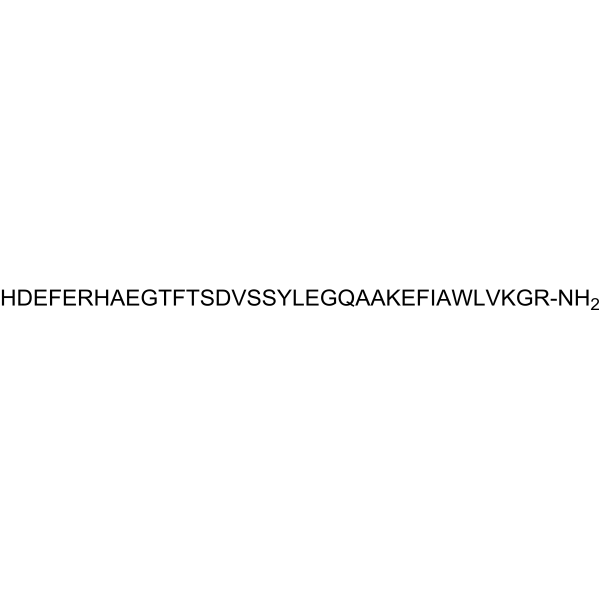
) is a molecular variant of glucagon-like peptide 1 (GLP-1)-(7-36) amide. GLP-1 (1-36) amide (human, rat) can stimulate [14C]aminopyrine accumulation on enzymatically dispersed enriched rat parietal cells .
|
-
-
- HY-154630
-
|
|
Biochemical Assay Reagents
|
Others
|
|
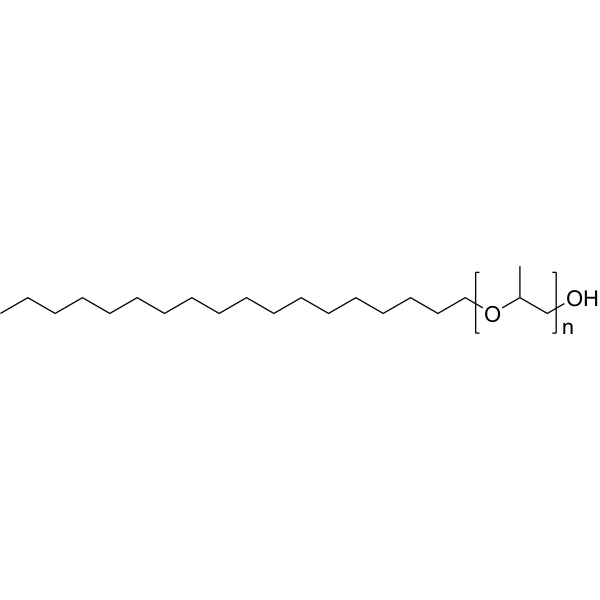
Polyoxypropylene stearyl ether can be used as an excipient, such as surfactant, softener, lubricating, wetting, plasticizing, solubilizing and dispersing properties. Pharmaceutical excipients, or pharmaceutical auxiliaries, refer to other chemical substances used in the pharmaceutical process other than pharmaceutical ingredients. Pharmaceutical excipients generally refer to inactive ingredients in pharmaceutical preparations, which can improve the stability, solubility and processability of pharmaceutical preparations. Pharmaceutical excipients also affect the absorption, distribution, metabolism, and elimination (ADME) processes of co-administered drugs .
|
-
-
- HY-D0370
-
|
|
Environmental Pollutants
Biochemical Assay Reagents
|
Others
|
|
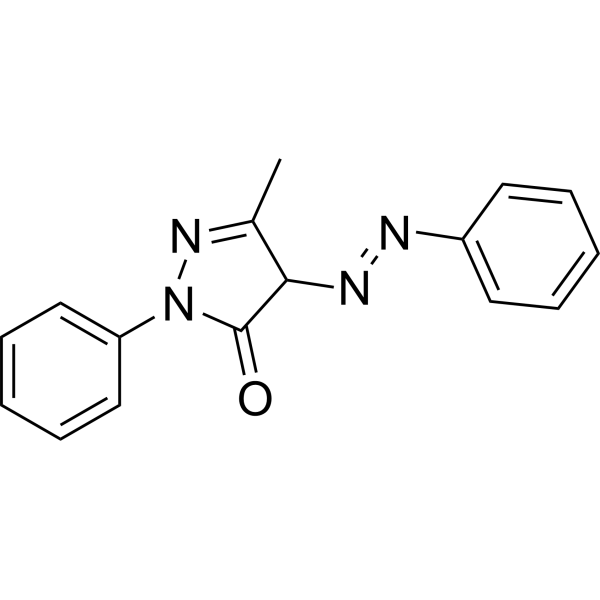
Solvent Yellow 16 is a disperse dye. Dyes are important tools in biological experiments. They can help researchers observe and analyze cell structures, track biomolecules, evaluate cell functions, distinguish cell types, detect biomolecules, study tissue pathology and monitor microorganisms. Their applications range from basic scientific research to clinical A wide range of diagnostics. Dyes are also widely used in traditional fields such as textile dyeing, as well as in emerging fields such as functional textile processing, food pigments and dye-sensitized solar cells .
|
-
-
- HY-135737
-
|
Dioctyl carbonate
|
Others
|
Others
|
|
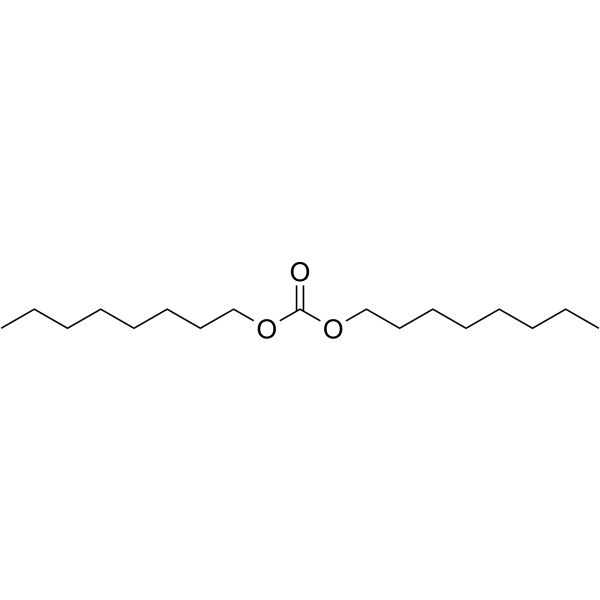
Dicaprylyl carbonate, a solid, plant-derived fat, is a dry emollient. Dicaprylyl carbonate has excellent dermatological compatibility and a comprehensive performance profile, such as solubilizing and dispersing ability for sun-care filters .
|
-
-
- HY-P5815A
-
|
Glucagon-like Peptide 1 (1-36) amide (human, rat) TFA
|
GLP Receptor
GCGR
|
Metabolic Disease
|
|
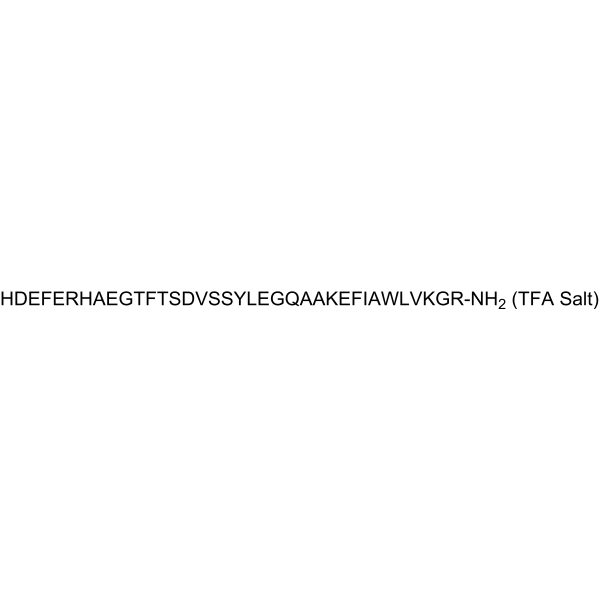
GLP-1 (1-36) amide (human, rat) (Glucagon-like Peptide 1 (1-36) amide (human, rat)
) TFA is a molecular variant of glucagon-like peptide 1 (GLP-1)-(7-36) amide. GLP-1 (1-36) amide (human, rat) TFA can stimulate [14C]aminopyrine accumulation on enzymatically dispersed enriched rat parietal cells .
|
-
-
- HY-154739A
-
|
|
Biochemical Assay Reagents
|
Others
|
|
Amorphous silica can be used as an excipient, such as viscosifier, suspending agent, tablet disintegrating agent, adsorbent dispersing agent as liquid in powders. Pharmaceutical excipients, or pharmaceutical auxiliaries, refer to other chemical substances used in the pharmaceutical process other than pharmaceutical ingredients. Pharmaceutical excipients generally refer to inactive ingredients in pharmaceutical preparations, which can improve the stability, solubility and processability of pharmaceutical preparations. Pharmaceutical excipients also affect the absorption, distribution, metabolism, and elimination (ADME) processes of co-administered drugs .
|
-
-
- HY-D0332
-
|
|
Fluorescent Dye
|
|
|
Disperse Orange 1 is an orange-orange dye commonly used for fiber dyeing.
|
-
-
- HY-D0565
-
|
|
Fluorescent Dye
|
|
|
Disperse blue 291G is a blue dye commonly used for fiber dyeing.
|
-
-
- HY-D0348
-
|
Disperse Blue 7; 1,4-DiOH-5,8-bis(2-OHethyl)aminoanthraquinone
|
Biochemical Assay Reagents
|
Others
|
|
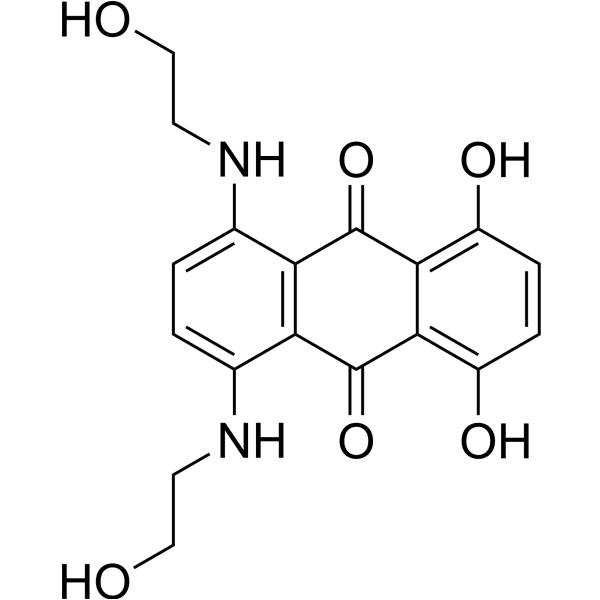
Celliton Fast Blue Green B (Disperse Blue 7), a blue-green dye used in textiles. The aqueous extract of Celliton Fast Blue Green B causes no signs of skin irritation and sensitization in laboratory animals. Celliton Fast Blue Green B colored textiles with no irritation in human .
|
-
-
- HY-W099642
-
|
Trimethyl-n-octylammonium bromide
|
Biochemical Assay Reagents
|
Others
|
|
Trimethyloctylammonium bromide (TOAB) is used as a surfactant and phase transfer catalyst in various chemical reactions. TOAB can be used in the synthesis of nanomaterials due to its ability to selectively transfer ions across interfaces and as a surfactant in the production of emulsions and foams. It is valued for its amphiphilic properties, which allow it to interact with water and oils, stabilizing and dispersing mixtures.
|
-
-
- HY-142981
-
|
DODA
|
Liposome
|
Others
|
|
Dioctadecylamine (DODA) is a secondary amine that has been shown to self-organize in plate-like structures in aqueous solution. Dioctadecylamine exhibits sufficiently hydrophobic properties of nanoparticles and good dispersibility in nonpolar solvent. Dioctadecylamine does not form a monolayer above pH 3.9 .
|
-
-
- HY-D1219
-
|
|
Fluorescent Dye
|
|
|
Disperse blue 359 is a blue dye commonly used for fiber dyeing.
|
-
-
- HY-N15995
-
|
|
Biochemical Assay Reagents
|
Others
|
|
DOPE-PEG(2000) Carboxylic acid sodium is a stabilizer. DOPE-PEG(2000) Carboxylic acid sodium produce a coating around the ferrofluid droplet chains which are dispersed in 5CB. DOPE-PEG(2000) Carboxylic acid sodium tends to fold, effectively shielding the surrounding LC molecules from the homeotropic anchoring at the droplet interface and leading to smaller deformations and thus also creating a more stable interface .
|
-
-
- HY-113293
-
|
|
Endogenous Metabolite
Estrogen Receptor/ERR
|
Metabolic Disease
Cancer
|
|
Estrone sulfate is an inactive endogenous estrogen that can be converted into Estrone (HY-B0234) and Estradiol (HY-B0141). Estrone sulfate is also a substrate of the OATP1B3 transporter. Estrone sulfate can be converted into Estrone and Estradiol in normal mammary parenchymal cells. Estrone sulfate stimulates the growth of nitrosomethylurea-induced mammary tumors in ovariectomized rats and the colony formation of dispersed nitrosomethylurea mammary cells, with conversion into Estrone and Estradiol occurring both in vivo and in vitro during this process. Estrone sulfate is applicable to breast cancer-related research .
|
-
-
- HY-D0479
-
-
-
- HY-W587874
-
|
|
Fluorescent Dye
|
Others
|
|
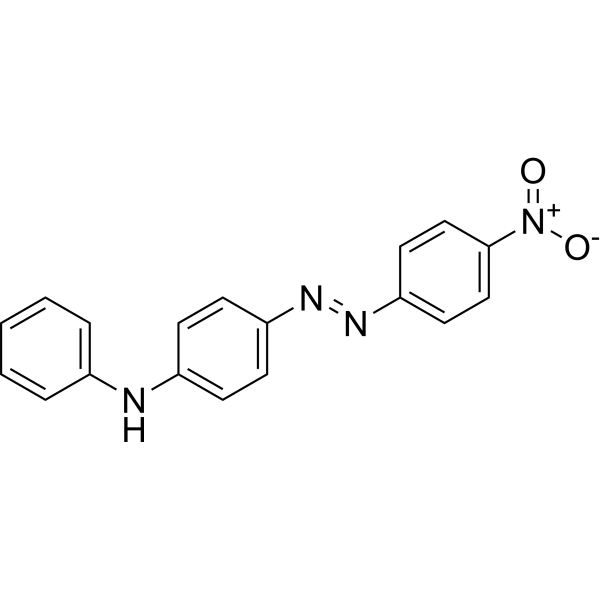
Disperse Orange 3 is a monoazo dye characterized by a dye content of 90% along with dispersing agents and surfactants; it features two aromatic rings, one of which possesses an amino group while the other is modified with a nitro group, exhibiting a prominent absorption peak at 415 nm.
|
-
-
- HY-D0667
-
|
|
Fluorescent Dye
|
|
|
Disperse yellow 211 is a yellow dye commonly used for fiber dyeing.
|
-
-
- HY-D0575
-
|
|
Fluorescent Dye
|
|
|
Disperse violet 93 is a violet dye commonly used for fiber dyeing.
|
-
-
- HY-D0637
-
|
|
Fluorescent Dye
|
|
|
Disperse Blue 106 is a yellow dye commonly used for fiber dyeing.
|
-
-
- HY-D0610
-
|
|
Fluorescent Dye
|
|
|
Disperse Violet 33 is a violet dye commonly used for fiber dyeing.
|
-
-
- HY-D0524
-
|
|
Fluorescent Dye
|
|
|
Disperse black 9 is a violet dye commonly used for fiber dyeing.
|
-
-
- HY-D0521
-
|
|
Fluorescent Dye
|
|
|
Disperse orange 29 is an orange-orange dye commonly used for fiber dyeing.
|
-
-
- HY-D0382
-
|
|
Fluorescent Dye
|
|
|
Disperse Orange 30 is an orange-orange dye commonly used for fiber dyeing.
|
-
-
- HY-D0491
-
|
|
Fluorescent Dye
|
|
|
C.I. Disperse blue 79 is a blue dye commonly used for fiber dyeing.
|
-
-
- HY-D0400
-
|
|
Fluorescent Dye
|
|
|
C.I. Disperse yellow 23 is a yellow dye commonly used for fiber dyeing.
|
-
-
- HY-D0341
-
|
Solvent Violet 26
|
Fluorescent Dye
|
|
|
Disperse Red 11 is a red dye derived from anthraquinone. It is used in plastics, textiles and cosmetics.
|
-
-
- HY-D0545
-
|
|
Fluorescent Dye
|
Others
|
|
Disperse red 91 is a red dye derived from anthraquinone. It is used in plastics, textiles and cosmetics.
|
-
-
- HY-D0687
-
|
|
Fluorescent Dye
|
|
|
Disperse red 324 is a red dye derived from anthraquinone. It is used in plastics, textiles and cosmetics.
|
-
-
- HY-D0497
-
|
|
Fluorescent Dye
|
|
|
C.I. Disperse orange 37 is an orange-orange dye commonly used for fiber dyeing.
|
-
-
- HY-D0673
-
|
|
Fluorescent Dye
|
|
|
Disperse red 311 is a red dye derived from anthraquinone. It is used in plastics, textiles and cosmetics.
|
-
-
- HY-D2424
-
|
|
Fluorescent Dye
|
Others
|
|
Disperse Red 343 is an azo dye widely used in the textile industry for dyeing polyester fabrics .
|
-
-
- HY-D0316
-
|
DR 167:1
|
Fluorescent Dye
|
|
|
Disperse red 167:1 is a red dye derived from anthraquinone. It is used in plastics, textiles and cosmetics.
|
-
-
- HY-N15601
-
|
NSC 257450
|
Biochemical Assay Reagents
|
Others
|
|
Dermocybin (NSC 257450) is a natural anthraquinone isolated from the fungus Derniocybe sarzgiiirzea. Dermocybin can be used as a high-temperature disperse dye for polyester and polyamide fabrics .
|
-
-
- HY-D0463
-
|
|
Fluorescent Dye
|
Others
|
|
Disperse yellow 54 is a multifunctional dye. Dyes are important tools in biological experiments. They can help researchers observe and analyze cell structures, track biomolecules, evaluate cell functions, distinguish cell types, detect biomolecules, study tissue pathology and monitor microorganisms. Their applications range from basic scientific research to clinical A wide range of diagnostics. Dyes are also widely used in traditional fields such as textile dyeing, as well as in emerging fields such as functional textile processing, food pigments and dye-sensitized solar cells.
|
-
-
- HY-D0583
-
|
|
Fluorescent Dye
|
Others
|
|
Disperse blue 291 is a multifunctional dye. Dyes are important tools in biological experiments. They can help researchers observe and analyze cell structures, track biomolecules, evaluate cell functions, distinguish cell types, detect biomolecules, study tissue pathology and monitor microorganisms. Their applications range from basic scientific research to clinical A wide range of diagnostics. Dyes are also widely used in traditional fields such as textile dyeing, as well as in emerging fields such as functional textile processing, food pigments and dye-sensitized solar cells.
|
-
-
- HY-113293BS
-
|
|
Isotope-Labeled Compounds
Endogenous Metabolite
Estrogen Receptor/ERR
|
Metabolic Disease
Cancer
|
|
Estrone sulfate-d5 sodium is the deuterium labeled Estrone sulfate sodium (HY-113293B). Estrone sulfate sodium is an inactive endogenous estrogen that can be converted into Estrone (HY-B0234) and Estradiol (HY-B0141). Estrone sulfate sodium is also a substrate of the OATP1B3 transporter. Estrone sulfate sodium can be converted into Estrone and Estradiol in normal mammary parenchymal cells. Estrone sulfate sodium stimulates the growth of nitrosomethylurea-induced mammary tumors in ovariectomized rats and the colony formation of dispersed nitrosomethylurea mammary cells, with conversion into Estrone and Estradiol occurring both in vivo and in vitro during this process. Estrone sulfate sodium is applicable to breast cancer-related research .
|
-
-
- HY-141720
-
|
|
HCV
|
Others
|
|
4-(2,4,4-Trimethylpentan-2-yl)benzene-PEG4-OH, a nonionic surfactant with a low hydrophile-lypophile balance (HLB) value and dispersible in aqueous solution at room temperature, has a Krafft point above the room temperature. 4-(2,4,4-Trimethylpentan-2-yl)benzene-PEG4-OH has the potential for the research of the hepatitis C virus (HCV) .
|
-
-
- HY-D0497R
-
|
|
Fluorescent Dye
Reference Standards
|
Others
|
|
C.I. Disperse orange 37 (Standard) is the analytical standard of C.I. Disperse orange 37. This product is intended for research and analytical applications. C.I. Disperse orange 37 is an orange-orange dye commonly used for fiber dyeing.
|
-
-
- HY-W414447
-
|
DB1
|
Biochemical Assay Reagents
|
Others
|
|
Disperse blue 1 is an organic dye. Disperse blue 1 can be used in staining experiments in biology to stain cells and tissues .
|
-
-
- HY-D0739
-
|
|
Fluorescent Dye
|
|
|
Disperse yellow 241 is a yellow dye commonly used for fiber dyeing.
|
-
- HY-D0416
-
|
|
Fluorescent Dye
|
|
|
Disperse yellow 9 is a yellow dye commonly used for fiber dyeing.
|
-
- HY-D0528
-
|
|
Fluorescent Dye
|
|
|
Disperse brown 1 is a brown dye commonly used for fiber dyeing.
|
-
- HY-D0644
-
|
|
Fluorescent Dye
|
|
|
Disperse blue 102 is a yellow dye commonly used for fiber dyeing.
|
-
- HY-W927157
-
-
- HY-D0381
-
|
|
Fluorescent Dye
|
|
|
Disperse Yellow 42 is a yellow dye commonly used for fiber dyeing.
|
-
- HY-D0611
-
|
|
Fluorescent Dye
|
|
|
Disperse Yellow 86 is a yellow dye commonly used for fiber dyeing.
|
-
- HY-D1202
-
|
|
Fluorescent Dye
|
|
|
Disperse Violet 63 is a violet dye commonly used for fiber dyeing.
|
-
- HY-D0346
-
|
|
Fluorescent Dye
|
|
|
Disperse Blue 85 is a blue dye commonly used for fiber dyeing.
|
-
- HY-D0339
-
|
|
Fluorescent Dye
|
|
|
Disperse Yellow 3 is a yellow dye commonly used for fiber dyeing.
|
-
- HY-D0289
-
|
|
Fluorescent Dye
|
|
|
Disperse violet 8 is a violet dye commonly used for fiber dyeing.
|
-
- HY-D0757
-
|
|
Fluorescent Dye
|
|
|
Disperse blue 366 is a blue dye commonly used for fiber dyeing.
|
-
- HY-D0517
-
|
|
Fluorescent Dye
|
|
|
Disperse brown 4 is a brown dye commonly used for fiber dyeing.
|
-
- HY-D1039
-
|
|
Fluorescent Dye
|
|
|
Disperse blue ANT is a blue dye commonly used for fiber dyeing.
|
-
- HY-D0321
-
|
|
Fluorescent Dye
|
|
|
Disperse Blue 183 is a blue dye commonly used for fiber dyeing.
|
-
- HY-D0364
-
|
|
Fluorescent Dye
|
|
|
Disperse Orange 44 is an orange-orange dye commonly used for fiber dyeing.
|
-
- HY-D0552
-
-
- HY-D1038
-
|
|
Fluorescent Dye
|
|
|
Disperse orange 31 is an orange-orange dye commonly used for fiber dyeing.
|
-
- HY-D0533
-
|
|
Fluorescent Dye
|
|
|
Disperse blue 165:1 is a blue dye commonly used for fiber dyeing.
|
-
- HY-D0542
-
-
- HY-D2425
-
|
|
Fluorescent Dye
|
Others
|
|
Disperse Red 153 is an azo dye that can be used in plastics, textiles, and cosmetics .
|
-
- HY-D0454
-
|
|
Fluorescent Dye
|
|
|
C.I. Disperse red 54 is a red dye commonly used for fiber dyeing.
|
-
- HY-D0484
-
|
|
Fluorescent Dye
|
|
|
C.I. Disperse yellow 70 is a yellow dye commonly used for fiber dyeing.
|
-
- HY-D0349
-
|
|
Fluorescent Dye
|
|
|
Disperse Red 13 is a red dye derived from anthraquinone. It is used in plastics, textiles and cosmetics.
|
-
- HY-D0315
-
|
|
Fluorescent Dye
|
|
|
Disperse red 74 is a red dye derived from anthraquinone. It is used in plastics, textiles and cosmetics.
|
-
- HY-D0513
-
|
|
Fluorescent Dye
|
|
|
Disperse red 65 is a red dye derived from anthraquinone. It is used in plastics, textiles and cosmetics.
|
-
- HY-D1037
-
|
|
Fluorescent Dye
|
|
|
Disperse red 50 is a red dye derived from anthraquinone. It is used in plastics, textiles and cosmetics.
|
-
- HY-D0594
-
|
|
Fluorescent Dye
|
|
|
Disperse Red 278 is a red dye derived from anthraquinone. It is used in plastics, textiles and cosmetics.
|
-
- HY-D0288
-
|
|
Fluorescent Dye
|
|
|
Disperse red 86 is a red dye derived from anthraquinone. It is used in plastics, textiles and cosmetics.
|
-
- HY-D0347
-
|
|
Fluorescent Dye
|
|
|
Disperse Red 17 is a red dye derived from anthraquinone. It is used in plastics, textiles and cosmetics.
|
-
- HY-D0393
-
|
|
Fluorescent Dye
|
|
|
Disperse red 54 is a red dye derived from anthraquinone. It is used in plastics, textiles and cosmetics.
|
-
- HY-D0625
-
|
|
Fluorescent Dye
|
|
|
Disperse Red 177 is a red dye derived from anthraquinone. It is used in plastics, textiles and cosmetics.
|
-
- HY-D0515
-
|
|
Fluorescent Dye
|
|
|
Disperse red 73 is a red dye derived from anthraquinone. It is used in plastics, textiles and cosmetics.
|
-
- HY-D0643
-
|
|
Fluorescent Dye
|
|
|
C.I. Disperse orange 33 is an orange-orange dye commonly used for fiber dyeing.
|
-
- HY-D0555
-
-
- HY-D1128
-
|
|
Fluorescent Dye
|
|
|
Disperse red 151 is a red dye derived from anthraquinone. It is used in plastics, textiles and cosmetics.
|
-
- HY-168631
-
|
|
Bacterial
|
Infection
|
|
Antibacterial agent 254 (Compound 2) is a dispersion sensor (DspS) activator that disperses Pseudomonas aeruginosa biofilms. Antibacterial agent 254 can dislodge 7-day P. aeruginosa biofilms at 50 μM. Antibacterial agent 254 also enhances the effects of Ciprofloxacin (HY-B0356) against P. aeruginosa and increases the expression of matrix-degrading enzyme genes pelA, pslG and eddA .
|
-
- HY-D0652
-
|
|
Fluorescent Dye
|
Others
|
|
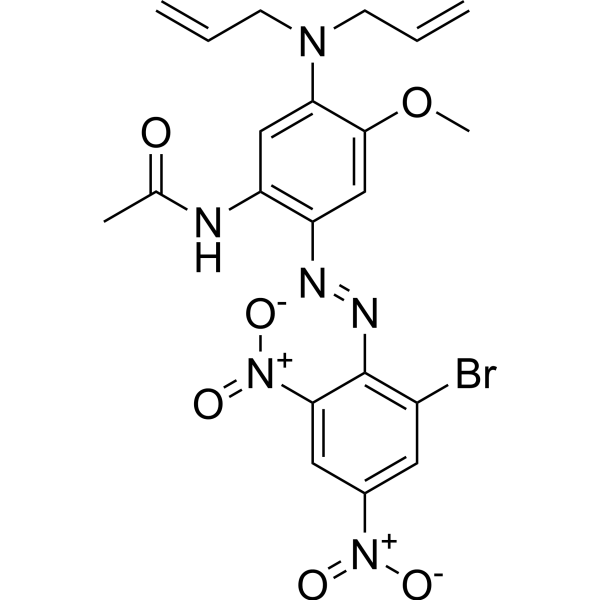
Disperse orange 80 is a multifunctional dye. Dyes are important tools in biological experiments. They can help researchers observe and analyze cell structures, track biomolecules, evaluate cell functions, distinguish cell types, detect biomolecules, study tissue pathology and monitor microorganisms. Their applications range from basic scientific research to clinical A wide range of diagnostics. Dyes are also widely used in traditional fields such as textile dyeing, as well as in emerging fields such as functional textile processing, food pigments and dye-sensitized solar cells.
|
-
- HY-D0453
-
|
|
Fluorescent Dye
|
Others
|
|
Disperse orange A is a multifunctional dye. Dyes are important tools in biological experiments. They can help researchers observe and analyze cell structures, track biomolecules, evaluate cell functions, distinguish cell types, detect biomolecules, study tissue pathology and monitor microorganisms. Their applications range from basic scientific research to clinical A wide range of diagnostics. Dyes are also widely used in traditional fields such as textile dyeing, as well as in emerging fields such as functional textile processing, food pigments and dye-sensitized solar cells.
|
-
- HY-D0589
-
|
|
Fluorescent Dye
|
Others
|
|
Disperse green 9 is a multifunctional dye. Dyes are important tools in biological experiments. They can help researchers observe and analyze cell structures, track biomolecules, evaluate cell functions, distinguish cell types, detect biomolecules, study tissue pathology and monitor microorganisms. Their applications range from basic scientific research to clinical A wide range of diagnostics. Dyes are also widely used in traditional fields such as textile dyeing, as well as in emerging fields such as functional textile processing, food pigments and dye-sensitized solar cells.
|
-
- HY-D0558
-
|
|
Fluorescent Dye
|
Others
|
|
Disperse blue 165 is a multifunctional dye. Dyes are important tools in biological experiments. They can help researchers observe and analyze cell structures, track biomolecules, evaluate cell functions, distinguish cell types, detect biomolecules, study tissue pathology and monitor microorganisms. Their applications range from basic scientific research to clinical A wide range of diagnostics. Dyes are also widely used in traditional fields such as textile dyeing, as well as in emerging fields such as functional textile processing, food pigments and dye-sensitized solar cells.
|
-
- HY-D0559
-
|
|
Fluorescent Dye
|
Others
|
|
C.I. Disperse blue 284 is a multifunctional dye. Dyes are important tools in biological experiments. They can help researchers observe and analyze cell structures, track biomolecules, evaluate cell functions, distinguish cell types, detect biomolecules, study tissue pathology and monitor microorganisms. Their applications range from basic scientific research to clinical A wide range of diagnostics. Dyes are also widely used in traditional fields such as textile dyeing, as well as in emerging fields such as functional textile processing, food pigments and dye-sensitized solar cells.
|
-
- HY-113293BR
-
|
|
Reference Standards
Endogenous Metabolite
Estrogen Receptor/ERR
|
Metabolic Disease
Cancer
|
|
Estrone sulfate sodium (Standard) is the analytical standard of Estrone sulfate sodium (HY-113293B). This product is intended for research and analytical applications. Estrone sulfate sodium is an inactive endogenous estrogen that can be converted into Estrone (HY-B0234) and Estradiol (HY-B0141). Estrone sulfate sodium is also a substrate of the OATP1B3 transporter. Estrone sulfate sodium can be converted into Estrone and Estradiol in normal mammary parenchymal cells. Estrone sulfate sodium stimulates the growth of nitrosomethylurea-induced mammary tumors in ovariectomized rats and the colony formation of dispersed nitrosomethylurea mammary cells, with conversion into Estrone and Estradiol occurring both in vivo and in vitro during this process. Estrone sulfate sodium is applicable to breast cancer-related research.
|
-
- HY-D0416R
-
|
|
Fluorescent Dye
Reference Standards
|
Others
|
|
Disperse yellow 9 (Standard) is the analytical standard of Disperse yellow 9. This product is intended for research and analytical applications. Disperse yellow 9 is a yellow dye commonly used for fiber dyeing.
|
-
- HY-D0347R
-
|
|
Fluorescent Dye
Reference Standards
|
Others
|
|
Disperse Red 17 (Standard) is the analytical standard of Disperse Red 17. This product is intended for research and analytical applications. Disperse Red 17 is a red dye derived from anthraquinone. It is used in plastics, textiles and cosmetics.
|
-
- HY-W585926
-
|
|
Reactive Oxygen Species (ROS)
|
Others
|
|
Disperse Polyester Dark Blue is a chemical compound extensively employed in scientific research. It serves as a redox-active agent and functions as a probe for identifying reactive oxygen species (ROS) in cells and tissues. By accepting electrons from ROS and undergoing oxidation, Disperse Polyester Dark Blue demonstrates its redox activity. Consequently, a chemiluminescent signal is generated, which can be measured using a luminometer. The intensity of the signal directly correlates with the quantity of ROS detected within the sample.
|
-
- HY-124533
-
|
|
Biochemical Assay Reagents
|
Others
|
|
Trimethylolmelamine is a bioactive chemical. The hydroxymethyl of Trimethylolmelamine plays an important role in atomically dispersing Cu atoms in carbon nitride in which the melem ring not only stabilizes Cu sites by quaternary coordination way but also provides high reactivity and selectivity for the hydrogenation reaction .
|
-
- HY-W075283
-
|
1-(4-Aminophenyl)-1,2,2-triphenylethene
|
|
Others
|
|
4-(1,2,2-Triphenylvinyl)aniline (1-(4-Aminophenyl)-1,2,2-triphenylethene) is a tetraphenylethene-based aggregation-induced luminescent molecule. 4-(1,2,2-Triphenylvinyl)aniline exhibits weak or no fluorescence in dilute solution/dispersed state, and strong fluorescence with increased quantum yield when aggregated into nanoparticles .
|
-
- HY-W585945
-
|
|
Reactive Oxygen Species (ROS)
|
Inflammation/Immunology
|
|
Mono N-Desmethyl Disperse Polyester Dark Blue is a bioreductive agent that is activated under hypoxic conditions. Once inside a cell, it is reduced to its active form, which generates reactive oxygen species that can damage cellular components, including DNA. This damage can lead to cell death, particularly in hypoxic cancer cells that are already under stress. It has also been shown to inhibit the activity of hypoxia-inducible factor 1 (HIF-1) , which is a key regulator of the cellular response to hypoxia.
|
-
- HY-171722
-
|
Asc-C9
|
Insecticide
PGC-1α
|
Infection
Cancer
|
|
Ascr#10 (Asc-C9) is an orally active thermogenesis inducer and insecticide that can be obtained from Monochamus alternatus. Ascr#10 binds to the insect adipokinetic hormone (AKH) receptor (Ka=272 µM) and stimulates mitochondrial biogenesis via the PGC1α-UCP4 axis. Consequently, Ascr#10 induces UCP4-mediated uncoupled respiration, reduces the ATP/ADP ratio and accelerates lipid mobilization, thereby driving the thermogenesis process. Ascr#10 delays pupation and exerts specific chemotaxis toward dispersive fourth-stage pinewood nematode LIV larvae. Ascr#10 promotes cold acclimation of Monochamus alternatus larvae through metabolic inhibition and cryoprotectant accumulation, enhancing their survival rate under cold stress. Ascr#10 also induces browning of white adipose tissue and activates brown adipose tissue in mice, thereby helping the body resist cold and tumor growth. Ascr#10 can be widely applied to research related to pine wilt disease, lung tumors and cold stress .
|
-
| Cat. No. |
Product Name |
Type |
-
- HY-D0342
-
|
|
Fluorescent Dye
|
|
Disperse Red 1, an azobenzene derivative, is an azo textile dye extensively used for dyeing polyester fabrics in textile industry .
|
-
- HY-D0370
-
|
|
Fluorescent Dye
|
|
Solvent Yellow 16 is a disperse dye. Dyes are important tools in biological experiments. They can help researchers observe and analyze cell structures, track biomolecules, evaluate cell functions, distinguish cell types, detect biomolecules, study tissue pathology and monitor microorganisms. Their applications range from basic scientific research to clinical A wide range of diagnostics. Dyes are also widely used in traditional fields such as textile dyeing, as well as in emerging fields such as functional textile processing, food pigments and dye-sensitized solar cells .
|
-
- HY-D0332
-
|
|
Fluorescent Dye
|
|
Disperse Orange 1 is an orange-orange dye commonly used for fiber dyeing.
|
-
- HY-D0565
-
|
|
Fluorescent Dye
|
|
Disperse blue 291G is a blue dye commonly used for fiber dyeing.
|
-
- HY-D1219
-
|
|
Fluorescent Dye
|
|
Disperse blue 359 is a blue dye commonly used for fiber dyeing.
|
-
- HY-D0479
-
-
- HY-D0667
-
|
|
Fluorescent Dye
|
|
Disperse yellow 211 is a yellow dye commonly used for fiber dyeing.
|
-
- HY-D0575
-
|
|
Fluorescent Dye
|
|
Disperse violet 93 is a violet dye commonly used for fiber dyeing.
|
-
- HY-D0637
-
|
|
Fluorescent Dye
|
|
Disperse Blue 106 is a yellow dye commonly used for fiber dyeing.
|
-
- HY-D0610
-
|
|
Fluorescent Dye
|
|
Disperse Violet 33 is a violet dye commonly used for fiber dyeing.
|
-
- HY-D0524
-
|
|
Fluorescent Dye
|
|
Disperse black 9 is a violet dye commonly used for fiber dyeing.
|
-
- HY-D0521
-
|
|
Fluorescent Dye
|
|
Disperse orange 29 is an orange-orange dye commonly used for fiber dyeing.
|
-
- HY-D0382
-
|
|
Fluorescent Dye
|
|
Disperse Orange 30 is an orange-orange dye commonly used for fiber dyeing.
|
-
- HY-D0491
-
|
|
Fluorescent Dye
|
|
C.I. Disperse blue 79 is a blue dye commonly used for fiber dyeing.
|
-
- HY-D0400
-
|
|
Fluorescent Dye
|
|
C.I. Disperse yellow 23 is a yellow dye commonly used for fiber dyeing.
|
-
- HY-D0341
-
|
Solvent Violet 26
|
Fluorescent Dye
|
|
Disperse Red 11 is a red dye derived from anthraquinone. It is used in plastics, textiles and cosmetics.
|
-
- HY-D0545
-
|
|
Fluorescent Dye
|
|
Disperse red 91 is a red dye derived from anthraquinone. It is used in plastics, textiles and cosmetics.
|
-
- HY-D0687
-
|
|
Fluorescent Dye
|
|
Disperse red 324 is a red dye derived from anthraquinone. It is used in plastics, textiles and cosmetics.
|
-
- HY-D0497
-
|
|
Fluorescent Dye
|
|
C.I. Disperse orange 37 is an orange-orange dye commonly used for fiber dyeing.
|
-
- HY-D0673
-
|
|
Fluorescent Dye
|
|
Disperse red 311 is a red dye derived from anthraquinone. It is used in plastics, textiles and cosmetics.
|
-
- HY-D2424
-
|
|
Fluorescent Dye
|
|
Disperse Red 343 is an azo dye widely used in the textile industry for dyeing polyester fabrics .
|
-
- HY-D0316
-
|
DR 167:1
|
Fluorescent Dye
|
|
Disperse red 167:1 is a red dye derived from anthraquinone. It is used in plastics, textiles and cosmetics.
|
-
- HY-D0463
-
|
|
Fluorescent Dye
|
|
Disperse yellow 54 is a multifunctional dye. Dyes are important tools in biological experiments. They can help researchers observe and analyze cell structures, track biomolecules, evaluate cell functions, distinguish cell types, detect biomolecules, study tissue pathology and monitor microorganisms. Their applications range from basic scientific research to clinical A wide range of diagnostics. Dyes are also widely used in traditional fields such as textile dyeing, as well as in emerging fields such as functional textile processing, food pigments and dye-sensitized solar cells.
|
-
- HY-D0583
-
|
|
Fluorescent Dye
|
|
Disperse blue 291 is a multifunctional dye. Dyes are important tools in biological experiments. They can help researchers observe and analyze cell structures, track biomolecules, evaluate cell functions, distinguish cell types, detect biomolecules, study tissue pathology and monitor microorganisms. Their applications range from basic scientific research to clinical A wide range of diagnostics. Dyes are also widely used in traditional fields such as textile dyeing, as well as in emerging fields such as functional textile processing, food pigments and dye-sensitized solar cells.
|
-
- HY-D0497R
-
|
|
Fluorescent Dye
|
|
C.I. Disperse orange 37 (Standard) is the analytical standard of C.I. Disperse orange 37. This product is intended for research and analytical applications. C.I. Disperse orange 37 is an orange-orange dye commonly used for fiber dyeing.
|
-
- HY-D0739
-
|
|
Fluorescent Dye
|
|
Disperse yellow 241 is a yellow dye commonly used for fiber dyeing.
|
-
- HY-D0416
-
|
|
Fluorescent Dye
|
|
Disperse yellow 9 is a yellow dye commonly used for fiber dyeing.
|
-
- HY-D0528
-
|
|
Fluorescent Dye
|
|
Disperse brown 1 is a brown dye commonly used for fiber dyeing.
|
-
- HY-D0644
-
|
|
Fluorescent Dye
|
|
Disperse blue 102 is a yellow dye commonly used for fiber dyeing.
|
-
- HY-D0381
-
|
|
Fluorescent Dye
|
|
Disperse Yellow 42 is a yellow dye commonly used for fiber dyeing.
|
-
- HY-D0611
-
|
|
Fluorescent Dye
|
|
Disperse Yellow 86 is a yellow dye commonly used for fiber dyeing.
|
-
- HY-D1202
-
|
|
Fluorescent Dye
|
|
Disperse Violet 63 is a violet dye commonly used for fiber dyeing.
|
-
- HY-D0346
-
|
|
Fluorescent Dye
|
|
Disperse Blue 85 is a blue dye commonly used for fiber dyeing.
|
-
- HY-D0339
-
|
|
Fluorescent Dye
|
|
Disperse Yellow 3 is a yellow dye commonly used for fiber dyeing.
|
-
- HY-D0289
-
|
|
Fluorescent Dye
|
|
Disperse violet 8 is a violet dye commonly used for fiber dyeing.
|
-
- HY-D0757
-
|
|
Fluorescent Dye
|
|
Disperse blue 366 is a blue dye commonly used for fiber dyeing.
|
-
- HY-D0517
-
|
|
Fluorescent Dye
|
|
Disperse brown 4 is a brown dye commonly used for fiber dyeing.
|
-
- HY-D1039
-
|
|
Fluorescent Dye
|
|
Disperse blue ANT is a blue dye commonly used for fiber dyeing.
|
-
- HY-D0321
-
|
|
Fluorescent Dye
|
|
Disperse Blue 183 is a blue dye commonly used for fiber dyeing.
|
-
- HY-D0364
-
|
|
Fluorescent Dye
|
|
Disperse Orange 44 is an orange-orange dye commonly used for fiber dyeing.
|
-
- HY-D0552
-
|
|
Fluorescent Dye
|
|
Disperse orange 62 is an orange-orange dye commonly used for fiber dyeing.
|
-
- HY-D1038
-
|
|
Fluorescent Dye
|
|
Disperse orange 31 is an orange-orange dye commonly used for fiber dyeing.
|
-
- HY-D0533
-
|
|
Fluorescent Dye
|
|
Disperse blue 165:1 is a blue dye commonly used for fiber dyeing.
|
-
- HY-D0542
-
|
|
Fluorescent Dye
|
|
Disperse orange 25 is an orange-orange dye commonly used for fiber dyeing.
|
-
- HY-D2425
-
|
|
Fluorescent Dye
|
|
Disperse Red 153 is an azo dye that can be used in plastics, textiles, and cosmetics .
|
-
- HY-D0454
-
|
|
Fluorescent Dye
|
|
C.I. Disperse red 54 is a red dye commonly used for fiber dyeing.
|
-
- HY-D0484
-
|
|
Fluorescent Dye
|
|
C.I. Disperse yellow 70 is a yellow dye commonly used for fiber dyeing.
|
-
- HY-D0349
-
|
|
Fluorescent Dye
|
|
Disperse Red 13 is a red dye derived from anthraquinone. It is used in plastics, textiles and cosmetics.
|
-
- HY-D0315
-
|
|
Fluorescent Dye
|
|
Disperse red 74 is a red dye derived from anthraquinone. It is used in plastics, textiles and cosmetics.
|
-
- HY-D0513
-
|
|
Fluorescent Dye
|
|
Disperse red 65 is a red dye derived from anthraquinone. It is used in plastics, textiles and cosmetics.
|
- HY-D1037
-
|
|
Fluorescent Dye
|
|
Disperse red 50 is a red dye derived from anthraquinone. It is used in plastics, textiles and cosmetics.
|
- HY-D0594
-
|
|
Fluorescent Dye
|
|
Disperse Red 278 is a red dye derived from anthraquinone. It is used in plastics, textiles and cosmetics.
|
- HY-D0288
-
|
|
Fluorescent Dye
|
|
Disperse red 86 is a red dye derived from anthraquinone. It is used in plastics, textiles and cosmetics.
|
- HY-D0347
-
|
|
Fluorescent Dye
|
|
Disperse Red 17 is a red dye derived from anthraquinone. It is used in plastics, textiles and cosmetics.
|
- HY-D0393
-
|
|
Fluorescent Dye
|
|
Disperse red 54 is a red dye derived from anthraquinone. It is used in plastics, textiles and cosmetics.
|
- HY-D0625
-
|
|
Fluorescent Dye
|
|
Disperse Red 177 is a red dye derived from anthraquinone. It is used in plastics, textiles and cosmetics.
|
- HY-D0515
-
|
|
Fluorescent Dye
|
|
Disperse red 73 is a red dye derived from anthraquinone. It is used in plastics, textiles and cosmetics.
|
- HY-D0643
-
|
|
Fluorescent Dye
|
|
C.I. Disperse orange 33 is an orange-orange dye commonly used for fiber dyeing.
|
- HY-D0555
-
|
|
Fluorescent Dye
|
|
C.I. Disperse orange 73 is an orange-orange dye commonly used for fiber dyeing.
|
- HY-D1128
-
|
|
Fluorescent Dye
|
|
Disperse red 151 is a red dye derived from anthraquinone. It is used in plastics, textiles and cosmetics.
|
- HY-D0652
-
|
|
Fluorescent Dye
|
|
Disperse orange 80 is a multifunctional dye. Dyes are important tools in biological experiments. They can help researchers observe and analyze cell structures, track biomolecules, evaluate cell functions, distinguish cell types, detect biomolecules, study tissue pathology and monitor microorganisms. Their applications range from basic scientific research to clinical A wide range of diagnostics. Dyes are also widely used in traditional fields such as textile dyeing, as well as in emerging fields such as functional textile processing, food pigments and dye-sensitized solar cells.
|
- HY-D0453
-
|
|
Fluorescent Dye
|
|
Disperse orange A is a multifunctional dye. Dyes are important tools in biological experiments. They can help researchers observe and analyze cell structures, track biomolecules, evaluate cell functions, distinguish cell types, detect biomolecules, study tissue pathology and monitor microorganisms. Their applications range from basic scientific research to clinical A wide range of diagnostics. Dyes are also widely used in traditional fields such as textile dyeing, as well as in emerging fields such as functional textile processing, food pigments and dye-sensitized solar cells.
|
- HY-D0589
-
|
|
Fluorescent Dye
|
|
Disperse green 9 is a multifunctional dye. Dyes are important tools in biological experiments. They can help researchers observe and analyze cell structures, track biomolecules, evaluate cell functions, distinguish cell types, detect biomolecules, study tissue pathology and monitor microorganisms. Their applications range from basic scientific research to clinical A wide range of diagnostics. Dyes are also widely used in traditional fields such as textile dyeing, as well as in emerging fields such as functional textile processing, food pigments and dye-sensitized solar cells.
|
- HY-D0558
-
|
|
Fluorescent Dye
|
|
Disperse blue 165 is a multifunctional dye. Dyes are important tools in biological experiments. They can help researchers observe and analyze cell structures, track biomolecules, evaluate cell functions, distinguish cell types, detect biomolecules, study tissue pathology and monitor microorganisms. Their applications range from basic scientific research to clinical A wide range of diagnostics. Dyes are also widely used in traditional fields such as textile dyeing, as well as in emerging fields such as functional textile processing, food pigments and dye-sensitized solar cells.
|
- HY-D0559
-
|
|
Fluorescent Dye
|
|
C.I. Disperse blue 284 is a multifunctional dye. Dyes are important tools in biological experiments. They can help researchers observe and analyze cell structures, track biomolecules, evaluate cell functions, distinguish cell types, detect biomolecules, study tissue pathology and monitor microorganisms. Their applications range from basic scientific research to clinical A wide range of diagnostics. Dyes are also widely used in traditional fields such as textile dyeing, as well as in emerging fields such as functional textile processing, food pigments and dye-sensitized solar cells.
|
- HY-D0416R
-
|
|
Fluorescent Dye
|
|
Disperse yellow 9 (Standard) is the analytical standard of Disperse yellow 9. This product is intended for research and analytical applications. Disperse yellow 9 is a yellow dye commonly used for fiber dyeing.
|
- HY-D0347R
-
|
|
Fluorescent Dye
|
|
Disperse Red 17 (Standard) is the analytical standard of Disperse Red 17. This product is intended for research and analytical applications. Disperse Red 17 is a red dye derived from anthraquinone. It is used in plastics, textiles and cosmetics.
|
- HY-W585926
-
|
|
Fluorescent Dye
|
|
Disperse Polyester Dark Blue is a chemical compound extensively employed in scientific research. It serves as a redox-active agent and functions as a probe for identifying reactive oxygen species (ROS) in cells and tissues. By accepting electrons from ROS and undergoing oxidation, Disperse Polyester Dark Blue demonstrates its redox activity. Consequently, a chemiluminescent signal is generated, which can be measured using a luminometer. The intensity of the signal directly correlates with the quantity of ROS detected within the sample.
|
| Cat. No. |
Product Name |
Type |
-
- HY-B1620B
-
|
PVP K15; Polyvidone K15; Povidone K15
|
Biochemical Assay Reagents
|
|
Polyvinylpyrrolidone K15 is a linear non-ionic polymer devises vigorous bright crystalline layers and has adhesive, cohesive and dispersive properties .
|
-
- HY-W250168
-
|
Polyethylene glycol oleyl ether, average Mn~709; Polyethylene glycol monooleyl ether, n~10
|
Biochemical Assay Reagents
|
|
Polyoxyethylene(10) oleyl ether, also known as POE(10) monooleate, is a nonionic surfactant consisting of a polyethylene glycol chain with 10 ethylene oxide units and an oleic acid residue. It has excellent emulsifying, wetting and dispersing properties, making it suitable for a variety of applications including personal care products and pharmaceutical formulations. POE(10) monooleate is commonly used as a solubilizer to improve the solubility and bioavailability of poorly soluble drugs. Furthermore, it is biodegradable and has low toxicity, making it an environmentally friendly ingredient suitable for various industrial applications.
|
-
- HY-W111692
-
|
|
Biochemical Assay Reagents
|
|
Sodium polyphosphate, crystal,+200 mesh, 96% is an inorganic polyphosphate that also serves as a stabilizer, dispersant, chelating agent, and coacervate-forming agent. Sodium polyphosphate provides electrostatic stabilization for mineral and material suspensions, but its dispersing efficacy decreases under acidic pH, high temperature, high calcium concentration, or a combination of these conditions. Sodium polyphosphate can chelate alkaline earth metals, reduce solution pH, and alter the rate of pH decline at a divalent cation/phosphorus molar ratio of 0.18. Sodium polyphosphate forms coacervates with smaller divalent cations and precipitates with larger divalent cations, where the functional requirements of cations depend on polyphosphate concentration, average degree of polymerization, and cation type .
|
-
- HY-W099642
-
|
Trimethyl-n-octylammonium bromide
|
Biochemical Assay Reagents
|
|
Trimethyloctylammonium bromide (TOAB) is used as a surfactant and phase transfer catalyst in various chemical reactions. TOAB can be used in the synthesis of nanomaterials due to its ability to selectively transfer ions across interfaces and as a surfactant in the production of emulsions and foams. It is valued for its amphiphilic properties, which allow it to interact with water and oils, stabilizing and dispersing mixtures.
|
-
- HY-142981
-
|
DODA
|
Biochemical Assay Reagents
|
|
Dioctadecylamine (DODA) is a secondary amine that has been shown to self-organize in plate-like structures in aqueous solution. Dioctadecylamine exhibits sufficiently hydrophobic properties of nanoparticles and good dispersibility in nonpolar solvent. Dioctadecylamine does not form a monolayer above pH 3.9 .
|
| Cat. No. |
Product Name |
Target |
Research Area |
-
- HY-P5815
-
|
Glucagon-like Peptide 1 (1-36) amide (human, rat)
|
GLP Receptor
GCGR
|
Metabolic Disease
|
|
GLP-1 (1-36) amide (human, rat) (Glucagon-like Peptide 1 (1-36) amide (human, rat)
) is a molecular variant of glucagon-like peptide 1 (GLP-1)-(7-36) amide. GLP-1 (1-36) amide (human, rat) can stimulate [14C]aminopyrine accumulation on enzymatically dispersed enriched rat parietal cells .
|
-
- HY-P5815A
-
|
Glucagon-like Peptide 1 (1-36) amide (human, rat) TFA
|
GLP Receptor
GCGR
|
Metabolic Disease
|
|
GLP-1 (1-36) amide (human, rat) (Glucagon-like Peptide 1 (1-36) amide (human, rat)
) TFA is a molecular variant of glucagon-like peptide 1 (GLP-1)-(7-36) amide. GLP-1 (1-36) amide (human, rat) TFA can stimulate [14C]aminopyrine accumulation on enzymatically dispersed enriched rat parietal cells .
|
-
- HY-K3007
-
5 Publications Verification
|
|
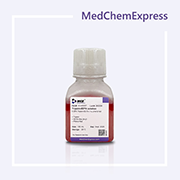
MCE 0.25% Trypsin-EDTA (1x), phenol red consists of dried trypsin powder dissolved in EDTA. MCE Trypsin hydrolyzes intercellular proteins and disperses primary tissues or adherent cells into individual cells, and can be widely used for cell dissociation, cell culture passaging and primary tissue dissociation. The 100 mL is defined as the base specification. All larger sizes correspond to incremental volumes of this base.
|
| Cat. No. |
Product Name |
Target |
Research Area |
Image |
-
- HY-P99974
-
|
Nanoparticle albumin-bound Paclitaxel; Nanoparticle albumin-bound ABI-007
|
Microtubule/Tubulin
Apoptosis
Autophagy
|
Cancer
|
|
Nab-Paclitaxel (Nanoparticle albumin-bound Paclitaxel) is an albumin-bound nanoparticle formulation of Paclitaxel (HY-B0015). Nab-Paclitaxel is composed of albumin and the active pharmaceutical ingredient Paclitaxel, in which human albumin is used as an excipient to disperse and stabilize particles and carry the main drug. Nab-Paclitaxel is a solvent-free taxane with higher response rates and improved tolerability. Nab-Paclitaxel displays less toxicity and greater antitumor activity. Nab-Paclitaxel is more readily available for tumor cell uptake in three rhabdomyosarcoma, seven neuroblastoma cell lines, and one ostersarcoma cell line Nab-Paclitaxel can be studied in cancer research for example breast cancer and solid tumors. (The product specifications below only indicate the effective content of Paditaxel, the actual albumin quality depends on the batch; the ratio of each ingredient in this product is Paditaxel: albumin -1:7~1:11) .
|
-
(5)
| Cat. No. |
Product Name |
Category |
Target |
Chemical Structure |
| Cat. No. |
Product Name |
Chemical Structure |
-
- HY-113293BS1
-
|
|
|
Estrone sulfate-d4 sodium is the deuterium labeled Estrone sulfate sodium (HY-113293B). Estrone sulfate sodium is an inactive endogenous estrogen that can be converted into Estrone (HY-B0234) and Estradiol (HY-B0141). Estrone sulfate sodium is also a substrate of the OATP1B3 transporter. Estrone sulfate sodium can be converted into Estrone and Estradiol in normal mammary parenchymal cells. Estrone sulfate sodium stimulates the growth of nitrosomethylurea-induced mammary tumors in ovariectomized rats and the colony formation of dispersed nitrosomethylurea mammary cells, with conversion into Estrone and Estradiol occurring both in vivo and in vitro during this process. Estrone sulfate sodium is applicable to breast cancer-related research .
|
-
-
- HY-113293BS
-
|
|
|
Estrone sulfate-d5 sodium is the deuterium labeled Estrone sulfate sodium (HY-113293B). Estrone sulfate sodium is an inactive endogenous estrogen that can be converted into Estrone (HY-B0234) and Estradiol (HY-B0141). Estrone sulfate sodium is also a substrate of the OATP1B3 transporter. Estrone sulfate sodium can be converted into Estrone and Estradiol in normal mammary parenchymal cells. Estrone sulfate sodium stimulates the growth of nitrosomethylurea-induced mammary tumors in ovariectomized rats and the colony formation of dispersed nitrosomethylurea mammary cells, with conversion into Estrone and Estradiol occurring both in vivo and in vitro during this process. Estrone sulfate sodium is applicable to breast cancer-related research .
|
-
| Cat. No. |
Product Name |
|
Classification |
-
- HY-W129593
-
|
Sorbitan monostearate
|
|
Emulsifiers
Solubilizing Agents
Surfactants
Suspending Agents
|
|
Sorbitan monooctadecanoate (Sorbitan monostearate) is a hydrophobic nonionic surfactant. Sorbitan monooctadecanoate can serve as a pharmaceutical excipient, such as an emulsifier, nonionic surfactant, solubilizer, wetting agent, and dispersing/suspending agent .
|
-
- HY-154630
-
|
|
|
Solubilizing Agents
Surfactants
|
|
Polyoxypropylene stearyl ether can be used as an excipient, such as surfactant, softener, lubricating, wetting, plasticizing, solubilizing and dispersing properties. Pharmaceutical excipients, or pharmaceutical auxiliaries, refer to other chemical substances used in the pharmaceutical process other than pharmaceutical ingredients. Pharmaceutical excipients generally refer to inactive ingredients in pharmaceutical preparations, which can improve the stability, solubility and processability of pharmaceutical preparations. Pharmaceutical excipients also affect the absorption, distribution, metabolism, and elimination (ADME) processes of co-administered drugs .
|
-
- HY-154739A
-
|
|
|
Disintegrants
Suspending Agents
|
|
Amorphous silica can be used as an excipient, such as viscosifier, suspending agent, tablet disintegrating agent, adsorbent dispersing agent as liquid in powders. Pharmaceutical excipients, or pharmaceutical auxiliaries, refer to other chemical substances used in the pharmaceutical process other than pharmaceutical ingredients. Pharmaceutical excipients generally refer to inactive ingredients in pharmaceutical preparations, which can improve the stability, solubility and processability of pharmaceutical preparations. Pharmaceutical excipients also affect the absorption, distribution, metabolism, and elimination (ADME) processes of co-administered drugs .
|
-
- HY-142981
-
|
DODA
|
|
Cationic Lipids
|
|
Dioctadecylamine (DODA) is a secondary amine that has been shown to self-organize in plate-like structures in aqueous solution. Dioctadecylamine exhibits sufficiently hydrophobic properties of nanoparticles and good dispersibility in nonpolar solvent. Dioctadecylamine does not form a monolayer above pH 3.9 .
|
-
- HY-N15995
-
|
|
|
Pegylated Lipids
|
|
DOPE-PEG(2000) Carboxylic acid sodium is a stabilizer. DOPE-PEG(2000) Carboxylic acid sodium produce a coating around the ferrofluid droplet chains which are dispersed in 5CB. DOPE-PEG(2000) Carboxylic acid sodium tends to fold, effectively shielding the surrounding LC molecules from the homeotropic anchoring at the droplet interface and leading to smaller deformations and thus also creating a more stable interface .
|
Your information is safe with us. * Required Fields.
Inquiry Information
- Product Name:
- Cat. No.:
- Quantity:
- MCE Japan Authorized Agent:

