



Estrone sulfate potassium
Based on 3 publication(s) in Google Scholar
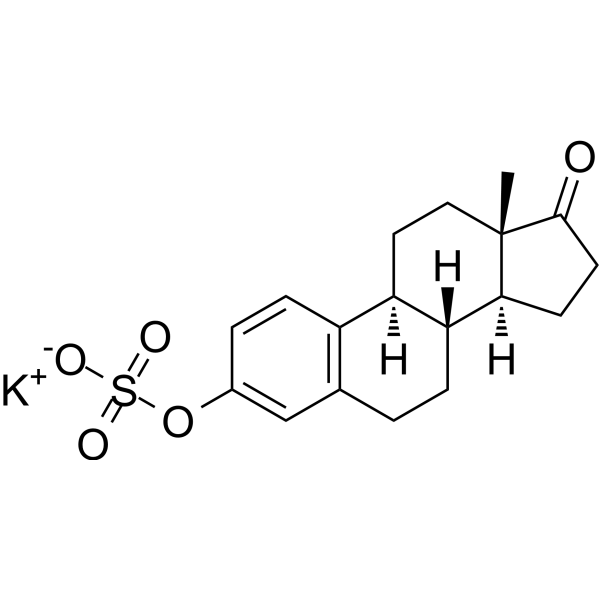
Estrone sulfate potassium is an inactive endogenous estrogen that can be converted into Estrone (HY-B0234) and Estradiol (HY-B0141). Estrone sulfate potassium is also a substrate of the OATP1B3 transporter. Estrone sulfate potassium can be converted into Estrone and Estradiol in normal mammary parenchymal cells. Estrone sulfate potassium stimulates the growth of nitrosomethylurea-induced mammary tumors in ovariectomized rats and the colony formation of dispersed nitrosomethylurea mammary cells, with conversion into Estrone and Estradiol occurring both in vivo and in vitro during this process. Estrone sulfate potassium is applicable to breast cancer-related research.
Nos produits utilisent uniquement pour la recherche. Nous ne vendons pas aux patients.
- Pureté : 99.94%
- CAS No.: 1240-04-6
- Formule: C18H21KO5S
- Masse moléculaire:388.52
-
Stockage:
4°C, sealed storage, away from moisture
* In solvent : -80°C, 6 months; -20°C, 1 month (sealed storage, away from moisture)

To place orders, for customer services and technical support, please contact: MedChemExpress USA
Tel: 609-228-6898 E-mail: [email protected] [email protected]


-
 Activité biologique
-
Chemical Information
-
Solvant et solubilité
- Protocole
- Pureté et documentation
- Références
-
 Help & FAQs


Publications Citing Use of MedChemExpress (MCE) Estrone sulfate potassium
MoreVoir tous les produits spécifiques à Isoform Endogenous Metabolite
More

Activité biologique
Description
IC50 & Target
|
Human Endogenous Metabolite |
In Vitro
Estrone sulfate (1.0 μM; 1-64 min) potassium is taken up at a low rate by dispersed normal breast parenchymal cells, resulting in a cells/medium concentration ratio of 0.20-0.33 when incubated at 37°C[2].
Estrone sulfate (1.0 nM-100 μM) potassium is converted to estrone by dispersed normal breast parenchymal cells with a mean half-time of 628 min per 106 cells (intact cells) or 246 min per 106 cells (homogenized cells)[2].
Estrone sulfate potassium is not produced via conversion of estrone by dispersed normal breast parenchymal cells under conditions where MCF-7 breast cancer cells exhibit sulfotransferase activity[2].
Estrone sulfate potassium stimulates colony formation in dispersed nitrosomethylurea mammary cells and is converted to estrone and estradiol by these cells[3].
MedChemExpress (MCE) has not independently confirmed the accuracy of these methods. They are for reference only.
In Vivo
Estrone sulfate (75 mg/kg; p.o; daily; for 5 days) potassium reduces glucose-6-phosphatase activity and protein levels, and lowers blood glucose in ob/ob mice[4].
Estrone sulfate potassium modulates glucose-6-phosphatase kinetic parameters in control mice[4].
MedChemExpress (MCE) has not independently confirmed the accuracy of these methods. They are for reference only.
-
Animal Model:Sprague-Dawley (female, castrated, nitrosomethylurea-induced mammary tumor model)[3]
-
Dosage:30 pmol/hr; 300 pmol/hr; 3000 pmol/hr; 400 pmol/hr; 1300 pmol/hr
-
Administration:s.c.; continuous infusion; 14 days
-
Result:Did not significantly alter castration-induced tumor regression at 30 pmol/hr; partially blunted castration-induced tumor regression at 300 pmol/hr; stimulated tumor growth at 3000 pmol/hr; Observed significantly different tumor growth slopes for 300 and 3000 pmol/hr doses; Detected 14%, 10%, and 13% conversion to estradiol, and 24%, 22%, and 28% conversion to estrone on days 7, 10, and 14, respectively, at 400 pmol/hr; Recorded similar conversion rates at 1300 pmol/hr; Measured serum estradiol levels of 17 pg/ml (400 pmol/hr), 56 pg/ml (1300 pmol/hr), 6.8 ± 1.2 pg/ml (300 pmol/hr, day 14), and 48 ± 10.2 pg/ml (3000 pmol/hr, day 14).


Chemical Information
-
CAS No. 1240-04-6
-
Appearance Solid
-
Masse moléculaire 388.52
-
Formule C18H21KO5S
-
Color White to off-white
-
SMILES
C[C@]1([C@](CC2)([H])[C@]3([H])CCC4=C(C=CC(OS(=O)([O-])=O)=C4)[C@@]3([H])CC1)C2=O.[K+]
-
Structure Classification
-
Initial Source
-
Livraison
Room temperature in continental US; may vary elsewhere.
-
Stockage
4°C, sealed storage, away from moisture
* In solvent : -80°C, 6 months; -20°C, 1 month (sealed storage, away from moisture)


Publications (3)
-
Journal Impact Factor
-
Most Recent
-
Cell Res
2023 Dec;33(12):940-951. PMID: 37674011 -
Nat Commun
2025 Aug 30;16(1):8124. PMID: 40885756 -
ACS Omega
Association Study of OATP1B3 Polymorphisms on Hepatic Uptake and Drug-Drug Interaction In Vitro. [Abstract]2025 Oct 29;10(44):52562-52575. PMID: 41244417


Solvant et solubilité
In Vitro:
DMSO : 100 mg/mL (257.39 mM; Need ultrasonic; Hygroscopic DMSO has a significant impact on the solubility of product, please use newly opened DMSO)
Please refer to the solubility information to select the appropriate solvent. Once prepared, please aliquot and store the solution to prevent product inactivation from repeated freeze-thaw cycles.
Storage method and period of stock solution: -80°C, 6 months; -20°C, 1 month (sealed storage, away from moisture). When stored at -80°C, please use it within 6 months. When stored at -20°C, please use it within 1 month.
Please refer to the solubility information to select the appropriate solvent. Once prepared, please aliquot and store the solution to prevent product inactivation from repeated freeze-thaw cycles.
Storage method and period of stock solution: -80°C, 6 months; -20°C, 1 month (sealed storage, away from moisture). When stored at -80°C, please use it within 6 months. When stored at -20°C, please use it within 1 month.
Concentration (start) × Volume (start) = Concentration (final) × Volume (final)
In Vivo:
Select the appropriate dissolution method based on your experimental animal and administration route.
- For the following dissolution methods, please ensure to first prepare a clear stock solution using an In Vitro approach and then sequentially add co-solvents:
- To ensure reliable experimental results, the clarified stock solution can be appropriately stored based on storage conditions. As for the working solution for In Vivo experiments, it is recommended to prepare freshly and use it on the same day.
- The percentages shown for the solvents indicate their volumetric ratio in the final prepared solution. If precipitation or phase separation occurs during preparation, heat and/or sonication can be used to aid dissolution.
Add each solvent one by one: 10% DMSO 40% PEG300 5% Tween-80 45% Saline
Solubility: ≥ 2.5 mg/mL (6.43 mM); Clear solution
This protocol yields a clear solution of ≥ 2.5 mg/mL (saturation unknown).
Taking 1 mL working solution as an example, add 100 μL DMSO stock solution (25.0 mg/mL) to 400 μL PEG300, and mix evenly; then add 50 μL Tween-80 and mix evenly; then add 450 μL Saline to adjust the volume to 1 mL.
Preparation of Saline: Dissolve 0.9 g sodium chloride in ddH₂O and dilute to 100 mL to obtain a clear Saline solution.
Add each solvent one by one: 10% DMSO 90% (20% SBE-β-CD in Saline)
Solubility: ≥ 2.5 mg/mL (6.43 mM); Clear solution
This protocol yields a clear solution of ≥ 2.5 mg/mL (saturation unknown).
Taking 1 mL working solution as an example, add 100 μL DMSO stock solution (25.0 mg/mL) to 900 μL 20% SBE-β-CD in Saline, and mix evenly.
Preparation of 20% SBE-β-CD in Saline (4°C, storage for one week): 2 g SBE-β-CD powder is dissolved in 10 mL Saline, completely dissolve until clear.
In Vivo Dissolution Calculator
Please enter the basic information of animal experiments:
-
-
-
-
Recommended: Prepare an additional quantity of animals to account for potential losses during experiments.
Please enter your animal formula composition:
-
%DMSO +
Recommended: Keep the proportion of DMSO in working solution below 2% if your animal is weak.
-
%+
-
+%Tween-80 + +
-
%Saline +
The co-solvents required include: DMSO, . All of co-solvents are available by MedChemExpress (MCE). , Tween 80. All of co-solvents are available by MedChemExpress (MCE).
Working solution concentration: 0.22 mg/mL
Method for preparing stock solution: mg drug dissolved in μL DMSO. Stock solution concentration: mg/mL. * In solvent : -80°C, 6 months; -20°C, 1 month (sealed storage, away from moisture)
1. Take μL DMSO stock solution;
2. Add μL .
μL , mix evenly;
3. Then add μL Tween 80, mix evenly;
4. Then add μL
Please ensure that the stock solution in the first step is dissolved to a clear state, and add co-solvents in sequence. You can use ultrasonic heating (ultrasonic cleaner, recommended frequency 20-40 kHz), vortexing, etc. to assist dissolution.


Pureté et documentation
-
Fiche technique (281 KB)
-
SDS (419 KB)
- English - EN (419 KB)
- Français - FR (419 KB)
- Deutsch - DE (419 KB)
- Norwegian - NO (419 KB)
- Español - ES (419 KB)
- Swedish - SV (419 KB)
- Italian - IT (419 KB)
- Korean - KR (419 KB)
- Portuguese - PT (419 KB)
-
Instruction de manipulation (2659 KB)
Références
[1]. Yang Z, et al. Association Study of OATP1B3 Polymorphisms on Hepatic Uptake and Drug-Drug Interaction In Vitro. ACS Omega. 2025;10(44):52562-52575. Published 2025 Oct 29. [Content Brief]
[2]. Chatterton RT Jr, et al. Formation of estrone and estradiol from estrone sulfate by normal breast parenchymal tissue. J Steroid Biochem Mol Biol. 2003;86(2):159-166. [Content Brief]
[3]. Santner SJ, et al. Estrone sulfate stimulates growth of nitrosomethylurea-induced breast carcinoma in vivo in the rat. Int J Cancer. 1990;46(1):73-78. [Content Brief]
[4]. Borthwick EB, et al. The antihyperglycemic effect of estrone sulfate in genetically obese-diabetic (ob/ob) mice is associated with reduced hepatic glucose-6-phosphatase. Horm Metab Res. 2001 Dec;33(12):721-6. [Content Brief]


Complete Stock Solution Preparation Table
Please refer to the solubility information to select the appropriate solvent. Once prepared, please aliquot and store the solution to prevent product inactivation from repeated freeze-thaw cycles.
Storage method and period of stock solution: -80°C, 6 months; -20°C, 1 month (sealed storage, away from moisture). When stored at -80°C, please use it within 6 months. When stored at -20°C, please use it within 1 month.
| Optional Solvent | Concentration Solvent Mass | 1 mg | 5 mg | 10 mg | 25 mg |
|---|---|---|---|---|---|
| DMSO | 1 mM | 2.5739 mL | 12.8694 mL | 25.7387 mL | 64.3468 mL |
| 5 mM | 0.5148 mL | 2.5739 mL | 5.1477 mL | 12.8694 mL | |
| 10 mM | 0.2574 mL | 1.2869 mL | 2.5739 mL | 6.4347 mL | |
| 15 mM | 0.1716 mL | 0.8580 mL | 1.7159 mL | 4.2898 mL | |
| 20 mM | 0.1287 mL | 0.6435 mL | 1.2869 mL | 3.2173 mL | |
| 25 mM | 0.1030 mL | 0.5148 mL | 1.0295 mL | 2.5739 mL | |
| 30 mM | 0.0858 mL | 0.4290 mL | 0.8580 mL | 2.1449 mL | |
| 40 mM | 0.0643 mL | 0.3217 mL | 0.6435 mL | 1.6087 mL | |
| 50 mM | 0.0515 mL | 0.2574 mL | 0.5148 mL | 1.2869 mL | |
| 60 mM | 0.0429 mL | 0.2145 mL | 0.4290 mL | 1.0724 mL | |
| 80 mM | 0.0322 mL | 0.1609 mL | 0.3217 mL | 0.8043 mL | |
| 100 mM | 0.0257 mL | 0.1287 mL | 0.2574 mL | 0.6435 mL |


Estrone sulfate potassium Related Classifications
HY-113293A Related Classifications
 Powered by Bioz
Keywords