16 Results for "

hinge region

" in MedChemExpress (MCE) Product Catalog:
Products (16)

16 Results for "hinge region" in MCE Product Catalog:

  • Targets Recommended:
3
3 Cited Publications
Cat. No.: HY-112299
CAS No.: 1661854-97-2
Purity:  99.81%
Synonyms: TAS6417; CLN-081
Target:  

EGFR Apoptosis

Research Areas:  

Cancer

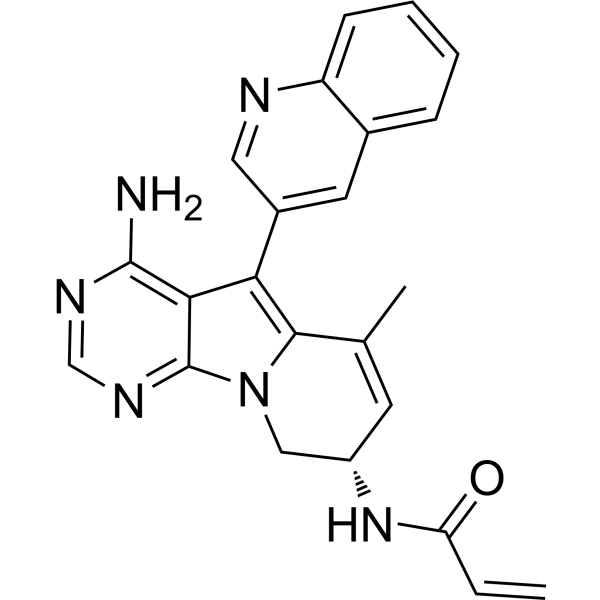
Zipalertinib (TAS6417; CLN-081) is a highly effective, orally active and pan-mutation-selective EGFR tyrosine kinase inhibitor with a unique scaffold fitting into the ATP-binding site of the EGFR hinge region, with IC50 values ranging from 1.1-8.0 nM .
loading...
    loading...
1
1 Cited Publications
Cat. No.: HY-E70365
CAS No.: 2764750-38-9
Research Areas:  

Inflammation/Immunology

IdeS protease is an IgG-specific endopeptidase, which is highly specific for the lower hinge region of IgG. IdeS protease represses innate immune responses to promote streptococcal survival in an inflammatory environment .
loading...
    loading...
Cat. No.: HY-N10472
CAS No.: 123297-90-5
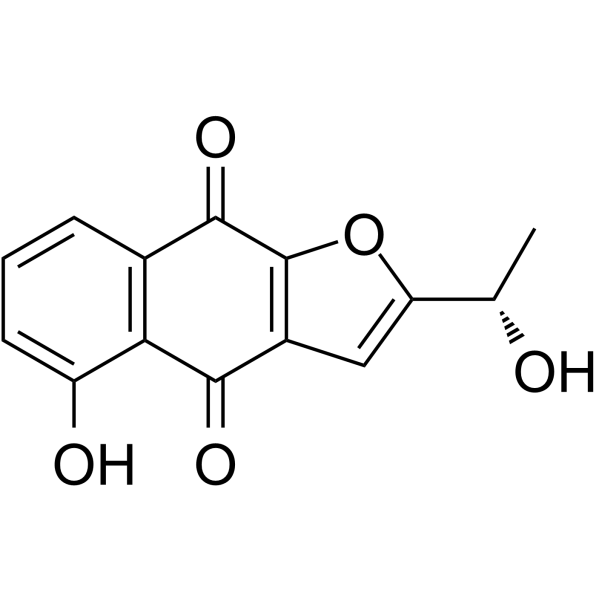
STAT3-IN-14 (Compound 1) is a STAT3 inhibitor and has STAT3 phosphorylation inhibitory activity. STAT3-IN-14 (Compound 1) can directly bind to the hinge region of STAT3 .
loading...
    loading...
Cat. No.: HY-E70364
CAS No.: 1892548-76-3
Research Areas:  

Inflammation/Immunology

IgdE protease is a cysteine protease, which is initially isolated from Streptococcus agalactiae. IgdE protease digests monoclonal antibodies (mAbs) of the IgG1 type specifically at their upper hinge region, produces Fc/2, hinge peptide dimers, and Fab fragment. IgdE protease can be used in disulfide bonds and free thiol analysis, as it requires no reducing agents for cleavage .
loading...
    loading...
Cat. No.: HY-144308
CAS No.: 2645409-78-3
Target:  

Mps1

Research Areas:  

Others

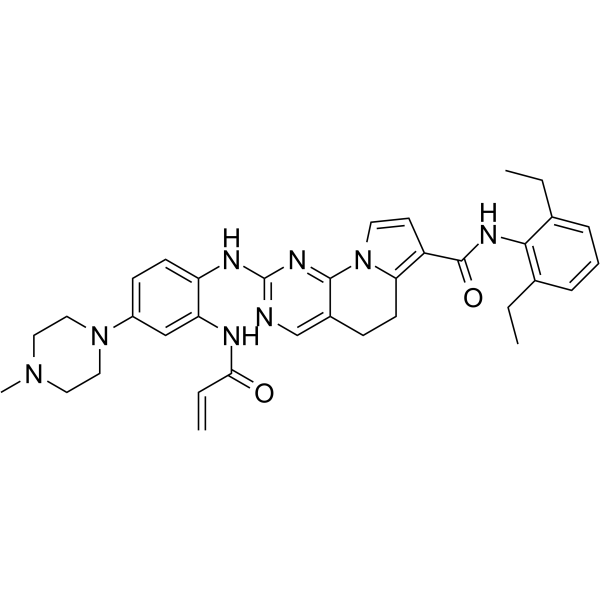
RMS-07 is a covalent Monopolar Spindle Kinase 1 (MPS1/TTK) inhibitor, with an apparent IC50 of 13.1 nM. RMS-07 targets a poorly conserved cysteine in the kinase's hinge region .
loading...
    loading...
Cat. No.: HY-P5310
Research Areas:  

Others

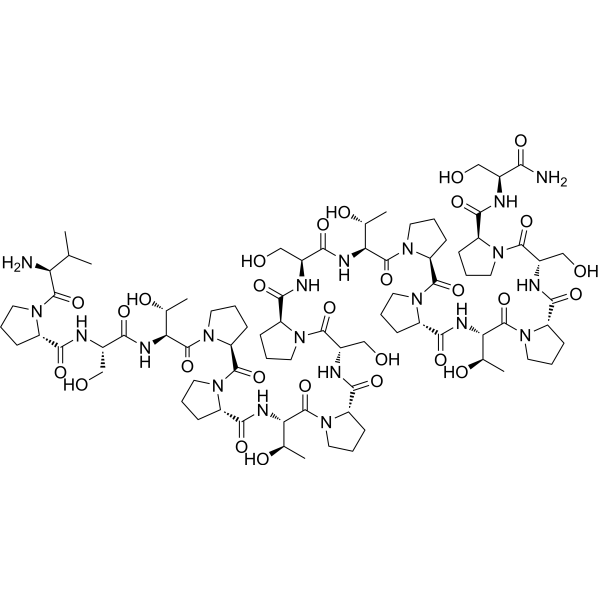
IgA1 Peptide HP is an IgA1 hinge region peptide .
loading...
    loading...
Cat. No.: HY-L907
12,406 compounds

The most prominent mechanism of action of kinase inhibitors is their competition with ATP by binding to the hinge region of the kinase protein. Once the kinase is blocked by an inhibitor, it loses the ability to transfer phosphate groups from ATP to other molecules, resulting in the loss of kinase activity.

The hinge-binding region of kinase inhibitors mimics the interaction pattern between the ATP nucleobase and the kinase. MCE extracted thousands of kinase inhibitors from the ChEMBL database and isolated their molecular fragments. In certain cases, the amino and amide groups on the molecular fragments are crucial for binding in the hinge region. Therefore, we enhanced the diversity of the collected results by adding these two groups to unoccupied positions on the ring system. Subsequently, the fragments were assessed for their hinge region binding ability via docking at distinct kinases, we also applied pharmacophore constraints to ensure interactions with key amino acids in the kinase hinge region, ultimately obtaining kinase-related molecular fragments.

MCE provides over 12,406 kinase fragment molecules that meet the above requirements and are available off the shelf, serving as an effective tool for screening and developing drugs targeting kinases.

Cat. No.: HY-P992154
Synonyms: KJ-103
Ricefidase (KJ-103) is a recombinant human immunoglobulin G-degrading enzyme. Ricefidase efficiently cleaves human IgG at the hinge region. Ricefidase rapidly reduces IgG levels. Ricefidase has low immunogenicity and clears AAV neutralizing antibodies. Ricefidase is applicable to research related to desensitization of all IgG subclasses and improvement of the suitability of AAV-based gene therapy .
loading...
    loading...
Cat. No.: HY-P5310A
Target:  

Peptides

Research Areas:  

Others

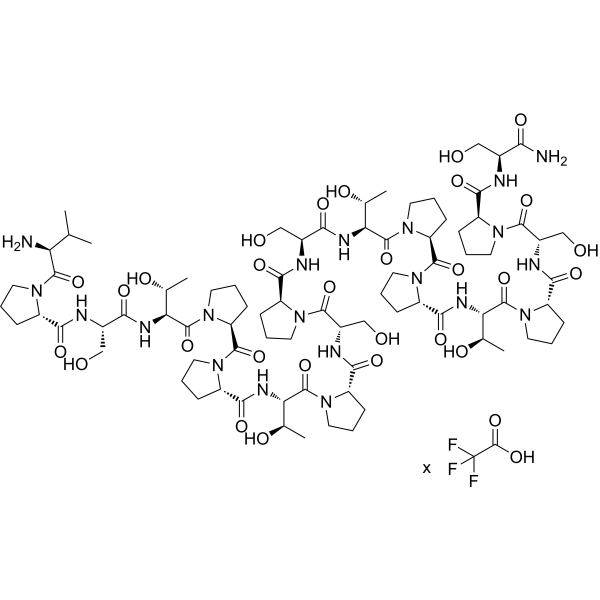
IgA1 Peptide HP (TFA) is an IgA1 hinge region peptide .
loading...
    loading...
Cat. No.: HY-182281
Target:  

FLT3 STAT Akt ERK Apoptosis

Research Areas:  

Cancer

FLT3-IN-41 is a highly potent FLT3 inhibitor. The IC50 values of FLT3-IN-41 against human FLT3-ITD and FLT3-WT are 3.16 nM and 294.7 nM, respectively. By binding to the ATP-binding pockets of FLT3-ITD and FLT3-WT and forming hydrogen bonds with hinge region residues and Phe830, FLT3-IN-41 inhibits the STAT5, Akt and Erk signaling pathways. FLT3-IN-41 induces G2/M phase arrest and promotes apoptosis in FLT3-ITD-positive acute myeloid leukemia cells, exhibiting significant antiproliferative activity. FLT3-IN-41 serves as a valuable tool for the study of acute myeloid leukemia .
loading...
    loading...
Cat. No.: HY-130305A
CAS No.: 913640-58-1
Target:  

PKC

Research Areas:  

Cancer

GSK-943949A is a PRK1 inhibitor with an IC50 of 40.0 nM. GSK-943949A is applicable to research related to prostate cancer .
loading...
    loading...
Cat. No.: HY-182764A
Target:  

CDK

Research Areas:  

Cancer

CDK11-IN-1 hydrochloride is a potent, highly selective, and orally active CDK11 inhibitor with an IC50 of 4 nM, showing 32.5-fold and 2700-fold selectivity over CDK7 and CDK9, respectively. CDK11-IN-1 hydrochloride binds competitively to the ATP-binding pocket of CDK11 and forms a hydrogen bond with the hinge region residue Val163. It inhibits tumor cell proliferation and exhibits antitumor activity in lung cancer xenograft models. CDK11-IN-1 hydrochloride can be used for studies on the pathophysiology of CDK11-mediated tumors, as well as research on malignant tumors such as lung cancer .
loading...
    loading...
Cat. No.: HY-P11905
CAS No.: 874909-17-8
Research Areas:  

Others

FcIII peptide is a 13-amino-acid peptide that competitively binds the hinge region of IgG Fc fragment with high affinity. FcIII peptide has an inhibition constant Ki of 25 nM when competing with Protein A for binding sites. FcIII peptide displays high selectivity toward human IgG subtypes yet weak binding affinity for murine IgG1. FcIII peptide anchors IgG Fc through hydrophobic interactions formed by tryptophan and valine residues, alongside multiple hydrogen bonds and salt bridges. FcIII peptide alters the local microenvironment of conjugated fluorescein after binding IgG Fc, which triggers enhanced fluorescent signals. FcIII peptide can be applied to researches related to monoclonal antibody production. .
loading...
    loading...
Cat. No.: HY-187340
CSF1R/c-Kit-IN-1 is a CSF-1R and c-Kit inhibitor, with an IC50 of 5.88 nM against human CSF-1R and an IC50 of 1.47 nM against human c-Kit. CSF1R/c-Kit-IN-1 binds to the ATP-binding pocket of CSF-1R, forming a hinge interaction with Cys666 via the oxazole nitrogen atom and adjacent amino group, and binds to residues in the hydrophobic binding pocket. CSF1R/c-Kit-IN-1 binds to the ATP-binding pocket of c-Kit, maintains a hinge interaction through its 2-amino-oxazole core, and binds to a broader hydrophobic surface near the solvent-exposed region via its morpholine substituent. CSF1R/c-Kit-IN-1 inhibits CSF-1-induced phosphorylation of ERK, which is a downstream readout of the CSF-1R signaling pathway. CSF1R/c-Kit-IN-1 can be used in the research of neuroinflammation-related neurodegenerative diseases .
loading...
    loading...
Cat. No.: HY-184317
CAS No.: 2421140-72-7
Research Areas:  

Cancer

M4K2149 is a selective ALK2 inhibitor with an IC50 value of 17 nM. M4K2149 is applicable to research related to diffuse intrinsic pontine glioma .
loading...
    loading...
Cat. No.: HY-186223
CAS No.: 897375-76-7
Enzyme modulator-1 (example 205) is a potent enzyme modulator that modulates p38, bcr-ab1, and VEGFR. Enzyme modulator-1 can be used for the research of cancer, rheumatoid arthritis, retinopathies including diabetic retinal neuropathy and macular degeneration .
loading...
    loading...
  • 1

