9 Results for "

mitochondria fission

" in MedChemExpress (MCE) Product Catalog:
Products (9)

9 Results for "mitochondria fission" in MCE Product Catalog:

4
4 Cited Publications
Cat. No.: HY-139109
CAS No.: 115970-66-6
Purity:  99.87%
Synonyms: ADS 780WS
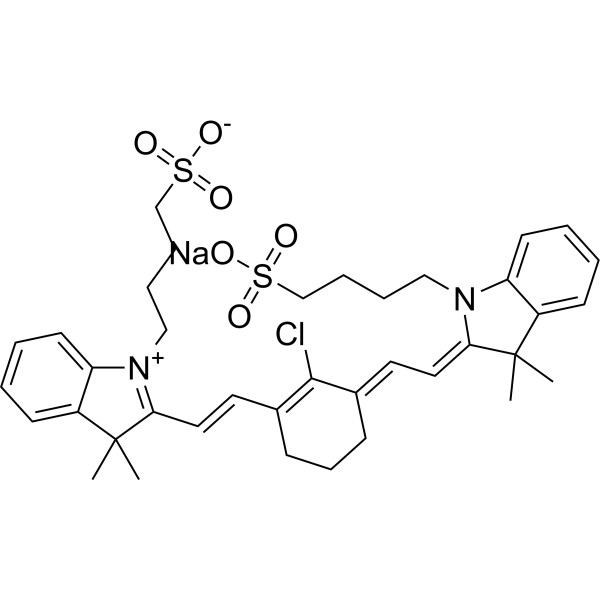
IR-783 (ADS 780WS) is a heptamethine cyanine dye. IR-783 induces Mitochondrial membrane potential loss, ATP depletion, mitochondrial permeability transition pore opening, Cytochrome c release and Apoptosis in breast cancer cells. IR-783 promotes the translocation of Drp1 from the cytosol to mitochondria. IR-783 increases the expression of mitochondrial fission proteins such as MFF and Fission-1. IR-783 possesses imaging, cancer-targeting and anticancer properties. IR-783 exerts anticancer effects against breast cancer. IR-783 can be used in breast cancer-related research .
loading...
    loading...
3
3 Cited Publications
Cat. No.: HY-103661
CAS No.: 791835-21-7
Purity:  98.47%
Research Areas:  

Neurological Disease

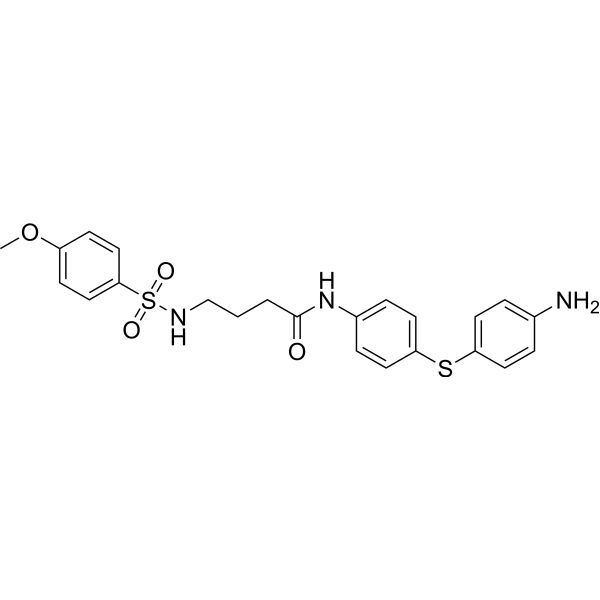
BI-6C9 is a highly specific BH3 interacting domain (Bid) inhibitor, which prevents mitochondrial outer membrane potential (MOMP) and mitochondrial fission, and protects the cells from mitochondrial apoptosis inducing factor (AIF) release and caspase-independent cell death in neurons .
loading...
    loading...
1
1 Cited Publications
Cat. No.: HY-N10470
CAS No.: 11116-32-8
Synonyms: Pingyangmycin
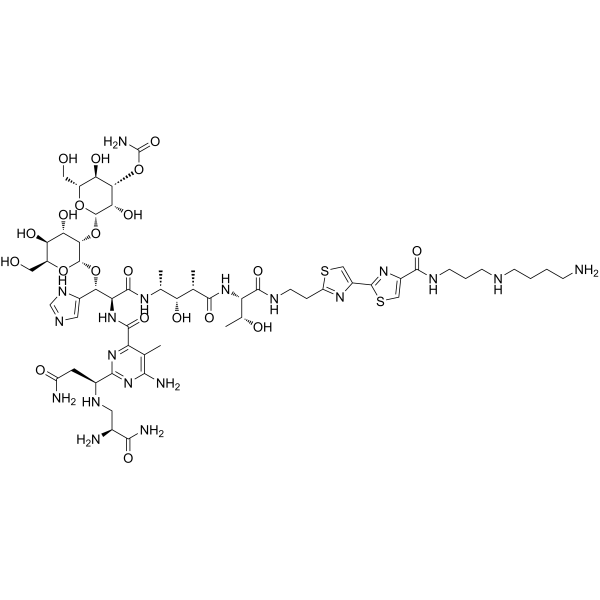
Bleomycin A5 (Pingyangmycin) is a glycopeptide antibiotic with multiple biological activities, which can be isolated from Streptomyces. Bleomycin A5 exerts cytotoxic effects by binding to Fe 2+ to form a complex, inducing single-strand and double-strand DNA breaks, and inhibiting DNA replication. Bleomycin A5 inhibits Drp1-mediated mitochondrial fission and suppresses PINK1/Parkin pathway-mediated mitophagy, ultimately triggering mitochondria-mediated cellular apoptosis. Bleomycin A5 can be used in cancer research .
loading...
    loading...
Cat. No.: HY-P6374
Target:  

Dynamin

Research Areas:  

Neurological Disease

IIQLPEIVVV TFA is a specific inhibitor of Drp1-Mff interaction. IIQLPEIVVV TFA can distinguish physiological from pathological fission and block physiological fission, thus leading to mitochondrial dysfunction. IIQLPEIVVV TFA can be used in the study of Huntington's disease .
loading...
    loading...
Cat. No.: HY-125918
CAS No.: 55658-47-4
Synonyms: Pingyangmycin hydrochloride
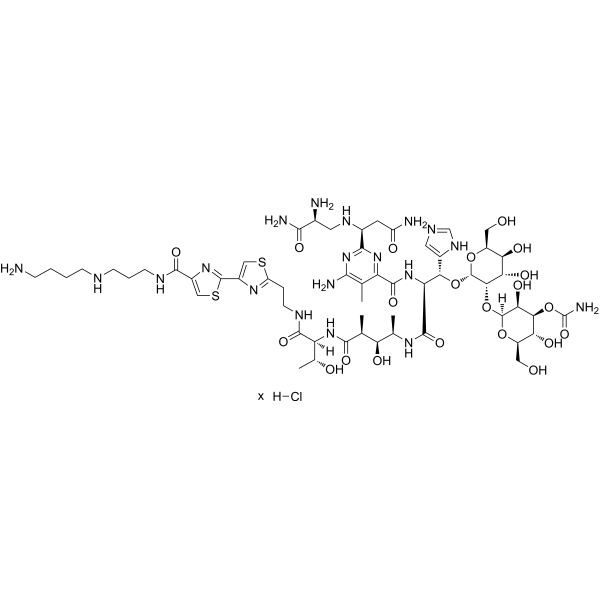
Bleomycin A5 (Pingyangmycin) hydrochloride is a glycopeptide antibiotic with multiple biological activities, which can be isolated from Streptomyces. Bleomycin A5 hydrochloride exerts cytotoxic effects by binding to Fe 2+ to form a complex, inducing single-strand and double-strand DNA breaks, and inhibiting DNA replication. Bleomycin A5 hydrochloride inhibits Drp1-mediated mitochondrial fission and suppresses PINK1/Parkin pathway-mediated mitophagy, ultimately triggering mitochondria-mediated cellular apoptosis. Bleomycin A5 hydrochloride can be used in cancer research .
loading...
    loading...
Cat. No.: HY-P11005
Target:  

Dynamin ATP Synthase

Research Areas:  

Neurological Disease

P259 is a Drp1-Mff inhibitor. P259 distinguishes physiological from pathological fission by specifically inhibiting Drp1-Mff interaction. P259 elongates cell mitochondria and disrupts mitochondrial function and motility. P259 reduces ATP levels and alters mitochondrial structure in the brain, resulting in behavioral deficits in wild-type mice and a short lifespan in Huntington's disease (HD) mice model .
loading...
    loading...
Cat. No.: HY-P10650
CAS No.: 1588388-60-6
Target:  

Ras

Research Areas:  

Cancer

FAM49B (190-198) mouse is a peptide fragment of FAM49B. FAM49B is a mitochondria-localized protein that regulates mitochondrial fission. FAM49B regulates mitochondrial function and integrity and tumor progression. FAM49B is also a negative regulator in T cell activation, it acts by repressing GTPase Rac activity and modulating cytoskeleton reorganization .
loading...
    loading...
Cat. No.: HY-D3148
CAS No.: 1804107-88-7
Target:  

Fluorescent Dye

Research Areas:  

Others

TPE-Ph-In is a mitochondria-targeted voltage-sensitive probe that can be used for mitochondrial membrane potential detection, mitochondrial imaging of animal and plant cells and tissues, mouse sperm activity indication, and detection of mitochondrial membrane potential changes associated with early apoptosis. TPE-Ph-In is non-fluorescent in solution, but emits strong fluorescence when aggregated via restriction of intramolecular rotation/movement, and its fluorescence intensity is directly correlated with local probe concentration or mitochondrial membrane potential level. TPE-Ph-In can penetrate cell membranes, target mitochondria through charge-dependent accumulation, has low cytotoxicity and high photostability, and enables super-resolution imaging of plant mitochondrial fission, fusion and cristae structures. The excitation wavelengths of TPE-Ph-In include 450 nm, 488 nm, and 489 nm, while its emission wavelengths include 551-661 nm, 660 nm, and 694 nm. TPE-Ph-In can be used for studies on mitochondrial dysfunction associated with early apoptosis .
loading...
    loading...
Cat. No.: HY-103661R
CAS No.: 791835-21-7
BI-6C9 (Standard) is the analytical standard of BI-6C9 (HY-103661). This product is intended for research and analytical applications. BI-6C9 is a highly specific BH3 interacting domain (Bid) inhibitor, which prevents mitochondrial outer membrane potential (MOMP) and mitochondrial fission, and protects the cells from mitochondrial apoptosis inducing factor (AIF) release and caspase-independent cell death in neurons .
loading...
    loading...

