
1. Search Result
Search Result
Pathways Recommended: Cell Cycle/DNA Damage
Results for "

native DNA

" in MedChemExpress (MCE) Product Catalog:

7

Inhibitors & Agonists

2

Biochemical Assay Reagents

1

MCE Kits

2

Natural
Products

Cat. No. Product Name Target Research Areas Chemical Structure
  • HY-15435
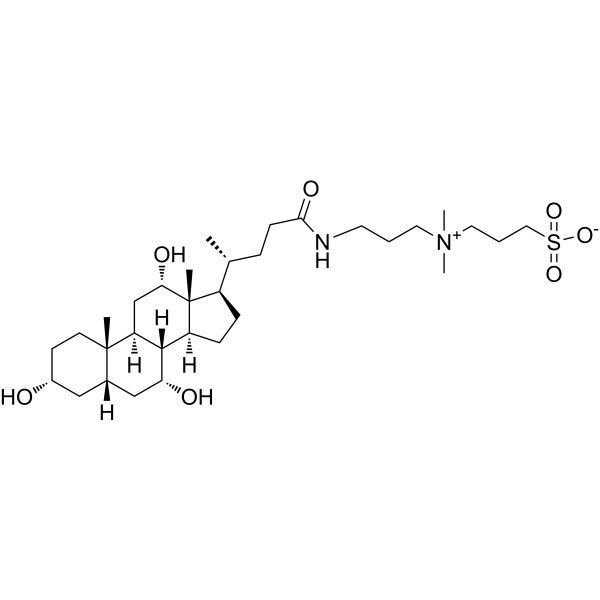
    CHAPS
    4 Publications Verification

    Exosomes Biochemical Assay Reagents Others
    CHAPS is a cholic acid-derived, sulfobetaine-type zwitterionic detergent and micelle-forming agent. CHAPS exhibits properties of weak cationic or nonionic surfactants in different solution systems, undergoes micellization, and forms small, loose hydrophilic aggregates that are temperature-dependent. CHAPS stabilizes mononucleosomes under different ionic strengths, reduces nucleosome sequence specificity, promotes sliding of histone cores along DNA, solubilizes Tamm-Horsfall protein to reduce its interference with urinary exosome isolation, and maintains vesicle structure and the activity of related proteins at the same time. CHAPS is used to recover native folded fusion proteins, enhance the binding capacity of GST fusion proteins, and restore GST enzyme activity. However, CHAPS cannot refold proteins denatured by urea, guanidine hydrochloride or heat, nor can it construct the structure of intrinsically disordered proteins. CHAPS is commonly used in research on the separation and purification of membrane proteins .
    CHAPS
  • HY-P2863
    Deoxyribonuclease II
    2 Publications Verification

    DNAse II

    Endonuclease Others
    Deoxyribonuclease II (DNase II) is an endonuclease that hydrolyzes the phosphodiester bonds of deoxyribonucleotides in native and denatured DNA, producing 3' phosphate and 5'-hydroxyl termini. Deoxyribonuclease II works best at acidic pH and is commonly used in biochemical research .
    Deoxyribonuclease II
  • HY-15435A
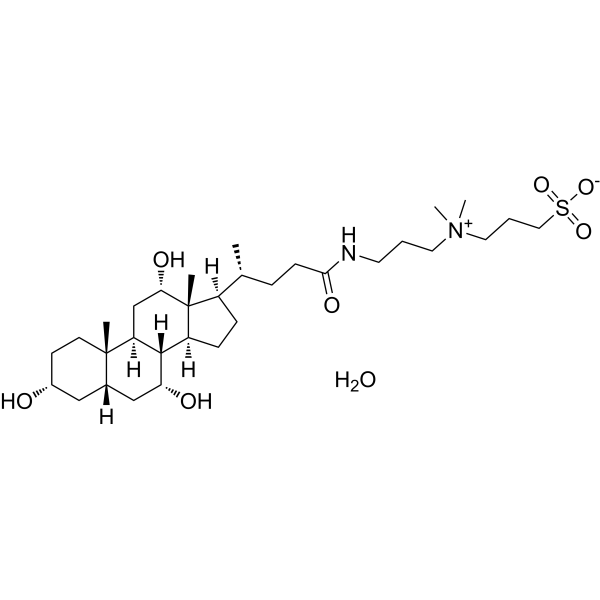
    CHAPS hydrate
    4 Publications Verification

    Biochemical Assay Reagents Exosomes Others
    CHAPS hydrate is a cholic acid-derived, sulfobetaine-type zwitterionic detergent and micelle-forming agent. CHAPS hydrate exhibits properties of weak cationic or nonionic surfactants in different solution systems, undergoes micellization, and forms small, loose hydrophilic aggregates that are temperature-dependent. CHAPS hydrate stabilizes mononucleosomes under different ionic strengths, reduces nucleosome sequence specificity, promotes sliding of histone cores along DNA, solubilizes Tamm‑Horsfall protein to reduce its interference with urinary exosome isolation, and maintains vesicle structure and the activity of related proteins at the same time. CHAPS hydrate is used to recover native folded fusion proteins, enhance the binding capacity of GST fusion proteins, and restore GST enzyme activity. However, CHAPS hydrate cannot refold proteins denatured by urea, guanidine hydrochloride or heat, nor can it construct the structure of intrinsically disordered proteins. CHAPS hydrate is commonly used in research on the separation and purification of membrane proteins .
    CHAPS hydrate
  • HY-Y0543
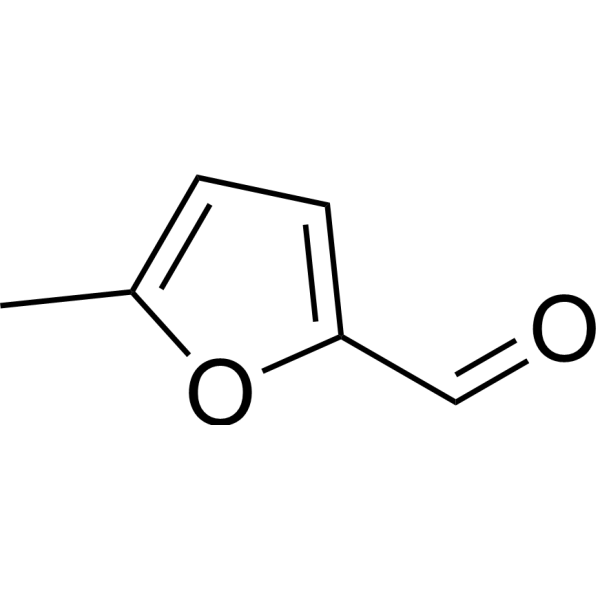
    5-Methylfurfural
    1 Publications Verification

    Biochemical Assay Reagents COX Inflammation/Immunology Cancer
    5-Methylfurfural is a chemical that can be utilized as food additive, intermediate in the production of agrochemicals, and precursor of certain anti-cancer natural products. 5-Methylfurfural is formed during the photoexposition of ranitidine hydrochloride. 5-Methylfurfural is an organic compound. 5-Methylfurfural has a strong tendency to be further hydrogenated to 2,5-dimethylfuran (DMF). 5-Methylfurfural can predominantly evoke skin inflammation and barrier disintegration. 5-Methylfurfural degrades native DNA through the formation of single-strand breaks .
    5-Methylfurfural
  • HY-W013741

    Biochemical Assay Reagents DNA Alkylator/Crosslinker DNA/RNA Synthesis Others
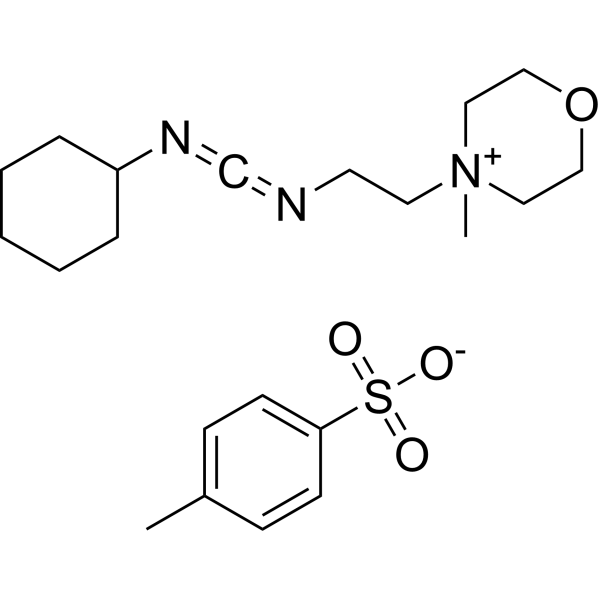
    CME-carbodiimide is a nucleic acid modification reagent. CME-carbodiimide reacts specifically with uracil and guanine residues of RNA, as well as guanine and thymine residues of denatured DNA; it does not react with native DNA. Modification of DNA by CME-carbodiimide inhibits phosphodiester bond cleavage or DNA hydrolysis mediated by pancreatic ribonuclease, snake venom phosphodiesterase and deoxyribonuclease .
    CME-carbodiimide
  • HY-Y0543R

    Biochemical Assay Reagents Reference Standards COX Inflammation/Immunology Cancer
    5-Methylfurfural (Standard) is the analytical standard of 5-Methylfurfural. This product is intended for research and analytical applications. 5-Methylfurfural is a chemical that can be utilized as food additive, intermediate in the production of agrochemicals, and precursor of certain anti-cancer natural products. 5-Methylfurfural is formed during the photoexposition of ranitidine hydrochloride. 5-Methylfurfural is an organic compound. 5-Methylfurfural has a strong tendency to be further hydrogenated to 2,5-dimethylfuran (DMF). 5-Methylfurfural can predominantly evoke skin inflammation and barrier disintegration. 5-Methylfurfural degrades native DNA through the formation of single-strand breaks .
    5-Methylfurfural (Standard)
  • HY-P2863A

    Endogenous Metabolite Metabolic Disease
    Deoxyribonuclease II, Bovine (EC 3.1.22.1) hydrolyzes deoxyribonucleotide linkages in native and denatured DNA yielding products with 3'-phosphates. In vitro, its optimum pH range is 4.5-5.0. Deoxyribonuclease II, Bovine (EC 3.1.22.1) also acts upon p-nitrophenyl-phosphodiesters at pH 5.6-5.9.
    Deoxyribonuclease II, Bovine

Inquiry Online

Your information is safe with us. * Required Fields.

Salutation


Country or Region *

Applicant Name *


Organization Name *

Department *


Email Address *


Product Name *

Cat. No.


Requested quantity *

Phone Number *


Remarks

Inquiry Online

Inquiry Information

Product Name:
Cat. No.:
Quantity:
MCE Japan Authorized Agent:

