19 Results for "

non-immunogenicity

" in MedChemExpress (MCE) Product Catalog:
Products (19)

19 Results for "non-immunogenicity" in MCE Product Catalog:

Cat. No.: HY-Y1310A
CAS No.: 9005-38-3
Sodium alginate is an anionic straight chain polysaccharide. Sodium alginate can be obtained from different species of algae. Sodium alginate has different properties, such as pH-sensitivity, nontoxicity, nonimmunogenicity. Sodium alginate has weak gelation, viscosity, and film-forming properties. Sodium alginate can be utilized to prepare gels and film materials for food preservation. Sodium alginate is a versatile functional biomaterial for viscosity enhancement, stabilizer, matrixing agent, encapsulation polymer, bioadhesive and film former .
loading...
    loading...
Cat. No.: HY-Y0498
CAS No.: 1344-28-1
Aluminum oxide is a nanoparticulate carrier and adjuvant.Aluminum oxide elicits antibody production against non-immunogenic haptens when coupled to them in mice and rabbits. Aluminum oxide functions in eliciting antibodies from non-immunogenic haptens .
loading...
    loading...
Cat. No.: HY-160429
CAS No.: 2313534-26-6
Synonyms: Ac-PSAR18-COOH
Research Areas:  

Others

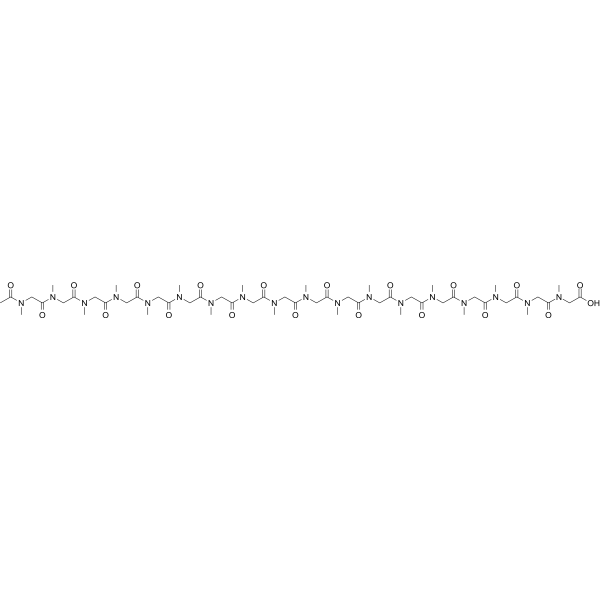
PSAR18-COOH (Ac-PSAR18-COOH) is a polysarcosine PSAR derivative. PSAR is a biodegradable, non-immunogenic polymer that has been used in a variety of compounds or diagnostic delivery systems. PSAR18 can be used as a component of ADC linkers .
loading...
    loading...
Cat. No.: HY-Y0850U3
CAS No.: 9002-89-5
Synonyms: Polyvinyl alcohol (Mw 125000, 98-99% hydrolyzed, ~2800 polymerization); Poly(Ethenol) (Mw 125000, 98-99% hydrolyzed, ~2800 polymerization)
PVA (Polyvinyl alcohol) (Mw 125000, 98-99% hydrolyzed, ~2800 polymerization) is a water-soluble, biodegradable, biocompatible and non-immunogenic polymer. PVA (Mw 125000, 98-99% hydrolyzed, ~2800 polymerization) causes no irritation to rabbit eyes, no skin sensitization in guinea pigs, promotes the proliferation of human skin keratinocytes, and reduces the loss of corneal endothelial cells. The LD50 of PVA (Mw 125000, 98-99% hydrolyzed, ~2800 polymerization) in rats and dogs is greater than 10 g/kg. PVA (Mw 125000, 98-99% hydrolyzed, ~2800 polymerization) is hardly absorbed by the digestive system, causes no adverse effects upon long-term oral administration, and shows no mutagenicity or carcinogenicity. However, repeated intravenous or portal vein injection of PVA (Mw 125000, 98-99% hydrolyzed, ~2800 polymerization) may induce pathological changes such as glomerular lesions, anemia, hypertension or liver fibrosis in rats or dogs. Crosslinked nanofibers prepared by modifying PVA (Mw 125000, 98-99% hydrolyzed, ~2800 polymerization) can be used in studies related to wound dressings and other applications .
loading...
    loading...
Cat. No.: HY-112111
CAS No.: 25513-46-6
Purity:  ≥95.0%
Research Areas:  

Cancer

Poly-L-Glutamic acid (MW 700000) is a synthetic polypeptide with biocompatibility, biodegradability and non-immunogenicity. Poly-L-Glutamic acid is an ideal tumor-targeting polymer carrier. Poly-L-Glutamic acid can be hydrolyzed by cathepsin B during metabolic decomposition .
loading...
    loading...
Cat. No.: HY-158222A
Synonyms: AlgMA (MW 300000)
Alginate Methacryloyl (MW 300000) is a methacryloyl alginate with potential for use as a tissue engineering scaffold and 3D printing ink. Alginate Methacryloyl (MW 300000) is biocompatible, non-immunogenic, has low toxicity and is capable of physical cross-linking with divalent cations such as calcium . Alginate Methacryloyl (MW 300000) needs to self-assemble into fibrous hydrogel under the action of photoinitiator LAP (HY-44076), and target bioactive adhesion sites, play an inherent supporting role for tissue cells and biodegradable activity.
Application: cell culture, biological 3D printing, tissue engineering, etc.
loading...
    loading...
Cat. No.: HY-W596474D
CAS No.: 26247-79-0
Poly-L-glutamic acid sodium salt (MW 30000) is a synthetic polypeptide with biocompatibility, biodegradability and non-immunogenicity. Poly-L-glutamic acid sodium salt is an ideal tumor-targeting polymer carrier. Poly-L-glutamic acid sodium salt can be hydrolyzed by cathepsin B during metabolic decomposition .
loading...
    loading...
Cat. No.: HY-158222
Synonyms: AlgMA (MW 50000)
Alginate Methacryloyl (MW 50000) is a methacryloyl alginate with potential for use as a tissue engineering scaffold and 3D printing ink. Alginate Methacryloyl (MW 50000) is biocompatible, non-immunogenic, has low toxicity and is capable of physical cross-linking with divalent cations such as calcium . Alginate Methacryloyl (MW 50000) needs to self-assemble into fibrous hydrogel under the action of photoinitiator LAP (HY-44076), and target bioactive adhesion sites, play an inherent supporting role for tissue cells and biodegradable activity.
Application: cell culture, biological 3D printing, tissue engineering, etc.
loading...
    loading...
Cat. No.: HY-W012166
CAS No.: 42014-51-7
Synonyms: NHS-Bromoacetate
Research Areas:  

Infection

N-Succinimidyl bromoacetate (NHS-Bromoacetate) is a heterobifunctional crosslinking reagent, mainly used to modify the ɛ-amino group of lysine side chains. By covalently linking its bromoacetyl moiety to the ɛ-amino group of lysine in peptidomimetics, N-Succinimidyl bromoacetate enables their conjugation with thiol-modified nanoparticles via thioether bonds. N-Succinimidyl bromoacetate also performs bromoacetylation modification on carrier proteins, which then forms stable thioether bonds with the thiol groups of cysteine in peptides, thus efficiently preparing soluble peptide-protein conjugates with high substitution ratios. N-Succinimidyl bromoacetate can be used to prepare activated Sepharose derivatives for affinity chromatography, protein affinity labeling reagents, and peptide-protein immunogen conjugates with non-immunogenic linkages. N-Succinimidyl bromoacetate is applicable to studies related to HIV-1 infection and glioblastoma multiforme .
loading...
    loading...
Cat. No.: HY-W596474B
CAS No.: 26247-79-0
Poly-L-glutamic acid sodium salt (MW 7500) is a synthetic polypeptide with biocompatibility, biodegradability and non-immunogenicity. Poly-L-glutamic acid sodium salt is an ideal tumor-targeting polymer carrier. Poly-L-glutamic acid sodium salt can be hydrolyzed by cathepsin B during metabolic decomposition .
loading...
    loading...
Cat. No.: HY-W596474C
CAS No.: 26247-79-0
Poly-L-glutamic acid sodium salt (MW 15000) is a synthetic polypeptide with biocompatibility, biodegradability and non-immunogenicity. Poly-L-glutamic acid sodium salt is an ideal tumor-targeting polymer carrier. Poly-L-glutamic acid sodium salt can be hydrolyzed by cathepsin B during metabolic decomposition .
loading...
    loading...
Cat. No.: HY-177406
Research Areas:  

Inflammation/Immunology

VR11 aptamer is a DNA-based TNF-α inhibitor with a KD of 7.0 nM. VR11 aptamer prevents TNFα-induced apoptosis and NO production. VR11 aptamer has non-immunogenicity and does not raise immune responses when injected intraperitoneally into C57BL/6 mice model. VR11 aptamer can be used for inflammatory diseases research .
loading...
    loading...
Cat. No.: HY-107634
CAS No.: 35607-20-6
Purity:  98.34%
Synonyms: Avridine
Target:  

IFNAR

Research Areas:  

Infection Inflammation/Immunology

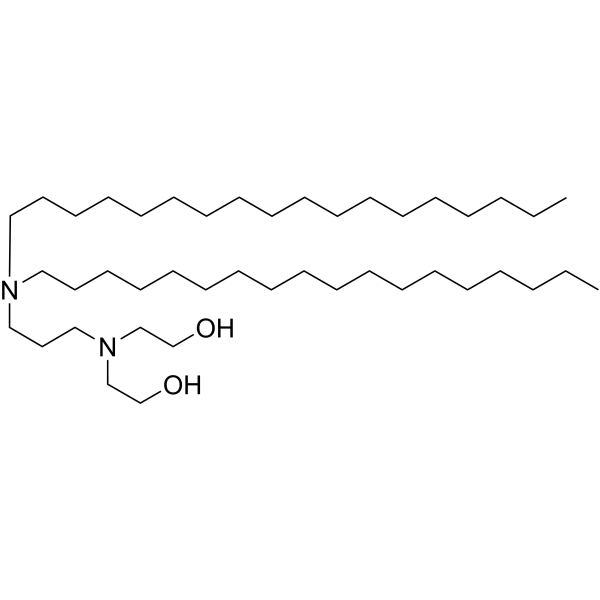
CP-20961 is an interferon inducer. CP-20961 is a potent synthetic non-immunogenic adjuvant that induces arthritis .
loading...
    loading...
Cat. No.: HY-W596474H
CAS No.: 26247-79-0
Poly-L-glutamic acid sodium salt (MW 60000) is a synthetic polypeptide with biocompatibility, biodegradability and non-immunogenicity. Poly-L-glutamic acid sodium salt is an ideal tumor-targeting polymer carrier. Poly-L-glutamic acid sodium salt can be hydrolyzed by cathepsin B during metabolic decomposition .
loading...
    loading...
Cat. No.: HY-W596474A
CAS No.: 26247-79-0
Poly-L-glutamic acid sodium salt (MW 3000) is a synthetic polypeptide with biocompatibility, biodegradability and non-immunogenicity. Poly-L-glutamic acid sodium salt is an ideal tumor-targeting polymer carrier. Poly-L-glutamic acid sodium salt can be hydrolyzed by cathepsin B during metabolic decomposition .
loading...
    loading...
Cat. No.: HY-W596474I
CAS No.: 26247-79-0
Poly-L-glutamic acid sodium salt (MW 120000) is a synthetic polypeptide with biocompatibility, biodegradability and non-immunogenicity. Poly-L-glutamic acid sodium salt is an ideal tumor-targeting polymer carrier. Poly-L-glutamic acid sodium salt can be hydrolyzed by cathepsin B during metabolic decomposition .
loading...
    loading...
Cat. No.: HY-112111A
CAS No.: 25513-46-6
Poly-L-Glutamic acid (MW 100000) is a synthetic polypeptide with biocompatibility, biodegradability and non-immunogenicity. Poly-L-Glutamic acid is an ideal tumor-targeting polymer carrier. Poly-L-Glutamic acid can be hydrolyzed by cathepsin B during metabolic decomposition .
loading...
    loading...
Cat. No.: HY-W596474E
CAS No.: 26247-79-0
Poly-L-glutamic acid sodium salt (MW 45000) is a synthetic polypeptide with biocompatibility, biodegradability and non-immunogenicity. Poly-L-glutamic acid sodium salt is an ideal tumor-targeting polymer carrier. Poly-L-glutamic acid sodium salt can be hydrolyzed by cathepsin B during metabolic decomposition .
loading...
    loading...
Cat. No.: HY-L038
2,537 compounds

Stem cells, which are found in all multi-cellular organisms, can divide and differentiate into diverse special cell types and can self-renew to produce more stem cells. To be useful in therapy, stem cells must be converted into desired cell types as necessary which is called induced differentiation or directed differentiation. Understanding and using signaling pathways for differentiation is an important method in successful regenerative medicine. Small molecules or growth factors induce the conversion of stem cells into appropriate progenitor cells, which will later give rise to the desired cell type. There is a variety of signal molecules and molecular families that may affect the establishment of germ layers in vivo, such as fibroblast growth factors (FGFs); the wnt family or superfamily of transforming growth factors β (TGFβ) and bone morphogenetic proteins (BMP). Unfortunately, for now, a high cost of recombinant factors is likely to limit their use on a larger scale in medicine. The more promising technique focuses on the use of small molecules. These small molecules can be used for either activating or deactivating specific signaling pathways. They enhance reprogramming efficiency by creating cells that are compatible with the desired type of tissue. It is a cheaper and non-immunogenic method.

MCE Differentiation Inducing Compound Library contains a unique collection of 2,537 compounds that act on signaling pathways for differentiation. These compounds are potential stimulators for induced differentiation. This library is a useful tool for researching directed differentiation and regenerative medicine.

  • 1

