1. Search Result
Search Result
Results for "

pH 4.0

" in MedChemExpress (MCE) Product Catalog:

15

Inhibitors & Agonists

1

Fluorescent Dyes

1

Biochemical Assay Reagents

1

Peptides

1

Isotope-Labeled Compounds

1

Oligonucleotides

Targets Recommended:
Cat. No. Product Name Target Research Areas Chemical Structure
  • HY-B1610N

    Biochemical Assay Reagents Others
    Sodium Citrate Buffer, 0.1M, pH 4.0 is an acidic, aqueous buffer solution. Sodium Citrate Buffer, 0.1M, pH 4.0 resists pH fluctuations, chelates metal ions, and regulates the redox potential of the system. Sodium Citrate Buffer, 0.1M, pH 4.0 is widely used in molecular biology, immunohistochemistry (IHC), and biochemistry .
    Sodium Citrate Buffer, 0.1M, pH 4.0
  • HY-10403
    PH-797804
    5+ Cited Publications

    p38 MAPK Autophagy Inflammation/Immunology Cancer
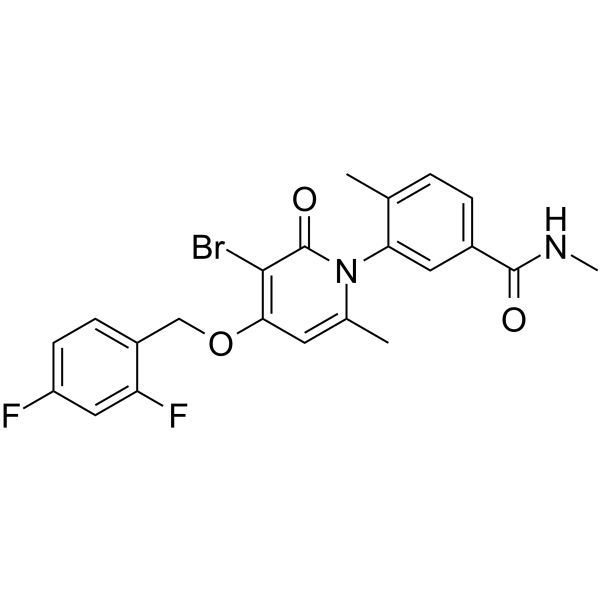
    PH-797804 is a ATP-competitive, selective p38α/p38β inhibitor (IC50=26 nM and Ki=5.8 nM for p38α; Ki=40 nM for p38β) and does not inhibit JNK2.
    PH-797804
  • HY-E70518

    Bacterial Infection
    Oxalate decarboxylase, Microorganism (EC 4.1.1.2), a stress-response enzyme in certain soil bacteria, is a Mn-dependent enzyme in the cupin superfamily and is found in fungi and soil bacteria. Oxalate decarboxylase catalyzes the decarboxylation of the oxalate mono-anion in the soil bacterium Bacillus subtilis. Enzymatic activity of OxDC is strongly pH dependent, with a maximum at around pH 4.0 .
    Oxalate decarboxylase, Microorganism
  • HY-115062

    Phospholipase NADPH Oxidase p38 MAPK Akt NF-κB AP-1 Reactive Oxygen Species (ROS) Cardiovascular Disease Inflammation/Immunology Cancer
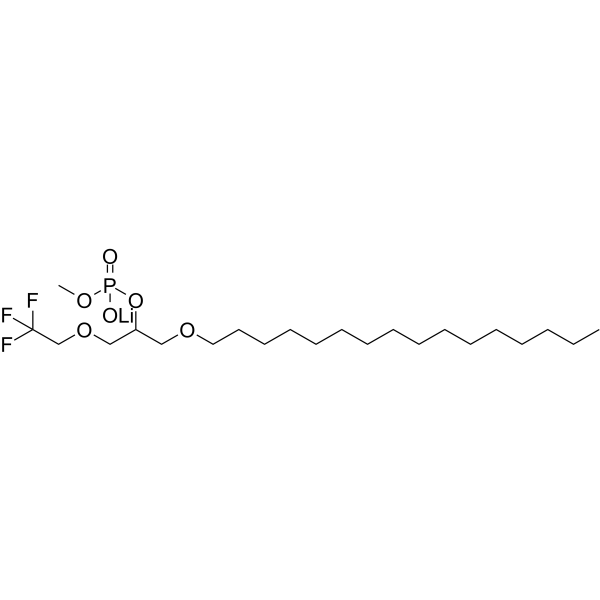
    MJ-33 lithium salt is a competitive phospholipase A2 (PLA2) inhibitor with an IC50 of 0.3 μM. MJ-33 lithium salt inhibits NOX2 activation and reduces ROS production by blocking the PLA2 activity of Prdx6. MJ-33 lithium salt effectively inhibits the activity of acidic PLA2 (pH 4.0) and reduces the degradation of alveolar surfactant phosphatidylcholine (PC), but exerts no effect on alkaline PLA2 (pH 8.5). MJ-33 lithium salt significantly alleviates lung oxidative injury induced by ischemia-reperfusion (I/R). MJ-33 lithium salt significantly inhibits the invasion, migration and adhesion abilities of prostate cancer cells by suppressing the MAPK, AKT, NF-κB and AP-1 signaling pathways. MJ-33 lithium salt can be used for the research of ROS-related diseases and prostate cancer .
    MJ33 lithium salt
  • HY-P2866A

    NAG, Porcine kidney

    Others Others
    β-N-Acetylhexosaminidase, Porcine kidney is a glycosidase with transglycosylation activity, used to generate health-beneficial human milk oligosaccharides, and it effectively interacts with low molecular weight sugar alcohols (such as glycerol, erythritol, and xylitol). The enzyme exhibits optimal activity at pH 5 and 40 °C, and shows high thermal stability (up to 55°C) when bound to the cell wall. β-N-Acetylhexosaminidase holds promise for applications in the biotransformation of Chitin (HY-126389) and research in the food health sector .
    β-N-Acetylhexosaminidase, Porcine kidney
  • HY-W193844

    ZINC13684400

    GPR65 Inflammation/Immunology
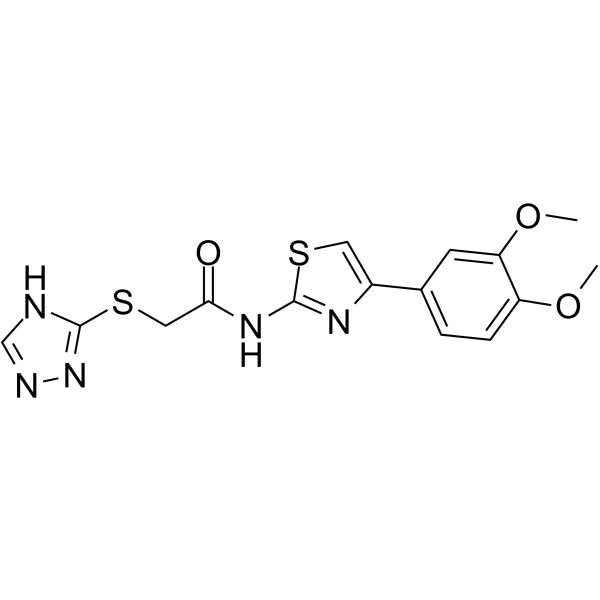
    MLS001006105 (ZINC13684400) is a GPR65 allosteric agonist. MLS001006105 displays GPR65 allosteric agonist activity at pH 8.40 but not at lower pH .
    MLS001006105
  • HY-W025785

    Solvent Yellow 2; Dimethyl yellow

    Biochemical Assay Reagents Cancer
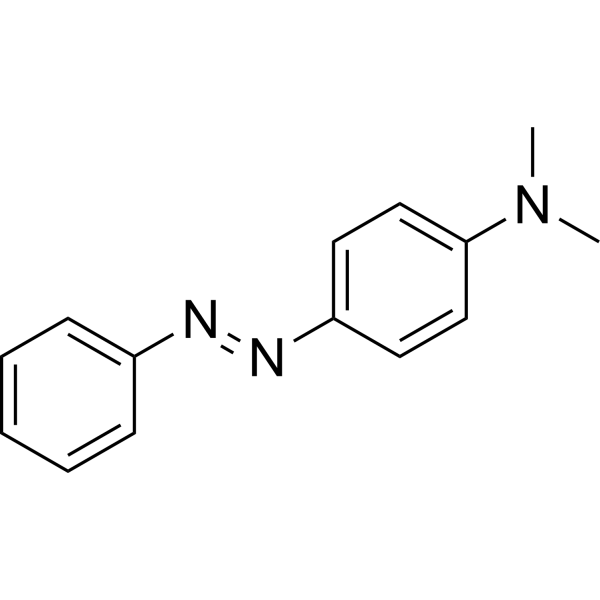
    Methyl yellow (Solvent Yellow 2) is a pH indicator. Methyl yellow appears red at low pH, and becomes yellow above pH 4.0 .
    Methyl yellow
  • HY-P10923

    Cathepsin Others
    KYS-1 is a selective substrate for cathepsin E with a Km value of 1.9 μM. KYS-1 was incubated with cathepsin E (1.0 ng) with the pH optimum of approximately pH 4.0 .
    KYS-1
  • HY-159743

    Toll-like Receptor (TLR) Inflammation/Immunology
    M101 is a vaccine adjuvant. Its main component is highly purified immunologically active substances with a pH value ranging from 4.0 to 6.5. This adjuvant is safe, non-toxic and metabolizable, and can effectively induce immune responses in the body. It has strong immune effects on both T-cell-dependent and T-cell-independent antigens. This adjuvant is applicable to various veterinary vaccines and is recommended for use in porcine circovirus.
    M101
  • HY-136271

    Phospholipase NADPH Oxidase p38 MAPK Akt NF-κB AP-1 Reactive Oxygen Species (ROS) Cardiovascular Disease Inflammation/Immunology Cancer
    MJ-33 is a competitive phospholipase A₂ (PLA₂) inhibitor with an IC50 of 0.3 μM. MJ-33 inhibits the activation of NOX2 by blocking the PLA₂ activity of Prdx6, thereby reducing the production of ROS. MJ-33 effectively inhibits the activity of acidic PLA₂ (pH 4.0), reduces the degradation of pulmonary surfactant phosphatidylcholine (PC), but has no effect on alkaline PLA₂ (pH 8.5). MJ-33 significantly alleviates lung oxidative damage induced by ischemia-reperfusion (I/R). MJ-33 significantly inhibits the invasive, migratory and adhesive abilities of prostate cancer cells by suppressing the MAPK, AKT, NF-κB and AP-1 signaling pathways. MJ-33 can be used to study ROS-related diseases and prostate cancer .
    MJ33
  • HY-103300

    Endogenous Metabolite Infection
    NPE-caged-proton is a reagent that releases protons under UV light and has the activity of activating the fusion protein GP64 under weak acidic conditions. NPE-caged-proton can promote the binding of enveloped viruses to liposome membranes with acidic phospholipids in an environment of pH 4.0 to 5.5, thereby initiating membrane fusion. The ultraviolet unblocking effect of NPE-caged-proton can lower the environmental pH, thereby triggering the process of viral membrane fusion. When studying the interaction between viruses and cell membranes, NPE-caged-proton provides a valuable tool for revealing the subtle behaviors of viruses in different chemical and biochemical environments .
    NPE-caged-proton
  • HY-D3003

    Fluorescent Dye Others
    M-H2S is an endoplasmic reticulum-targeted ratio-type near-infrared fluorescent probe (Ex/Em : 480 nm/560 nm) specifically designed for the detection of hydrogen sulfide (H2S) in living cells and zebrafish. M-H2S exhibits detection limit for H2S of 39.1 nM, and the fluorescence intensity ratio (F₆₅₀/F₅₆₀) within the range of 0-40 μM shows a linear relationship with the H2S concentration. M-H2S responds best under pH = 7.2 (the normal physiological pH of the endoplasmic reticulum) conditions, making it suitable for the detection of the microenvironment of the endoplasmic reticulum. M-H2S can be used to study the role of H2S in endoplasmic reticulum function, stress response, and related diseases .
    M-H2S
  • HY-W025785S1

    Solvent Yellow 2-d6; Dimethyl yellow-d6

    Isotope-Labeled Compounds Biochemical Assay Reagents Cancer
    Methyl yellow-d6 (Solvent Yellow 2-d6) is the deuterium labeled Methyl yellow (HY-W025785). Methyl yellow (Solvent Yellow 2) is a pH indicator. Methyl yellow appears red at low pH, and becomes yellow above pH 4.0 .
    Methyl yellow-d6
  • HY-10403R

    Reference Standards p38 MAPK Autophagy Inflammation/Immunology Cancer
    PH-797804 (Standard) is the analytical standard of PH-797804 (HY-10403). This product is intended for research and analytical applications. PH-797804 is a ATP-competitive, selective p38α/p38β inhibitor (IC50=26 nM and Ki=5.8 nM for p38α; Ki=40 nM for p38β) and does not inhibit JNK2.
    PH-797804 (Standard)
  • HY-Y0282

    NSC 77384; Sanibrom 40

    Environmental Pollutants Neurological Disease
    Sodium bromide (NSC 77384; Sanibrom 40) is a GABA-ergic system modulator that crosses the blood-brain barrier, and it effectively reduces and blocks epileptiform discharges. Sodium bromide exerts significant anticonvulsant effects by enhancing GABA-ergic inhibitory functions, such as increasing the amplitude of inhibitory postsynaptic currents and paired-pulse inhibition. Sodium bromide specifically enhances stimulation-induced extracellular alkalosis without affecting baseline pH or subsequent acidosis processes. Sodium bromide exhibits species-specific pharmacokinetic characteristics, competes with chloride ions for renal tubular reabsorption sites, and serves as a marker for extracellular fluid volume. Sodium bromide can be used in the research of epilepsy and related neurological diseases .
    Sodium bromide

Inquiry Online

Your information is safe with us. * Required Fields.

Salutation


Country or Region *

Applicant Name *


Organization Name *

Department *


Email Address *


Product Name *

Cat. No.


Requested quantity *

Phone Number *


Remarks

Inquiry Online

Inquiry Information

Product Name:
Cat. No.:
Quantity:
MCE Japan Authorized Agent:

