13 Results for "

sleeping sickness

" in MedChemExpress (MCE) Product Catalog:
Products (13)

13 Results for "sleeping sickness" in MCE Product Catalog:

4
4 Cited Publications
Cat. No.: HY-13801
CAS No.: 59729-37-2
Purity:  99.84%
Synonyms: HOE 239
Target:  

Parasite

Research Areas:  

Infection

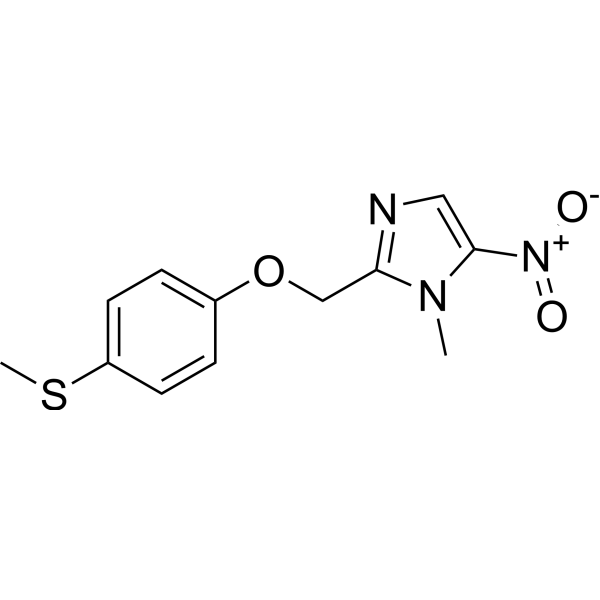
Fexinidazole (HOE 239) is an orally active, potent nitroimidazole antitrypanosomal agent. Fexinidazole shows trypanocidal activity against T. brucei subspecies and strains with IC50s of 0.7-3.3 μM (0.2-0.9 μg/ml). Fexinidazol has the potential for human sleeping sickness (HAT) caused by infection with T. brucei .
loading...
    loading...
Cat. No.: HY-153021
CAS No.: 326879-46-3
Purity:  ≥98.0%
Target:  

Parasite

Research Areas:  

Infection

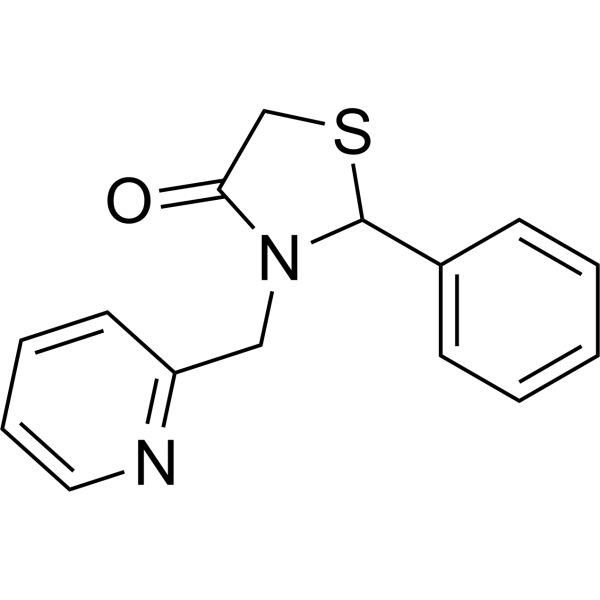
NMT-IN-1 is a Trypanosoma brucei N-myristoyltransferase (TbNMT) inhibitor, with an IC50 of 31 μM against TbNMT and an IC50 of 66 μM against hNMT. As a thiazolidinone hit compound identified via virtual screening, NMT-IN-1 exerts enzymatic inhibitory effects by binding to the active site of TbNMT. NMT-IN-1 adopts a binding mode distinct from that of pyrazole sulfonamide inhibitors and can inhibit the myristoyl transfer reaction catalyzed by TbNMT. NMT-IN-1 is mainly used in the research of anti-parasitic lead compounds for human African trypanosomiasis (African sleeping sickness). It provides a structural basis for the subsequent optimization of TbNMT inhibitors with high activity, high selectivity and blood-brain barrier permeability .
loading...
    loading...
Cat. No.: HY-108534
CAS No.: 485842-97-5
Synonyms: AW 464
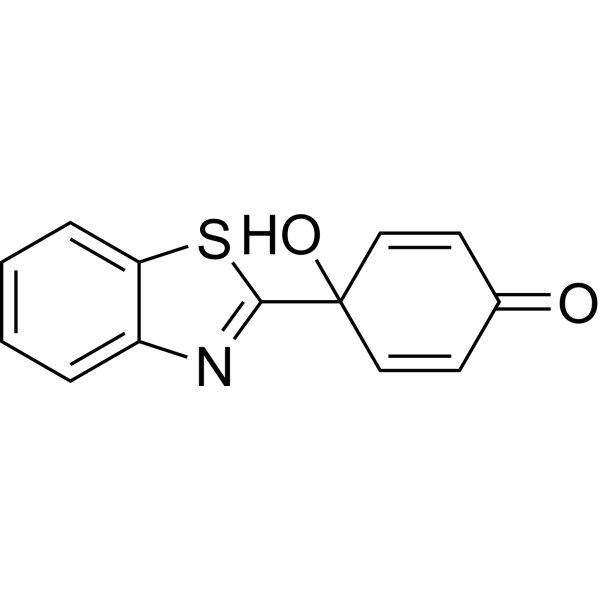
PMX464 (AW 464) is a thiol-reactive quinol compound and an inhibitor of the thioredoxin-thioredoxin reductase (Trx/TrxR) system, with an IC50 value of 6.5 μM against TrxR. PMX464 acts by irreversibly inhibiting the thioredoxin (Trx-1) system, blocking HIF-1α transcriptional activation and the NF-κB inflammatory pathway, inducing apoptosis, attenuating platelet function and inhibiting thrombosis, and specifically disrupting the trypanothione antioxidant metabolic network in parasites. PMX464 is used in research concerning malignant tumors (colorectal cancer, breast cancer, renal cancer, and leukemia), pulmonary inflammation, African sleeping sickness, and antithrombotic applications .
loading...
    loading...
Cat. No.: HY-179690
CAS No.: 671754-20-4
Research Areas:  

Infection

Antiparasitic agent-30 is a potent adenosine kinase TbrAK modulator and antitrypanosomal agent. Antiparasitic agent-30 exhibits significant inhibitory activity against Trypanosoma brucei rhodesiense, while enhancing the activity of recombinant TbrAK(EC50=38 nM, Ka=75 nM-497 nM). Antiparasitic agent-30 exerts its pharmacological effects by eliminating intrinsic substrate inhibition and hyperactivating TbrAK in Trypanosoma brucei rhodesiense. Antiparasitic agent-30 serves as a valuable tool molecule for studying acute African human trypanosomiasis (sleeping sickness) .
loading...
    loading...
Cat. No.: HY-118996A
CAS No.: 34301-55-8
Target:  

Parasite

Research Areas:  

Infection

Isometamidium chloride is an antiprotozoal agent, that exhibits activity against trypanosome. Isometamidium chloride can be used in research of african sleeping sickness .
loading...
    loading...
Cat. No.: HY-118996B
CAS No.: 6798-24-9
Target:  

Parasite

Research Areas:  

Infection

Isometamidium chloride hydrochloride is an antiprotozoal agent, that exhibits activity against trypanosome. Isometamidium chloride hydrochloride can be used in research of african sleeping sickness .
loading...
    loading...
Cat. No.: HY-13801R
CAS No.: 59729-37-2
Synonyms: HOE 239 (Standard)
Research Areas:  

Infection

Fexinidazole (Standard) is the analytical standard of Fexinidazole. This product is intended for research and analytical applications. Fexinidazole (HOE 239) is an orally active, potent nitroimidazole antitrypanosomal agent. Fexinidazole shows trypanocidal activity against T. brucei subspecies and strains with IC50s of 0.7-3.3 μM (0.2-0.9 μg/ml). Fexinidazol has the potential for human sleeping sickness (HAT) caused by infection with T. brucei .
loading...
    loading...
Cat. No.: HY-150506
CAS No.: 3032859-14-3
Target:  

Parasite

Research Areas:  

Infection

SPR7 (compound 7) is a potent and selective rhodesain inhibitor, with a Ki of 0.51 nM. SPR7 shows antiparasitic activity against T. b. brucei, with an EC50 of 1.65 μM .
loading...
    loading...
Cat. No.: HY-151195
CAS No.: 2827061-47-0
Target:  

Proteasome Parasite

Research Areas:  

Infection

20S Proteasome-IN-4 (Compound 7) is a brain-penetrant, parasite-selective, orally active 20S proteasome inhibitor with an IC50 of 6.3 nM against T. b. brucei 20S proteasome. 20S Proteasome-IN-4 can be used for the research of human African trypanosomiasis (HAT) .
loading...
    loading...
Cat. No.: HY-183387
CAS No.: 1348565-08-1
Target:  

Parasite Cathepsin

Research Areas:  

Infection

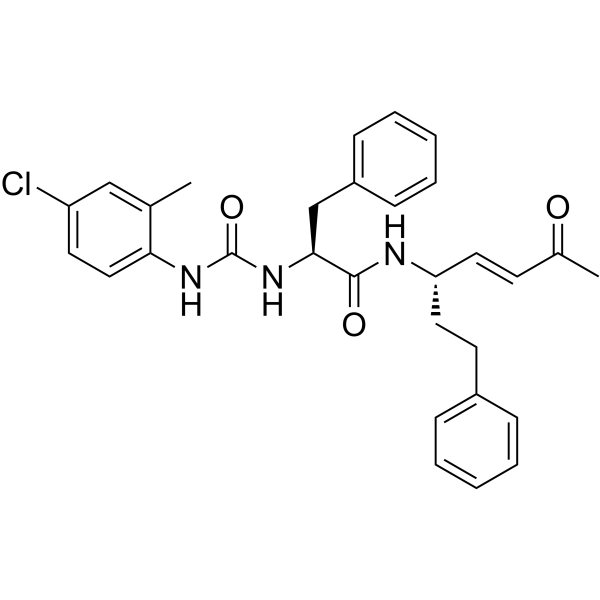
K11002 hydrobromide is a cysteine protease inhibitor. K11002 hydrobromide forms a covalent bond with the active site cysteine residue via Michael addition. K11002 hydrobromide inhibits the growth of Trypanosoma brucei. K11002 hydrobromide can be used in the research of African human trypanosomiasis (sleeping sickness) .
loading...
    loading...
Cat. No.: HY-N19754
CAS No.: 307503-97-5
Target:  

Parasite

Cladospirone B is a secondary metabolite of the endophytic fungus Lasiodiplodia theobromae. Cladospirone B exhibits trypanocidal activity, with a MIC of 17.8 µM against Trypanosoma brucei. Cladospirone B can be used in the research of African human trypanosomiasis (sleeping sickness) .
loading...
    loading...
Cat. No.: HY-175979
Target:  

Parasite

Research Areas:  

Infection

HAT-IN-9 (Compound 3F) is a selective proliferation inhibitor targeting Trypanosoma brucei. HAT-IN-9 inhibits the proliferation and division of Trypanosoma brucei. HAT-IN-9 is promising for research of African trypanosomiasis (HAT, i.e., sleeping sickness) .
loading...
    loading...
Cat. No.: HY-165316
CAS No.: 13699-45-1
Myristoyllysophosphatidylcholine is a NLRP3 inflammasome inhibitor with multiple activities including anti-inflammatory and antioxidant effects. Myristoyllysophosphatidylcholine inhibits LPS-induced NLRP3 inflammasome activation, reduces pro-inflammatory cytokine secretion, decreases ROS and MDA levels, alleviates lung tissue and cell damage, and mediates apoptosis. Myristoyllysophosphatidylcholine serves as a myristate donor for myristoylation of the Glucose-6-Phosphate Isomerase (GPI) anchor in Trypanosoma brucei and undergoes hydrolysis. Myristoyllysophosphatidylcholine acts as a biomarker for the severity of community-acquired pneumonia. Myristoyllysophosphatidylcholine can be used in research related to diseases such as community-acquired pneumonia and acute lung injury .
loading...
    loading...
  • 1

