



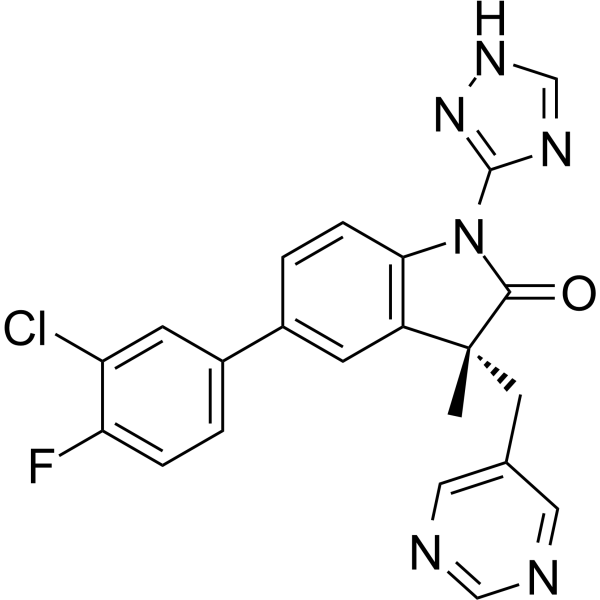
TROX-1

Based on 1 Customer Validation
TROX-1 is a selective, orally active and brain-penetrant N-type calcium channel (Cav2.2) inhibitor with an IC50 value of 0.11 μM. TROX-1 exerts state-dependent and use-dependent inhibition, preferentially targets open/inactivated channels, blocks depolarization-associated calcium influx, and fully blocks calcium influx in rat dorsal root ganglion neurons. TROX-1 reverses inflammatory-induced hyperalgesia, nerve injury-induced allodynia. TROX-1 can be used for the research of pain.
연구목적의 판매만을 진행합니다. 환자를 대상으로 한 판매는 하지 않습니다.
- Purity : 99.55%
- CAS No.: 1309601-26-0
- 화학식: C22H16ClFN6O
- 분자량:434.85
-
보관:Powder -20°C, 3 years , 4°C, 2 years ; In solvent -80°C, 6 months , -20°C, 1 month

To place orders, for customer services and technical support, please contact: MedChemExpress USA
Tel: 609-228-6898 E-mail: [email protected] [email protected]


-
 Biological Activity
-
Chemical Information
-
용액&용해도
- Protocol
- 순도&문서
- References
-
 Help & FAQs


All Calcium Channel Isoforms
More

Biological Activity
제품 설명
IC50 & Target
[1]|
CaV2.2 0.11 μM (IC50) |
In Vitro
TROX-1 (0.3-3 μM) potently inhibits CaV2.2 channels in stable HEK293 bMHN-4 cells under depolarized (inactivated/open state-biased) conditions with an IC50 of 0.11 μM, and shows drastically reduced potency under hyperpolarized (closed state-biased) conditions[1].
TROX-1 inhibits CaV2.2 channels in stable HEK293 bMHN-4 cells in a voltage-dependent manner, with potency increasing 11.7-fold as the holding potential shifts from -110 mV (IC50 = 4.2 μM) to -70 mV (IC50 = 0.36 μM)[1].
TROX-1 inhibits CaV2.2 channels in stable HEK293 CBK cells in a use-dependent manner, with 10-fold higher potency at the 20th pulse (IC50 = 2.4 μM) compared to the first pulse (IC50 = 24 μM) of a depolarizing train[1].
TROX-1 inhibits CaV2.1, CaV2.2, and CaV2.3 channels in stable HEK293 cells with similar potency (IC50 values = 0.29, 0.19, 0.28 μM, respectively) when tested under depolarized conditions with matched ~30% channel inactivation, and shows apparent selectivity for CaV2.2 and CaV2.3 over CaV2.1 under hyperpolarized conditions[1].
TROX-1 (1 nM-30 μM; 30 min preincubation) inhibits CaV2.1, CaV2.2, and CaV2.3 channel-mediated calcium influx in stable HEK293 cells in vitro in a state-dependent manner, with similar potency across all three subtypes when normalized to channel inactivation levels, and larger potency shifts for CaV2.2 and CaV2.3 between hyperpolarized and depolarized conditions compared to CaV2.1[1].
TROX-1 (0.001-30 μM) potently and state-dependently inhibits calcium influx through recombinant Cav2.2 channels in CBK cells, with an IC50 of 0.27 μM under depolarized conditions and >10 μM under hyperpolarized conditions[2].
TROX-1 (0.3-3 μM) state-dependently inhibits Cav2.2-mediated barium currents in rat DRG neurons, with an IC50 of 0.4 μM under depolarized conditions and 2.6 μM under hyperpolarized conditions[2].
TROX-1 (1-30 μM; 20 min) dose-dependently and fully inhibits calcium influx mediated by all Cav2 family channels in neonatal rat DRG neurons[2].
MedChemExpress (MCE) has not independently confirmed the accuracy of these methods. They are for reference only. Further protocols information, click here.
In Vivo
TROX-1 (3-30 mg/kg; p.o.; single dose) dose-dependently reverses SNL-induced tactile allodynia in rats after oral administration, with maximal 72% reversal at 30 mg/kg and an ED50 of 8 mg/kg[2].
TROX-1 (3-30 mg/kg; p.o.; single dose) dose-dependently reverses Capsaicin (HY-10448)-induced secondary allodynia in rats after oral administration[2].
TROX-1 (3-30 mg/kg; p.o.; single dose) dose-dependently reverses Iodoacetate-induced allodynia and weight bearing changes in rats after oral administration, with maximal 49% reversal of allodynia and 43% reversal of weight bearing changes at 30 mg/kg[2].
TROX-1 (10-30 mg/kg; p.o.; single dose) does not alter thermal latency in the rat hot-plate model of acute nociception at oral doses up to 30 mg/kg[2].
TROX-1 (30 mg/kg; p.o.; single dose) significantly reverses CFA-induced thermal hyperalgesia in wild-type mice after oral administration at 30 mg/kg, but its efficacy is abrogated in Cav2.2-deficient mice[2].
TROX-1 (30-100 mg/kg; p.o.; single dose) causes mild motor impairment in rats only at an oral dose of 100 mg/kg, providing a CNS therapeutic window of ~12.5 relative to its analgesic efficacy in neuropathic pain[2].
TROX-1 (0.1-1 mg/kg/min; i.v.; 30 min infusion) does not significantly alter baroreflex function in conscious rats at intravenous infusion doses up to 0.3 mg/kg/min, with mild HR range reduction only at 1 mg/kg/min, providing a cardiovascular therapeutic window of 38-fold relative to analgesic efficacy[2].
TROX-1 (1-7 mg/kg; i.v.; 30 min infusion, cumulative doses 1-10 mg/kg) dose-dependently decreases MAP and HR in anesthetized, vagotomized dogs at cumulative intravenous doses of 3 mg/kg and higher, with significant effects observed at plasma levels ≥18 μM[2].
MedChemExpress (MCE) has not independently confirmed the accuracy of these methods. They are for reference only.
-
Animal Model:Sprague-Dawley (male, 220-350 g, CFA-induced inflammatory pain model)[2]
-
Dosage:3, 10, 30 mg/kg
-
Administration:p.o.; single dose; daily for 3 days
-
Result:Produced a maximal 81% reversal of hyperalgesia, with duration of action greater than 8 h at 30 mg/kg single dose.
Demonstrated duration of action greater than 8 h at 3 mg/kg single dose.
Induced 52% reversal on day 1, 57% reversal on day 2, and 58% reversal on day 3 (all measured 3 h post-dose) with chronic 10 mg/kg once-daily dosing.


Chemical Information
-
CAS No. 1309601-26-0
-
Appearance Solid
-
분자량 434.85
-
화학식 C22H16ClFN6O
-
Color White to off-white
-
SMILES
O=C1N(C2=C([C@]1(CC3=CN=CN=C3)C)C=C(C=C2)C4=CC=C(C(Cl)=C4)F)C5=NNC=N5
-
선적
Room temperature in continental US; may vary elsewhere.
-
보관
Powder -20°C 3 years 4°C 2 years In solvent -80°C 6 months -20°C 1 month


용액&용해도
In Vitro:
DMSO : 100 mg/mL (229.96 mM; Need ultrasonic; Hygroscopic DMSO has a significant impact on the solubility of product, please use newly opened DMSO)
Please refer to the solubility information to select the appropriate solvent. Once prepared, please aliquot and store the solution to prevent product inactivation from repeated freeze-thaw cycles.
Storage method and period of stock solution: -80°C, 6 months; -20°C, 1 month. When stored at -80°C, please use it within 6 months. When stored at -20°C, please use it within 1 month.
Please refer to the solubility information to select the appropriate solvent. Once prepared, please aliquot and store the solution to prevent product inactivation from repeated freeze-thaw cycles.
Storage method and period of stock solution: -80°C, 6 months; -20°C, 1 month. When stored at -80°C, please use it within 6 months. When stored at -20°C, please use it within 1 month.
Concentration (start) × Volume (start) = Concentration (final) × Volume (final)
In Vivo:
Select the appropriate dissolution method based on your experimental animal and administration route.
- For the following dissolution methods, please ensure to first prepare a clear stock solution using an In Vitro approach and then sequentially add co-solvents:
- To ensure reliable experimental results, the clarified stock solution can be appropriately stored based on storage conditions. As for the working solution for In Vivo experiments, it is recommended to prepare freshly and use it on the same day.
- The percentages shown for the solvents indicate their volumetric ratio in the final prepared solution. If precipitation or phase separation occurs during preparation, heat and/or sonication can be used to aid dissolution.
Add each solvent one by one: 10% DMSO 40% PEG300 5% Tween-80 45% Saline
Solubility: ≥ 2.5 mg/mL (5.75 mM); Clear solution
This protocol yields a clear solution of ≥ 2.5 mg/mL (saturation unknown).
Taking 1 mL working solution as an example, add 100 μL DMSO stock solution (25.0 mg/mL) to 400 μL PEG300, and mix evenly; then add 50 μL Tween-80 and mix evenly; then add 450 μL Saline to adjust the volume to 1 mL.
Preparation of Saline: Dissolve 0.9 g sodium chloride in ddH₂O and dilute to 100 mL to obtain a clear Saline solution.
Add each solvent one by one: 10% DMSO 90% (20% SBE-β-CD in Saline)
Solubility: ≥ 2.5 mg/mL (5.75 mM); Clear solution
This protocol yields a clear solution of ≥ 2.5 mg/mL (saturation unknown).
Taking 1 mL working solution as an example, add 100 μL DMSO stock solution (25.0 mg/mL) to 900 μL 20% SBE-β-CD in Saline, and mix evenly.
Preparation of 20% SBE-β-CD in Saline (4°C, storage for one week): 2 g SBE-β-CD powder is dissolved in 10 mL Saline, completely dissolve until clear.
In Vivo Dissolution Calculator
Please enter the basic information of animal experiments:
-
-
-
-
Recommended: Prepare an additional quantity of animals to account for potential losses during experiments.
Please enter your animal formula composition:
-
%DMSO +
Recommended: Keep the proportion of DMSO in working solution below 2% if your animal is weak.
-
%+
-
+%Tween-80 + +
-
%Saline +
The co-solvents required include: DMSO, . All of co-solvents are available by MedChemExpress (MCE). , Tween 80. All of co-solvents are available by MedChemExpress (MCE).
Working solution concentration: 0.22 mg/mL
Method for preparing stock solution: mg drug dissolved in μL DMSO. Stock solution concentration: mg/mL.
1. Take μL DMSO stock solution;
2. Add μL .
μL , mix evenly;
3. Then add μL Tween 80, mix evenly;
4. Then add μL
Please ensure that the stock solution in the first step is dissolved to a clear state, and add co-solvents in sequence. You can use ultrasonic heating (ultrasonic cleaner, recommended frequency 20-40 kHz), vortexing, etc. to assist dissolution.

Protocol
-
Ca2+ Staining Technique
Ca2+ staining is an experimental technique that utilizes specific fluorescent probes (such as Fluo-4 AM, Fura-2, etc.) to qualitatively or quantitatively detect dynamic changes in intracellular Ca2+ concentrations; this is achieved by monitoring the changes in fluorescent signals generated when these probes bind to free intracellular calcium ions. The underlying principle relies primarily on the presence of chelating groups within the probe's molecular structure that possess high affinity for calcium ions.
-
Primary Dorsal Root Ganglion Sensory Neuron Culture
Primary dorsal root ganglion sensory neuron culture isolates DRG neuronal somata from rodent or human ganglia, dissociates tissue enzymatically and mechanically, and maintains post-mitotic sensory neurons in vitro for readouts such as neurite outgrowth, immunocytochemical marker expression, calcium imaging, electrophysiology, RNA/protein analysis, or neuropeptide release assays. The method reflects peripheral sensory neuron biology because DRG neurons are primary sensory neurons whose cell bodies reside in dorsal root ganglia and whose cultured dissociated cells can retain neuronal morphology, sensory-neuron marker expression, and stimulus-responsive properties depending on the downstream assay.


순도&문서
-
Data Sheet (285 KB)
-
SDS (251 KB)
- English - EN (251 KB)
- Français - FR (251 KB)
- Deutsch - DE (251 KB)
- Norwegian - NO (251 KB)
- Español - ES (251 KB)
- Swedish - SV (251 KB)
- Italian - IT (251 KB)
- Korean - KR (251 KB)
- Portuguese - PT (251 KB)
-
Handling Instructions (2659 KB)
References
[1]. Swensen AM, et al. Characterization of the substituted N-triazole oxindole TROX-1, a small-molecule, state-dependent inhibitor of Ca(V)2 calcium channels. Mol Pharmacol. 2012;81(3):488-497. [Content Brief]
[2]. Abbadie C, et al. Analgesic effects of a substituted N-triazole oxindole (TROX-1), a state-dependent, voltage-gated calcium channel 2 blocker. J Pharmacol Exp Ther. 2010;334(2):545-555. [Content Brief]


Complete Stock Solution Preparation Table
Please refer to the solubility information to select the appropriate solvent. Once prepared, please aliquot and store the solution to prevent product inactivation from repeated freeze-thaw cycles.
Storage method and period of stock solution: -80°C, 6 months; -20°C, 1 month. When stored at -80°C, please use it within 6 months. When stored at -20°C, please use it within 1 month.
| Optional Solvent | Concentration Solvent Mass | 1 mg | 5 mg | 10 mg | 25 mg |
|---|---|---|---|---|---|
| DMSO | 1 mM | 2.2996 mL | 11.4982 mL | 22.9964 mL | 57.4911 mL |
| 5 mM | 0.4599 mL | 2.2996 mL | 4.5993 mL | 11.4982 mL | |
| 10 mM | 0.2300 mL | 1.1498 mL | 2.2996 mL | 5.7491 mL | |
| 15 mM | 0.1533 mL | 0.7665 mL | 1.5331 mL | 3.8327 mL | |
| 20 mM | 0.1150 mL | 0.5749 mL | 1.1498 mL | 2.8746 mL | |
| 25 mM | 0.0920 mL | 0.4599 mL | 0.9199 mL | 2.2996 mL | |
| 30 mM | 0.0767 mL | 0.3833 mL | 0.7665 mL | 1.9164 mL | |
| 40 mM | 0.0575 mL | 0.2875 mL | 0.5749 mL | 1.4373 mL | |
| 50 mM | 0.0460 mL | 0.2300 mL | 0.4599 mL | 1.1498 mL | |
| 60 mM | 0.0383 mL | 0.1916 mL | 0.3833 mL | 0.9582 mL | |
| 80 mM | 0.0287 mL | 0.1437 mL | 0.2875 mL | 0.7186 mL | |
| 100 mM | 0.0230 mL | 0.1150 mL | 0.2300 mL | 0.5749 mL |


TROX-1 Related Classifications
HY-120751 Related Classifications
 Powered by Bioz