



VEGFR-3-IN-1
Based on 3 publication(s) in Google Scholar
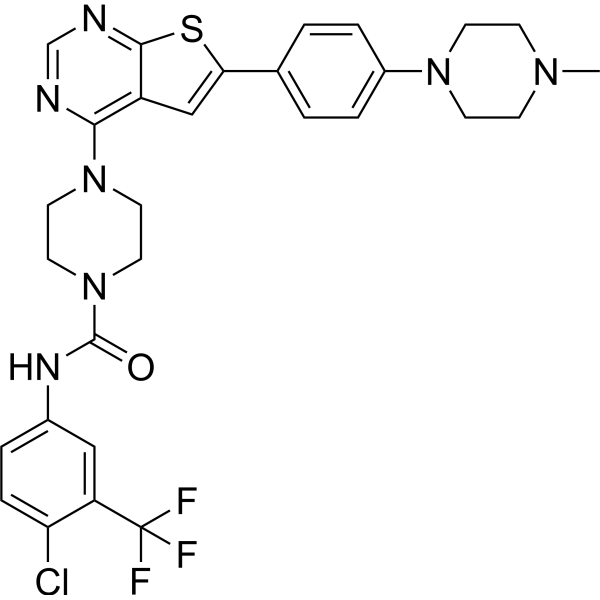
VEGFR-3-IN-1 is a potent and selective VEGFR3 inhibitor with an IC50 of 110.4 nM. VEGFR-3-IN-1 significantly inhibits proliferation and migration of VEGF-C-induced human dermal lymphatic endothelial cells (HDLEC), MDA-MB-231, and MDA-MB-436 cells by inactivating the VEGFR3 signaling pathway, and also effectively inhibits breast cancer growth.
For research use only. We do not sell to patients.
- Purity : 98.76%
- CAS No.: 2756668-73-0
- Formula: C29H29ClF3N7OS
- Molecular Weight:616.10
-
Storage:Powder -20°C, 3 years , 4°C, 2 years ; In solvent -80°C, 6 months , -20°C, 1 month

To place orders, for customer services and technical support, please contact: MedChemExpress USA
Tel: 609-228-6898 E-mail: [email protected] [email protected]


-
 Biological Activity
-
Chemical Information
-
Solvent & Solubility
- Protocols
- Purity & Documentation
- References
-
 Help & FAQs


Publications Citing Use of MedChemExpress (MCE) VEGFR-3-IN-1
MoreAll VEGFR Isoforms
More

Biological Activity
Description
IC50 & Target
[1]|
VEGFR3 110.4 nM (IC50) |
Cellular Effect
|
Cell Line

|
Type | Value | Description | References |
|---|---|---|---|---|
| MDA-MB-231 | IC50 |
2.22 μM
Compound: 38k
|
Anticancer activity against human MDA-MB-231 cells assessed as cell viability incubated for 48 hrs by MTT assay
Anticancer activity against human MDA-MB-231 cells assessed as cell viability incubated for 48 hrs by MTT assay
|
[PMID: 34351741] |
| MDA-MB-436 | IC50 |
3.5 μM
Compound: 38k
|
Anticancer activity against human MDA-MB-436 cells assessed as cell viability incubated for 48 hrs by MTT assay
Anticancer activity against human MDA-MB-436 cells assessed as cell viability incubated for 48 hrs by MTT assay
|
[PMID: 34351741] |
In Vitro
VEGFR-3-IN-1 (compound 38k) exhibits a significantly higher antiproliferative activity on MDA-MB-231 and MDA-MB-436 cells than 10 (IC50 > 50 μM), with IC50 values of 2.22 and 3.50 μM, respectively[1].
VEGFR-3-IN-1 markedly suppresses the phosphorylation of VEGFR3 and its downstream proteins in a dose-dependent manner[1].
MedChemExpress (MCE) has not independently confirmed the accuracy of these methods. They are for reference only. Further protocols information, click here.
-
Cell Line:MDA-MB-231 and MDA-MB-436 cells
-
Concentration:100 nM
-
Incubation Time:48 hours
-
Result:Exerted antimigration and antiproliferative activities through targeting VEGFR3 in MDA-MB-231 and MDA-MB-436 cells.
-
Cell Line:HDLEC cells
-
Concentration:10-500 nM
-
Incubation Time:
-
Result:Antilymphangiogenic activities of VEGFR-3-IN-1 by suppressing the expression of VEGFR3.
In Vivo
MedChemExpress (MCE) has not independently confirmed the accuracy of these methods. They are for reference only.
-
Animal Model:Nude mice (carrying xenografted BC)[1]
-
Dosage:50 mg/kg
-
Administration:P.o.;once
-
Result:Reduced the tumor volume, and displayed the strongest inhibitory activity in mice.
-
Animal Model:Sprague-Dawley (SD) rats [1]
-
Dosage:10 mg/kg
-
Administration:P.o. (Pharmacokinetic Analysis)
-
Result:The Cmax, AUC0-t , AUC0-∞ and t1/2 were 420 ng/mL, 9219 ng h/mL, 12304 ng h/mL and 16 hours, respectively.


Chemical Information
-
CAS No. 2756668-73-0
-
Appearance Solid
-
Molecular Weight 616.10
-
Formula C29H29ClF3N7OS
-
Color Off-white to yellow
-
SMILES
O=C(N1CCN(C2=C(C=C(C3=CC=C(N4CCN(C)CC4)C=C3)S5)C5=NC=N2)CC1)NC6=CC=C(Cl)C(C(F)(F)F)=C6
-
Shipping
Room temperature in continental US; may vary elsewhere.
-
Storage
Powder -20°C 3 years 4°C 2 years In solvent -80°C 6 months -20°C 1 month


Publications (3)
-
Journal Impact Factor
-
Most Recent
-
Inflamm Res
Aldosterone induces renal lymphangiogenesis through macrophage-lymphatic endothelial cell transformation and Inhibition by esaxerenone. [Abstract]2025 May 24;74(1):85. PMID: 40413281 -
Int J Mol Sci
Esaxerenone Attenuates Aldosterone-Induced Renal Fibrosis by Suppressing Fibroblast-to-Lymphatic Endothelial-like Cell Transdifferentiation. [Abstract]2026 May 12;27(10):4297. PMID: 42196278 -
Front Biosci (Landmark Ed)
Aldosterone-Induced Renal Lymphangiogenesis and Endothelial-To-Mesenchymal Transformation to Promote Renal Interstitial Fibrosis Through the MR/TGF-β1 Pathway in Mice. [Abstract]2025 Nov 27;30(11):45591. PMID: 41351406


Solvent & Solubility
In Vitro:
DMSO : 12.5 mg/mL (20.29 mM; ultrasonic and warming and adjust pH to 6 with HCl and heat to 60°C; Hygroscopic DMSO has a significant impact on the solubility of product, please use newly opened DMSO)
Please refer to the solubility information to select the appropriate solvent. Once prepared, please aliquot and store the solution to prevent product inactivation from repeated freeze-thaw cycles.
Storage method and period of stock solution: -80°C, 6 months; -20°C, 1 month. When stored at -80°C, please use it within 6 months. When stored at -20°C, please use it within 1 month.
Please refer to the solubility information to select the appropriate solvent. Once prepared, please aliquot and store the solution to prevent product inactivation from repeated freeze-thaw cycles.
Storage method and period of stock solution: -80°C, 6 months; -20°C, 1 month. When stored at -80°C, please use it within 6 months. When stored at -20°C, please use it within 1 month.
Concentration (start) × Volume (start) = Concentration (final) × Volume (final)
In Vivo:
Select the appropriate dissolution method based on your experimental animal and administration route.
- For the following dissolution methods, please ensure to first prepare a clear stock solution using an In Vitro approach and then sequentially add co-solvents:
- To ensure reliable experimental results, the clarified stock solution can be appropriately stored based on storage conditions. As for the working solution for In Vivo experiments, it is recommended to prepare freshly and use it on the same day.
- The percentages shown for the solvents indicate their volumetric ratio in the final prepared solution. If precipitation or phase separation occurs during preparation, heat and/or sonication can be used to aid dissolution.
Add each solvent one by one: 10% DMSO 40% PEG300 5% Tween-80 45% Saline
Solubility: ≥ 1.25 mg/mL (2.03 mM); Clear solution
This protocol yields a clear solution of ≥ 1.25 mg/mL (saturation unknown).
Taking 1 mL working solution as an example, add 100 μL DMSO stock solution (12.5 mg/mL) to 400 μL PEG300, and mix evenly; then add 50 μL Tween-80 and mix evenly; then add 450 μL Saline to adjust the volume to 1 mL.
Preparation of Saline: Dissolve 0.9 g sodium chloride in ddH₂O and dilute to 100 mL to obtain a clear Saline solution.
In Vivo Dissolution Calculator
Please enter the basic information of animal experiments:
-
-
-
-
Recommended: Prepare an additional quantity of animals to account for potential losses during experiments.
Please enter your animal formula composition:
-
%DMSO +
Recommended: Keep the proportion of DMSO in working solution below 2% if your animal is weak.
-
%+
-
+%Tween-80 + +
-
%Saline +
The co-solvents required include: DMSO, . All of co-solvents are available by MedChemExpress (MCE). , Tween 80. All of co-solvents are available by MedChemExpress (MCE).
Working solution concentration: 0.22 mg/mL
Method for preparing stock solution: mg drug dissolved in μL DMSO. Stock solution concentration: mg/mL.
1. Take μL DMSO stock solution;
2. Add μL .
μL , mix evenly;
3. Then add μL Tween 80, mix evenly;
4. Then add μL
Please ensure that the stock solution in the first step is dissolved to a clear state, and add co-solvents in sequence. You can use ultrasonic heating (ultrasonic cleaner, recommended frequency 20-40 kHz), vortexing, etc. to assist dissolution.

Protocols
-
Cell Cytotoxicity Assay
Cytotoxicity assays are usually based on the assessment of cell membrane damage, which can also be indirectly detected by measuring cell viability. Detection methods include MTT assay, CKK-8 assay, LDH assay and ATP assay, etc.
-
Cell migration
Cell migration is a method that plays an important role in wound healing, cell differentiation, embryonic development, etc.
-
Endothelial Tube Formation Assay
Endothelial tube formation assay evaluates the ability of endothelial cells to attach, migrate, align, and organize into capillary-like networks when cultured on gelled basement membrane extract or Matrigel; the readout is the morphology and quantity of tube-like networks, which reflects an in vitro endothelial morphogenesis step related to angiogenesis. Basement membrane extract/Matrigel provides laminin-rich extracellular matrix cues that support endothelial differentiation into capillary-like structures, but it can contain biologically active growth factors, so growth-factor-reduced matrix is preferred when testing defined angiogenic stimulators or inhibitors.
-
Breast Cancer Modeling
Breast cancer is a heterogeneous cancer, and it has been distinguished into four subtypes: luminal A, luminal B, HER2-positive and basal-like. Molecular mutations, epigenetic alterations, hormone exposure and immune microenvironment are related to the progression of breast cancer.
-
Cell Viability Determination by MTT Colorimetric Assay
The following protocol uses the MTT colorimetric assay as a classic literature-established method for assessing cell viability/metabolic activity in cultured mammalian cells. MTT[3-(4,5-dimethylthiazol-2-yl)-2,5-diphenyltetrazolium bromide] is reduced by metabolically active cells to a colored formazan product; the amount of formazan is quantified spectrophotometrically and provides an indirect measure of metabolically active viable cells. Importantly, MTT reduction reflects cellular oxidoreductase/metabolic activity rather than an absolute direct count of living cells, so changes in cellular metabolism can alter the signal independently of cell number.


Purity & Documentation
-
Data Sheet (281 KB)
-
SDS (252 KB)
- English - EN (252 KB)
- Français - FR (252 KB)
- Deutsch - DE (252 KB)
- Norwegian - NO (252 KB)
- Español - ES (252 KB)
- Swedish - SV (252 KB)
- Italian - IT (252 KB)
- Korean - KR (252 KB)
- Portuguese - PT (252 KB)
-
Handling Instructions (2659 KB)
References


Complete Stock Solution Preparation Table
Please refer to the solubility information to select the appropriate solvent. Once prepared, please aliquot and store the solution to prevent product inactivation from repeated freeze-thaw cycles.
Storage method and period of stock solution: -80°C, 6 months; -20°C, 1 month. When stored at -80°C, please use it within 6 months. When stored at -20°C, please use it within 1 month.
| Optional Solvent | Concentration Solvent Mass | 1 mg | 5 mg | 10 mg | 25 mg |
|---|---|---|---|---|---|
| DMSO | 1 mM | 1.6231 mL | 8.1156 mL | 16.2311 mL | 40.5778 mL |
| 5 mM | 0.3246 mL | 1.6231 mL | 3.2462 mL | 8.1156 mL | |
| 10 mM | 0.1623 mL | 0.8116 mL | 1.6231 mL | 4.0578 mL | |
| 15 mM | 0.1082 mL | 0.5410 mL | 1.0821 mL | 2.7052 mL | |
| 20 mM | 0.0812 mL | 0.4058 mL | 0.8116 mL | 2.0289 mL |


VEGFR-3-IN-1 Related Classifications
HY-132305 Related Classifications
 Powered by Bioz