



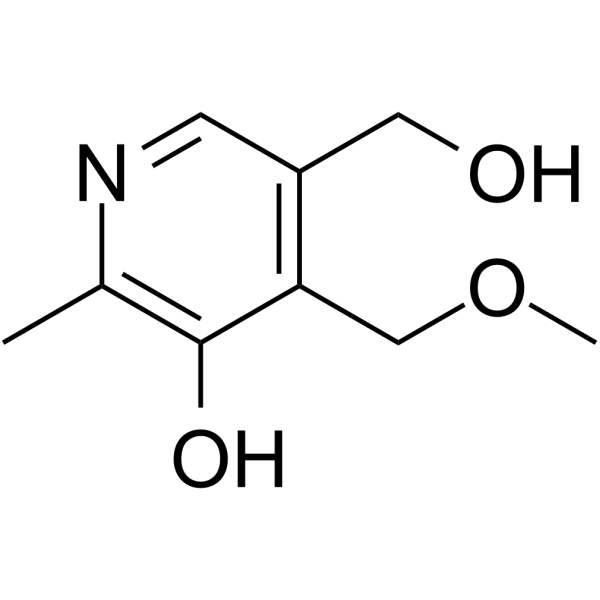
4'-O-Methylpyridoxine
Based on 1 publication(s) in Google Scholar
4'-O-Methylpyridoxine is an orally active antivitamin B6 compound found in Ginkgo biloba seeds and leaves. 4'-O-Methylpyridoxine inhibits pyridoxal kinase. 4'-O-Methylpyridoxine reduces brain pyridoxal-5'-phosphate (PLP) levels, decreases gamma-aminobutyric acid/glutamate (GABA/Glu) ratio. 4'-O-Methylpyridoxine increases plasma levels of pyridoxal-5'-phosphate and pyridoxal. 4'-O-Methylpyridoxine induces hyperactivity, convulsions, pathological tissue changes, organ damage in rodent brain and heart.
For research use only. We do not sell to patients.
- Purity : 99.92%
- CAS No.: 1464-33-1
- Formula: C9H13NO3
- Molecular Weight:183.20
-
Storage:Powder -20°C, 3 years , 4°C, 2 years ; In solvent -80°C, 6 months , -20°C, 1 month

To place orders, for customer services and technical support, please contact: MedChemExpress USA
Tel: 609-228-6898 E-mail: [email protected] [email protected]


-
 Biological Activity
-
Chemical Information
-
Solvent & Solubility
- Purity & Documentation
- References
-
 Help & FAQs


Publications Citing Use of MedChemExpress (MCE) 4'-O-Methylpyridoxine
More

Biological Activity
Description
In Vitro
4'-O-Methylpyridoxine inhibits pyridoxal kinase[1].
MedChemExpress (MCE) has not independently confirmed the accuracy of these methods. They are for reference only.
In Vivo
4'-O-Methylpyridoxine (10-50 mg/kg; i.g.; daily; 15 days) causes pathological changes in the brain and heart tissues of rats[2].
MedChemExpress (MCE) has not independently confirmed the accuracy of these methods. They are for reference only.
-
Animal Model:ddY mice (male, 4-5-week-old, mean body weight 29.2 ± 3.1 g, intrathecal administration-induced neurological dysfunction)[1]
-
Dosage:5 nmol; 10 nmol; 20 nmol; 40 nmol; 80 nmol; 0.39 mg/kg (lowest seizure-inducing dose/body weight ratio)
-
Administration:i.c.v.; single dose
-
Result:Induced 0% seizure incidence at 5 nmol, 10 nmol and 20 nmol, 11% at 40 nmol, 20% at 80 nmol.
Showed lowest seizure-inducing dose/body weight ratio of 0.39 mg/kg (1.79 nmol/kg).
Caused significantly lower brain PLP concentration, brain total vitamin B6 (PLP+PL) concentration, and brain GABA/Glu ratio in hyperactive mice compared to control mice.
-
Animal Model:Sprague Dawley (SD) (male, 8-week-old, 210 ± 10 g)[2]
-
Dosage:10 mg/kg; 30 mg/kg; 50 mg/kg
-
Administration:i.g.; daily; 15 days
-
Result:Showed no significant effect on body weight, food/water intake, or organ coefficients.
Caused pathological changes in brain (apoptotic hippocampal pyramidal cells with nuclear pyknosis) and heart (mild vacuolar degeneration of left ventricular myocardial cells, mild interstitial vascular congestion) tissues at 50 mg/kg.
Significantly increased plasma levels of pyridoxal-5'-phosphate (PLP), pyridoxal (PL), total vitamin B6 (TVB6), and pyridoxine (PN) at 10 mg/kg and 30 mg/kg; significantly increased plasma pyridoxamine (PM) levels at 10 mg/kg; showed no significant difference in plasma PLP, PL, and TVB6 levels from controls at 50 mg/kg, while significantly elevated PN levels at all doses.
Significantly increased plasma protein, free fatty acid, creatinine, aspartate aminotransferase (AST), and creatine kinase (CK) levels; decreased plasma triglyceride and uric acid levels at all doses.
Significantly increased plasma alanine aminotransferase (ALT) and lactate dehydrogenase (LDH) levels at 30 mg/kg and 50 mg/kg; significantly decreased plasma hemoglobin levels and increased plasma cholesterol levels at 50 mg/kg.
Significantly increased plasma malondialdehyde (MDA) and glutathione peroxidase (GSH-Px) levels, and decreased total antioxidant capacity (T-AOC) and glutathione (GSH) levels at 50 mg/kg; significantly decreased plasma GSH levels at 30 mg/kg; showed no significant changes in superoxide dismutase (SOD) levels at any dose.


Chemical Information
-
CAS No. 1464-33-1
-
Appearance Solid
-
Molecular Weight 183.20
-
Formula C9H13NO3
-
Color White to yellow
-
SMILES
OCC1=C(COC)C(O)=C(C)N=C1
-
Structure Classification
-
Initial Source
-
Shipping
Room temperature in continental US; may vary elsewhere.
-
Storage
Powder -20°C 3 years 4°C 2 years In solvent -80°C 6 months -20°C 1 month


Publications (1)
-
Journal Impact Factor
-
Most Recent
-
Dev Cell
2025 Nov 27:S1534-5807(25)00691-4. PMID: 41314217


Solvent & Solubility
In Vitro:
DMSO : 100 mg/mL (545.85 mM; Need ultrasonic; Hygroscopic DMSO has a significant impact on the solubility of product, please use newly opened DMSO)
Please refer to the solubility information to select the appropriate solvent. Once prepared, please aliquot and store the solution to prevent product inactivation from repeated freeze-thaw cycles.
Storage method and period of stock solution: -80°C, 6 months; -20°C, 1 month. When stored at -80°C, please use it within 6 months. When stored at -20°C, please use it within 1 month.
Please refer to the solubility information to select the appropriate solvent. Once prepared, please aliquot and store the solution to prevent product inactivation from repeated freeze-thaw cycles.
Storage method and period of stock solution: -80°C, 6 months; -20°C, 1 month. When stored at -80°C, please use it within 6 months. When stored at -20°C, please use it within 1 month.
Concentration (start) × Volume (start) = Concentration (final) × Volume (final)
In Vivo:
Select the appropriate dissolution method based on your experimental animal and administration route.
- For the following dissolution methods, please ensure to first prepare a clear stock solution using an In Vitro approach and then sequentially add co-solvents:
- To ensure reliable experimental results, the clarified stock solution can be appropriately stored based on storage conditions. As for the working solution for In Vivo experiments, it is recommended to prepare freshly and use it on the same day.
- The percentages shown for the solvents indicate their volumetric ratio in the final prepared solution. If precipitation or phase separation occurs during preparation, heat and/or sonication can be used to aid dissolution.
Add each solvent one by one: 10% DMSO 40% PEG300 5% Tween-80 45% Saline
Solubility: ≥ 2.5 mg/mL (13.65 mM); Clear solution
This protocol yields a clear solution of ≥ 2.5 mg/mL (saturation unknown).
Taking 1 mL working solution as an example, add 100 μL DMSO stock solution (25.0 mg/mL) to 400 μL PEG300, and mix evenly; then add 50 μL Tween-80 and mix evenly; then add 450 μL Saline to adjust the volume to 1 mL.
Preparation of Saline: Dissolve 0.9 g sodium chloride in ddH₂O and dilute to 100 mL to obtain a clear Saline solution.
Add each solvent one by one: 10% DMSO 90% (20% SBE-β-CD in Saline)
Solubility: ≥ 2.5 mg/mL (13.65 mM); Clear solution
This protocol yields a clear solution of ≥ 2.5 mg/mL (saturation unknown).
Taking 1 mL working solution as an example, add 100 μL DMSO stock solution (25.0 mg/mL) to 900 μL 20% SBE-β-CD in Saline, and mix evenly.
Preparation of 20% SBE-β-CD in Saline (4°C, storage for one week): 2 g SBE-β-CD powder is dissolved in 10 mL Saline, completely dissolve until clear.
In Vivo Dissolution Calculator
Please enter the basic information of animal experiments:
-
-
-
-
Recommended: Prepare an additional quantity of animals to account for potential losses during experiments.
Please enter your animal formula composition:
-
%DMSO +
Recommended: Keep the proportion of DMSO in working solution below 2% if your animal is weak.
-
%+
-
+%Tween-80 + +
-
%Saline +
The co-solvents required include: DMSO, . All of co-solvents are available by MedChemExpress (MCE). , Tween 80. All of co-solvents are available by MedChemExpress (MCE).
Working solution concentration: 0.22 mg/mL
Method for preparing stock solution: mg drug dissolved in μL DMSO. Stock solution concentration: mg/mL.
1. Take μL DMSO stock solution;
2. Add μL .
μL , mix evenly;
3. Then add μL Tween 80, mix evenly;
4. Then add μL
Please ensure that the stock solution in the first step is dissolved to a clear state, and add co-solvents in sequence. You can use ultrasonic heating (ultrasonic cleaner, recommended frequency 20-40 kHz), vortexing, etc. to assist dissolution.


Purity & Documentation
-
Data Sheet (280 KB)
-
SDS (393 KB)
- English - EN (393 KB)
- Français - FR (393 KB)
- Deutsch - DE (393 KB)
- Norwegian - NO (393 KB)
- Español - ES (393 KB)
- Swedish - SV (393 KB)
- Italian - IT (393 KB)
- Korean - KR (393 KB)
- Portuguese - PT (393 KB)
-
Handling Instructions (2659 KB)
References


Complete Stock Solution Preparation Table
Please refer to the solubility information to select the appropriate solvent. Once prepared, please aliquot and store the solution to prevent product inactivation from repeated freeze-thaw cycles.
Storage method and period of stock solution: -80°C, 6 months; -20°C, 1 month. When stored at -80°C, please use it within 6 months. When stored at -20°C, please use it within 1 month.
| Optional Solvent | Concentration Solvent Mass | 1 mg | 5 mg | 10 mg | 25 mg |
|---|---|---|---|---|---|
| DMSO | 1 mM | 5.4585 mL | 27.2926 mL | 54.5852 mL | 136.4629 mL |
| 5 mM | 1.0917 mL | 5.4585 mL | 10.9170 mL | 27.2926 mL | |
| 10 mM | 0.5459 mL | 2.7293 mL | 5.4585 mL | 13.6463 mL | |
| 15 mM | 0.3639 mL | 1.8195 mL | 3.6390 mL | 9.0975 mL | |
| 20 mM | 0.2729 mL | 1.3646 mL | 2.7293 mL | 6.8231 mL | |
| 25 mM | 0.2183 mL | 1.0917 mL | 2.1834 mL | 5.4585 mL | |
| 30 mM | 0.1820 mL | 0.9098 mL | 1.8195 mL | 4.5488 mL | |
| 40 mM | 0.1365 mL | 0.6823 mL | 1.3646 mL | 3.4116 mL | |
| 50 mM | 0.1092 mL | 0.5459 mL | 1.0917 mL | 2.7293 mL | |
| 60 mM | 0.0910 mL | 0.4549 mL | 0.9098 mL | 2.2744 mL | |
| 80 mM | 0.0682 mL | 0.3412 mL | 0.6823 mL | 1.7058 mL | |
| 100 mM | 0.0546 mL | 0.2729 mL | 0.5459 mL | 1.3646 mL |


4'-O-Methylpyridoxine Related Classifications
HY-N8157 Related Classifications
 Powered by Bioz