



5β-Dihydrocortisol (Standard)
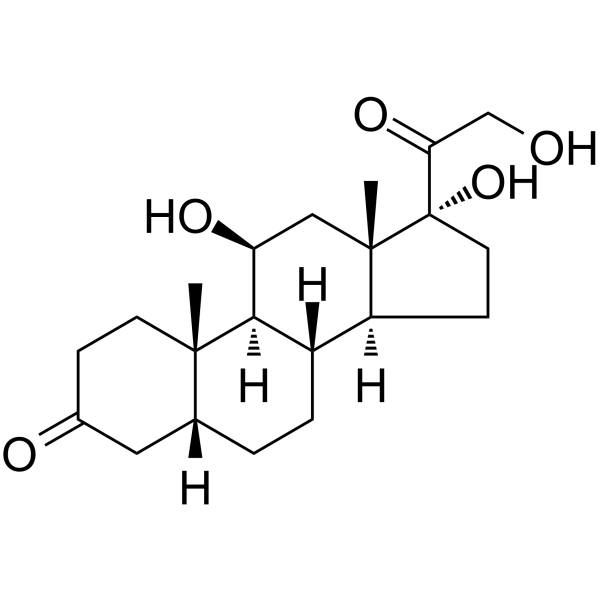
5β-Dihydrocortisol (Standard) is the analytical standard of 5β-Dihydrocortisol (HY-N3995). This product is intended for research and analytical applications. 5β-Dihydrocortisol, a metabolite of Cortisol, is a potential mineralocorticoid. 5β-Dihydrocortisol can potentiate glucocorticoid activity in raising the intraocular pressure. 5β-Dihydrocortisol causes breast cancer cell apoptosis.
연구목적의 판매만을 진행합니다. 환자를 대상으로 한 판매는 하지 않습니다.
- CAS No.: 1482-50-4
- 화학식: C21H32O5
- 분자량:364.48
-
보관:
Please store the product under the recommended conditions in the Certificate of Analysis.


To place orders, for customer services and technical support, please contact: MedChemExpress USA
Tel: 609-228-6898 E-mail: [email protected] [email protected]


-
 Product Information
-
Chemical Information
- 순도&문서
-
 Help & FAQs




Product Information
Information
신청
The compound is the grade of analytical standard, which is the reference standard supplied assay. It is commonly used in qualitative, quantitative and methodological research experiments in HPLC, GC and MS.


Chemical Information
-
CAS No. 1482-50-4
-
분자량 364.48
-
화학식 C21H32O5
-
SMILES
C[C@@]1([C@@]2(O)C(CO)=O)[C@](CC2)([H])[C@@](CC[C@@](C3)([H])[C@@]4(CCC3=O)C)([H])[C@]4([H])[C@@H](O)C1
-
Structure Classification
-
Initial Source
-
선적
Room temperature in continental US; may vary elsewhere.
-
보관
Please store the product under the recommended conditions in the Certificate of Analysis.


순도&문서
References
[1]. Marver D, et, al. Dihydrocortisol: a potential mineralocorticoid. J Steroid Biochem. 1978 Jan;9(1):1-7. [Content Brief]
[2]. Kallubai M, et, al. Spectroscopic evaluation of synthesized 5β-dihydrocortisol and 5β-dihydrocortisol acetate binding mechanism with human serum albumin and their role in anticancer activity. J Biomol Struct Dyn. 2019 Feb;37(3):623-640. [Content Brief]
[3]. Southren AL, et, al. 5 beta-Dihydrocortisol: possible mediator of the ocular hypertension in glaucoma. Invest Ophthalmol Vis Sci. 1985 Mar;26(3):393-5. [Content Brief]
[4]. Appanna N, et, al. Differential activity and expression of human 5β-reductase (AKR1D1) splice variants. J Mol Endocrinol. 2021 Mar;66(3):181-194. [Content Brief]
[5]. Weinstein BI, et, al. Potentiation of glucocorticoid activity by 5 beta-dihydrocortisol: its role in glaucoma. Science. 1983 Oct 14;222(4620):172-3. [Content Brief]

Calculators
Concentration (start) × Volume (start) = Concentration (final) × Volume (final)


5β-Dihydrocortisol (Standard) Related Classifications
HY-N3995R Related Classifications
 Powered by Bioz