



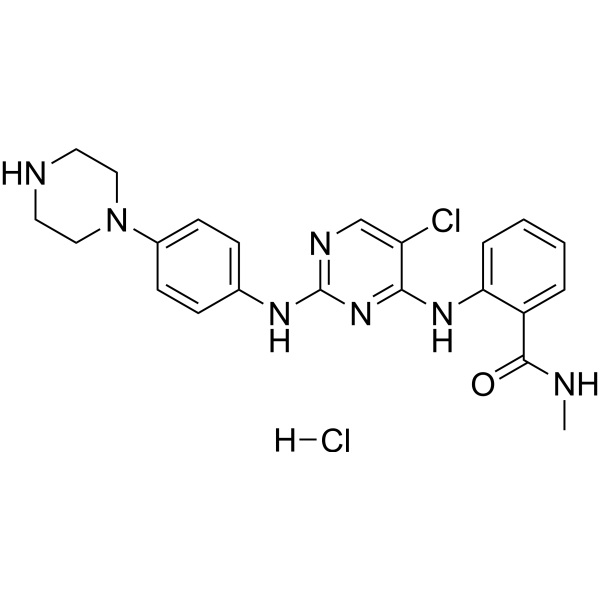
CTX-0294885 hydrochloride
Based on 3 publication(s) in Google Scholar
CTX-0294885 hydrochloride is a broad spectrum kinase inhibitor that can capture 235 kinases from MDA-MB-231 cells, and can capture all members of the AKT family. CTX-0294885 hydrochloride is a powerful reagent for analysis of kinome signaling networks that can be used for the research of diseases like inflammation, diabetes, and cancer.
For research use only. We do not sell to patients.
- Purity : 99.73%
- CAS No.: 2319590-02-6
- Formula: C22H25Cl2N7O
- Molecular Weight:474.39
-
Storage:
4°C, sealed storage, away from moisture
* In solvent : -80°C, 6 months; -20°C, 1 month (sealed storage, away from moisture)

To place orders, for customer services and technical support, please contact: MedChemExpress USA
Tel: 609-228-6898 E-mail: [email protected] [email protected]


-
 Biological Activity
-
Chemical Information
-
Solvent & Solubility
- Protocol
- Purity & Documentation
- References
-
 Help & FAQs


Publications Citing Use of MedChemExpress (MCE) CTX-0294885 hydrochloride
More

Biological Activity
Description
In Vitro
CTX-0294885 hydrochloride is a kinase capture tool in large-scale kinome profiling experiments, with 185 kinases identified as total protein, and 179 identified from TiO2 enrichment for phosphopeptides in MDA-MB-231 cells (by quantitative MS)[1].
CTX-0294885 hydrochloridecaptures all members of the AKT family that's not identified from previous studies using other kinase capture reagents[1].
MedChemExpress (MCE) has not independently confirmed the accuracy of these methods. They are for reference only.


Chemical Information
-
CAS No. 2319590-02-6
-
Appearance Solid
-
Molecular Weight 474.39
-
Formula C22H25Cl2N7O
-
Color Light yellow to yellow
-
SMILES
[H]Cl.O=C(NC)C1=CC=CC=C1NC2=NC(NC3=CC=C(N4CCNCC4)C=C3)=NC=C2Cl
-
Shipping
Room temperature in continental US; may vary elsewhere.
-
Storage
4°C, sealed storage, away from moisture
* In solvent : -80°C, 6 months; -20°C, 1 month (sealed storage, away from moisture)


Publications (3)
-
Journal Impact Factor
-
Most Recent
-
Int J Mol Sci
2021 Mar 17;22(6):3063. PMID: 33802742 -
Bioorg Chem
Identification of FTY720 and COH29 as novel topoisomerase I catalytic inhibitors by experimental and computational studies. [Abstract]2024 Jun:147:107412. PMID: 38696845 -
ChemMedChem
Potent Pyrimidine and Pyrrolopyrimidine Inhibitors of Testis-Specific Serine/Threonine Kinase 2 (TSSK2). [Abstract]2017 Nov 22;12(22):1857-1865. PMID: 28952188


Solvent & Solubility
In Vitro:
H2O : 55 mg/mL (115.94 mM; Need ultrasonic)
DMSO : 9.17 mg/mL (19.33 mM; Need ultrasonic; Hygroscopic DMSO has a significant impact on the solubility of product, please use newly opened DMSO)
Please refer to the solubility information to select the appropriate solvent. Once prepared, please aliquot and store the solution to prevent product inactivation from repeated freeze-thaw cycles.
Storage method and period of stock solution: -80°C, 6 months; -20°C, 1 month (sealed storage, away from moisture). When stored at -80°C, please use it within 6 months. When stored at -20°C, please use it within 1 month.
* Note: If you choose water as the stock solution, please dilute it to the working solution, then filter and sterilize it with a 0.22 μm filter before use.
Please refer to the solubility information to select the appropriate solvent. Once prepared, please aliquot and store the solution to prevent product inactivation from repeated freeze-thaw cycles.
Storage method and period of stock solution: -80°C, 6 months; -20°C, 1 month (sealed storage, away from moisture). When stored at -80°C, please use it within 6 months. When stored at -20°C, please use it within 1 month.
* Note: If you choose water as the stock solution, please dilute it to the working solution, then filter and sterilize it with a 0.22 μm filter before use.
Concentration (start) × Volume (start) = Concentration (final) × Volume (final)
In Vivo:
Select the appropriate dissolution method based on your experimental animal and administration route.
- For the following dissolution methods, please ensure to first prepare a clear stock solution using an In Vitro approach and then sequentially add co-solvents:
- To ensure reliable experimental results, the clarified stock solution can be appropriately stored based on storage conditions. As for the working solution for In Vivo experiments, it is recommended to prepare freshly and use it on the same day.
- The percentages shown for the solvents indicate their volumetric ratio in the final prepared solution. If precipitation or phase separation occurs during preparation, heat and/or sonication can be used to aid dissolution.
Add each solvent one by one: 10% DMSO 40% PEG300 5% Tween-80 45% Saline
Solubility: ≥ 0.92 mg/mL (1.94 mM); Clear solution
This protocol yields a clear solution of ≥ 0.92 mg/mL (saturation unknown).
Taking 1 mL working solution as an example, add 100 μL DMSO stock solution (9.2 mg/mL) to 400 μL PEG300, and mix evenly; then add 50 μL Tween-80 and mix evenly; then add 450 μL Saline to adjust the volume to 1 mL.
Preparation of Saline: Dissolve 0.9 g sodium chloride in ddH₂O and dilute to 100 mL to obtain a clear Saline solution.
Add each solvent one by one: 10% DMSO 90% (20% SBE-β-CD in Saline)
Solubility: ≥ 0.92 mg/mL (1.94 mM); Clear solution
This protocol yields a clear solution of ≥ 0.92 mg/mL (saturation unknown).
Taking 1 mL working solution as an example, add 100 μL DMSO stock solution (9.2 mg/mL) to 900 μL 20% SBE-β-CD in Saline, and mix evenly.
Preparation of 20% SBE-β-CD in Saline (4°C, storage for one week): 2 g SBE-β-CD powder is dissolved in 10 mL Saline, completely dissolve until clear.
For the following dissolution methods, please prepare the working solution directly:
It is recommended to prepare fresh solutions and use them promptly within a short period of time.
The percentages shown for the solvents indicate their volumetric ratio in the final prepared solution. If precipitation or phase separation occurs during preparation, heat and/or sonication can be used to aid dissolution.
Add each solvent one by one: PBS
Solubility: 50 mg/mL (105.40 mM); Clear solution; Need ultrasonic
In Vivo Dissolution Calculator
Please enter the basic information of animal experiments:
-
-
-
-
Recommended: Prepare an additional quantity of animals to account for potential losses during experiments.
Working solution concentration: 0.22 mg/mL
This product has good water solubility, please refer to the measured solubility data in water/PBS/Saline for details.

Protocol
Kinase Assay[1]
Reactions contains assay buffer, a Nterminally biotinylated peptide substrate, and ATP at a concentration equaling the KM of the kinase. The compounds (CTX-0294885) are added in a volume of 100 nL from an 11-point-dilution series prepared in DMSO, positive and negative control reactions receiving the same volume of DMSO without compound. The kinases are added at redetermined concentrations, generally ranging between 0.2 nd 8 nM, with the enzyme being omitted from negative ontrol reactions. The reactions are incubated for 90 min at 0 °C and stopped by adding 5 μL of Stop buffer containing streptavidin-coated donor and antiphosphotyrosine acceptor beads. Plates are incubated for 4-6 h before being read on a plate reader[1].
MedChemExpress (MCE) has not independently confirmed the accuracy of these methods. They are for reference only.


Purity & Documentation
-
Data Sheet (274 KB)
-
SDS (252 KB)
- English - EN (252 KB)
- Français - FR (252 KB)
- Deutsch - DE (252 KB)
- Norwegian - NO (252 KB)
- Español - ES (252 KB)
- Swedish - SV (252 KB)
- Italian - IT (252 KB)
- Korean - KR (252 KB)
- Portuguese - PT (252 KB)
-
Handling Instructions (2659 KB)
References


Complete Stock Solution Preparation Table
Please refer to the solubility information to select the appropriate solvent. Once prepared, please aliquot and store the solution to prevent product inactivation from repeated freeze-thaw cycles.
Storage method and period of stock solution: -80°C, 6 months; -20°C, 1 month (sealed storage, away from moisture). When stored at -80°C, please use it within 6 months. When stored at -20°C, please use it within 1 month.
| Optional Solvent | Concentration Solvent Mass | 1 mg | 5 mg | 10 mg | 25 mg |
|---|---|---|---|---|---|
| DMSO / H2O | 1 mM | 2.1080 mL | 10.5399 mL | 21.0797 mL | 52.6993 mL |
| 5 mM | 0.4216 mL | 2.1080 mL | 4.2159 mL | 10.5399 mL | |
| 10 mM | 0.2108 mL | 1.0540 mL | 2.1080 mL | 5.2699 mL | |
| 15 mM | 0.1405 mL | 0.7027 mL | 1.4053 mL | 3.5133 mL | |
| H2O | 20 mM | 0.1054 mL | 0.5270 mL | 1.0540 mL | 2.6350 mL |
| 25 mM | 0.0843 mL | 0.4216 mL | 0.8432 mL | 2.1080 mL | |
| 30 mM | 0.0703 mL | 0.3513 mL | 0.7027 mL | 1.7566 mL | |
| 40 mM | 0.0527 mL | 0.2635 mL | 0.5270 mL | 1.3175 mL | |
| 50 mM | 0.0422 mL | 0.2108 mL | 0.4216 mL | 1.0540 mL | |
| 60 mM | 0.0351 mL | 0.1757 mL | 0.3513 mL | 0.8783 mL | |
| 80 mM | 0.0263 mL | 0.1317 mL | 0.2635 mL | 0.6587 mL | |
| 100 mM | 0.0211 mL | 0.1054 mL | 0.2108 mL | 0.5270 mL |
* Note: If you choose water as the stock solution, please dilute it to the working solution, then filter and sterilize it with a 0.22 μm filter before use.


CTX-0294885 hydrochloride Related Classifications
HY-15985A Related Classifications
 Powered by Bioz