



Gardiquimod diTFA
Based on 2 publication(s) in Google Scholar
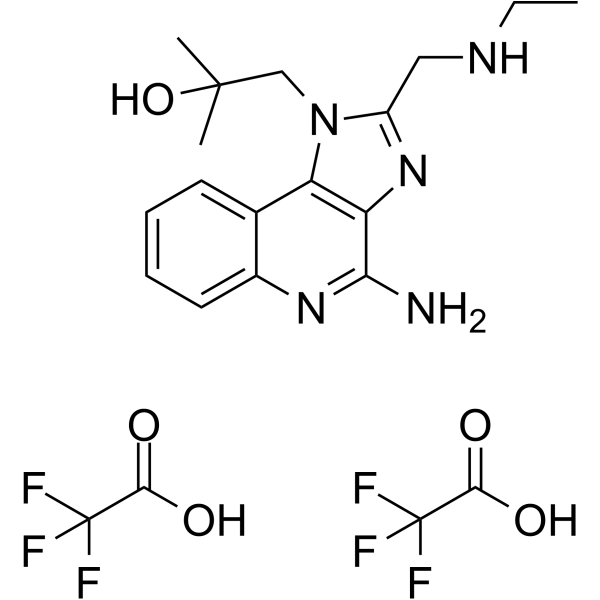
Gardiquimod diTFA is an imidazoline TLR7/8 agonist. Gardiquimod diTFA inhibits HIV-1 infection of macrophages and activated peripheral blood mononuclear cells (PBMCs). Gardiquimod diTFA specifically activates TLR7 at concentrations below 10 μM.
For research use only. We do not sell to patients.
- Purity : 99.0%
- CAS No.: 1159840-61-5
- Formula: C21H25F6N5O5
- Molecular Weight:541.44
-
Storage:
4°C, sealed storage, away from moisture
* In solvent : -80°C, 6 months; -20°C, 1 month (sealed storage, away from moisture)

To place orders, for customer services and technical support, please contact: MedChemExpress USA
Tel: 609-228-6898 E-mail: [email protected] [email protected]


-
 Biological Activity
-
Chemical Information
-
Solvent & Solubility
- Purity & Documentation
- References
-
 Help & FAQs


Publications Citing Use of MedChemExpress (MCE) Gardiquimod diTFA
More

Biological Activity
Description
IC50 & Target
[1]|
TLR7 |
TLR8 |
HIV-1 |
Cellular Effect
|
Cell Line

|
Type | Value | Description | References |
|---|---|---|---|---|
| HEK293 | IC50 |
0.65 μg/mL
Compound: 9
|
Agonist activity at TLR7 expressed in HEK293 cells assessed as increase in NF-kappaB activation by SEAP assay
Agonist activity at TLR7 expressed in HEK293 cells assessed as increase in NF-kappaB activation by SEAP assay
|
[PMID: 19285861] |
In Vitro
Gardiquimod diTFA (6-60 μM ) significantly inhibits cDNA synthesis by HIV-1 reverse transcriptase[1].
MedChemExpress (MCE) has not independently confirmed the accuracy of these methods. They are for reference only.
In Vivo
MedChemExpress (MCE) has not independently confirmed the accuracy of these methods. They are for reference only.
-
Animal Model:Male athymic nude mice (Balb-nu/nu, 5 weeks old) (bearing human HepG2 liver carcinoma xenografts)[2]
-
Dosage:1 mg/kg per mouse
-
Administration:i.p.; daily for 7 days
-
Result:Significantly suppressed the growth of human HepG2 liver carcinoma xenografts.


Chemical Information
-
CAS No. 1159840-61-5
-
Appearance Solid
-
Molecular Weight 541.44
-
Formula C21H25F6N5O5
-
Color White to off-white
-
SMILES
OC(C)(C)CN1C(CNCC)=NC2=C1C3=CC=CC=C3N=C2N.FC(C(O)=O)(F)F.FC(C(O)=O)(F)F
-
Shipping
Room temperature in continental US; may vary elsewhere.
-
Storage
4°C, sealed storage, away from moisture
* In solvent : -80°C, 6 months; -20°C, 1 month (sealed storage, away from moisture)


Publications (2)


Solvent & Solubility
In Vitro:
DMSO : 50 mg/mL (92.35 mM; Need ultrasonic; Hygroscopic DMSO has a significant impact on the solubility of product, please use newly opened DMSO)
H2O : 25 mg/mL (46.17 mM; Need ultrasonic)
Please refer to the solubility information to select the appropriate solvent. Once prepared, please aliquot and store the solution to prevent product inactivation from repeated freeze-thaw cycles.
Storage method and period of stock solution: -80°C, 6 months; -20°C, 1 month (sealed storage, away from moisture). When stored at -80°C, please use it within 6 months. When stored at -20°C, please use it within 1 month.
* Note: If you choose water as the stock solution, please dilute it to the working solution, then filter and sterilize it with a 0.22 μm filter before use.
Please refer to the solubility information to select the appropriate solvent. Once prepared, please aliquot and store the solution to prevent product inactivation from repeated freeze-thaw cycles.
Storage method and period of stock solution: -80°C, 6 months; -20°C, 1 month (sealed storage, away from moisture). When stored at -80°C, please use it within 6 months. When stored at -20°C, please use it within 1 month.
* Note: If you choose water as the stock solution, please dilute it to the working solution, then filter and sterilize it with a 0.22 μm filter before use.
Concentration (start) × Volume (start) = Concentration (final) × Volume (final)
In Vivo:
Select the appropriate dissolution method based on your experimental animal and administration route.
- For the following dissolution methods, please ensure to first prepare a clear stock solution using an In Vitro approach and then sequentially add co-solvents:
- To ensure reliable experimental results, the clarified stock solution can be appropriately stored based on storage conditions. As for the working solution for In Vivo experiments, it is recommended to prepare freshly and use it on the same day.
- The percentages shown for the solvents indicate their volumetric ratio in the final prepared solution. If precipitation or phase separation occurs during preparation, heat and/or sonication can be used to aid dissolution.
Add each solvent one by one: 10% DMSO 40% PEG300 5% Tween-80 45% Saline
Solubility: ≥ 2.5 mg/mL (4.62 mM); Clear solution
This protocol yields a clear solution of ≥ 2.5 mg/mL (saturation unknown).
Taking 1 mL working solution as an example, add 100 μL DMSO stock solution (25.0 mg/mL) to 400 μL PEG300, and mix evenly; then add 50 μL Tween-80 and mix evenly; then add 450 μL Saline to adjust the volume to 1 mL.
Preparation of Saline: Dissolve 0.9 g sodium chloride in ddH₂O and dilute to 100 mL to obtain a clear Saline solution.
Add each solvent one by one: 10% DMSO 90% (20% SBE-β-CD in Saline)
Solubility: ≥ 2.5 mg/mL (4.62 mM); Clear solution
This protocol yields a clear solution of ≥ 2.5 mg/mL (saturation unknown).
Taking 1 mL working solution as an example, add 100 μL DMSO stock solution (25.0 mg/mL) to 900 μL 20% SBE-β-CD in Saline, and mix evenly.
Preparation of 20% SBE-β-CD in Saline (4°C, storage for one week): 2 g SBE-β-CD powder is dissolved in 10 mL Saline, completely dissolve until clear.
For the following dissolution methods, please prepare the working solution directly:
It is recommended to prepare fresh solutions and use them promptly within a short period of time.
The percentages shown for the solvents indicate their volumetric ratio in the final prepared solution. If precipitation or phase separation occurs during preparation, heat and/or sonication can be used to aid dissolution.
Add each solvent one by one: PBS
Solubility: 50 mg/mL (92.35 mM); Clear solution; Need ultrasonic
In Vivo Dissolution Calculator
Please enter the basic information of animal experiments:
-
-
-
-
Recommended: Prepare an additional quantity of animals to account for potential losses during experiments.
Working solution concentration: 0.22 mg/mL
This product has good water solubility, please refer to the measured solubility data in water/PBS/Saline for details.


Purity & Documentation
-
Data Sheet (279 KB)
-
SDS (393 KB)
- English - EN (393 KB)
- Français - FR (393 KB)
- Deutsch - DE (393 KB)
- Norwegian - NO (393 KB)
- Español - ES (393 KB)
- Swedish - SV (393 KB)
- Italian - IT (393 KB)
- Korean - KR (393 KB)
- Portuguese - PT (393 KB)
-
Handling Instructions (2659 KB)
References
[1]. Buitendijk M, et al. Gardiquimod: a Toll-like receptor-7 agonist that inhibits HIV type 1 infection of human macrophages and activated T cells. AIDS Res Hum Retroviruses. 2013 Jun;29(6):907-18. [Content Brief]
[2]. Ma F, et al. The TLR7 agonists imiquimod and gardiquimod improve DC-based immunotherapy for melanoma in mice. Cell Mol Immunol. 2010 Sep;7(5):381-8. [Content Brief]
[3]. Zhou Z, et al. TLR7/8 agonists promote NK-DC cross-talk to enhance NK cell anti-tumor effects in hepatocellular carcinoma. Cancer Lett. 2015 Dec 28;369(2):298-306. [Content Brief]


Complete Stock Solution Preparation Table
Please refer to the solubility information to select the appropriate solvent. Once prepared, please aliquot and store the solution to prevent product inactivation from repeated freeze-thaw cycles.
Storage method and period of stock solution: -80°C, 6 months; -20°C, 1 month (sealed storage, away from moisture). When stored at -80°C, please use it within 6 months. When stored at -20°C, please use it within 1 month.
| Optional Solvent | Concentration Solvent Mass | 1 mg | 5 mg | 10 mg | 25 mg |
|---|---|---|---|---|---|
| H2O / DMSO | 1 mM | 1.8469 mL | 9.2346 mL | 18.4693 mL | 46.1732 mL |
| 5 mM | 0.3694 mL | 1.8469 mL | 3.6939 mL | 9.2346 mL | |
| 10 mM | 0.1847 mL | 0.9235 mL | 1.8469 mL | 4.6173 mL | |
| 15 mM | 0.1231 mL | 0.6156 mL | 1.2313 mL | 3.0782 mL | |
| 20 mM | 0.0923 mL | 0.4617 mL | 0.9235 mL | 2.3087 mL | |
| 25 mM | 0.0739 mL | 0.3694 mL | 0.7388 mL | 1.8469 mL | |
| 30 mM | 0.0616 mL | 0.3078 mL | 0.6156 mL | 1.5391 mL | |
| 40 mM | 0.0462 mL | 0.2309 mL | 0.4617 mL | 1.1543 mL | |
| DMSO | 50 mM | 0.0369 mL | 0.1847 mL | 0.3694 mL | 0.9235 mL |
| 60 mM | 0.0308 mL | 0.1539 mL | 0.3078 mL | 0.7696 mL | |
| 80 mM | 0.0231 mL | 0.1154 mL | 0.2309 mL | 0.5772 mL |
* Note: If you choose water as the stock solution, please dilute it to the working solution, then filter and sterilize it with a 0.22 μm filter before use.


Gardiquimod diTFA Related Classifications
HY-103697A Related Classifications
 Powered by Bioz