



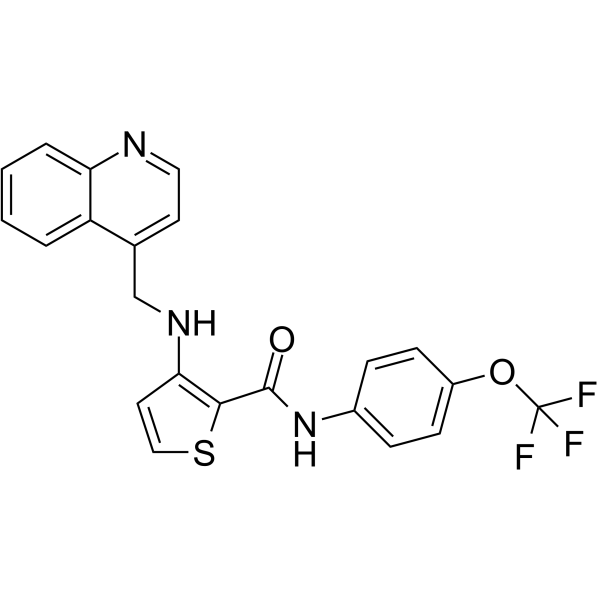
OSI-930
Based on 4 publication(s) in Google Scholar
OSI-930 is an orally selective inhibitor of Kit, KDR and CSF-1R (c-Fms) with IC50s of 80 nM, 9 nM and 15 nM, respectively. OSI-930 also moderately inhibits Flt-1, c-Raf, Lck and low activity against PDGFRα/β, Flt-3 and Abl. OSI-930 has antitumor activity.
Nur für Forschungszwecke. Wir verkaufen nicht an Patienten.
- Reinheit : 98.33%
- CAS. Nr.: 728033-96-3
- Formel: C22H16F3N3O2S
- Molecular Weight:443.44
-
Speicherung:Powder -20°C, 3 years , 4°C, 2 years ; In solvent -80°C, 2 years , -20°C, 1 year

To place orders, for customer services and technical support, please contact: MedChemExpress USA
Tel: 609-228-6898 E-mail: [email protected] [email protected]


-
 Biologische Aktivität
-
Chemical Information
-
Lösungsmittel & Löslichkeit
- Protokoll
- Reinheit & Dokumentation
- Verweise
-
 Help & FAQs


-
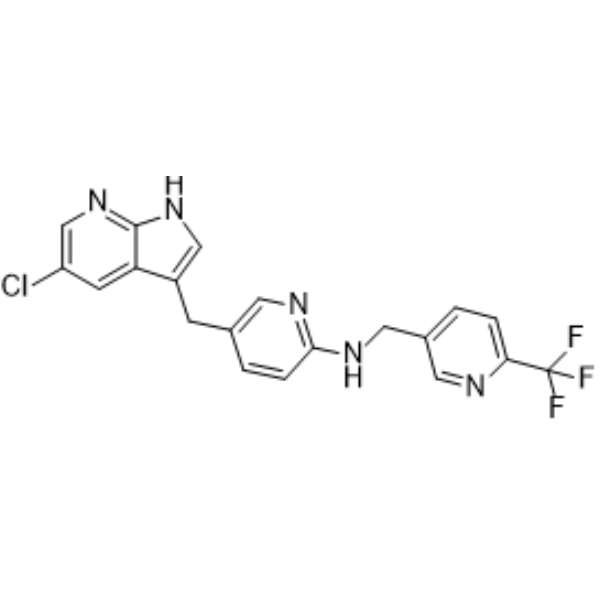
HY-16749
PexidartinibCSF1R/c-Kit Inhibitor -
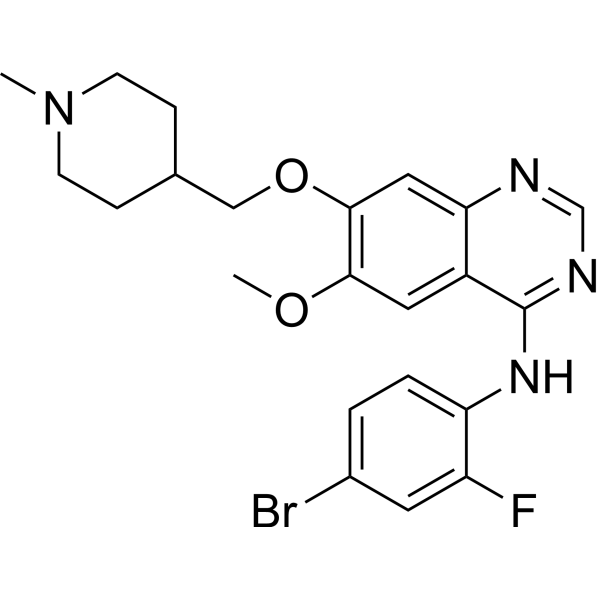
HY-10260
VandetanibVEGFR2/3 Inhibitor -
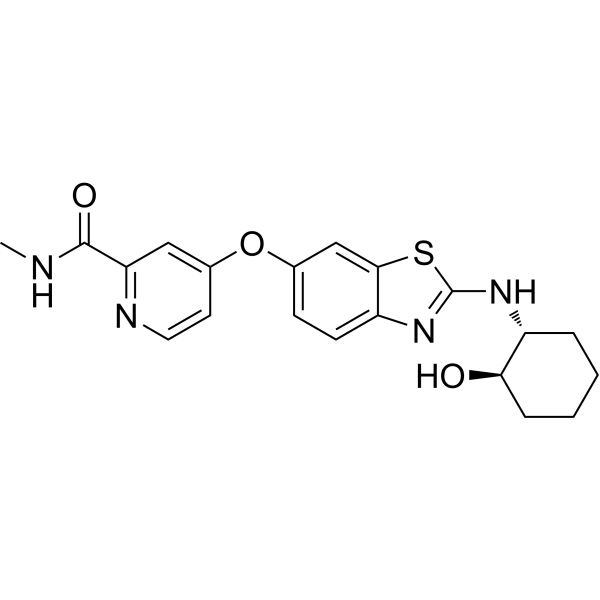
HY-12768
SotuletinibCSF-1R Inhibitor -
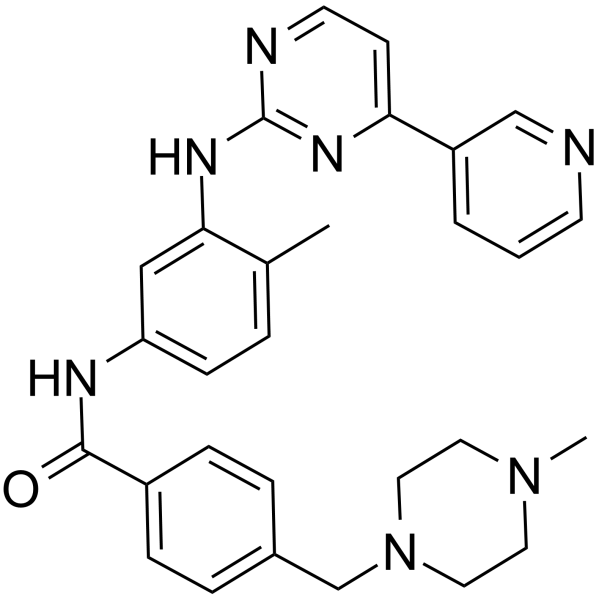
HY-15463
ImatinibTyrosine Kinases Inhibitor -

HY-10204R
OSI-930 (Standard)Reference Standard -
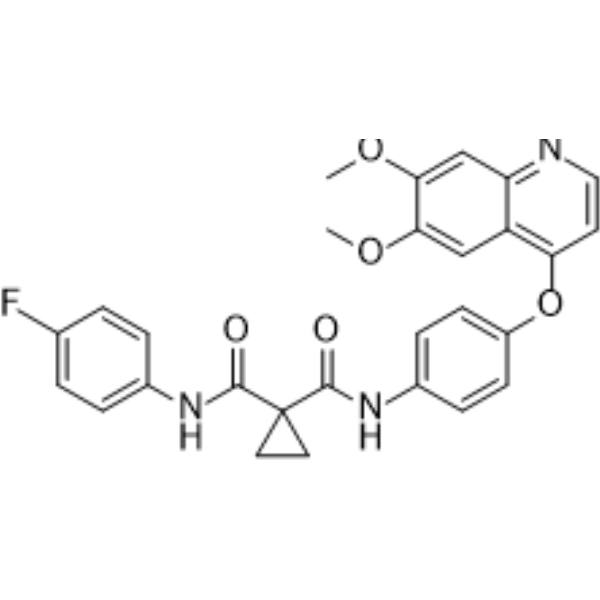
HY-13016
CabozantinibVEGFR2/MET Inhibitor -
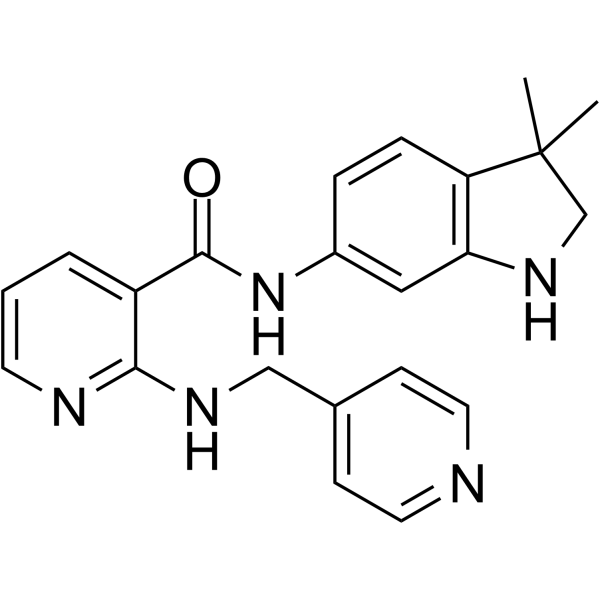
HY-10228
MotesanibVEGFR1/2/3 Inhibitor -
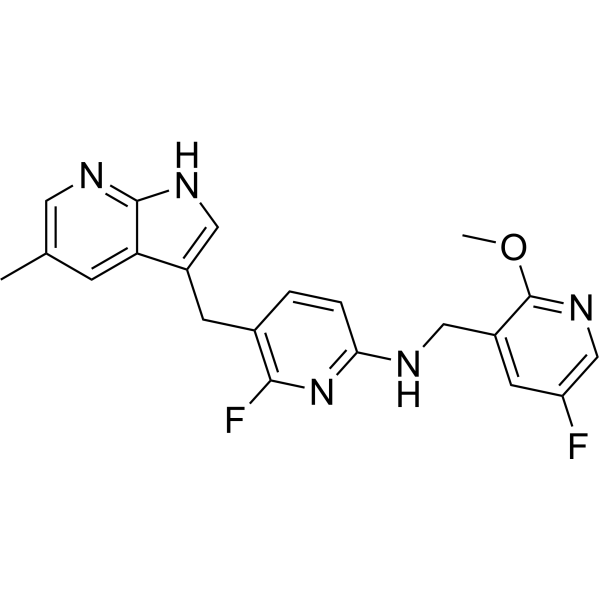
HY-114153C
PLX5622 in AIN-76A Diet (1200 ppm)PLX5622 Microglia Clearance Diet -
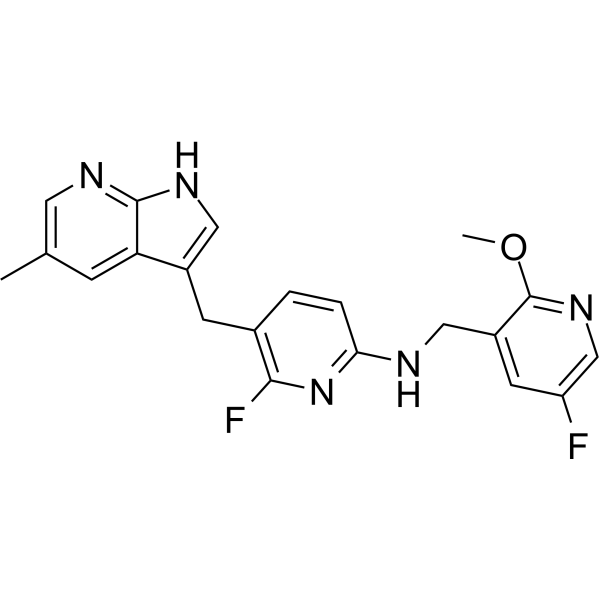
HY-114153
PLX5622CSF1R Inhibitor -

HY-15463R
Imatinib (Standard)Tyrosine Kinases Inhibitor -
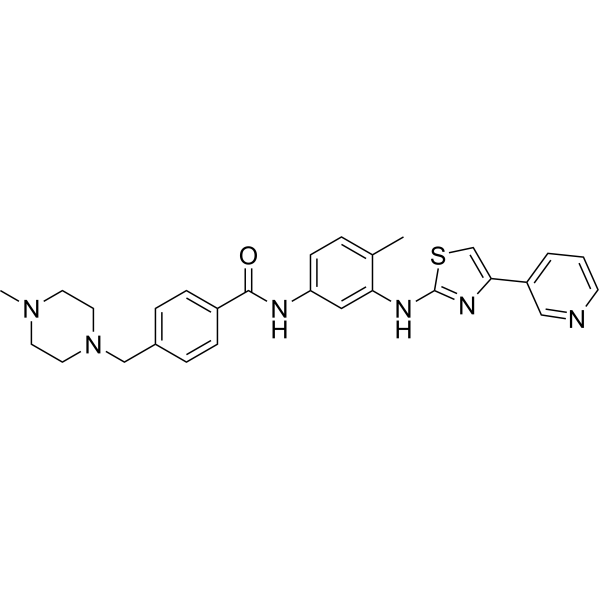
HY-10209
Masitinibc-Kit Inhibitor -
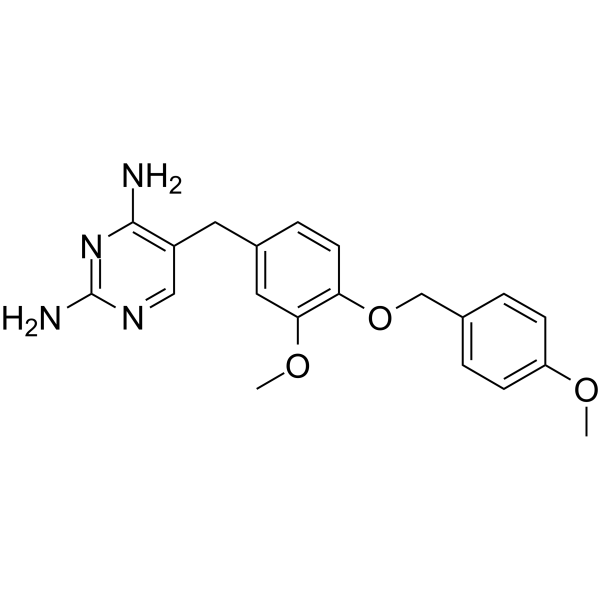
HY-10917
GW2580c-Fms Inhibitor
Publications Citing Use of MedChemExpress (MCE) OSI-930
MoreAlle VEGFR Isoform-spezifische Produkte anzeigen
More

Biologische Aktivität
Beschreibung
IC50 & Target
[1]|
KDR 9 nM (IC50) |
Flt-1 8 nM (IC50) |
Kit 80 nM (IC50) |
PDGFRβ 6900 nM (IC50) |
PDGFRα 3408 nM (IC50) |
CSF-1R 15 nM (IC50) |
c-Raf 41 nM (IC50) |
Flt-3 1303 nM (IC50) |
Lck 22 nM (IC50) |
Abl 4738 nM (IC50) |
In Vitro
OSI-930 inhibits cell proliferation in the HMC-1 cell line with IC50 of 14 nM but has no significant effect on the growth of COLO-205 cell line that does not express constitutively active mutant receptor tyrosine kinase[1]. OSI-930 induces apoptosis in HMC-1 cell line with an EC50 value of 34 nM[1]. OSI-930 inactivates purified, recombinant cytochrome P450 3A4 with a Ki of 24 μM in a time- and concentration-dependent manner[2]
MedChemExpress (MCE) has not independently confirmed the accuracy of these methods. They are for reference only.
In Vivo
MedChemExpress (MCE) has not independently confirmed the accuracy of these methods. They are for reference only.
-
Animal Model:Female nu/nu CD-1 mice bearing HMC-1, NCI-SNU-5, COLO-205 and U251 xenograft models[1]
-
Dosage:200 mg/kg
-
Administration:Oral gavage; once a day; 38 days
-
Result:Showed a significant level of inhibition of Kit, KDR and CSF-1R.
Clinical Trial
| NCT Number | Sponsor | Condition | Start Date |
Phase

|
|---|---|---|---|---|
| NCT01329991 | 2011-05 | PHASE1 |


Chemical Information
-
CAS. Nr. 728033-96-3
-
Appearance Solid
-
Molecular Weight 443.44
-
Formel C22H16F3N3O2S
-
Color Light yellow to yellow
-
SMILES
O=C(C1=C(NCC2=CC=NC3=CC=CC=C23)C=CS1)NC4=CC=C(OC(F)(F)F)C=C4
-
Versand
Room temperature in continental US; may vary elsewhere.
-
Speicherung
Powder -20°C 3 years 4°C 2 years In solvent -80°C 2 years -20°C 1 year


Publications (4)
-
Journal Impact Factor
-
Most Recent
-
Nat Biomed Eng
TLR7/8-agonist-loaded nanoparticles promote the polarization of tumour-associated macrophages to enhance cancer immunotherapy. [Abstract]2018 Aug;2(8):578-588. PMID: 31015631 -
Sci Transl Med
PP2A inhibition is a druggable MEK inhibitor resistance mechanism in KRAS-mutant lung cancer cells. [Abstract]2018 Jul 18;10(450):eaaq1093. PMID: 30021885 -
Commun Biol
2022 Jul 28;5(1):750. PMID: 35902736 -
Drug Metab Dispos
Physiologically based pharmacokinetic modeling of aldehyde oxidase drug-drug interactions mediated by erlotinib. [Abstract]2025 Jun 23;53(8):100113. PMID: 40683226


Lösungsmittel & Löslichkeit
In Vitro:
DMSO : 50 mg/mL (112.75 mM; Need ultrasonic; Hygroscopic DMSO has a significant impact on the solubility of product, please use newly opened DMSO)
Please refer to the solubility information to select the appropriate solvent. Once prepared, please aliquot and store the solution to prevent product inactivation from repeated freeze-thaw cycles.
Storage method and period of stock solution: -80°C, 2 years; -20°C, 1 year. When stored at -80°C, please use it within 2 years. When stored at -20°C, please use it within 1 year.
Please refer to the solubility information to select the appropriate solvent. Once prepared, please aliquot and store the solution to prevent product inactivation from repeated freeze-thaw cycles.
Storage method and period of stock solution: -80°C, 2 years; -20°C, 1 year. When stored at -80°C, please use it within 2 years. When stored at -20°C, please use it within 1 year.
Konzentration (Stammlösung) × Volumen (Stammlösung) = Konzentration (Ziellösung) × Volumen (Ziellösung)
In Vivo:
Select the appropriate dissolution method based on your experimental animal and administration route.
- For the following dissolution methods, please ensure to first prepare a clear stock solution using an In Vitro approach and then sequentially add co-solvents:
- To ensure reliable experimental results, the clarified stock solution can be appropriately stored based on storage conditions. As for the working solution for In Vivo experiments, it is recommended to prepare freshly and use it on the same day.
- The percentages shown for the solvents indicate their volumetric ratio in the final prepared solution. If precipitation or phase separation occurs during preparation, heat and/or sonication can be used to aid dissolution.
Add each solvent one by one: 10% DMSO 40% PEG300 5% Tween-80 45% Saline
Solubility: ≥ 2.5 mg/mL (5.64 mM); Clear solution
This protocol yields a clear solution of ≥ 2.5 mg/mL (saturation unknown).
Taking 1 mL working solution as an example, add 100 μL DMSO stock solution (25.0 mg/mL) to 400 μL PEG300, and mix evenly; then add 50 μL Tween-80 and mix evenly; then add 450 μL Saline to adjust the volume to 1 mL.
Preparation of Saline: Dissolve 0.9 g sodium chloride in ddH₂O and dilute to 100 mL to obtain a clear Saline solution.
In Vivo Dissolution Calculator
Please enter the basic information of animal experiments:
-
-
-
-
Recommended: Prepare an additional quantity of animals to account for potential losses during experiments.
Please enter your animal formula composition:
-
%DMSO +
Recommended: Keep the proportion of DMSO in working solution below 2% if your animal is weak.
-
%+
-
+%Tween-80 + +
-
%Saline +
The co-solvents required include: DMSO, . All of co-solvents are available by MedChemExpress (MCE). , Tween 80. All of co-solvents are available by MedChemExpress (MCE).
Working solution concentration: 0.22 mg/mL
Method for preparing stock solution: mg drug dissolved in μL DMSO. Stock solution concentration: mg/mL.
1. Take μL DMSO stock solution;
2. Add μL .
μL , mix evenly;
3. Then add μL Tween 80, mix evenly;
4. Then add μL
Please ensure that the stock solution in the first step is dissolved to a clear state, and add co-solvents in sequence. You can use ultrasonic heating (ultrasonic cleaner, recommended frequency 20-40 kHz), vortexing, etc. to assist dissolution.


Reinheit & Dokumentation
-
Data Sheet (276 KB)
-
SDS (393 KB)
- English - EN (393 KB)
- Français - FR (393 KB)
- Deutsch - DE (393 KB)
- Norwegian - NO (393 KB)
- Español - ES (393 KB)
- Swedish - SV (393 KB)
- Italian - IT (393 KB)
- Korean - KR (393 KB)
- Portuguese - PT (393 KB)
-
Handling Instructions (2659 KB)
Verweise
[1]. Garton AJ, et al. OSI-930: a novel selective inhibitor of Kit and kinase insert domain receptor tyrosine kinases with antitumor activity in mouse xenograft models. Cancer Res. 2006, 66(2):1015-1024. [Content Brief]
[2]. Lin HL, et al. Inactivation of cytochrome P450 (P450) 3A4 but not P450 3A5 by OSI-930, a thiophene-containing anticancer drug. Drug Metab Dispos. 2011, 39(2), 345-350. [Content Brief]


Complete Stock Solution Preparation Table
Please refer to the solubility information to select the appropriate solvent. Once prepared, please aliquot and store the solution to prevent product inactivation from repeated freeze-thaw cycles.
Storage method and period of stock solution: -80°C, 2 years; -20°C, 1 year. When stored at -80°C, please use it within 2 years. When stored at -20°C, please use it within 1 year.
| Optional Solvent | Concentration Solvent Mass | 1 mg | 5 mg | 10 mg | 25 mg |
|---|---|---|---|---|---|
| DMSO | 1 mM | 2.2551 mL | 11.2755 mL | 22.5510 mL | 56.3774 mL |
| 5 mM | 0.4510 mL | 2.2551 mL | 4.5102 mL | 11.2755 mL | |
| 10 mM | 0.2255 mL | 1.1275 mL | 2.2551 mL | 5.6377 mL | |
| 15 mM | 0.1503 mL | 0.7517 mL | 1.5034 mL | 3.7585 mL | |
| 20 mM | 0.1128 mL | 0.5638 mL | 1.1275 mL | 2.8189 mL | |
| 25 mM | 0.0902 mL | 0.4510 mL | 0.9020 mL | 2.2551 mL | |
| 30 mM | 0.0752 mL | 0.3758 mL | 0.7517 mL | 1.8792 mL | |
| 40 mM | 0.0564 mL | 0.2819 mL | 0.5638 mL | 1.4094 mL | |
| 50 mM | 0.0451 mL | 0.2255 mL | 0.4510 mL | 1.1275 mL | |
| 60 mM | 0.0376 mL | 0.1879 mL | 0.3758 mL | 0.9396 mL | |
| 80 mM | 0.0282 mL | 0.1409 mL | 0.2819 mL | 0.7047 mL | |
| 100 mM | 0.0226 mL | 0.1128 mL | 0.2255 mL | 0.5638 mL |


OSI-930 Related Classifications
HY-10204 Related Classifications
 Powered by Bioz