



PH-064
Based on 2 publication(s) in Google Scholar
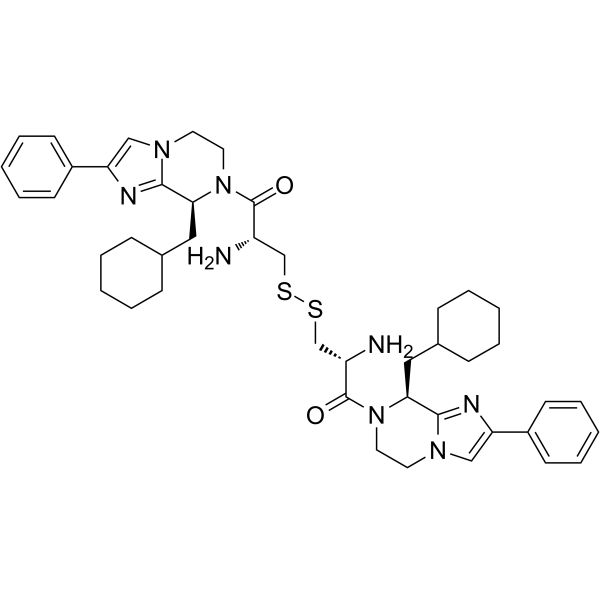
PH-064 (BIM-46187) is an orally active inhibitor of the heterotrimeric G-protein complex. PH-064 inhibits SERT activity and attenuates shear stress-induced Akt phosphorylation. PH-064 has potent anti-hyperalgesia activity. PH-064 inhibits G protein-coupled receptor-dependent tumorigenesis. PH-064 can be used in the study of pain (e.g., inflammatory pain, neuropathic pain), GPCR-dependent tumors, and inflammatory lung injury.
For research use only. We do not sell to patients.
- Purity : 98.78%
- CAS No.: 892546-37-1
- Formula: C44H58N8O2S2
- Molecular Weight:795.11
-
Storage:Powder -20°C, 3 years ; In solvent -80°C, 6 months , -20°C, 1 month

To place orders, for customer services and technical support, please contact: MedChemExpress USA
Tel: 609-228-6898 E-mail: [email protected] [email protected]


-
 Biological Activity
-
Chemical Information
-
Solvent & Solubility
- Protocols
- Purity & Documentation
- References
-
 Help & FAQs


Publications Citing Use of MedChemExpress (MCE) PH-064
More

Biological Activity
Description
Cellular Effect
|
Cell Line

|
Type | Value | Description | References |
|---|---|---|---|---|
| MP41 | IC50 |
10.2 μM
Compound: BIM-46187; 3
|
Antiproliferative activity against human MP41 cells assessed as reduction in cell viability measured after 72 hrs by CCK-8 method
Antiproliferative activity against human MP41 cells assessed as reduction in cell viability measured after 72 hrs by CCK-8 method
|
[PMID: 35716516] |
In Vitro
PH-064 (20 μM; 1 h) abrogates the flow-induced dissociation of Gαq/11 from PECAM-1 in HCAECs and attenuates shear stress-induced Akt phosphorylation[2].
PH-064 (10 μM-100 μM; 30 min) concentration-dependently inhibits SERT-mediated 5HT uptake in mouse midbrain and frontal cortex synaptosomes, and also inhibits SERT activity in TRex-SERT cells[3].
PH-064 (for basal IP: even at 10-4 M) has no inhibitory effect on basal IP production in E151A-CCK2R-transfected COS cells, but completely inhibits Gastrin-stimulated IP production (EC50: 34 μM)[5].
PH-064 (10 μM; 1 h) reduces IFNγ generation in RGS2 null BMDMs to the level of WT-BMDMs without affecting BMDM viability[6].
MedChemExpress (MCE) has not independently confirmed the accuracy of these methods. They are for reference only. Further protocols information, click here.
In Vivo
PH-064 (0.3-3 mg/kg; i.v.) shows dose-dependent anti-hyperalgesic effect in chronic constriction injury (CCI) model in rats[1].
PH-064 (75 mg/kg; p.o.; twice a day; 16 days) exhibits antitumor activity in athymic nude mouse xenografts with E151A-CCK2R-NIH-3T3 cells without apparent toxicity[5].
PH-064 (3 mg/kg; i.v.; 2 h after i.t. LPS) reduces IFNγ expression by 80% in RGS2 null mouse lungs and promotes resolution of lung edema[6].
MedChemExpress (MCE) has not independently confirmed the accuracy of these methods. They are for reference only.
-
Animal Model:Male Sprague Dawley rats (160-170 g on arrival, allowed to habituate for at least 5 days; Carrageenan-induced hyperalgesia model)[1]
-
Dosage:0.1 mg/kg, 1 mg/kg
-
Administration:Intravenous injection
-
Result:Significantly increased paw withdrawal thresholds (1 mg/kg: 10 g/40 at 0.5 h, 8.9 g/40 at 2.5 h).


Chemical Information
-
CAS No. 892546-37-1
-
Appearance Solid
-
Molecular Weight 795.11
-
Formula C44H58N8O2S2
-
Color White to light yellow
-
SMILES
O=C([C@H](CSSC[C@@H](C(N1CCN2C([C@@H]1CC3CCCCC3)=NC(C4=CC=CC=C4)=C2)=O)N)N)N([C@H]5CC6CCCCC6)CCN(C5=N7)C=C7C8=CC=CC=C8
-
Synonyms
BIM-46187
-
Shipping
Room temperature in continental US; may vary elsewhere.
-
Storage
Powder -20°C 3 years In solvent -80°C 6 months -20°C 1 month


Publications (2)
-
Journal Impact Factor
-
Most Recent
-
Phytomedicine
Sinapine targeting PLCβ3 EF hands disrupts Gαq-PLCβ3 interaction and ameliorates cardiovascular diseases. [Abstract]2024 Apr:126:155200. PMID: 38387273 -
Biochem Pharmacol
Interplay between G protein-biased and arrestin-biased pathways in 5-HT2AR-mediated ERK activation. [Abstract]2025 Sep:239:117015. PMID: 40473228


Solvent & Solubility
In Vitro:
DMSO : 100 mg/mL (125.77 mM; Need ultrasonic; Hygroscopic DMSO has a significant impact on the solubility of product, please use newly opened DMSO)
Please refer to the solubility information to select the appropriate solvent. Once prepared, please aliquot and store the solution to prevent product inactivation from repeated freeze-thaw cycles.
Storage method and period of stock solution: -80°C, 6 months; -20°C, 1 month. When stored at -80°C, please use it within 6 months. When stored at -20°C, please use it within 1 month.
Please refer to the solubility information to select the appropriate solvent. Once prepared, please aliquot and store the solution to prevent product inactivation from repeated freeze-thaw cycles.
Storage method and period of stock solution: -80°C, 6 months; -20°C, 1 month. When stored at -80°C, please use it within 6 months. When stored at -20°C, please use it within 1 month.
Concentration (start) × Volume (start) = Concentration (final) × Volume (final)
In Vivo:
Select the appropriate dissolution method based on your experimental animal and administration route.
- For the following dissolution methods, please ensure to first prepare a clear stock solution using an In Vitro approach and then sequentially add co-solvents:
- To ensure reliable experimental results, the clarified stock solution can be appropriately stored based on storage conditions. As for the working solution for In Vivo experiments, it is recommended to prepare freshly and use it on the same day.
- The percentages shown for the solvents indicate their volumetric ratio in the final prepared solution. If precipitation or phase separation occurs during preparation, heat and/or sonication can be used to aid dissolution.
Add each solvent one by one: 10% DMSO 40% PEG300 5% Tween-80 45% Saline
Solubility: ≥ 2.5 mg/mL (3.14 mM); Clear solution
This protocol yields a clear solution of ≥ 2.5 mg/mL (saturation unknown).
Taking 1 mL working solution as an example, add 100 μL DMSO stock solution (25.0 mg/mL) to 400 μL PEG300, and mix evenly; then add 50 μL Tween-80 and mix evenly; then add 450 μL Saline to adjust the volume to 1 mL.
Preparation of Saline: Dissolve 0.9 g sodium chloride in ddH₂O and dilute to 100 mL to obtain a clear Saline solution.
Add each solvent one by one: 10% DMSO 90% (20% SBE-β-CD in Saline)
Solubility: ≥ 2.5 mg/mL (3.14 mM); Clear solution
This protocol yields a clear solution of ≥ 2.5 mg/mL (saturation unknown).
Taking 1 mL working solution as an example, add 100 μL DMSO stock solution (25.0 mg/mL) to 900 μL 20% SBE-β-CD in Saline, and mix evenly.
Preparation of 20% SBE-β-CD in Saline (4°C, storage for one week): 2 g SBE-β-CD powder is dissolved in 10 mL Saline, completely dissolve until clear.
In Vivo Dissolution Calculator
Please enter the basic information of animal experiments:
-
-
-
-
Recommended: Prepare an additional quantity of animals to account for potential losses during experiments.
Please enter your animal formula composition:
-
%DMSO +
Recommended: Keep the proportion of DMSO in working solution below 2% if your animal is weak.
-
%+
-
+%Tween-80 + +
-
%Saline +
The co-solvents required include: DMSO, . All of co-solvents are available by MedChemExpress (MCE). , Tween 80. All of co-solvents are available by MedChemExpress (MCE).
Working solution concentration: 0.22 mg/mL
Method for preparing stock solution: mg drug dissolved in μL DMSO. Stock solution concentration: mg/mL.
1. Take μL DMSO stock solution;
2. Add μL .
μL , mix evenly;
3. Then add μL Tween 80, mix evenly;
4. Then add μL
Please ensure that the stock solution in the first step is dissolved to a clear state, and add co-solvents in sequence. You can use ultrasonic heating (ultrasonic cleaner, recommended frequency 20-40 kHz), vortexing, etc. to assist dissolution.

Protocols
-
Kinase activity and phosphorylation assays
Kinase activity assays measure the ability of kinases to transfer phosphate groups from ATP to specific substrates, while phosphorylation assays detect the presence and levels of phosphorylated proteins. Common methods include radiolabeled ATP incorporation (e. g. ,), ADP release detection via bioluminescence (e. g. ,[3]), enzyme-linked immunosorbent assays (ELISA) for phospho-specific epitopes (e. g. ,[6]), and microtiter-based formats for high-throughput screening (e. g. ,[8]). The ADP-Glo assay quantifies kinase activity by measuring ADP produced during phosphorylation using a luciferase-based system. Radiometric assays involve autoradiography or scintillation counting after incorporation of 32P-labeled ATP into substrate proteins. ELISA-based approaches rely on phospho-specific antibodies to detect activated kinases in cell lysates or purified samples.
-
Western Blot
Western blotting (WB) is a commonly used experimental method in molecular biology, biochemistry, and immunogenetics for identifying and quantifying target proteins. It combines gel electrophoresis with immunoassay, enabling researchers to analyze protein expression, post-translational modifications, and molecular weight.
-
Immunoprecipitation
Immunoprecipitation (IP) is an experimental method that uses the principle of antibody specific binding to purify and enrich target proteins.
-
Formalin-Induced Paw Inflammation/Nociceptive Inflammation
The formalin-induced paw inflammation/nociceptive test is a chemical persistent pain model in rodents in which subcutaneous injection of formalin into the hind paw produces spontaneous nocifensive behaviors such as flinching and licking. The response is classically biphasic, consisting of an early acute phase (Phase I) reflecting direct activation of peripheral nociceptors (particularly C-fiber afferents), followed by a later prolonged phase (Phase II) associated with central sensitization in the spinal dorsal horn driven by sustained afferent input and inflammatory signaling. This model is widely used to evaluate analgesic and anti-inflammatory interventions because it captures both peripheral nociception and central sensitization processes within a single assay system.
-
Protocol for Kinase activity and phosphorylation assays
Kinase activity assays measure transfer of phosphate from ATP to a protein or peptide substrate, generating phosphorylated substrate, ADP, or incorporated radiolabeled phosphate as the readout; phosphorylation assays measure site-specific phosphorylation in cells or tissues as a proxy for kinase-pathway activation, inhibition, or substrate regulation. Phosphorylation can be detected by phospho-specific Western blot, immunoprecipitation kinase assay, phospho-immunofluorescence, phospho-flow cytometry, luminescent ADP detection, radiolabeled ATP incorporation, or reporter-based pathway assays, and these readouts can be applied to cancer cells, primary neurons, mouse tumors, organoids, inflammatory macrophages, ferroptosis studies, and mitophagy studies when the kinase target is biologically relevant.
-
Inhalation Toxicity Study
Inhalation toxicity studies expose rodents to a controlled aerosol, vapor, gas, or smoke atmosphere and assess respiratory and systemic toxicity using exposure-atmosphere characterization, clinical observations, body and organ weights, bronchoalveolar lavage fluid, histopathology, blood chemistry, hematology, and, when included, molecular endpoints such as transcriptomics, proteomics, lipidomics, or tissue burden analysis. The primary biological readouts are airway irritation, pulmonary inflammation, cytotoxicity, altered surfactant or lipid homeostasis, impaired particle clearance, and tissue remodeling, reflected by BALF cell differentials, BALF protein, LDH, phosphatase activities, cytokines, lung weight, microscopic respiratory-tract lesions, and retained lung burden.
-
Co-Immunoprecipitation
Co-immunoprecipitation technology can verify protein interaction based on the specific immune reaction between antibodies and antigens.


Purity & Documentation
-
Data Sheet (281 KB)
-
SDS (396 KB)
- English - EN (396 KB)
- Français - FR (396 KB)
- Deutsch - DE (396 KB)
- Norwegian - NO (396 KB)
- Español - ES (396 KB)
- Swedish - SV (396 KB)
- Italian - IT (396 KB)
- Korean - KR (396 KB)
- Portuguese - PT (396 KB)
-
Handling Instructions (2659 KB)
References
[1]. Favre-Guilmard C, et al. The novel inhibitor of the heterotrimeric G-protein complex, BIM-46187, elicits anti-hyperalgesic properties and synergizes with morphine. Eur J Pharmacol. 2008 Oct 10;594(1-3):70-6. [Content Brief]
[2]. Dela Paz NG, et al. Rapid flow-induced activation of Gαq/11 is independent of Piezo1 activation. Am J Physiol Cell Physiol. 2019 May 1;316(5):C741-C752. [Content Brief]
[3]. Haase J, et al. Sex and brain region-specific regulation of serotonin transporter activity in synaptosomes in guanine nucleotide-binding protein G(q) alpha knockout mice. J Neurochem. 2021 Oct;159(1):156-171. [Content Brief]
[6]. Joshi JC, et al. RGS2 is an innate immune checkpoint for suppressing Gαq-mediated IFNγ generation and lung injury. iScience. 2025 Jan 27;28(2):111878. [Content Brief]


Complete Stock Solution Preparation Table
Please refer to the solubility information to select the appropriate solvent. Once prepared, please aliquot and store the solution to prevent product inactivation from repeated freeze-thaw cycles.
Storage method and period of stock solution: -80°C, 6 months; -20°C, 1 month. When stored at -80°C, please use it within 6 months. When stored at -20°C, please use it within 1 month.
| Optional Solvent | Concentration Solvent Mass | 1 mg | 5 mg | 10 mg | 25 mg |
|---|---|---|---|---|---|
| DMSO | 1 mM | 1.2577 mL | 6.2884 mL | 12.5769 mL | 31.4422 mL |
| 5 mM | 0.2515 mL | 1.2577 mL | 2.5154 mL | 6.2884 mL | |
| 10 mM | 0.1258 mL | 0.6288 mL | 1.2577 mL | 3.1442 mL | |
| 15 mM | 0.0838 mL | 0.4192 mL | 0.8385 mL | 2.0961 mL | |
| 20 mM | 0.0629 mL | 0.3144 mL | 0.6288 mL | 1.5721 mL | |
| 25 mM | 0.0503 mL | 0.2515 mL | 0.5031 mL | 1.2577 mL | |
| 30 mM | 0.0419 mL | 0.2096 mL | 0.4192 mL | 1.0481 mL | |
| 40 mM | 0.0314 mL | 0.1572 mL | 0.3144 mL | 0.7861 mL | |
| 50 mM | 0.0252 mL | 0.1258 mL | 0.2515 mL | 0.6288 mL | |
| 60 mM | 0.0210 mL | 0.1048 mL | 0.2096 mL | 0.5240 mL | |
| 80 mM | 0.0157 mL | 0.0786 mL | 0.1572 mL | 0.3930 mL | |
| 100 mM | 0.0126 mL | 0.0629 mL | 0.1258 mL | 0.3144 mL |


PH-064 Related Classifications
HY-10499 Related Classifications
 Powered by Bioz