



Synaptamide
Based on 2 publication(s) in Google Scholar
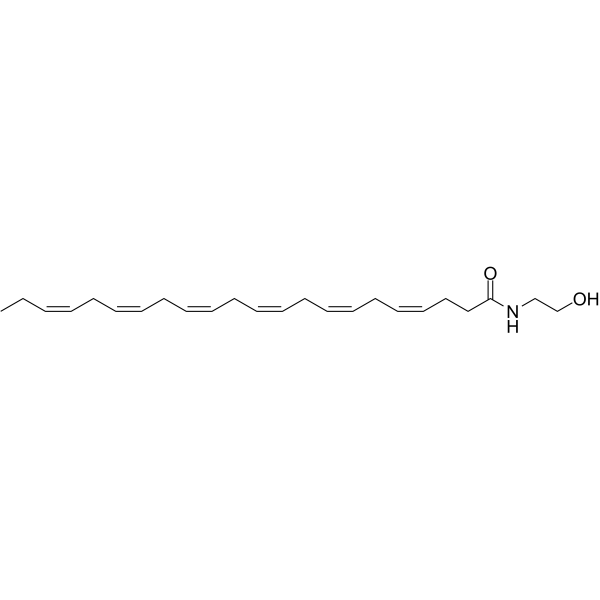
Synaptamide (Dehydroepiandrosteron; DHEA) is an endogenous metabolite and structural analogue of Anandamide. Synaptamide binds to both the cannabinoid-1 and 2 (CB1 and CB2) cannabinoid receptors and has anti-inflammatory properties. Synaptamide is the first small-molecule endogenous ligand of an adhesion G protein-coupled receptor (aGPCR) .
For research use only. We do not sell to patients.
- CAS No.: 162758-94-3
- Formula: C24H37NO2
- Molecular Weight:371.56
-
Storage:
Solution, -20°C, 2 years

To place orders, for customer services and technical support, please contact: MedChemExpress USA
Tel: 609-228-6898 E-mail: [email protected] [email protected]


-
 Biological Activity
-
Chemical Information
- Protocols
- Purity & Documentation
- References
-
 Help & FAQs


-

HY-124089
Eicosapentaenoyl ethanolamideCB1/CB2 Receptor Agonist -

HY-113421
Linoleoyl ethanolamideFatty Acid Ethanolamide -

HY-113421S
Linoleoyl ethanolamide-d4Stable Isotope -
HY-10863
AnandamideCB1/2 Agonist -

HY-10863S
Anandamide-d8Stable Isotope -
HY-113204
N-Oleoyl glycineCannabinoid Receptor Activator -
HY-127061
Palmitoleoyl ethanolamideEndogenous Metabolite -

HY-130567
1-Monoarachidin2-arachidonoylglycerol derivative -
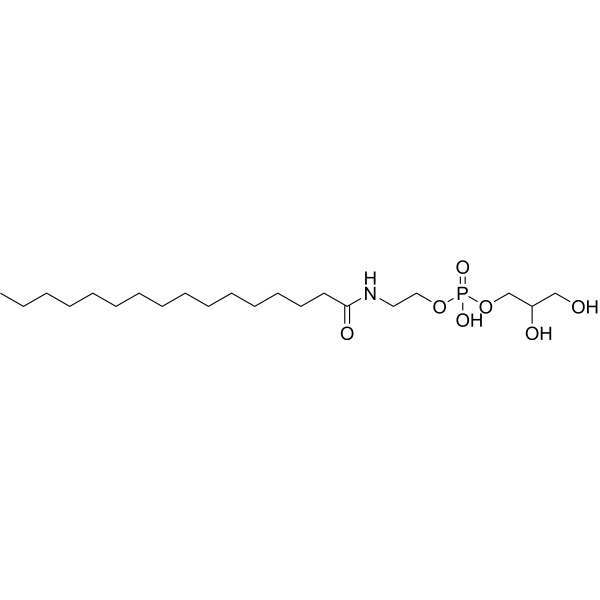
HY-112528
Glycerophospho-N-palmitoyl ethanolamineEndogenous Metabolite -
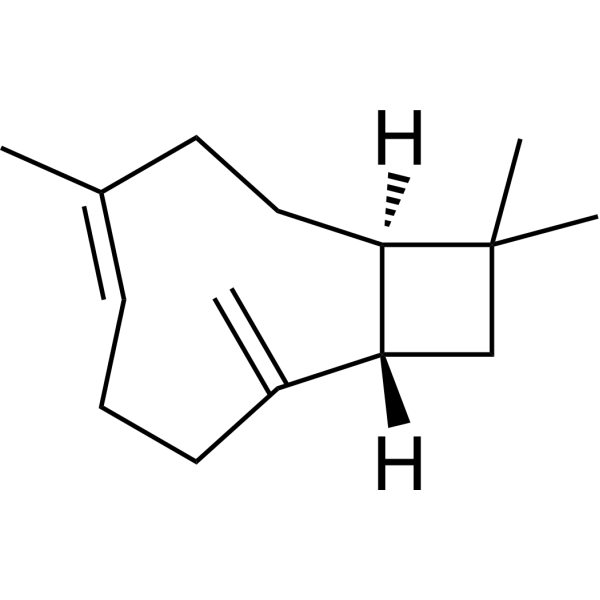
HY-N1415
β-CaryophylleneCannabinoid Receptor Agonist -

HY-103332S
N-Arachidonylglycine-d8Stable Isotope -

HY-124089S
Eicosapentaenoyl ethanolamide-d4Stable Isotope
Publications Citing Use of MedChemExpress (MCE) Synaptamide
More

Biological Activity
Description
IC50 & Target
[2]|
CB1 633 nM (Ki) |
CB2 3843 nM (Ki) |
Cellular Effect
|
Cell Line

|
Type | Value | Description | References |
|---|---|---|---|---|
| RBL-2H3 | IC50 |
25 μM
Compound: 18; DHEA
|
Antiallergic activity in rat RBL2H3 cells assessed as inhibition of DNP-HSA-mediated degranulation by measuring decrease in beta-hexosaminidase activity incubated for 30 mins prior to CB2 antagonist AM630 addition further incubated for 30 mins followed by
Antiallergic activity in rat RBL2H3 cells assessed as inhibition of DNP-HSA-mediated degranulation by measuring decrease in beta-hexosaminidase activity incubated for 30 mins prior to CB2 antagonist AM630 addition further incubated for 30 mins followed by
|
[PMID: 31618024] |
| RBL-2H3 | IC50 |
25 μM
Compound: 18; DHEA
|
Antiallergic activity in rat RBL2H3 cells assessed as inhibition of DNP-HSA-mediated degranulation by measuring decrease in beta-hexosaminidase activity preincubated for 30 mins followed by DNP-HSA stimulation and measured after 30 mins by 4-nitrophenyl 2
Antiallergic activity in rat RBL2H3 cells assessed as inhibition of DNP-HSA-mediated degranulation by measuring decrease in beta-hexosaminidase activity preincubated for 30 mins followed by DNP-HSA stimulation and measured after 30 mins by 4-nitrophenyl 2
|
[PMID: 31618024] |
| RBL-2H3 | IC50 |
7.6 μM
Compound: 18; DHEA
|
Antiallergic activity in rat RBL2H3 cells assessed as inhibition of DNP-HSA-mediated degranulation by measuring decrease in beta-hexosaminidase activity incubated for 30 mins prior to FAAH inhibitor URB597 addition further incubated for 30 mins followed b
Antiallergic activity in rat RBL2H3 cells assessed as inhibition of DNP-HSA-mediated degranulation by measuring decrease in beta-hexosaminidase activity incubated for 30 mins prior to FAAH inhibitor URB597 addition further incubated for 30 mins followed b
|
[PMID: 31618024] |
| Sf9 | IC50 |
>50 μM
Compound: 18; DHEA
|
Inhibition of human FAAH expressed in baculovirus infected Sf9 cells using N-(6-methoxypyridin-3-yl)octanamide as substrate measured for 15 mins by fluorescence based assay
Inhibition of human FAAH expressed in baculovirus infected Sf9 cells using N-(6-methoxypyridin-3-yl)octanamide as substrate measured for 15 mins by fluorescence based assay
|
[PMID: 31618024] |
In Vitro
In Vivo
Synaptamide (2-10 mg/kg; adult male C57BL/6J mice) reduced the levels of nociceptive and inflammatory pain-related behaviour over 60 min in the intraplantar formaldehyde assay via both intraperitoneal and local intraplantar administration[2].
MedChemExpress (MCE) has not independently confirmed the accuracy of these methods. They are for reference only.
-
Animal Model:Male Wistar rats;260 ± 20 g, age 3 months; mTBI model)[1]
-
Dosage:10 mg/kg
-
Administration:Subcutaneously; daily for 7 days
-
Result:Reversed the mTBI-induced cognitive deficits.


Chemical Information
-
CAS No. 162758-94-3
-
Appearance Liquid
-
Molecular Weight 371.56
-
Formula C24H37NO2
-
Color Colorless to light yellow
-
SMILES
CC/C=C\C/C=C\C/C=C\C/C=C\C/C=C\C/C=C\CCC(NCCO)=O
-
Synonyms
N-Docosahexaenoyl ethanolamine (DHEA); Docosahexaenoyl ethanolamide
-
Shipping
Room temperature in continental US; may vary elsewhere.
-
Storage
Solution, -20°C, 2 years


Publications (2)
-
Journal Impact Factor
-
Most Recent
-
-
Ecotoxicol Environ Saf
Role of PKA/CREB/BDNF signaling in PM2.5-induced neurodevelopmental damage to the hippocampal neurons of rats. [Abstract]2021 May:214:112005. PMID: 33640725


Purity & Documentation
-
Data Sheet (267 KB)
-
SDS (393 KB)
- English - EN (393 KB)
- Français - FR (393 KB)
- Deutsch - DE (393 KB)
- Norwegian - NO (393 KB)
- Español - ES (393 KB)
- Swedish - SV (393 KB)
- Italian - IT (393 KB)
- Korean - KR (393 KB)
- Portuguese - PT (393 KB)
-
Handling Instructions (2659 KB)
References
[1]. Kim HY, et al. Synaptamide, endocannabinoid-like derivative of docosahexaenoic acid with cannabinoid-independent function. Prostaglandins Leukot Essent Fatty Acids. 2013 Jan;88(1):121-5. [Content Brief]
[2]. Rashid MA, et al. N-Docosahexaenoylethanolamine is a potent neurogenic factor for neural stem cell differentiation. J Neurochem. 2013 Jun;125(6):869-84. [Content Brief]

Calculators
Concentration (start) × Volume (start) = Concentration (final) × Volume (final)


Synaptamide Related Classifications
HY-100197 Related Classifications
 Powered by Bioz