



EphA
EphA receptors are receptor tyrosine kinases that bind cell-surface ephrin ligands on adjacent cells and mediate contact-dependent bidirectional signaling[1]. Mechanistically, EphA/ephrin-A signaling regulates cell adhesion, positioning, migration, and cytoskeletal organization, linking receptor activation to developmental patterning and adult tissue homeostasis[1][2]. In cancer models, EphA2 shows a key isoform-specific distinction: ephrin-A1 activation inhibits chemotactic migration of glioma and prostate cancer cells, whereas EphA2 overexpression promotes migration in a ligand-independent manner through Akt-dependent Ser897 phosphorylation[3]. Compared with related EphA isoforms, EphA4 is strongly defined by axon-guidance biology, where activated EphA4 recruits α2-chimaerin to mediate growth-cone collapse and neuronal circuit formation[4]. For experimental applications, EphA2 ligands, agonistic antibodies, blocking antibodies, and kinase inhibitors can separate canonical ligand-dependent signaling from noncanonical ligand-independent signaling in cancer-cell migration, invasion, vascular-permeability, and tumor-model studies[3][5][6]. - EphA biology centers on contact-dependent ephrin signaling, cytoskeletal control, and cell-position regulation. - EphA2 research should distinguish ligand-activated suppression from ligand-independent Akt-linked migration. - EphA4 provides a mechanistically distinct axon-guidance model through α2-chimaerin signaling.
References:
- [1]. Pasquale EB. Eph-ephrin bidirectional signaling in physiology and disease. Cell. 2008 Apr 4;133(1):38-52. doi: 10.1016/j.cell.2008.03.011. PMID: 18394988. et al. Eph-ephrin bidirectional signaling in physiology and disease. Cell. 2008 Apr 4;133(1):38-52. [Content Brief]
- [2]. Paris Z, et al. Determinants of tRNA editing and modification: avoiding conundrums, affecting function. Semin Cell Dev Biol. 2012 May;23(3):269-74. [Content Brief]
- [3]. Miao H, et al. EphA2 mediates ligand-dependent inhibition and ligand-independent promotion of cell migration and invasion via a reciprocal regulatory loop with Akt. Cancer Cell. 2009 Jul 7;16(1):9-20. [Content Brief]
- [4]. Wegmeyer H, et al. EphA4-dependent axon guidance is mediated by the RacGAP alpha2-chimaerin. Neuron. 2007 Sep 6;55(5):756-67. [Content Brief]
- [5]. Offenhäuser C, et al. EphA2 regulates vascular permeability and prostate cancer metastasis via modulation of cell junction protein phosphorylation. Oncogene. 2025 Feb;44(4):208-227. [Content Brief]
- [6]. Xiao T, et al. Targeting EphA2 in cancer. J Hematol Oncol. 2020 Aug 18;13(1):114. [Content Brief]
-
EphA Related Products (9)
Related Products (9)

-
Urolithin D
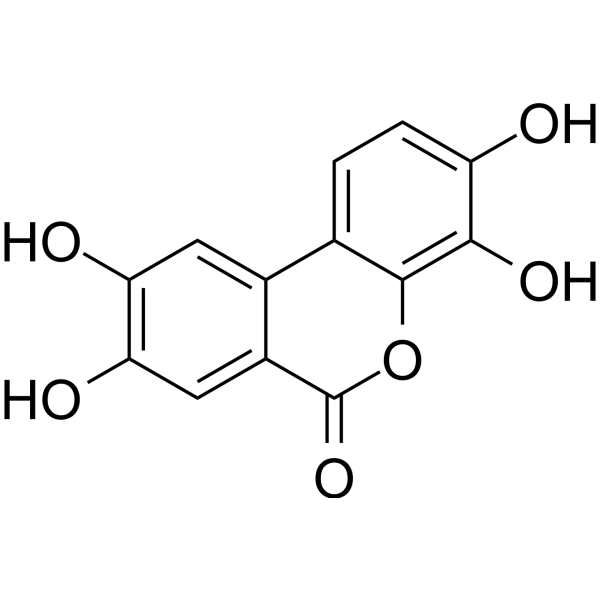 0 ImagesSynonyms: 3,4,8,9-Tetrahydroxy urolithinUrolithin D (3,4,8,9-Tetrahydroxy urolithin) is a colonic metabolite of Ellagitannins and a competitive, reversible, and selective antagonist of the EphA receptor. Urolithin D inhibits EphA2-ephrin-A1 binding with an IC50 of 0.9 μM. Urolithin D is also a potent antioxidant that scavenges free radicals and repairs oxidized DNA damage. Additionally, Urolithin D suppresses triglyceride accumulation and promotes fatty acid oxidation by activating the AMPK signaling pathway. Urolithin D can be used for research on tumors, metabolic, and inflammatory diseases.
-
UniPR1331
 0 ImagesUniPR1331 is an orally active 3β-hydroxy-Δ5-choline acid derivative that inhibits Eph-ephrin interactions. UniPR1331 blocks the interaction of VEGFR2 with its natural ligand vascular endothelial growth factor and inhibits subsequent autophosphorylation, signaling, and pro-angiogenic activation of endothelial cells. UniPR1331 exhibits anti-angiogenesis, anti-cancer and anti-inflammation effects. UniPR1331 can be used for the researches of cancer and inflammation, such as glioma and colitis.
-
APY-d3
 0 ImagesCat. No.: HY-P11035Purity: 99.18%APY-d3 is a highly selective EphA4 receptor inhibitor, with an IC50 value of 17-56 nM for human EphA4, an IC50 value of 20 nM for mouse EphA4, and a Kd value of 138 nM for EphA4-LBD. APY-d3 binds to EphA4, blocks its interaction with ephrin ligands, inhibits tyrosine phosphorylation of EphA4, prevents growth cone collapse, and does not induce EphA4 phosphorylation in primary cortical neurons. APY-d3 adopts a β-hairpin conformation stabilized by an N-terminal to C-terminal disulfide bond. APY-d3 can be used in research related to amyotrophic lateral sclerosis, Alzheimer's disease, stroke, neurodegenerative diseases and cancer.
-
DS-8895
 0 ImagesCat. No.: HY-P991577Synonyms: DS-8895ADS-8895(DS-8895A) is an anti-EphA2 monoclonal antibody with specific binding to EphA2 receptors and EphA2-expressing cells. DS-8895, when conjugated with 89Zr, 111In, or 125I, supports molecular imaging of EphA2 expression in xenograft models. DS-8895 allows noninvasive measurement of EphA2 expresssion in tumors in vivo..
-
EPHA4 antagonist-1
 0 ImagesCat. No.: HY-W078239CAS No.: 313701-92-7
-
MBRC-101 Antibody
 0 ImagesCat. No.: HY-P992403MBRC-101 Antibody is a human monoclonal antibody targeting EphA5. MBRC-101 Antibody can be used to synthesize the ADC MBRC-101.
-
(123B9)2-Motif
 0 ImagesCat. No.: HY-P11015(123B9)2-Motif is a selective EphA2 receptor agonist (Kd=4.9 μM) that does not bind to EphA4. (123B9)2-Motif works by inducing EphA2 receptor phosphorylation and oligomerization, thereby promoting receptor activation and internalization. (123B9)2-Motif is primarily used in targeted drug delivery studies for cancers that overexpress EphA2, such as breast cancer, to reduce circulating tumor cells and inhibit metastasis.
-
(123B9)2-L2-PTX
 0 ImagesCat. No.: HY-P11018(123B9)2-L2-PTX is an EphA2-agonistic peptide-drug conjugate (PDC). (123B9)2-L2-PTX consists of a dimeric 123B9 (HY-P10579) and Paclitaxel (HY-B0015). (123B9)2-L2-PTX significantly reduces circulating tumor cells and inhibits lung tumor metastasis in breast-cancer-Metastasis mice model. (123B9)2-L2-PTX can be used for cancers research, such as melanomas and ovarian and breast cancers.
-
Lithocholic amide-C2-N(didecane)
 0 ImagesCat. No.: HY-178721CAS No.: 2768690-22-6Lithocholic amide-C2-N(didecane) (Compound LC10) is a Lithocholic acid (HY-B0172) analogue. Lithocholic amide-C2-N(didecane) can form lipid nanoparticles spontaneously in the aqueous milieu, permeate through the skin, penetrate the deeper dermal layers, and exert anti-inflammatory effects against psoriasis-like chronic skin inflammations. Lithocholic amide-C2-N(didecane) can inhibit abnormal proliferation of keratinocytes, downregulate the mRNA expression of the psoriasis-associated receptor EphA2 and reduce serum levels of multiple pro-inflammatory factors such as IL-1α, IL-1β, and IFN-γ by inhibiting activation of the Th17/Th2 inflammatory pathway.



