



GDF15
GDF15 is a stress-inducible secreted member of the transforming growth factor-β superfamily, originally described as macrophage inhibitory cytokine-1 and later characterized as a liver-injury–induced growth differentiation factor[1][2]. In metabolic and inflammatory stress, GDF15 functions as an endocrine signal that links peripheral tissue injury, nutrient stress, and systemic adaptation rather than acting as a conventional intracellular signaling enzyme[3][4]. Mechanistically, circulating GDF15 engages the hindbrain GFRAL–RET pathway, which controls food intake, body weight, and energy balance, making the GDF15–GFRAL axis a central experimental model for anorexia, cachexia, nausea, and obesity research[4][5]. In disease models, GDF15 supports tissue tolerance during infection and inflammatory injury, while human pregnancy studies link fetal and maternal GDF15 biology to nausea and hyperemesis gravidarum risk[3][6]. Compared with related GDF/TGF-β family ligands, the selected literature distinguishes GDF15 by its divergent sequence identity, stress-responsive expression, and GFRAL-dependent endocrine biology rather than by functionally validated GDF15 isoforms[1][2][4]. For experimental applications, recombinant GDF15 or metformin-induced GDF15 elevation can model pathway activation, whereas anti-GDF15 antibody blockade, including ponsegromab, tests causal involvement in cancer cachexia and appetite-loss phenotypes[5][7].
References:
- [1]. Bootcov MR, et al. MIC-1, a novel macrophage inhibitory cytokine, is a divergent member of the TGF-beta superfamily. Proc Natl Acad Sci U S A. 1997;94(21):11514-11519. [Content Brief]
- [2]. Hsiao EC, et al. Characterization of growth-differentiation factor 15, a transforming growth factor beta superfamily member induced following liver injury. Mol Cell Biol. 2000;20(10):3742-3751. [Content Brief]
- [3]. Luan HH, et al. GDF15 Is an Inflammation-Induced Central Mediator of Tissue Tolerance. Cell. 2019;178(5):1231-1244.e11. [Content Brief]
- [4]. Wang D, et al. GDF15: emerging biology and therapeutic applications for obesity and cardiometabolic disease. Nat Rev Endocrinol. 2021;17(10):592-607. [Content Brief]
- [5]. Coll AP, et al. GDF15 mediates the effects of metformin on body weight and energy balance. Nature. 2020;578(7795):444-448. [Content Brief]
- [6]. Fejzo M, et al. GDF15 linked to maternal risk of nausea and vomiting during pregnancy. Nature. 2024;625(7996):760-767. [Content Brief]
- [7]. Groarke JD, et al. Ponsegromab for the Treatment of Cancer Cachexia. N Engl J Med. 2024;391(24):2291-2303. [Content Brief]
All Product Categories
-
GDF15 Related Products (13)
Related Products (13)

- 1
-
Ponsegromab
 0 ImagesSynonyms: PF 06946860Ponsegromab is a Growth differentiation factor 15 (GDF15) inhibitor with human, cynomolgus monkey, and mouse target IC50 values of 0.123 nM, 0.053 nM, and 0.102 nM, respectively. Ponsegromab acts as a chemosensitizer, increases intracellular reactive oxygen species, reduces glutathione levels. Ponsegromab can be used for the research of oxaliplatin-resistant colorectal cancer.
-
N-Acetyltaurine
 0 ImagesN‑acetyltaurine is an orally active endogenous sulfonate that is synthesized from taurine and acetate in the renal cortex. N‑acetyltaurine supports bacterial growth as a sole fixed nitrogen or carbon source. N‑acetyltaurine buffers acetyl moieties of mitochondrial acetyl‑CoA in skeletal muscle. N‑acetyltaurine reduces food intake and body weight in obese and lean wild‑type mice in a GFRAL‑dependent manner. N‑acetyltaurine can be used for the research of diet‑induced obesity, hyperacetatemia and diabetes.
-
Visugromab
 0 ImagesSynonyms: CTL-002Visugromab (CTL-002) is a GDF-15 neutralizing IgG4 mAb. Visugromab has synergistic anticancer activity with the anti-PD1 antibody Nivolumab (HY-P9903) and can effectively act on PD-1/PD-L1 relapsed/refractory metastatic solid tumors. Recommend Isotype Controls: Human IgG4 (S228P) kappa, Isotype Control (HY-P99003).
-
Rilogrotug
 0 ImagesSynonyms: AV-380
-
AMPK activator 12
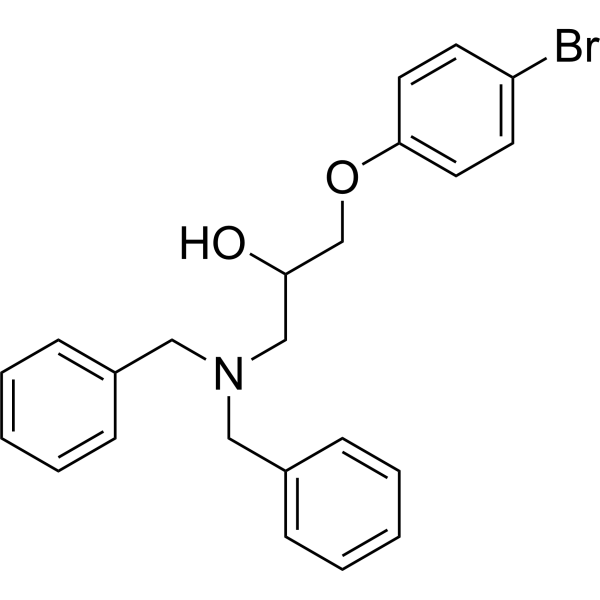 0 ImagesAMPK activator 12 (compound 21) is a potent AMPK activator and GDF15 inducer. AMPK activator 12 increases GDF15 protein levels in human hepatic cells.
-
GIV3727
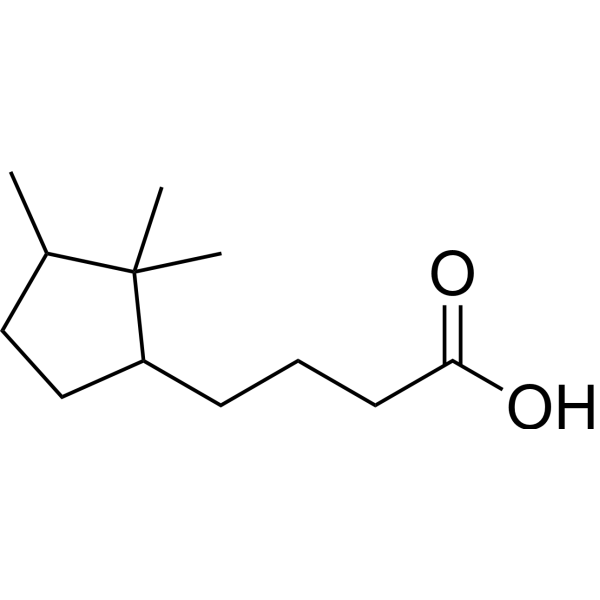 0 ImagesCat. No.: HY-124956CAS No.: 957136-80-0GIV3727 is an orally active bitter taste receptor antagonist targeting TAS2R4, TAS2R7, TAS2R20, TAS2R31, TAS2R40, and TAS2R43, with orthosteric, insurmountable antagonism at hTAS2R31. GIV3727 blocks TAS2R4 and prevents Gallic acid-induced upregulation of GDF15 mRNA expression. GIV3727 inhibits agonist-evoked receptor activation. GIV3727 reduces the perceived bitterness of acesulfame K and saccharin without affecting sweet taste perception. GIV3727 can be used for obesity research.
-
YXX0248
 0 ImagesCat. No.: HY-183332YXX0248 is an orally active anti-hypoxic agent. YXX0248 upregulates mRNA expression of FGF21 and GDF15 via activation of the ISR/ATF4 transcriptional axis. YXX0248 exhibits low cytotoxicity. YXX0248 enhances hypoxic survival in mice. YXX0248 can be used for the research of acute mountain sickness and hypoxia-related diseases.
-
YXX0237
 0 ImagesCat. No.: HY-183331CAS No.: 860445-85-8YXX0237 is an orally active anti-hypoxic agent. YXX0237 upregulates mRNA expression of FGF21 and GDF15 via activation of the ISR/ATF4 transcriptional axis. YXX0237 exhibits low cytotoxicity. YXX0237 enhances hypoxic survival in mice. YXX0237 can be used for the research of acute mountain sickness and hypoxia-related diseases.


-
Visugromab (Powder)
 0 ImagesCat. No.: HY-P99100ACAS No.: 2556646-63-8Synonyms: CLT-002 (Powder)Visugromab (CTL-002) (Powder) is a GDF-15 neutralizing IgG4 mAb. Visugromab (Powder) has synergistic anticancer activity with the anti-PD1 antibody Nivolumab (HY-P9903) and can effectively act on PD-1/PD-L1 relapsed/refractory metastatic solid tumors. Recommend Isotype Controls: Human IgG4 (S228P) kappa, Isotype Control (HY-P99003).

-
N-Acetyltaurine hemimagnesium
 0 ImagesCat. No.: HY-W587486ACAS No.: 75350-40-2N-Acetyltaurine hemimagnesium is an orally active endogenous sulfonate that is synthesized from taurine and acetate in the renal cortex. N-Acetyltaurine hemimagnesium supports bacterial growth as a sole fixed nitrogen or carbon source. N-Acetyltaurine hemimagnesium buffers acetyl moieties of mitochondrial acetyl‑CoA in skeletal muscle. N-Acetyltaurine hemimagnesium reduces food intake and body weight in obese and lean wild‑type mice in a GFRAL‑dependent manner. N-Acetyltaurine hemimagnesium can be used for the research of diet‑induced obesity, hyperacetatemia and diabetes.
- 1



