



Fluorescent Dye
Fluorescence is a phenomenon of photoluminescence in luminescence. When an atom is irradiated by light, some electrons around the nucleus jump from their original orbitals to higher energy orbitals under the influence of light energy, i.e., from the ground state to the first or second excited single-line state, etc. Due to the instability of the first or second excited singlet state, the electron returns from the excited singlet state to the ground state accompanied by released energy, resulting in fluorescence.
Fluorescent dyes can be covalently bound or physically adsorbed in the structure of the substance. The fluorescence properties allow for the characterization, localization and quantitative analysis of the labeled object. Fluorescent dyes have shown great potential for the detection of proteins, nucleic acids, cells, and immunoassays, attributed to the advantages in non-radioactive contamination, simple experimental operation and easy observation.
Fluorescent dyes have penetrated many fields such as pharmacology, physiology, environmental science, and information science, as well as functional studies of proteins and drug screening.
All Product Categories
-
Fluorescent Dye Related Products (4848)
Related Products (4848)

-
Antibodies (4)
-
Alizarin Red S Staining Solution (1%, pH 4.2)
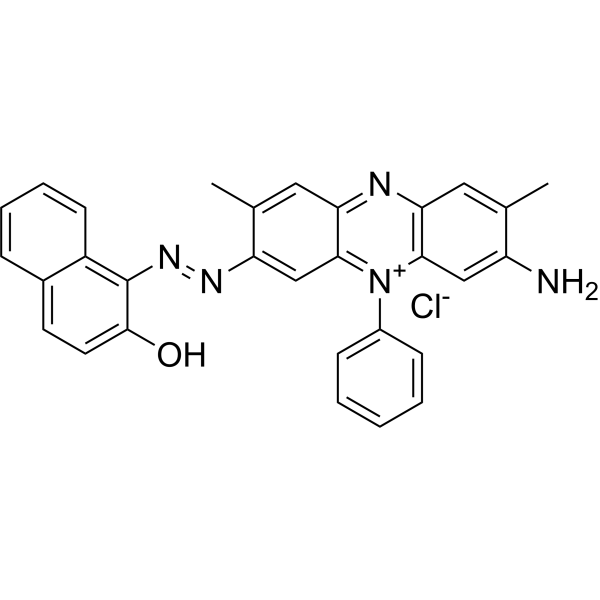
 0 ImagesCat. No.: HY-DY2044Alizarin Red S Staining Solution (1%, pH 4.2) is an anthraquinone dye (sodium alizarinsulfonate) with an optimized pH of 4.2. It undergoes a dye-lake reaction with calcium and serves as an intercellular stain for the boundaries of corneal endothelial cells. Alizarin Red S Staining Solution (1%, pH 4.2) enables screening tests for calcium compounds in synovial fluid, detection of osteoblast differentiation, and staining detection of bone in mice. Excitation/emission wavelength: 500/570 nm.
-
Fluorescent HIV Substrate
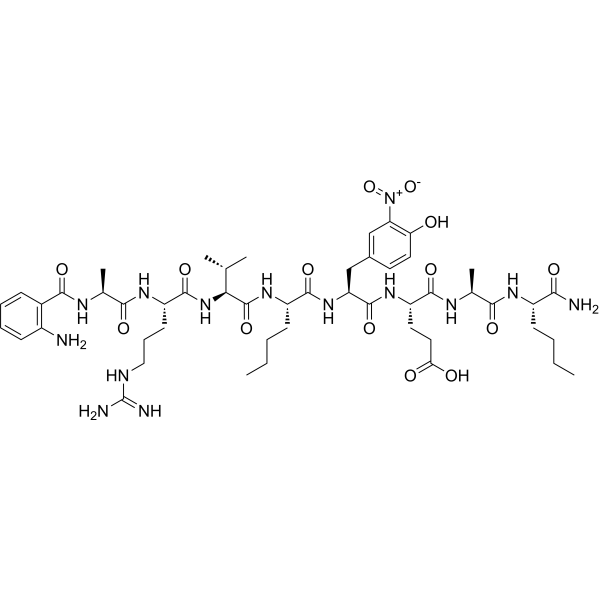 0 ImagesCat. No.: HY-P3951CAS No.: 1426174-10-8
-
L-ANAP TFA
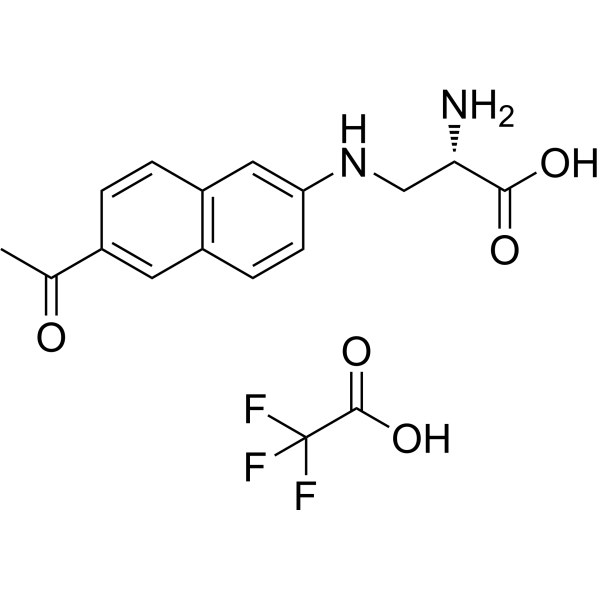 0 ImagesCat. No.: HY-101937DCAS No.: 2287346-69-2L-ANAP TFA is a genetically encodable and polarity-sensitive fluorescent unnatural amino acid (Uaa).
-
NRERf
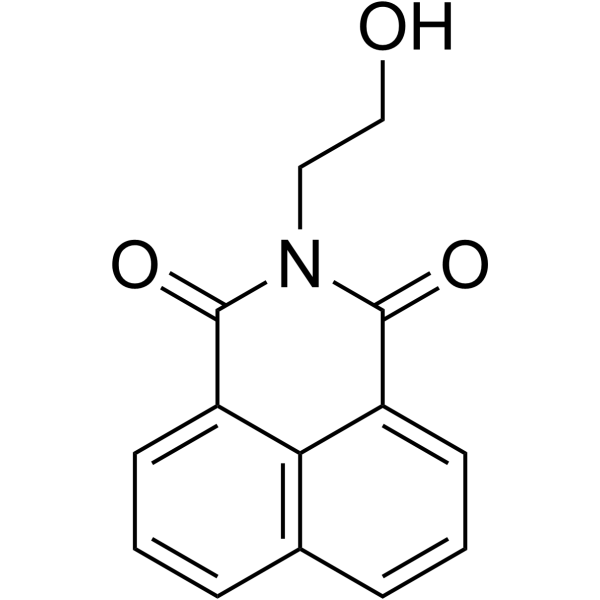
 0 ImagesCat. No.: HY-D3092CAS No.: 2757682-01-0NRERf is an endoplasmic reticulum (ER)-targeted solvatochromic fluorescent probe based on Nile Red (HY-D0718). It possesses ER-targeting capability and can sense changes in local polarity and lipid order of biological membranes. NRERf undergoes excited-state charge transfer, with its emission color changing according to local polarity: the tightly packed, low-polarity liquid-ordered phase (Lo) induces a blue-shifted emission, while the high-polarity liquid-disordered phase (Ld) induces a red-shifted emission. The emission wavelength of NRERf varies with the environment. NRERf can be used to detect changes in lipid order and polarity induced in the ER by cholesterol extraction/enrichment, oxidative stress, and hyperosmotic shock.
-
AF555-PEG12-DBCO
 0 ImagesCat. No.: HY-D3578AF555-PEG12-DBCO is a derivative of Alexa Fluor 555 featuring a DBCO (dibenzocyclooctyne) group for copper-free click chemistry (SPAAC). It incorporates a PEG12 linker to enhance hydrophilicity and provide spacer distance. AF555-PEG12-DBCO is primarily used for copper-free click chemistry (SPAAC) bioconjugation (Ex/Em = 555/565 nm).
-
Bromophenol red sodium
 0 ImagesCat. No.: HY-W926978CAS No.: 102185-50-2Bromophenol red sodium is a chemical indicator. Bromophenol red sodium binds to lysozyme and inhibits its activity against the bacterial cell wall, but not the polysaccharide component of peptidoglycan.
-
BODIPY TMR acid
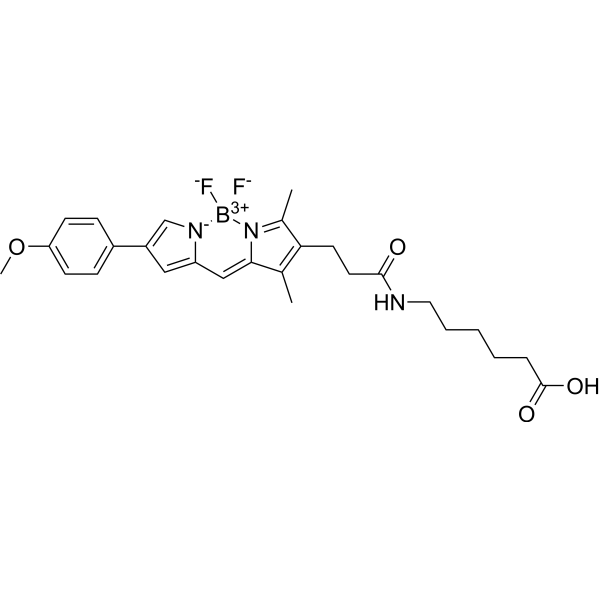 0 ImagesCat. No.: HY-D2292BODIPY TMR acid is a fluorescent dye. BODIPY TMR acid is a high quantum yield fluorophore which can be coupled with Rebastinib.
-
TYMJ-01
 0 ImagesCat. No.: HY-181506CAS No.: 3109321-90-3TYMJ-01 is a fluorescent probe and eEF2K degrader. TYMJ-01 induces dose-dependent and specific degradation of eEF2K via the ubiquitin-proteasome pathway, with a DC50 of 82 nM. TYMJ-01 inhibits the proliferation, migration and invasion of triple-negative breast cancer cells. TYMJ-01 enables dynamic fluorescent imaging of eEF2K degradation in triple-negative breast cancer cells; it enhances the anti-tumor activity of Paclitaxel (HY-B0015). TYMJ-01 can be used for the research of triple-negative breast cancer.
-
Datura Stramonium Lectin-Cy3
 0 ImagesCat. No.: HY-NP065JSynonyms: DSL-Cy3Datura Stramonium Lectin-Cy3 (DSL-Cy3) is a datura lectin (DSL) labeled with the Cy3 fluorescent dye. Datura Stramonium Lectin is a dimeric glycoprotein that specifically recognizes and binds to glycan structures containing N-acetylglucosamine (GlcNAc) oligomers. Datura Stramonium Lectin-Cy3 can be used for glycosyl studies on cell surfaces (Ex/Em = 554/568 nm).

-
C4 BODIPY 505/515 MG
 0 ImagesCat. No.: HY-N15886CAS No.: 2260795-61-5C4 BODIPY 505/515 MG is a fluorescently labeled glycerolipid (Ex/Em = 495/503 nm).
-
HJTA
 0 ImagesCat. No.: HY-D3211CAS No.: 2442502-32-9HJTA is a selective, pH/GSH dual-responsive Fluorescent probe and anticancer agent. HJTA selectively undergoes an enzymatic reaction with GSTπ. HJTA induces Apoptosis and Autophagy by regulating the expression of apoptotic and autophagic proteins. HJTA exhibits pH- and GSH-dual-responsive fluorescence in tumor cells. HJTA selectively illuminates tumor tissues, enabling precise in situ visualization of colon tumors. HJTA exerts anticancer effects against colon cancer. HJTA can be used for colon cancer research.
-
Ir-ImNO
 0 ImagesCat. No.: HY-161476Ir-ImNO is a mitochondria-targeted two-photon probe with excellent cell membrane permeability, capable of detecting both endogenous and exogenous cell membrane permeability. Ir-ImNO can monitor different immune response states of macrophages through various imaging techniques, including one-photon and two-photon phosphorescence imaging as well as phosphorescence lifetime imaging. Ir-ImNO can be utilized in the research to assist in the clinical monitoring of immunotherapy.
-
Vari Fluor 660 SE
 0 ImagesCat. No.: HY-D1797Synonyms: VF 660 SEVari Fluor 660 SE (VF 660 SE) is a dye marker of the Vari Fluor SE series (Ex/Em=660 nm/679 nm). The Vari Fluor SE series of dyes are a class of fluorescent dyes containing NHS ester groups used to label free amines (-NHX) on antibodies, proteins, peptides, amine-modified oligonucleotides and other biomolecules.
-
Oxonol Blue
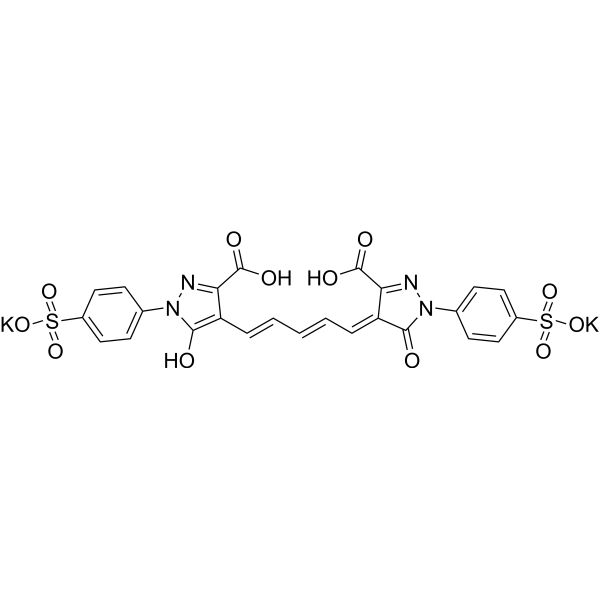 0 ImagesCat. No.: HY-D1511CAS No.: 51858-17-4Oxonol Blue is a staining dye. Oxonol Blue can be used as a monitor of membrane potential.


-
Cy3 NHS ester (solution)
 0 ImagesCat. No.: HY-DY1069CAS No.: 1393363-07-9Cy3 NHS ester (solution) is a CY dye. CY, short for Cyanine, is a compound consisting of two nitrogen atoms connected by an odd number of methyl units. Cyanine compounds have the characteristics of long wavelength, adjustable absorption and emission, high extinction coefficient, good water solubility and relatively simple synthesis. CY dyes are of en used for the labeling of proteins, antibodies and small molecular compounds. For the labeling of protein antibodies, the combination can be completed through a simple mixing reaction. Below, we introduce the labeling method of protein antibody labeling, which has certain reference significance.
Solvent and concentration: DMSO: 10 mM




