



Fluorescent Dye
Fluorescence is a phenomenon of photoluminescence in luminescence. When an atom is irradiated by light, some electrons around the nucleus jump from their original orbitals to higher energy orbitals under the influence of light energy, i.e., from the ground state to the first or second excited single-line state, etc. Due to the instability of the first or second excited singlet state, the electron returns from the excited singlet state to the ground state accompanied by released energy, resulting in fluorescence.
Fluorescent dyes can be covalently bound or physically adsorbed in the structure of the substance. The fluorescence properties allow for the characterization, localization and quantitative analysis of the labeled object. Fluorescent dyes have shown great potential for the detection of proteins, nucleic acids, cells, and immunoassays, attributed to the advantages in non-radioactive contamination, simple experimental operation and easy observation.
Fluorescent dyes have penetrated many fields such as pharmacology, physiology, environmental science, and information science, as well as functional studies of proteins and drug screening.
All Product Categories
-
Fluorescent Dye Related Products (4851)
Related Products (4851)

-
Antibodies (4)
-
FAM labled Cavrotolimod sodium
 0 ImagesCat. No.: HY-139785DFAM labled Cavrotolimod sodiumis a FAM labled Cavrotolimod sodium.

-
BDL-E5
 0 ImagesCat. No.: HY-D3525BDL-E5 is a fluorescent probe for detecting live induced pluripotent stem cells at the early reprogramming stage. Its detection mechanism involves specific binding to authentic reprogramming cells, which exhibit increased expression of pluripotency and epithelial genes and decreased expression of mesenchymal genes compared to non-reprogramming cells; it appears to co-localize more significantly with the Golgi complex than other organelle markers in reprogramming cells, and it does not require washing after staining to reduce background signals; fluorescence is generated upon binding to these early reprogramming cells, with positive cells appearing 7 days before iPS colonies are visible and stain positive for the conventional pluripotent marker TRA-1-60, and sorting BDL-E5-positive cells enriches populations that generate higher numbers and quality of iPS colonies. Its detection wavelength is Ex/Em = 578/599 nm.
-
RH 795
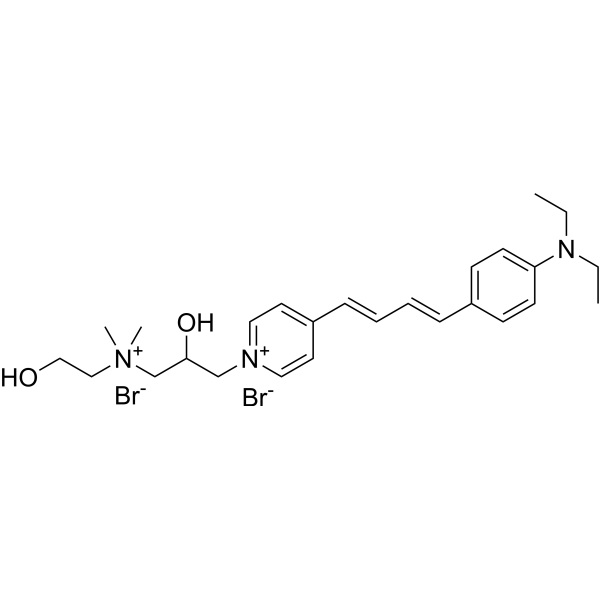 0 ImagesCat. No.: HY-D1439CAS No.: 172807-13-5RH 795 is a lipophilic potentiometric styryl fluorescent dye (Ex/Em = 530 nm/712 nm). RH 795 stains the cell membranes of sensory cells and nerve fibers in living cells that maintain membrane potential, while it shows weak staining effect on supporting cells. RH 795 supports in vivo and in vitro confocal microscopy imaging of intact living inner ear cells and neuronal components. RH 795 can be used in studies related to hearing loss.
-
γ-[(6-Aminohexyl)-imido]-ATP-biotin
![γ-[(6-Aminohexyl)-imido]-ATP-biotin](https://file.medchemexpress.com/product_pic/hy-d0979.gif "Click to View γ-[(6-Aminohexyl)-imido]-ATP-biotin Product Detail") 0 ImagesCat. No.: HY-D0979CAS No.: 2579331-99-8γ-[(6-Aminohexyl)-imido]-ATP-biotin is a multifunctional dye. Dyes are important tools in biological experiments. They can help researchers observe and analyze cell structures, track biomolecules, evaluate cell functions, distinguish cell types, detect biomolecules, study tissue pathology and monitor microorganisms. Their applications range from basic scientific research to clinical A wide range of diagnostics. Dyes are also widely used in traditional fields such as textile dyeing, as well as in emerging fields such as functional textile processing, food pigments and dye-sensitized solar cells.
0 ImagesCat. No.: HY-D0979CAS No.: 2579331-99-8γ-[(6-Aminohexyl)-imido]-ATP-biotin is a multifunctional dye. Dyes are important tools in biological experiments. They can help researchers observe and analyze cell structures, track biomolecules, evaluate cell functions, distinguish cell types, detect biomolecules, study tissue pathology and monitor microorganisms. Their applications range from basic scientific research to clinical A wide range of diagnostics. Dyes are also widely used in traditional fields such as textile dyeing, as well as in emerging fields such as functional textile processing, food pigments and dye-sensitized solar cells.
-
6-JOE alkyne, CHC protected
 0 ImagesCat. No.: HY-D35076-JOE alkyne (CHC-protected) is a derivative of JOE (dimethoxy-dichloro-carboxyfluorescein) featuring a terminal alkyne group for use in click chemistry reactions (CuAAC); the CHC (cyclohexylcarbodiimide) protecting group ensures stability during oligonucleotide synthesis. 6-JOE alkyne (CHC-protected) is primarily used for click chemistry-based bioconjugation (Ex/Em = 520/548 nm).
-
NIR-RED ROS-H2O2 Probe
 0 ImagesCat. No.: HY-D3000NIR-RED ROS-H2O2 Probe is a near-infrared fluorescent probe used for detecting hydrogen peroxide (H₂O₂) and featuring dual-modal fluorescence/photoacoustic imaging capabilities. NIR-RED ROS-H2O2 Probe successfully detects the upregulated fluorescence signal of H₂O₂ in HepG2 cells and a mouse liver injury model. NIR-RED ROS-H2O2 Probe can be used as a biomarker detection tool for drug-induced liver injury (DILI).
-
BAY-771
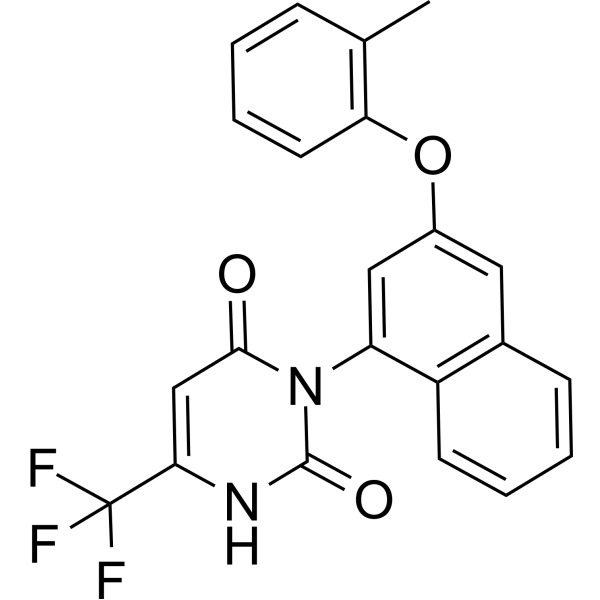 0 ImagesCat. No.: HY-156965CAS No.: 2771756-82-0BAY-771, a structurally close pyrimidinedione, is a chemical probe with good lead-like properties and high permeability in Caco-2 cells (no hint of efflux). BAY-771 shows very weak inhibitory activity in the BCAT1 biochemical assay and no activity in BCAT2. BAY-771 can be used as a negative control of HY-148242 BAY-069. BAY-771 can be used for the research of tumor metabolism.
-
N-(2-Hydroxyethyl)-2-phenylacetamide
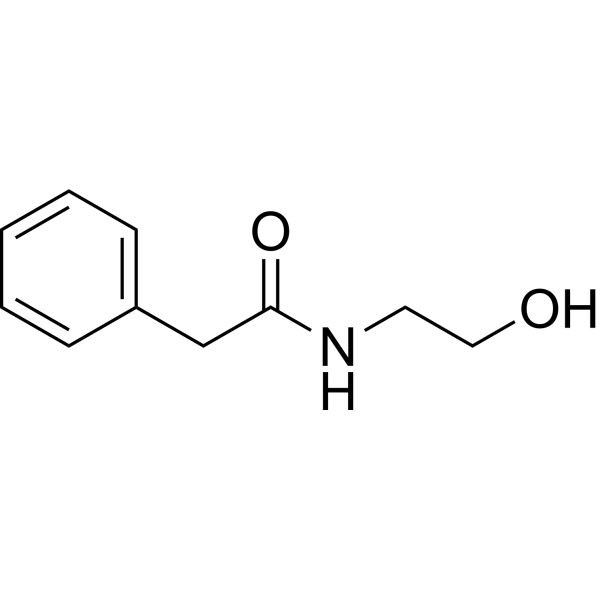 0 ImagesCat. No.: HY-W042853CAS No.: 6269-99-4N-(2-Hydroxyethyl)-2-phenylacetamide is a fluorescent dye.
-
Cy3 labled Sapablursen sodium
 0 ImagesCat. No.: HY-177662DCy3 labled Sapablursen sodium is a Cy3 labled Sapablursen sodium.

-
RB-PEG10000-RB
 0 ImagesCat. No.: HY-D2893LSynonyms: Rhodamine B-PEG10000-Rhodamine BRB-PEG10000-RB (Rhodamine B-PEG10000-Rhodamine B) a fluorescent dye composed of two Rhodamine B (HY-Y0016) and PEG. RB-PEG10000-RB can be used for fluorescent labeling and imaging (Ex/Em=546/610 nm).
-
Vari Fluor 532 Carboxylic acid(free acid)
 0 ImagesCat. No.: HY-D1825Synonyms: VF 532 Carboxylic acid(free acid)Vari Fluor 532 Carboxylic acid (VF 532 Carboxylic acid) free acid is a carboxylic acid derivative of Vari Fluor. Vari Fluor carboxylic acid derivatives are unactivated labeled fluorescent dyes for protein, antibody, and polysaccharide labeling that require carboxylic acid activation for use.
-
RB-PEG5000-SH
 0 ImagesCat. No.: HY-D2883ESynonyms: Rhodamine B-PEG5000-SHRB-PEG5000-SH (Rhodamine B-PEG5000-SH) is a fluorescent dye composed of Rhodamine B (HY-Y0016), PEG and sulfhydryl (SH). SH is highly reactive and can react with a variety of functional groups (such as maleimide) to form stable thioether bonds (Ex/Em=546/610 nm).
-
RB-PEG1000-SH
 0 ImagesCat. No.: HY-D2883BSynonyms: Rhodamine B-PEG1000-SHRB-PEG1000-SH (Rhodamine B-PEG1000-SH) is a fluorescent dye composed of Rhodamine B (HY-Y0016), PEG and sulfhydryl (SH). SH is highly reactive and can react with a variety of functional groups (such as maleimide) to form stable thioether bonds (Ex/Em=546/610 nm).

-
DC432
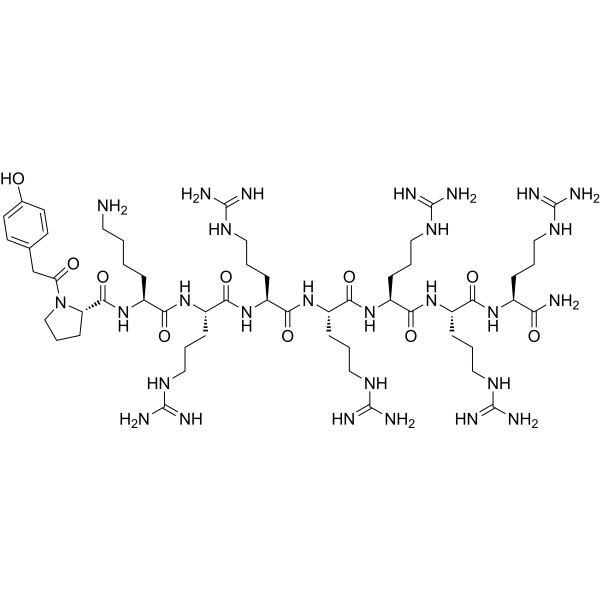 0 ImagesCat. No.: HY-P10028CAS No.: 2388988-70-1HCT116 is a peptidomimetic inhibitor of N-terminal methyltransferase 1/2 (NTMT1/2) with an IC50 of 54 nM. HCT116 can inhibit the N-terminal methylation level of NTMT1/2 substrates in HCT116 cells, and is used for the study of NTMT1/2 probes.
-
IR 750 NHS ester
 0 ImagesCat. No.: HY-D3271IR 750 NHS ester is a near-infrared fluorescent dye composed of IRDye 750 near-infrared fluorophore and NHS ester reactive group. IR 750 NHS ester can be applied to fluorescent labeling, imaging and detection.
-
Biotin-PEG3400-OH
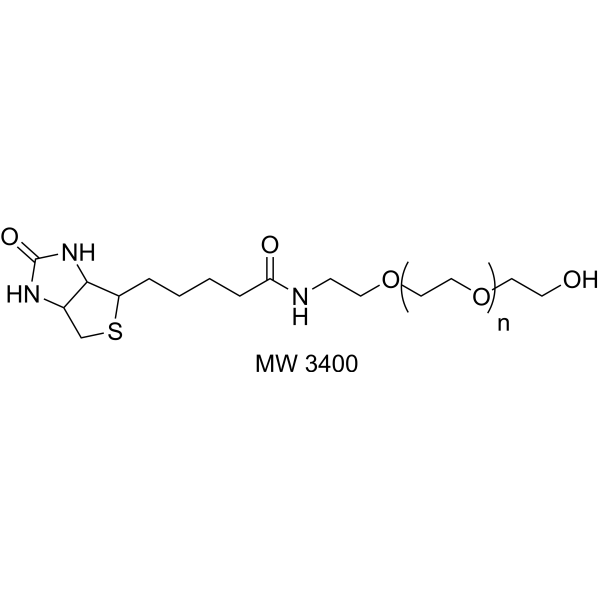 0 ImagesCat. No.: HY-147205BBiotin-PEG3400-OH is a polymer containing biotin and PEG molecules.
-
Cy3-PEG3-exo-BCN
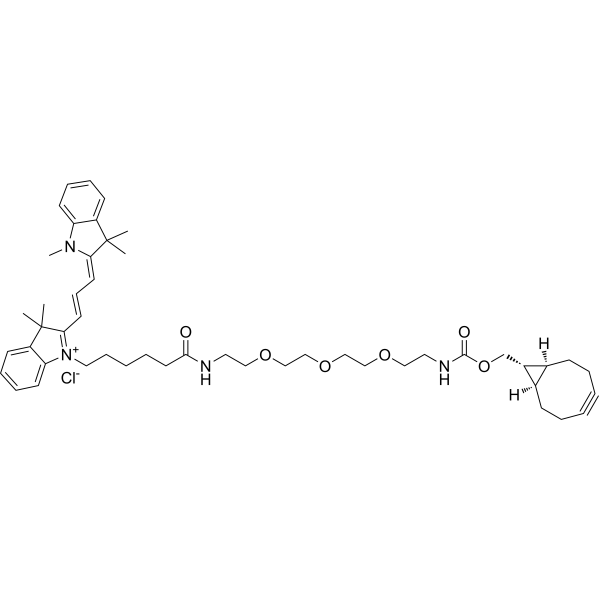 0 ImagesCat. No.: HY-D2120ACy3-PEG3-exo-BCN is a dye derivative of Cyanine 3 (Cy3) (HY-D0822) containing 3 PEG units. Cy3-PEG3-exo-BCN contains the lyophilic bidentate macrocyclic ligand BCN, which can further synthesize macrocyclic complexes. In click chemistry, exo-BCN can react with molecules containing azide groups to form stable triazoles in the absence of catalysts.




